
 Français
 Deutsch
 Español
 Italiano
 Parts & Accessories by Drone
 Drones
 Action camera
 Microphones
 Camera Stabilizers
 VR Headsets
DJI Lito X1 vs Mini 5 Pro: which drone to choose?
May
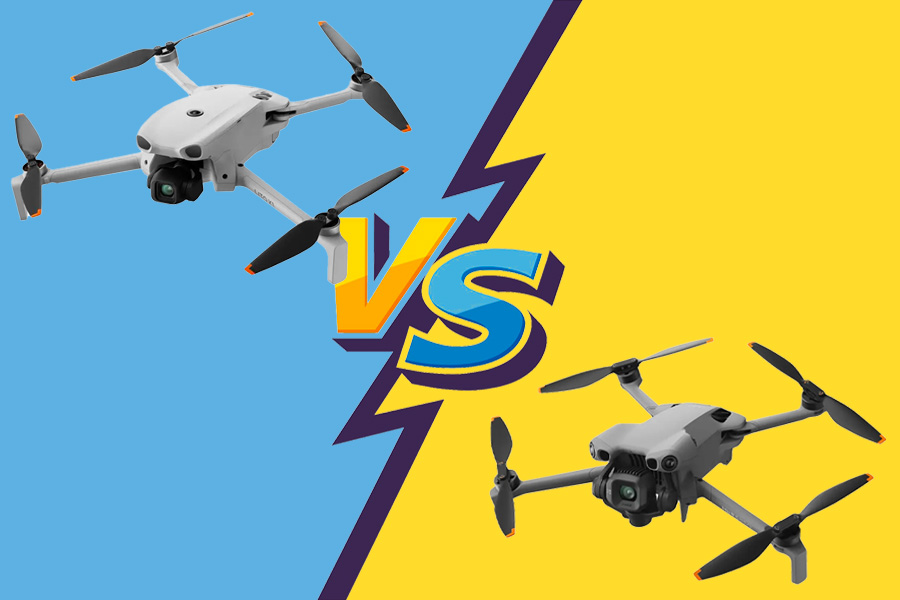
With the DJI Lito X1, DJI brings its entry-level drones closer than ever to its premium models. More modern and much better equipped than the brand’s previous budget drones, it now includes several features that were once reserved for the DJI Mini 5 Pro, the flagship of the Mini lineup. As a result, the gap between the two drones is much smaller than before. So, DJI Lito X1 or Mini 5 Pro: which one should you choose? What are the real differences between the two? Is the Mini 5 Pro still worth its higher price? And above all, which drone is really right for you? Find all the answers in our complete DJI Lito X1 vs DJI Mini 5 Pro comparison.
DJI Lito X1 vs Mini 5 Pro: What you need to know
No time (or laziness 😅 ) to read it all? Here are the main differences between the DJI Lito X1 and DJI Mini 5 Pro 👇
- 🧳 Two foldable drones weighing less than 250 g, with a very compact, easy-to-transport format
- 💾 42 GB internal memory + microSD port up to 1 TB on both drones
- 📡 DJI O4 on the Lito X1 versus DJI O4+ on the Mini 5 Pro, with a slightly greater range on the latter
- 🕹️ DJI RC-N3 and DJI RC 2 compatibility on both models, plus DJI RC Pro 2 for the Mini 5 Pro
- 🔋 Same theoretical autonomy with standard battery: up to 36 minutes claimed by DJI
- 🔋 Intelligent Flight Battery Plus officially available in Europe for both models, offering up to 52 minutes of theoretical flight time
- 🌬️ Better wind resistance on the Mini 5 Pro (12 m/s vs. 10.7 m/s)
- 🎯 Subject tracking on both drones, with some additional options on the Mini 5 Pro: automatic mode, dedicated presets and higher tracking speed
- 🚧 Omnidirectional obstacle detection + frontal LiDAR on both UAVs
- 🎬 Same photo and video modes, but a few more creative options on the Mini 5 Pro
- 📷 1/1.3-inch sensor on the Lito X1 versus 1-inch sensor on the Mini 5 Pro
- 📱 True 4K vertical mode with rotating pod on the Mini 5 Pro, versus simple 2.7K cropping on the Lito X1
- 🎥 4K at up to 100 fps on the Lito X1 vs. 4K 120 fps on the Mini 5 Pro
- 🌙 Better overall image quality and low-light management on the Mini 5 Pro
- 💸 Around €400 difference between the two drones with equivalent packages
📌 The DJI Mini 5 Pro remains DJI’s most comprehensive Mini drone , but the Lito X1 closes the gap enormously with premium models thanks to a particularly aggressive features/price ratio.
DJI Lito X1 vs Mini 5 Pro: Design
| DJI Lito X1 | DJI Mini 5 Pro | |
| Weight | 249 g (standard battery) 340 g (Plus battery) | 249,9 g |
| Dimensions (folded, without helices) (L x W x H) | 149 × 94 × 62 mm | 157 × 95 × 68 mm |
| Dimensions (unfolded) (L x W x H) | 183 × 251 × 79 mm (without propellers) | 304 × 380 × 91 mm (with propellers) |
| Storage | 42 GB internal memory microSD card (up to 1 TB) | 42 GB internal memory microSD card (up to 1 TB) |
| Class (Europe) | C0 (standard battery) / C1 (Plus battery) | C0 (standard battery) / C1 (Plus battery) |
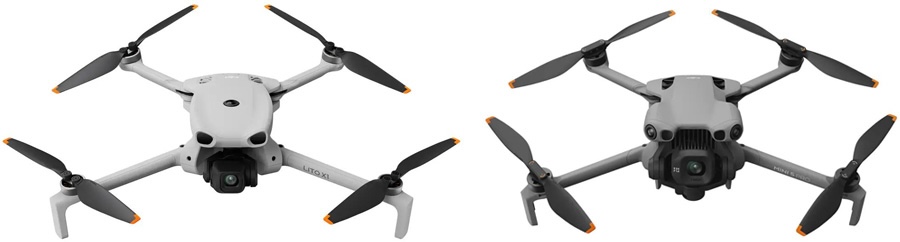
On paper, the two drones are clearly in the same league: foldable, weighing less than 250 g, they take up very little space, making them easy to transport on a daily basis. Both the DJI Lito X1 and the DJI Mini 5 Pro fit easily into a small bag, with very similar dimensions when folded. However, the Lito X1 has a slight advantage on the compact side, being slightly shorter when folded.
The Mini 5 Pro, however, has a slightly more premium feel to its design. Its new, darker gray color, its more refined finish and, above all, its new quick-release propeller attachment system make for a real gain in everyday comfort. Where the Lito X1 still retains a classic screw system, the Mini 5 Pro allows the propellers to be removed in a matter of seconds with a simple quarter-turn.
Both drones feature omnidirectional obstacle detection, but with a different technical approach. The DJI Mini 5 Pro uses a more conventional architecture, with several sensors distributed around the drone, as DJI usually does on its high-end models. The Lito X1, on the other hand, adopts a new DJI approach, with two modules placed above and below the drone, functioning a little like 360° camera lenses capable of monitoring the environment all around the device. Both models also add a front-facing LiDAR sensor, designed to enhance detection in complex or low-light environments.
On the storage side, both models offer 42GB of internal memory, plus a microSD port compatible with up to 1TB. An excellent feature for quick repairs, even without a memory card.
Finally, both drones now benefit from very similar European regulations. When used with their standard battery, both the DJI Lito X1 and the DJI Mini 5 Pro are classified as C0. With their Intelligent Flight Battery Plus, they both move into the C1 category. This may appeal to pilots looking for longer flight times, although it also means complying with the regulations applicable to C1 drones.
🏆 It’s a tie: it’s difficult to pick a clear winner here. The Mini 5 Pro feels a little more premium and practical thanks to its new quick-release propeller system, while the Lito X1 remains slightly more compact when folded.
Discover our accessories for
DJI Lito X1
DJI Lito X1 vs Mini 5 Pro: Transmission and radio controls
| DJI Lito X1 | DJI Mini 5 Pro | |
| Compatible radio controls | DJI RC-N2/RC-N3, DJI RC 2 | DJI RC-N2/RC-N3, DJI RC 2, DJI RC Pro 2 |
| Video transmission system | DJI O4 | DJI O4+ |
| Max. transmission distance | 15 km (IC), 8 km (CE / SRRC / MIC) | 20 km (FCC), 10 km (CE / SRRC / MIC) |
| Live preview quality | up to 1080p at 60 fps | up to 1080p at 60 fps |
On the video transmission side, both drones benefit from very similar technologies, clearly top-of-the-range for their category. The DJI Lito X1 uses the DJI O4 system, while the Mini 5 Pro switches to the DJI O4+, a slightly more advanced version recently introduced on DJI’s premium models. On paper, the O4+ offers a slightly longer range and greater resistance to interference and obstacles. The Mini 5 Pro goes up to 20 km in FCC and 10 km in CE, compared with 15 km and 8 km for the Lito X1.
In practice, these distances remain largely theoretical, since a drone is supposed to be operated within visual range. However, they do give a good indication of signal stability and reliability. On paper, the DJI O4+ of the Mini 5 Pro is indeed a little more efficient, particularly in the face of interference or in complicated environments. According to the various tests and user feedbacks available, however, the differences appear to be fairly small in conventional use, with the DJI O4 on the Lito X1 already offering an extremely stable and reliable connection.
Both drones also offer video feedback up to 1080p at 60 frames per second, with a smooth, pleasant image for both piloting and framing.
On the radio control side, both models offer virtually identical options. Both the DJI Lito X1 and the Mini 5 Pro are compatible with the DJI RC-N2 / RC-N3, which use a smartphone as a screen, as well as with the very good DJI RC 2 and its integrated screen. However, the Mini 5 Pro still has a slight advantage in that it is also compatible with the DJI RC Pro 2, DJI’s ultra-high-end remote control with large, ultra-bright flip-up screen. A solution clearly aimed at the most demanding users… and those with the highest budgets.
🏆 DJI Mini 5 Pro: DJI O4+ system and compatibility with DJI RC Pro 2.
DJI Lito X1 vs Mini 5 Pro: Autonomy and recharging
| DJI Lito X1 | DJI Mini 5 Pro | |
| Battery | Standard battery: 2788 mAh Plus battery: 4680 mAh | Standard battery: 2788 mAh Plus battery: 4680 mAh |
| Maximum autonomy | 36 minutes (standard battery) 52 minutes (Plus battery) | 36 minutes (standard battery) 52 minutes (Plus battery) |
| Typical autonomy | 23 minutes (standard battery) 37 minutes (Plus battery) | 21 minutes 33 minutes |
| Charging time (standard battery) | Direct 73 min / Station 45 min (1 battery), 87 min (3 batteries) (65W charger) | Direct 69 min / Station 46 min (1 battery), 115 min (3 batteries) (65W charger) |
| Charging time (Plus battery) | Direct 102 min / Station 56 min (1 battery), 130 min (3 batteries) (65W charger) | Direct 94 min / Charging Hub 56 min (1 battery), 193 min (3 batteries) (65W charger) |
Both drones feature a standard 2788 mAh battery, but beware: despite this identical capacity, their batteries are totally incompatible. It is therefore impossible to interchange them between the two models.
On the autonomy side, DJI claims up to 36 minutes of maximum runtime with their respective standard batteries. But, as is often the case with ultra-compact drones, these values remain largely theoretical, and are measured under ideal conditions that are difficult to reproduce in reality.
What’s more interesting here are the so-called “typical” autonomies, intended to reflect more realistic use with movement, video recording and obstacle avoidance activated. Here again, the two drones remain extremely close: around 23 minutes for the DJI Lito X1 with its standard battery, versus around 21 minutes for the Mini 5 Pro. According to the various tests and user feedback available, these figures appear to be broadly consistent in practice.
Both drones now officially offer an Intelligent Flight Battery Plus in Europe, available through their respective Fly More Plus Bundle. It increases the maximum flight time to 52 minutes and the typical flight time to around 37 minutes. A real advantage for those who prefer longer flying sessions, although using it moves both drones from the C0 category to the C1 category.
On the recharging side, the two drones remain very similar with their standard batteries. It takes around 73 minutes to recharge the Lito X1 battery directly from the drone, compared with 69 minutes for the Mini 5 Pro. Via the recharging station, the gaps remain small for a single battery(45 minutes for the Lito X1 vs. 46 minutes for the Mini 5 Pro), but the Mini 5 Pro becomes a little slower when three batteries have to be recharged at the same time, with around 115 minutes, compared with 87 minutes for the Lito X1.
🤝 Tie: both drones now officially offer an Intelligent Flight Battery Plus in Europe, providing up to 52 minutes of maximum flight time.
OUR BEST SELLERS - DJI Lito X1

Propeller Protection Guards
Accessories
DJI Lito X1 vs Mini 5 Pro: In-flight performance
| DJI Lito X1 | DJI Mini 5 Pro | |
| Maximum speed | 18 m/s (Sport mode) 12 m/s (Normal / Tracking mode) | 18 m/s (Sport mode) 15 m/s (Normal / Tracking mode) |
| Max. ascent speed | 7 m/s (Sport mode) 5 m/s (Normal mode) 3 m/s (Cine mode) | 10 m/s (Sport mode) 6 m/s (Normal mode) 3 m/s (Cine mode) |
| Max. descent speed | 7 m/s (Sport mode) 5 m/s (Normal mode) 3 m/s (Cine mode) | 6 m/s (Sport mode) 6 m/s (Normal mode) 3 m/s (Cine mode) |
| Max. wind resistance | 10.7 m/s (level 5) | 12 m/s (level 6) |
As with the Mini 5 Pro, the DJI Lito X1 switches on automatically when the right rear arm is unfolded, and switches off when it is folded. A very practical little detail for everyday use, especially when you need to launch a flight quickly. This function can also be disabled in the settings on both drones.
In flight, both models boast identical maximum speeds of 18 m/s in Sport mode (approx. 65 km/h), with a generally fluid and responsive handling. However, the Mini 5 Pro retains an advantage in Normal and Tracking modes , with speeds of up to 15 m/s, compared with 12 m/s for the Lito X1. A difference that could become interesting when tracking fast-moving subjects such as bicycles, cars or certain sports.
The DJI Mini 5 Pro also gains an edge in wind resistance, with certification up to 12 m/s (level 6), compared with 10.7 m/s (level 5) for the Lito X1. In the field, a number of tests and user feedbacks have highlighted the Mini 5 Pro’s excellent wind behaviour for such a compact drone. Of course, this is no substitute for the stability of a heavier drone like a Mavic, but the Mini 5 Pro nevertheless seems to inspire greater confidence when conditions become a little more difficult.
Finally, when it comes to noise, it’s hard to really tell the two drones apart. Both the DJI Lito X1 and the Mini 5 Pro are relatively discreet for their class, with less aggressive noise than some very small drones such as the DJI Neo range.
🏆 DJI Mini 5 Pro: better tracking speed and superior wind resistance.
DJI Lito X1 vs Mini 5 Pro: Features
| DJI Lito X1 | DJI Mini 5 Pro | |
| Photo modes | Single shot, Burst, Auto exposure bracketing (AEB), Interval, Panorama | Single shot, Burst, Auto exposure bracketing (AEB), Interval, Panorama |
| Video modes | Slow motion, QuickShots, MasterShots, Hyperlapse, Subject tracking, Waypoint | Slow motion, QuickShots, MasterShots, Hyperlapse, Subject tracking, Waypoint |
| Obstacle detection | Omnidirectional monocular optical system + LiDAR forward + infrared downward sensor | Omnidirectional monocular optical system + LiDAR forward + infrared downward sensor |
Photo and video modes
In terms of creative functions, the two drones are extremely similar. Both the DJI Lito X1 and Mini 5 Pro offer a comprehensive range of photo and video modes, including the classic QuickShots, MasterShots, Hyperlapse, slow motion, panoramas, AEB and Waypoint routes. Clearly a far cry from the old “entry-level” drones limited to a few basic functions.
However, the Mini 5 Pro retains a few additional refinements. In particular, it adds a free Panorama mode, offering greater freedom for panoramic shots, as well as a new QuickShot variation made possible by its rotating gondola. This enables more cinematic rolling effects, with a camera movement impossible on the Lito X1.
Both drones also use Wi-Fi 6 for fast transfers to smartphone, but the Mini 5 Pro retains an advantage with speeds of up to 100 Mb/s, compared with around 50 Mb/s for the Lito X1.
Subject follow-up
Subject tracking is one of the major strengths of both drones. Both the DJI Lito X1 and the Mini 5 Pro feature a truly advanced tracking system, with modes such as ActiveTrack, Spotlight and Point of Interest.
The Mini 5 Pro goes one step further, however, with a more advanced version ofActiveTrack 360, capable of adapting its trajectories more intelligently to the type of subject selected, whether it’s a person, a bike or a skier. It also adds an automatic mode enabling the drone to choose its own position around the subject during tracking. Finally, it boasts a higher tracking speed of up to 15 m/s, compared with 12 m/s for the Lito X1. A real advantage for fast-moving subjects or sporting activities.
According to the various tests and feedback available, both drones offer smooth, reliable tracking in most situations.
Obstacle detection
Both drones feature omnidirectional obstacle detection combined with a front-end LiDAR sensor, a technology previously reserved for DJI’s much higher-end models. This sensor not only enhances detection in dark or low-light environments, but also certain automatic functions such as intelligent return to starting point.
In practice, both drones offer a very high level of safety for this ultra-compact category. The Mini 5 Pro, however, uses a more conventional sensor architecture with several modules distributed around the drone, while the Lito X1 adopts DJI’s new system based on two large modules placed above and below the drone. It remains to be seen whether either approach will prove superior in everyday use.
🏆 DJI Mini 5 Pro: more comprehensive in some creative modes, faster in tracking and with a few extra functions.

Discover our accessories for
DJI Mini 5 Pro
DJI Lito X1 vs Mini 5 Pro : Image
| DJI Lito X1 | DJI Mini 5 Pro | |
| Aerial work platform | 3-axis mechanical gondola | 3-axis mechanical gondola |
| Sensor | 1/1.3-inch CMOS | 1-inch CMOS |
| Objective | 24 mm equivalent format Aperture f/1.7 FOV 82.1 | 24mm equivalent format F/1.8 aperture FOV 84° (French only) |
| Photo resolution | 12 MP / 48 MP | 12 MP / 50 MP |
| Max. video resolution (horizontal) | 4K up to 100 fps FHD up to 200 fps | 4K up to 120 fps FHD up to 240 fps |
| Max. video resolution (vertical) | 2.7K up to 60 fps | 4K up to 120 fps |
| ISO range | 100 à 12800 | 100 à 12800 |
| Max. bit rate | 130 Mb/s | 130 Mb/s |
| Digital zoom | Video: 1 to 3x (4K), 1 to 4x (FHD) Photo: 1 to 3x (12 MP) | Video: 1 to 3x (4K, 2.7K vertical), 1 to 4x (FHD) Photo: 1 to 3x (12/48 MP) |
| Photo format | JPEG / DNG (RAW) | JPEG / DNG (RAW) |
| Video format | MP4 (MPEG-4 AVC/H.264, HEVC/H.265) | MP4 (MPEG-4 AVC/H.264, HEVC/H.265) |
| Color profile | Normal (8 / 10 bits), D-Log M (10 bits) | Normal (8 or 10 bits), HLG (10 bits), D-Log M (10 bits) |
Pod, sensor and resolutions
Both drones use a 3-axis mechanical gondola, but the Mini 5 Pro retains several important technical advantages. Firstly, thanks to its rotating gondola, which can film in true vertical format without cropping, using the entire surface of the sensor. The DJI Lito X1 does offer a portrait mode, but this is based on a simple crop of the image with a definition limited to 2.7K 60 fps. The Mini 5 Pro, on the other hand, can shoot in vertical 4K at up to 120 fps, using the entire sensor area to offer a wider angle of view and better image quality in portrait format.
The Mini 5 Pro also adds rotation on the roll axis, enabling more cinematic camera movements directly during flight. A feature still unique on such a compact drone.
The other big difference is the sensor. The DJI Lito X1 already uses a very good 1/1.3-inch CMOS sensor, but the Mini 5 Pro features a 1-inch sensor, which is larger and more ambitious for a drone weighing less than 250g. Both models support the RAW (DNG) format, as well as 10-bit D-Log M profiles.
On the resolution side, both drones remain very well equipped, with photos up to 48 MP on the Lito X1 and 50 MP on the Mini 5 Pro. However, the Mini 5 Pro can film at up to 4K 120 fps, compared with 4K 100 fps for the Lito X1. The same applies to Full HD slow-motion, with up to 240 fps, compared with 200 fps on the Lito X1.
The Mini 5 Pro also benefits from a slightly wider field of view(84° vs. 82.1°) and a particularly interesting 2x zoom mode. Unlike a simple, conventional digital zoom, this is based on a sensor crop that maintains very clean image quality, to the point of approaching a second focal length that can be used in certain situations.
Image quality
Overall, both drones offer impressive image quality for their size. The DJI Lito X1 already marks a huge step up from DJI’s previous “entry-level” compact drones, with detailed imaging, pleasing colors and good overall light management.
However, the Mini 5 Pro still has a distinct advantage, especially for the most demanding users. According to the various tests and comparisons available, its 1-inch sensor generally produces a slightly cleaner, more detailed image, with slightly less “flat” rendering and better separation of elements in the image.
The difference becomes particularly noticeable as the light decreases. The Mini 5 Pro seems to handle digital noise better, as well as some of the small compression artifacts that can sometimes be found on the Lito X1 in dark or complex areas of the image. Its wider dynamic range also enables it to recover more detail in highlights and shadows.
That said, the gap is far from gigantic. The DJI Lito X1 already does very well for a drone in this category, coming closer to the premium Mini models than to DJI’s more affordable compact drones of yesteryear.
🏆 DJI Mini 5 Pro: its 1-inch sensor, rotating gondola and best overall image quality.
DJI Lito X1 vs Mini 5 Pro: Packs and prices
ℹ️ Note: some links in this section are Amazon affiliate links. As Amazon Associates, we earn from qualifying purchases, at no extra cost to you.
| DJI Lito X1 | DJI Mini 5 Pro | |
| Standard package | 419 € | 799 € |
| Fly More Pack (DJI RC-N3) | 579 € | 999 € |
| Fly More Pack (DJI RC 2) | 679 € | 1129 € |
| Fly More Plus Pack (DJI RC 2) | 759 € | 1189 € |
This is probably where the difference between the two drones becomes most apparent. The DJI Lito X1 starts at €419, compared with €799 for the Mini 5 Pro. And this difference of around €400 is found almost across the entire range of packages with equivalent equipment.
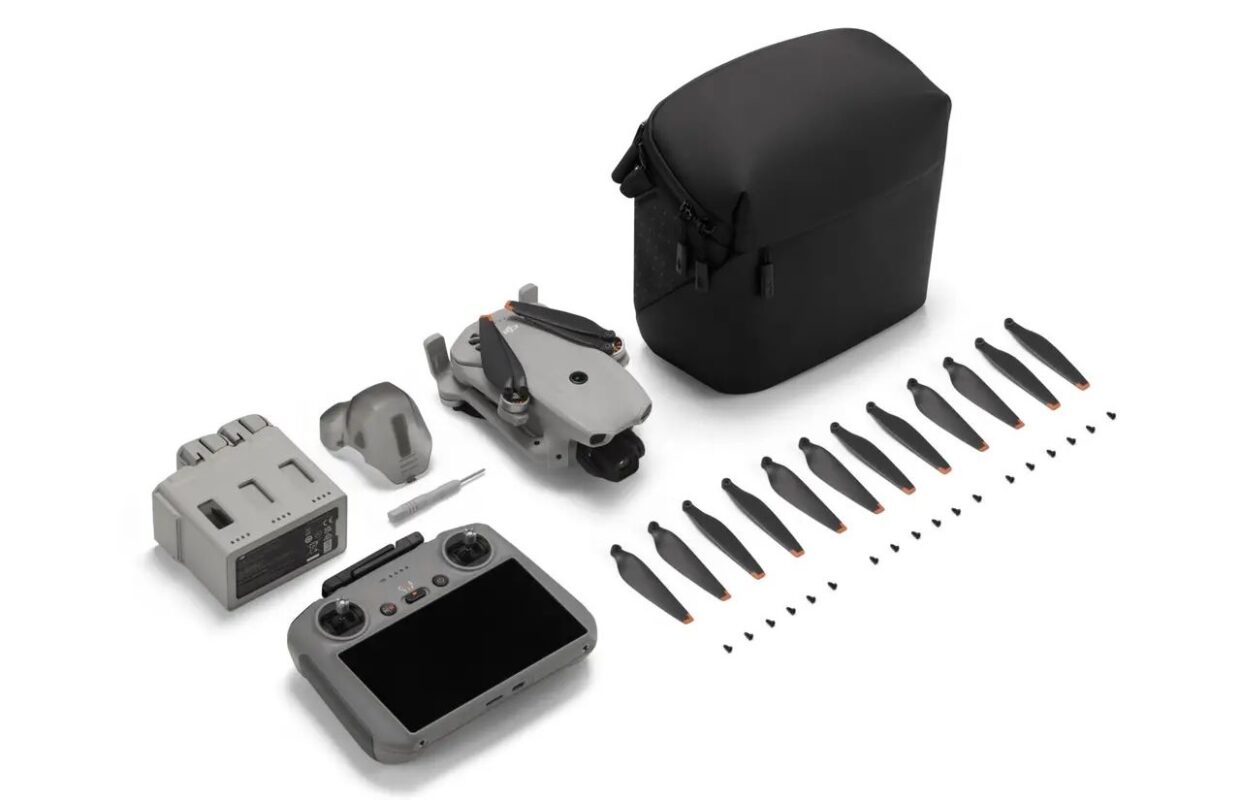
Broadly speaking, the packages offered remain fairly similar for both drones. Standard packages include the drone, DJI RC-N3 radio control system, battery and basic accessories. The Fly More versions, on the other hand, add a number of useful items for more comfortable day-to-day use:
- two additional batteries
- a charging station
- spare propellers
- and a carrying bag
Packs equipped with the DJI RC 2 simply replace the RC-N3 with the remote control with integrated screen, which is much more practical in the field, as it eliminates the need for a smartphone.
However, the Mini 5 Pro retains a few little extras in its Fly More packs, notably the addition of a set of ND filters included as standard. A welcome accessory for users who want to shoot in complicated lighting conditions or achieve a more cinematic video look.
Both drones now offer a Fly More Plus Bundle (DJI RC 2), which replaces the standard batteries with Intelligent Flight Battery Plus units offering significantly longer flight times. Despite this new option for the Mini 5 Pro, the DJI Lito X1 Fly More Plus Bundle remains available at a much more affordable price.
In the final analysis, the positioning of the two drones is quite clear: the Mini 5 Pro targets the most demanding users ready to invest more to get the best of the Mini range, while the Lito X1 seeks above all to offer a maximum of premium features at a much more accessible price.
🏆 DJI Lito X1: a much more affordable price and excellent features/price ratio.
OUR BEST SELLERS - DJI MINI 5 PRO


Bags Cases Straps
Sunnylife DJI Mini 5 Pro and RC-N1 / RC-N2 / RC-N3 / RC / RC 2 Remote Controls Individual Mini-Bags


Conclusion DJI Lito X1 vs Mini 5 Pro: which one to choose?
All in all, the DJI Mini 5 Pro remains the more complete drone of the two. Better image quality, rotating gondola, more advanced subject tracking, superior wind resistance and slightly more powerful transmission: on virtually every point, the Mini 5 Pro maintains a slight lead.
But above all, this comparison shows just how much the gap between “entry-level” drones and DJI’s premium models has narrowed in recent years. With the DJI Lito X1, you’ll find a huge number of functions once reserved for high-end models: omnidirectional obstacle detection with LiDAR, ActiveTrack, Waypoint, 10-bit D-Log M, 4K up to 100 fps and DJI O4 transmission.
And inevitably, this raises a real question: is the Mini 5 Pro still worth almost €400 more? For some users, clearly yes. But for many others, the Lito X1 could already offer everything they need, with an impressive level of functionality for its price.
Which drone should you choose for your needs?
| Your priority | Recommended drone | Why? |
|---|---|---|
| The best features-to-price ratio | DJI Lito X1 | Extremely well equipped for a much more affordable price. |
| The best image quality | DJI Mini 5 Pro | More capable camera sensor with superior photo and video quality. |
| Social media and vertical videos | DJI Mini 5 Pro | True vertical video mode and more advanced video features. |
| The most complete Mini drone | DJI Mini 5 Pro | It remains the most advanced model in the Mini lineup. |
| An excellent all-round drone without exceeding your budget | DJI Lito X1 | The best balance between price, flight time and features. |
Choose the DJI Lito X1 if…
- you want a full-featured drone without blowing your budget
- you are looking for the best features-to-price ratio in DJI’s lineup.
Choose the DJI Mini 5 Pro if…
- image quality is your priority
- you can film a lot for social networking thanks to the true vertical mode
- you want the most advanced and versatile Mini drone possible
💡 To find out more, discover our full tests of the two drones in this DJI Lito X1 vs Mini 5 Pro comparison:
➡️ Discover our full review of the DJI Lito X1
➡️ Discover our DJI Mini 5 Pro test
💡 Also read
➡️ Discover our complete guide to the best drones of the moment
➡️ Just starting out? Discover our selection of the best drones to get you started
➡️ Wondering whether the most affordable model in the Lito lineup could be enough for your needs? Discover our review of the DJI Lito 1 drone.
➡️ Want to see how the DJI Lito X1 compares with the Mini 4 Pro? Check out our DJI Lito X1 vs Mini 4 Pro comparison.
➡️ Hesitating between the two latest Mini generations? Discover the differences between the DJI Mini 4 Pro and Mini 5 Pro.

 Blog
Blog