
 Français
 Deutsch
 Español
 Italiano
 Parts & Accessories by Drone
 Drones
 Action camera
 Microphones
 Camera Stabilizers
 VR Headsets
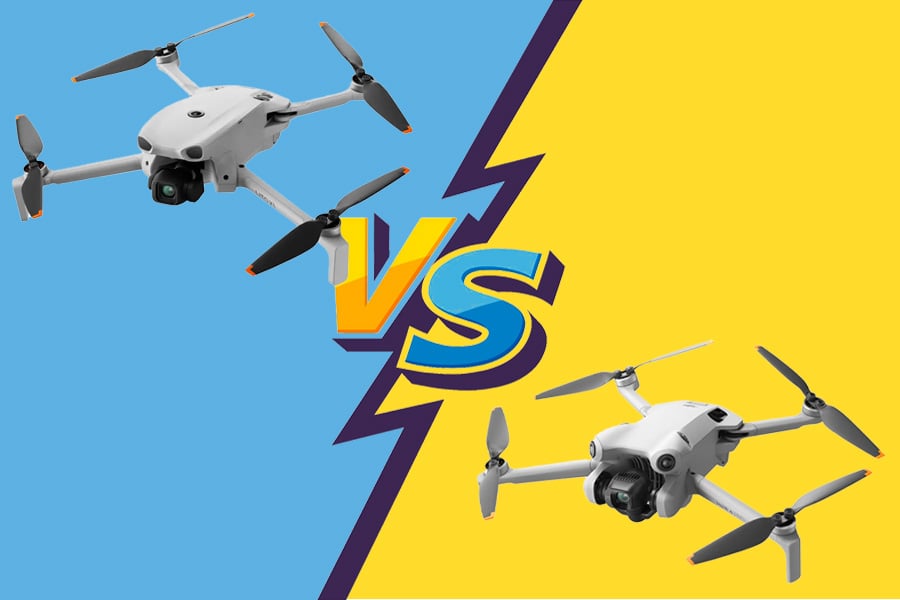
DJI Lito X1 vs Mini 4 Pro: which drone to choose?
Jun
With the DJI Lito X1, DJI is more than ever blurring the line between its entry-level drones and its premium models. On paper, its features and functionalities are surprisingly close to those of the DJI Mini 4 Pro, long considered one of the benchmarks of the Mini range. A fact that would have been hard to imagine just a few years ago for an entry-level drone. So what are the real differences between the DJI Lito X1 and the DJI Mini 4 Pro? Does the Mini 4 Pro retain enough advantages to justify its often higher price? And above all, which one should you buy? All the answers in our comprehensive DJI Lito X1 vs DJI Mini 4 Pro comparison.
DJI Lito X1 vs Mini 4 Pro: What you need to know
No time (or laziness 😅 ) to read it all? Here are the main differences between the DJI Lito X1 and DJI Mini 4 Pro 👇
- 🧳 Two foldable drones weighing less than 250 g, with a very compact, easy-to-transport format
- 📜 Both drones are rated C0 with their standard battery, but the Lito X1 can also be purchased in C1 version thanks to its Plus battery.
- 💾 42GB of internal memory and microSD compatibility up to 1TB on the Lito X1, versus just 2GB of internal storage and 512GB maximum on the Mini 4 Pro
- 📡 DJI O4 transmission system on both drones, with slightly greater range on the Mini 4 Pro
- 🕹️ DJI RC-N2 / RC-N3 and DJI RC 2 compatibility on both models, plus DJI RC Pro 2 for the Mini 4 Pro
- 🔋 Up to 36 minutes of autonomy announced on the Lito X1 versus 34 minutes on the Mini 4 Pro
- 🔋 Battery Plus officially available in Europe on the Lito X1, with up to 52 minutes of theoretical autonomy
- 🚀 S lightly higher maximum speed on the Lito X1 (18 m/s vs. 16 m/s)
- 🎯 Very similar creative functions on both drones: subject tracking, Waypoint, Hyperlapse, MasterShots and QuickShots
- 🚧 O mnidirectional obstacle detection on both models, with additional front-end LiDAR sensor on the Lito X1
- 📷 S ame 48 MP 1/1.3-inch CMOS sensor and horizontal video resolutions up to 4K 100 fps
- 📱 True 4K vertical mode thanks to the Mini 4 Pro’s rotating gondola, versus a 2.7K cropped portrait mode on the Lito X1
- 💸 B etween €260 and €280 difference depending on packs compared
📌 The DJI Mini 4 Pro retains the advantage of its rotating gondola and true full-sensor vertical format. But for most users, the DJI Lito X1 today offers an equipment/price ratio that’s particularly hard to beat.
DJI Lito X1 vs Mini 4 Pro: Design
| DJI Lito X1 | DJI Mini 4 Pro | |
| Weight | 249 g (standard battery) 340 g (Plus battery) | < 249 g |
| Dimensions (folded, without helices) (L x W x H) | 149 × 94 × 62 mm | 148 x 94 x 64 mm |
| Dimensions (unfolded) (L x W x H) | 183 × 251 × 79 mm (without propellers) | 298 x 373 x 101 mm (with propellers) |
| Storage | 42 GB internal memory microSD card (up to 1 TB) | 2 GB internal memory microSD card (up to 512 GB) |
| Class (Europe) | C0 (standard battery) / C1 (Plus battery) | C0 |
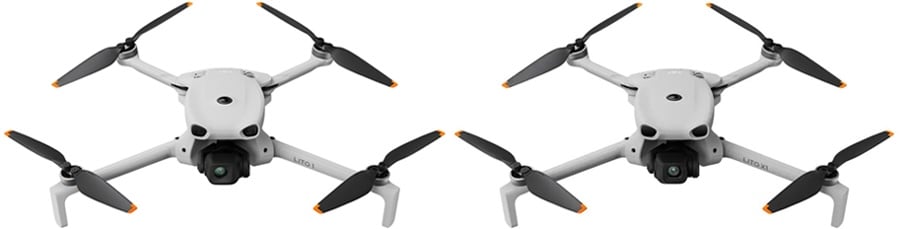
At first glance, the DJI Lito X1 and DJI Mini 4 Pro are in the same league. Both drones feature an ultra-compact foldable format designed to be easily transported on a daily basis while weighing less than 250 grams. When folded, their dimensions are very similar: 149 × 94 × 62 mm for the Lito X1 versus 148 × 94 × 64 mm for the Mini 4 Pro. In both cases, the result is a drone that’s easy to slip into a bag and take anywhere.
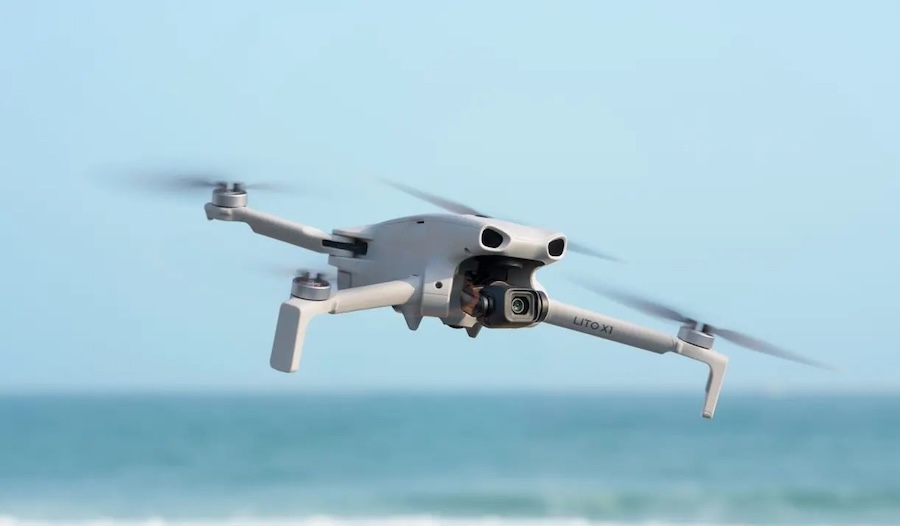
The differences are more apparent in their design. The Mini 4 Pro follows DJI’s classic architecture, with several sensors distributed around the drone for omnidirectional obstacle detection. The Lito X1, on the other hand, takes a more recent approach, with two modules positioned above and below the camera. Two different philosophies for the same objective: to monitor the environment all around the drone.
On the storage side, the DJI Lito X1 has a clear advantage. It boasts 42 GB of internal memory, compared with just 2 GB for the Mini 4 Pro. The Lito X1 also accepts microSD cards up to 1 TB, compared with 512 GB for its rival. This is a real plus for everyday use, enabling you to continue filming or taking photos even when you’ve forgotten your memory card, or simply to help out when it’s full.
Finally, the DJI Lito X1 also stands out in terms of European regulations. Like the Mini 4 Pro, it is classified C0 with its standard battery. But it can also be purchased in C1 version via its Fly More Plus pack and Plus battery, a possibility not offered by the Mini 4 Pro.
🏆 DJI Lito X1: 42 GB of internal memory and the option of a C1 version.
DJI Lito X1 vs Mini 4 Pro: Transmission and radio controls
| DJI Lito X1 | DJI Mini 4 Pro | |
| Compatible radio controls | DJI RC-N2/RC-N3, DJI RC 2 | DJI RC-N2/RC-N3, DJI RC 2, DJI RC Pro 2 |
| Video transmission system | DJI O4 | DJI O4 |
| Max. transmission distance | 15 km (IC), 8 km (CE / SRRC / MIC) | 20 km (FCC), 10 km (CE / SRRC / MIC) |
| Live preview quality | up to 1080p at 60 fps | up to 1080p at 60 fps |
On the video transmission side, the two drones are surprisingly similar. Both the DJI Lito X1 and the DJI Mini 4 Pro use the DJI O4 system, a technology renowned for its stability and reliability. Both models also offer video feedback up to 1080p at 60 frames per second, providing a smooth, comfortable image for both piloting and framing.
On paper, however, the Mini 4 Pro still has a slight advantage when it comes to range. DJI claims up to 20 km in FCC and 10 km in CE, compared with 15 km and 8 km respectively for the Lito X1. As always, these figures are largely theoretical, since a drone is supposed to be used visually. Nevertheless, they give a good indication of the signal’s robustness in more or less complex environments.
In practice, both drones benefit from particularly reliable transmission. According to the various tests and feedback available, the DJI O4 system proves highly stable and offers excellent link quality on both the Lito X1 and the Mini 4 Pro.
On the radio control side, both models offer virtually identical options. Both the DJI Lito X1 and the Mini 4 Pro are compatible with the DJI RC-N2 / RC-N3, which use a smartphone as a screen, as well as with the very good DJI RC 2 and its integrated screen. The Mini 4 Pro has a slight advantage, however, in that it is also compatible with the DJI RC Pro 2, DJI’s top-of-the-range remote control featuring a large, ultra-bright flip-up screen.
🏆 DJI Mini 4 Pro: slightly greater range and compatibility with the DJI RC Pro 2.
Discover our accessories for
DJI Lito X1
DJI Lito X1 vs Mini 4 Pro: Autonomy and recharging
| DJI Lito X1 | DJI Mini 4 Pro | |
| Battery | Standard battery: 2788 mAh Plus battery: 4680 mAh | 2590mAh |
| Maximum autonomy | 36 minutes (standard battery) 52 minutes (Plus battery) | 34 minutes |
| Typical autonomy | 23 minutes (standard battery) 37 minutes (Plus battery) | Not communicated |
| Charging time (standard battery) | Direct 73 min / Station 45 min (1 battery), 87 min (3 batteries) (65W charger) | Direct 70 min / Station 58 min (1 battery, 30W charger) |
| Charging time (Plus battery) | Direct 102 min / Station 56 min (1 battery, 130 min (3 batteries) (65W charger) | – |
The two drones use different and totally incompatible batteries. The DJI Lito X1 has a standard 2788 mAh battery, compared with 2590 mAh for the DJI Mini 4 Pro. A relatively modest difference on paper, but one that enables the Lito X1 to boast slightly higher autonomy figures.
DJI claims up to 36 minutes flight time with the Lito X1’s standard battery, compared with 34 minutes for the Mini 4 Pro. As always, these values are obtained under ideal conditions and are difficult to reproduce in practice.
In real-world use, however, the differences appear to be fairly limited. DJI reports a typical flight time of around 23 minutes for the Lito X1 with its standard battery. The Mini 4 Pro does not have an official equivalent value for typical use, but the various tests and user feedbacks generally report an actual autonomy of around 22 to 28 minutes, depending on flight conditions. In practice, then, the two drones appear to be operating in fairly similar waters.
The main difference is the Plus battery. The Lito X1 can be purchased in Europe with a 4680 mAh Plus battery, providing up to 52 minutes of theoretical autonomy and around 37 minutes in typical use. The Mini 4 Pro also features a Plus battery in some markets, but this is not normally available in Europe. For European users, the Lito X1 therefore retains a clear advantage in this respect.
On the recharging side, the two models remain relatively close with their standard batteries. It takes around 73 minutes to recharge the Lito X1 battery directly from the drone, compared with 70 minutes for the Mini 4 Pro. Charging station times are also slightly in the Lito X1’s favor, but these measurements were taken with different chargers (65 W for the Lito X1 vs. 30 W for the Mini 4 Pro), making the comparison less relevant.
🏆 DJI Lito X1: Plus battery available in Europe.
DJI Lito X1 vs Mini 4 Pro: In-flight performance
| DJI Lito X1 | DJI Mini 4 Pro | |
| Maximum speed | 18 m/s (Sport mode) 12 m/s (Normal / Tracking mode) | 16 m/s (Sport mode) 12 m/s (Normal mode) |
| Max. ascent speed | 7 m/s (Sport mode) 5 m/s (Normal mode) 3 m/s (Cine mode) | 5 m/s (Sport mode) 5 m/s (Normal mode) 3 m/s (Cine mode) |
| Max. descent speed | 7 m/s (Sport mode) 5 m/s (Normal mode) 3 m/s (Cine mode) | 5 m/s (Sport mode) 5 m/s (Normal mode) 3 m/s (Cine mode) |
| Max. wind resistance | 10.7 m/s (level 5) | 10.7 m/s (level 5) |
The DJI Lito X1 is distinguished first and foremost by a small detail of everyday practicality: it switches on automatically when the right rear arm is unfolded, and switches off when it is folded. This function is absent from the Mini 4 Pro, but saves a few seconds every time you take off. It can also be deactivated in the settings for those who prefer more conventional operation.
In flight, the Lito X1 also boasts slightly better performance on paper. Its top speed reaches 18 m/s in Sport mode (approx. 65 km/h), compared with 16 m/s (57.6 km/h) for the Mini 4 Pro. The same applies to vertical speeds, with up to 7 m/s for both uphill and downhill travel, compared with 5 m/s for the Mini 4 Pro. In practice, these differences don’t radically transform the flying experience, but the Lito X1 is a little more dynamic when you need to gain altitude quickly or cover a greater distance.
In terms of wind resistance, both drones are rated at 10.7 m/s (level 5). In the field, the Mini 4 Pro has proved its worth over the years, with particularly reassuring behavior for a drone weighing less than 250g. The Lito X1 boasts exactly the same specifications, and seems to be evolving at the same level overall.
Finally, when it comes to noise pollution, it’s hard to tell the difference between the two models. Both the DJI Lito X1 and the Mini 4 Pro are relatively discreet for their class, and their overall noise levels are very similar in flight.
🏆 DJI Lito X1: automatic ignition and higher maximum speed.
OUR BEST SELLERS - DJI Lito X1

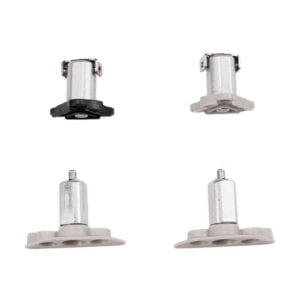
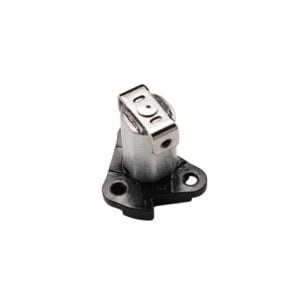
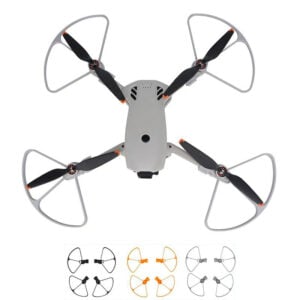
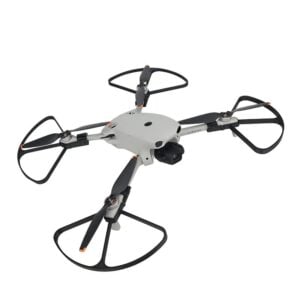
Propeller Protection Guards
Accessories
DJI Lito X1 vs Mini 4 Pro: Features
| DJI Lito X1 | DJI Mini 4 Pro | |
| Photo modes | Single shot, Burst, Auto exposure bracketing (AEB), Interval, Panorama | Single shot, Burst, Auto exposure bracketing (AEB), Interval, Panorama |
| Video modes | Slow motion, QuickShots, MasterShots, Hyperlapse, Subject tracking, Waypoint | Slow motion, QuickShots, MasterShots, Hyperlapse, Subject tracking, Waypoint |
| Obstacle detection | Omnidirectional monocular optical system + LiDAR forward + infrared downward sensor | Omnidirectional monocular optical system + downward-looking infrared sensor |
Photo and video modes
In terms of creative functions, the two drones are extremely similar. Both the DJI Lito X1 and Mini 4 Pro offer a comprehensive range of photo and video modes, including the classic QuickShots, MasterShots, Hyperlapse, slow motion, panoramas, AEB and Waypoint routes.
In fact, most users will find exactly the same creative possibilities on both models. Whether programming automatic trajectories, creating cinematic shots or reproducing movements with Waypoint, both drones offer a particularly comprehensive level of equipment for their category.
The DJI Lito X1 does, however, retain a small practical advantage with its QuickTransfer function, which can be used even when the drone is in standby mode. This feature makes it possible to quickly retrieve photos and videos without having to turn the device on completely.
Subject follow-up
Subject tracking is one of the major strengths of both drones. Both the DJI Lito X1 and the Mini 4 Pro feature a particularly comprehensive system with ActiveTrack, Spotlight and Point of Interest modes, capable of tracking a person, a bicycle, a vehicle, or automatically holding a subject in the frame.
According to the various tests and feedback available, both drones offer smooth, reliable tracking in most situations. For most users, the experience will therefore be very similar from one model to the next.
The Mini 4 Pro nevertheless retains a slight advantage thanks to its automatic ActiveTrack 360 mode, which allows the drone to choose its own position around the subject during tracking. A handy feature for achieving certain more complex camera movements without pilot intervention.
Obstacle detection
Both drones feature omnidirectional obstacle detection, a feature previously reserved for much higher-end models. In both cases, the system not only contributes to flight safety, but also improves the operation of subject tracking, Waypoint itineraries and automatic return to departure (RTH).
The Mini 4 Pro uses the classic DJI architecture, with several sensors distributed around the drone. The Lito X1, on the other hand, adopts a more recent approach based on two large modules positioned above and below the chassis, plus a front LiDAR sensor.
This LiDAR can improve the detection of certain obstacles in complex situations, particularly in low-light conditions, while also contributing to certain automatic functions such as Return to Home (RTH). However, it does not replace the pilot’s vigilance and cannot guarantee perfect obstacle detection in every environment, especially when dealing with thin branches, cables or transparent surfaces. On paper, it therefore gives the Lito X1 a slight technical advantage.
As with most DJI drones, some flight assistance features, including obstacle detection, may be limited or even disabled in Sport mode to prioritize performance. In practice, however, both drones still provide a particularly high level of safety for their category when used under the intended conditions.
🏆 DJI Lito X1: the addition of LiDAR gives it a slight edge in an otherwise well-balanced section.

Discover our accessories for
DJI Mini 4 Pro
DJI Lito X1 vs Mini 4 Pro : Image
| DJI Lito X1 | DJI Mini 4 Pro | |
| Aerial work platform | 3-axis mechanical gondola | 3-axis mechanical gondola |
| Sensor | 1/1.3-inch CMOS | 1/1.3-inch CMOS |
| Objective | 24 mm equivalent format Aperture f/1.7 FOV 82.1 | 24 mm equivalent format Aperture f/1.7 FOV 82.1 |
| Photo resolution | 12 MP / 48 MP | 12 MP / 48 MP |
| Max. video resolution (horizontal) | 4K up to 100 fps FHD up to 200 fps | 4K up to 100 fps FHD up to 200 fps |
| Max. video resolution (vertical) | 2.7K up to 60 fps | 4K up to 120 fps |
| ISO range | 100 à 12800 | 100 à 12800 |
| Max. bit rate | 130 Mb/s | 150 Mb/s |
| Digital zoom | Video: 1 to 3x (4K), 1 to 4x (FHD) Photo: 1 to 3x (12 MP) | Video: 1 to 3x (4K), 1 to 4x (FHD) Photo: 1 to 2x (12 MP) |
| Photo format | JPEG / DNG (RAW) | JPEG / DNG (RAW) |
| Video format | MP4 (MPEG-4 AVC/H.264, HEVC/H.265) | MP4 (MPEG-4 AVC/H.264, HEVC/H.265) |
| Color profile | Normal (8 / 10 bits), D-Log M (10 bits) | Normal (8 bits), HLG (10 bits), D-Log M (10 bits) |
Pod, sensor and resolutions
On paper, the two drones share an extremely similar technical base. Both feature a 3-axis mechanical gondola, a 1/1.3-inch 48 MP CMOS sensor, an f/1.7 aperture, a 24 mm equivalent lens and support for the RAW format (DNG) and 10-bit D-Log M profile.
Horizontal resolutions are also identical. Both the DJI Lito X1 and the Mini 4 Pro can film up to 4K at 100 frames per second, and up to 200 fps in Full HD for the most advanced slow-motion shots.
The main difference lies in the Mini 4 Pro’s rotating gondola. Unlike the Lito X1, whose portrait mode relies on simple image cropping limited to 2.7K 60 fps, the Mini 4 Pro can physically tilt its camera vertically. It is thus capable of filming in vertical 4K at up to 120 fps, using the entire surface of the sensor. The result: a wider angle of view and better image quality for content destined for social networks.
The Mini 4 Pro also retains a slight advantage, with a maximum video throughput of 150 Mb/s, compared with 130 Mb/s for the Lito X1. In practice, however, this difference remains relatively discreet.
Image quality
Overall, the two drones offer extremely similar image quality. This is hardly surprising, since the DJI Lito X1 and Mini 4 Pro are based on virtually identical hardware, with the same 1/1.3-inch sensor, f/1.7 aperture and very similar video characteristics.
The Mini 4 Pro has more than proved its worth since its release, with detailed images, natural colors and excellent dynamic range for a drone weighing less than 250g. The HLG and D-Log M profiles also make it possible to go far enough in post-production for those who like to calibrate their videos.
However, several tests and user reviews suggest that the DJI Lito X1 may hold a slight advantage in certain specific situations. Although both drones share similar hardware on paper, some comparisons highlight slightly better handling of high-contrast scenes and backlit conditions, as well as a marginally wider dynamic range in certain scenarios.
The difference remains relatively subtle and may vary depending on the settings, shooting conditions or future firmware updates. In the vast majority of situations, both drones deliver excellent image quality, and it would often be difficult to tell them apart without comparing them side by side.
🏆 DJI Mini 4 Pro: rotating pod and true full-sensor vertical mode.
DJI Lito X1 vs Mini 4 Pro: Packs and prices
ℹ️ Note: some links in this section are Amazon affiliate links. As Amazon Associates, we earn from qualifying purchases, at no extra cost to you.
| DJI Lito X1 | DJI Mini 4 Pro | |
| Standard package | 419 € | 679 € (RC-N2) or 849 € (RC 2) |
| Fly More Pack (DJI RC-N3) | 579 € | – |
| Fly More Pack (DJI RC 2) | 679 € | 959 € |
| Fly More Plus Pack (DJI RC 2) | 759 € | – |
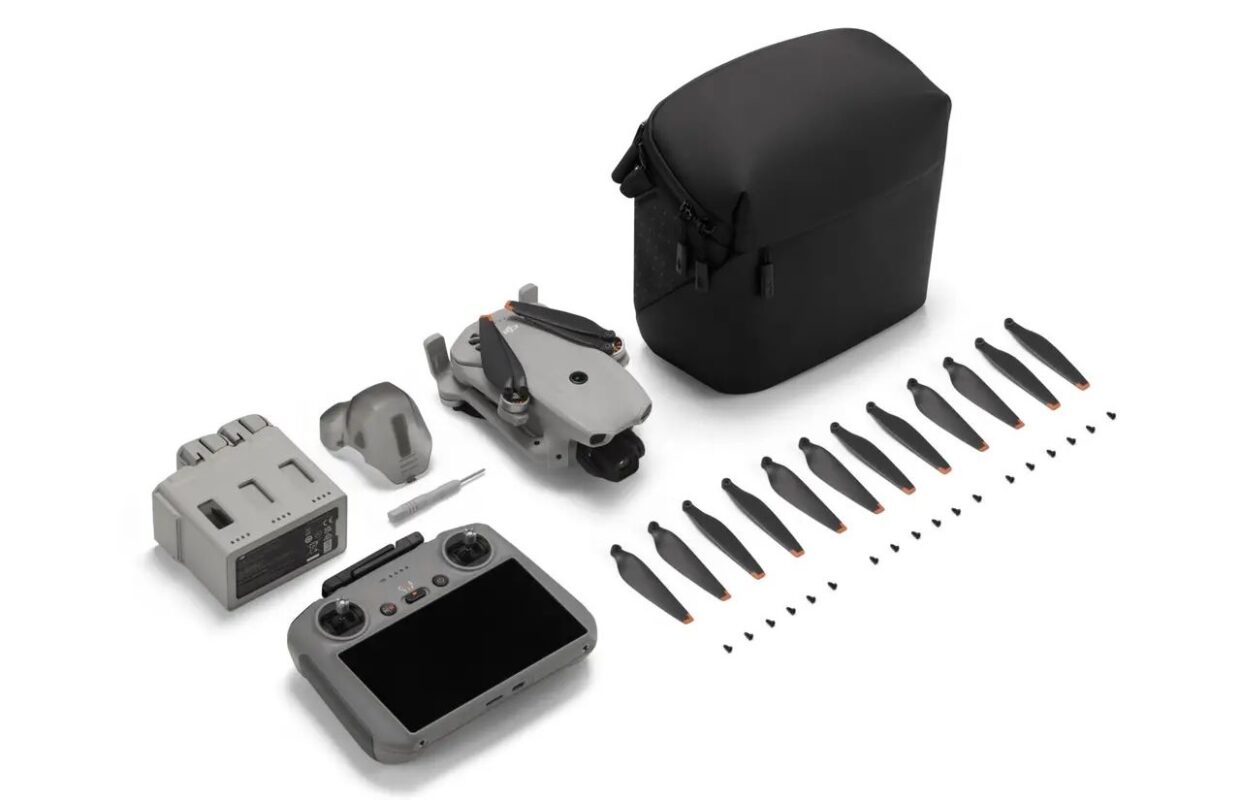
The DJI Lito X1 starts at €419 in its standard version with DJI RC-N3 radio control. DJI then offers a number of Fly More packs for additional batteries, a charging station and a carry bag. Depending on the package chosen, prices range from €579 for the Fly More RC-N3 to €759 for the Fly More Plus with DJI RC 2 and Plus batteries.
For its part, the DJI Mini 4 Pro starts at €679 with the DJI RC-N2 radio control system, which uses a smartphone as a screen. It is also available in a standard version with DJI RC 2 at €849, and in a Fly More RC 2 pack at €959, including three batteries, a charging station and a shoulder bag.
The price difference between the two models remains significant. The standard Lito X1 package is priced at €419, compared with €679 for the Mini 4 Pro with standard radio control, a difference of €260. The same applies to Fly More packs with DJI RC 2, priced at €679 for the Lito X1 versus €959 for the Mini 4 Pro, a difference of €280.
The Mini 4 Pro still has a few arguments to justify part of this price difference, notably its rotating gondola for true vertical format filming. But the price difference is far from negligible.
🏆 DJI Lito X1 : more attractive pricing.
OUR BEST SELLERS - DJI MINI 4 PRO


Conclusion DJI Lito X1 vs Mini 4 Pro: which one to choose?
When it came out, the DJI Mini 4 Pro was probably the best of the compact drone category, weighing less than 250 grams. But the arrival of the DJI Lito X1 clearly changes all that.
After all, the two drones are extremely similar. They share the same 1/1.3-inch sensor, the same DJI O4 transmission system, very similar functionalities, omnidirectional obstacle detection and generally comparable performance.
The Mini 4 Pro still has a few advantages. Its rotating gondola enables it to shoot in true full-sensor vertical format, with a wider angle of view and more flexibility for content creators regularly posting to Instagram, TikTok or YouTube Shorts. It also benefits from a slightly longer range and compatibility with the DJI RC Pro 2 radio control system.
On the other hand, the DJI Lito X1 doesn’t just keep up. It does even better in several respects, with its 42 GB internal memory, Plus battery available in Europe, front-facing LiDAR sensor, automatic ignition, slightly better flight performance and, above all, a much more attractive price.
All in all, the DJI Mini 4 Pro remains an excellent drone, but today it’s hard to ignore the €260 to €280 price gap that separates it from the DJI Lito X1, depending on the package chosen. For the vast majority of users, the Lito X1 simply offers better value for money.
🏆 O ur choice: DJI Lito X1. Unless the rotating pod and true full-sensor vertical mode are an essential criterion for you, the DJI Lito X1 today appears to be the more relevant choice between the two models.
Which drone should you choose based on your needs?
| Your priority | Recommended drone | Why? |
|---|---|---|
| The best value for money | DJI Lito X1 | Very close performance to the Mini 4 Pro at a significantly lower price. |
| Social media and vertical video | DJI Mini 4 Pro | True 4K vertical recording thanks to its rotating gimbal. |
| Maximum flight time in Europe | DJI Lito X1 | Plus Battery officially available in Europe, with up to 52 minutes of advertised flight time. |
| You already own a DJI Mini 4 Pro | Keep the Mini 4 Pro | The Lito X1 does not offer enough improvements to justify upgrading in most cases. |
| Your first versatile drone | DJI Lito X1 | Feature-packed, beginner-friendly and excellent value for money. |
| Demanding video creators | DJI Mini 4 Pro | Rotating gimbal, HLG profile and DJI RC Pro 2 compatibility. |
Choose the DJI Lito X1 if…
- You’re looking for the best equipment/price ratio.
- You want to take advantage of a Plus battery officially available in Europe.
- Add a front LiDAR sensor for added safety.
Choose the DJI Mini 4 Pro if…
- You regularly publish content on Instagram, TikTok or YouTube Shorts and want to take advantage of a true rotating gondola with full sensor vertical mode.
- You are using or planning to use the DJI RC Pro 2 radio control system.
FAQ – DJI Lito X1 vs Mini 4 Pro
Does the DJI Mini X1 exist?
No. Some users search for the “DJI Mini X1”, but they are actually referring to the DJI Lito X1. That is the model compared with the DJI Mini 4 Pro in this article.
Should you replace a DJI Mini 4 Pro with a DJI Lito X1?
In most cases, no. If you already own a Mini 4 Pro, the Lito X1 does not offer a significant enough improvement in image quality or features to justify switching. However, for a new buyer, the Lito X1 currently offers outstanding value for money.
Can the DJI Lito X1 record true vertical video?
No. The DJI Lito X1 offers a cropped portrait mode in up to 2.7K at 60 fps. The DJI Mini 4 Pro is the only one of the two with a rotating gimbal capable of recording true 4K vertical video using the entire sensor.
Which drone offers the best battery life?
The DJI Lito X1 has a slight advantage, with up to 36 minutes of advertised flight time using the standard battery, compared with 34 minutes for the Mini 4 Pro. It is also available with a Plus Battery in Europe, extending the advertised flight time to up to 52 minutes.
Are the DJI Lito X1 and DJI Mini 4 Pro batteries compatible?
No. The batteries are completely different and cannot be used interchangeably.
Which drone is better for TikTok, Instagram or YouTube Shorts?
The DJI Mini 4 Pro is the better choice thanks to its rotating gimbal and true 4K vertical recording, making it ideal for social media content.
Which drone offers the best value for money?
For most users, the DJI Lito X1 is currently the best choice. It delivers most of the Mini 4 Pro’s key features at a significantly lower price.
💡 To go further, discover our complete tests of the two drones in this DJI Lito X1 vs Mini 4 Pro comparison:
➡️ Discover the DJI Lito X1 test
➡️ Discover the DJI Mini 4 Pro test
🛠️ Pour l’entretien et la réparation, vous pouvez retrouver toutes les pièces compatibles :
Pièces DJI Lito X1
Pièces DJI Mini 4 Pro
💡 Also worth reading
➡️ Wondering whether the most affordable model in the Lito lineup could be enough for your needs? Discover our test of the DJI Lito 1 drone.

 Blog
Blog