
 Français
 Deutsch
 Español
 Italiano
 Parts & Accessories by Drone
 Drones
 Action camera
 Microphones
 Camera Stabilizers
 VR Headsets
DJI Lito 1, full review: DJI boosts its entry-level range
May
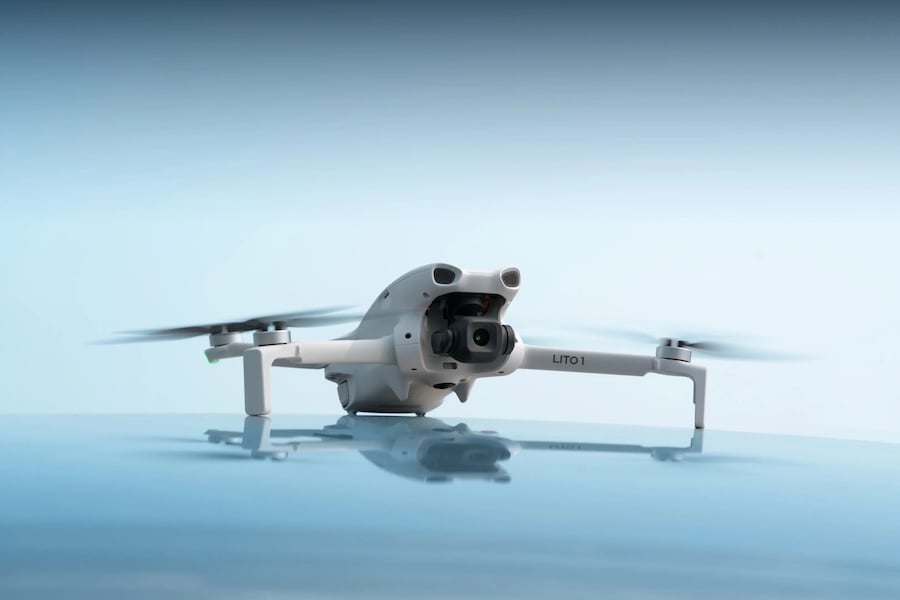
DJI renews its entry-level drone range with the arrival of the DJI Lito 1 and Lito X1, two models designed to succeed the “classic” Mini series drones such as the Mini SE, Mini 2 SE and Mini 4K, with a more modern and accessible approach than ever. But what is this DJI Lito 1 really worth? Who is it for? Is it a good choice for beginners or to replace an older model in the Mini range? And above all, is this the drone for you today? All the answers in this comprehensive review of the DJI Lito 1.
DJI Lito 1: What you need to know
No time (or laziness 😅 ) to read it all? Here are the key points to remember about the DJI Lito 1 👇
- 🧳 Compact folding design weighs less than 250 g, with C0 certification in Europe
- 📡 Reliable, stable DJI O4 transmission, with announced range of up to 8 km in CE
- 🕹️ Compatible with DJI RC-N3 and DJI RC 2 with integrated display
- 🔋 Up to 36 min theoretical autonomy, approx. 23 min in real use
- 🎯 ActiveTrack subject tracking arrives on DJI’s entry-level range
- 🎬 Video modes much more comprehensive than before: slow motion, Hyperlapse, QuickShots, MasterShots…
- 🚧 O mnidirectional obstacle detection with automatic stop or bypass
- 📷 1 /2-inch CMOS sensor with 4K video at up to 60 fps, slow motion at up to 100 fps and 48 MP RAW photos
- 💸 Two packs available from €339, with a full Fly More version at €479
📌 A more modern and complete entry-level drone than ever from DJI.
DJI Lito 1 : Design
| Weight | 249 g (standard battery) 340 g (Plus battery) |
| Dimensions (folded, without propellers) (L x W x H) | 149 × 94 × 62 mm |
| Dimensions (unfolded, without propellers) (L x W x H) | 183 × 251 × 79 mm |
| Storage | microSD card (up to 1TB) |
| Class (Europe) | C0 |
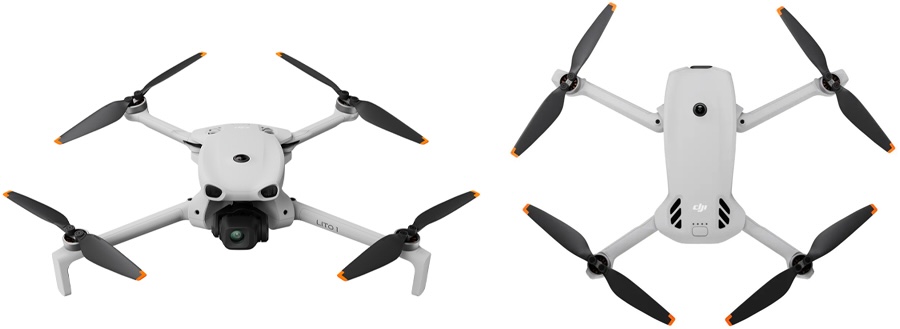
With the DJI Lito 1, we’re on familiar ground. DJI has clearly taken up the DNA of the Mini series, with a foldable, compact design and, above all, a weight of less than 250 g, enabling it to remain in class C0 in Europe. A point that remains as important as ever, especially for those who want to fly easily without constraints.
On the format side, the drone remains very compact: 149 × 94 × 62 mm when folded, and 183 × 251 × 79 mm when unfolded. In practical terms, it’s a drone you can take anywhere without thinking about it, exactly in the spirit of the Mini it replaces.
The real aesthetic and technical innovation lies in the sensors, with the addition of modules placed above and below the drone. Their operation is reminiscent of two opposing 360° camera lenses, which together cover the entire environment around the drone. A real step forward compared to previous Mini models, which are often much more limited in this respect.
Finally, on the storage side, the DJI Lito 1 works simply with a microSD card, with support for up to 1TB. Unlike the Lito X1, it has no internal memory, but this remains a classic and effective solution for this type of drone.
DJI Lito 1 : Transmission and radio controls

| Compatible radio controls | DJI RC-N3, DJI RC 2 |
| Video transmission system | DJI O4 |
| Max. transmission distance | 15 km (IC), 8 km (CE / SRRC / MIC) |
| Live preview quality | up to 1080p at 60 fps |
On the transmission side, the DJI Lito 1 relies on the DJI O4 system, a technology that has already proved its worth with the brand. Even if the O4+ is fitted on the most high-end models, the O4 is still a top performer today, with a stable, fluid and reliable connection in the vast majority of situations.
The advertised range is up to 15 km in IC standard and 8 km in CE. Distances that are never reached in practice, but which above all give a good idea of the signal strength and its ability to remain stable, even when conditions become a little more complex.
On the video feedback side, there’s a 1080p stream at up to 60 frames per second, enough to drive comfortably with a fluid, clean image.
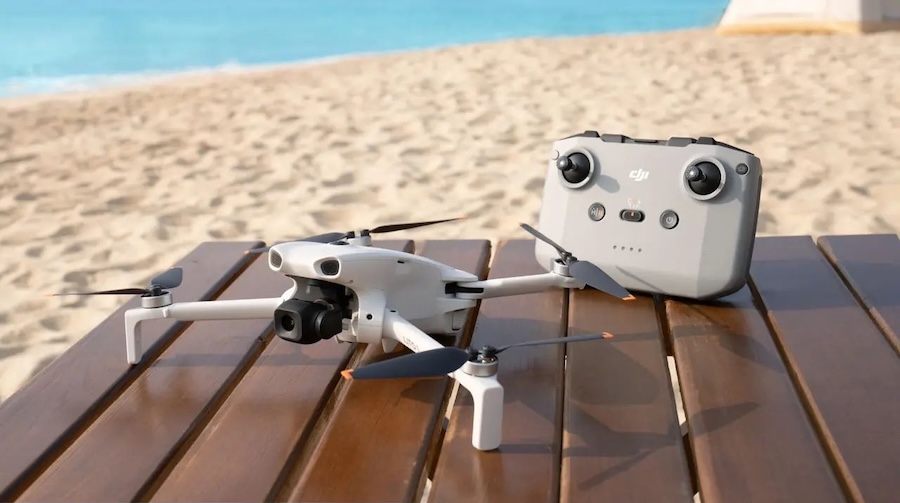
For piloting, the DJI Lito 1 is compatible with three remote controllers. First, the DJI RC-N3, which works with a smartphone attached to the controller: a simple and effective solution. It is also compatible with the DJI RC-N2, which operates in the same way, as well as the DJI RC 2, featuring a built-in integrated display for a more comfortable experience and faster setup in the field.
DJI Lito 1: Autonomy and recharging
| Battery | Standard battery: 2590 mAh Plus battery: 4680 mAh |
| Maximum autonomy | 36 minutes (standard battery) 52 minutes (Plus battery) |
| Typical autonomy | 23 minutes (standard battery) 37 minutes (Plus battery) |
| Charging time (standard battery) | Direct 73 min / Station 45 min (1 battery), 87 min (3 batteries) |
| Charging time (Plus battery) | Direct 102 min / Station 56 min (1 battery), 130 min (3 batteries) |
In terms of battery, the DJI Lito 1 uses a standard 2590 mAh battery, which is the drone’s main configuration. A 4680 mAh Plus battery is also available, but its use is more specific: while it is technically compatible, it is not supported on the Lito 1 in the European Union and the United Kingdom. As a result, we will not cover this battery in more detail in this review.
On paper, DJI claims up to 36 minutes of maximum autonomy with the standard battery. As always, this value corresponds to ideal conditions (constant flight, no wind, no sudden movements), and is therefore far removed from real-life use.
To give a more concrete estimate, DJI now communicates a “typical” autonomy of 23 minutes, based on a much more realistic use scenario: flight with movement, hover phases, active video recording and obstacle avoidance activated. This value is broadly in line with feedback from independent tests and users, giving a fairly reliable idea of what to expect in the field.
On the recharging side, times are about average. Allow around 73 minutes for direct charging via the drone, and 45 minutes with the charging station for one battery (or 87 minutes for three batteries). These are decent values, which mean you can get on with your sessions without waiting too long, especially with a charging hub.
Discover our accessories for
DJI Lito 1
DJI Lito 1: In-flight performance
| Maximum speed | 18 m/s (Sport mode) 12 m/s (Normal / Tracking mode) |
| Max. ascent speed | 7 m/s (Sport mode) 5 m/s (Normal mode) 3 m/s (Cine mode) |
| Max. descent speed | 7 m/s (Sport mode) 5 m/s (Normal mode) 3 m/s (Cine mode) |
| Max. wind resistance | 10.7 m/s (level 5) |
Once in the field, the DJI Lito 1 relies on a simple, effective approach: simply unfold the right rear arm to switch it on automatically. It’s a small detail, but one that makes getting started quick and natural, especially when you’re flying non-stop.
In the air, the behavior is very familiar. The drone offers several flight modes, with a maximum speed of 18 m/s in Sport mode and 12 m/s in Normal or Track mode. Nothing surprising here: we’re in line with the brand’s compact drones, with fluid, precise and very stable handling. The Lito 1 is easy to handle and reassuring to pilot, whether you’re flying simple routes or more dynamic shots.
Wind resistance is rated at 10.7 m/s (level 5), putting it in the mid-range. It’s not a drone designed to cope with extreme conditions, but in normal use, it manages without any particular difficulty.
Last but not least, a pleasant surprise when it comes to noise. The DJI Lito 1 is rather discreet in flight, with a noise level close to the quietest models in the range, such as the Mini 3, Mini 4 Pro or Mini 5 Pro. At a distance, noise becomes barely perceptible, limited to a slight hum, far less pronounced than on noisier drones like the Neo.
DJI Lito 1 : Features
| Photo modes | Single shot, Burst, Auto exposure bracketing (AEB), Interval, Panorama |
| Video modes | Slow motion, QuickShots, MasterShots, Hyperlapse, ActiveTrack subject tracking |
| Obstacle detection | Omnidirectional monocular optical system + downward-looking infrared sensor |
The DJI Lito 1 – like the Lito X1 – marks a real evolution in this respect. There are more photo and video modes than ever before, and above all, new features for this range, such as subject tracking and omnidirectional obstacle detection. A real step forward for entry-level drones.
Photo and video modes
The DJI Lito 1 offers a fairly comprehensive range of shooting modes for this model range. On the photo side, you’ll find the essentials with burst, exposure bracketing (AEB), interval mode and panorama, enough to cover most situations without difficulty.
On the video side, DJI has also added several creative modes. These include QuickShots, which automatically produce short, pre-programmed camera movements, as well as functions such as slow motion and MasterShots, capable of combining several trajectories to create an automatically edited clip.
The drone also offers ActiveTrack subject tracking, which is covered in greater detail in the next section.
Subject follow-up
This is clearly one of the big new features in this range. Where previous entry-level Mini drones were very limited in this respect, the DJI Lito 1 now features a true subject tracking system, with several different modes depending on the type of shot required.
First of all, there’s the ActiveTrack mode, capable of tracking a person, a bike or even a vehicle, with the option of positioning the drone as desired around the target during tracking. The drone can reach tracking speeds of up to 12 m/s, or around 43 km/h, which is more than enough for most conventional uses.
The Point of Interest mode locks onto a subject or monument and automatically rotates around it, while the Spotlight mode keeps a target permanently in focus while the pilot retains manual control of the drone.
According to the various tests and feedback available, tracking is smooth and reliable overall, with consistent behavior in most situations, especially for a drone in this range.
Obstacle detection
With the DJI Lito 1, DJI has adopted a new approach to obstacle detection. Rather than multiplying sensors on the front, rear or sides, as in previous models, the drone uses two modules positioned above and below the chassis. Their operation is a little like that of two opposing lenses on a 360° camera: each covers 180 degrees, enabling the drone to monitor its environment all around it.
As a result, the Lito 1 benefits from omnidirectional obstacle detection, a pretty impressive feature on an entry-level drone.
DJI also lets you choose the drone’s behavior when an obstacle is detected. Depending on the settings chosen, the drone can either stop automatically, or fly around the obstacle to continue its trajectory. This is a real plus, both in terms of flight safety and for making certain shots smoother and more natural.
It should be noted, however, that this obstacle avoidance system has certain limitations. Its effectiveness depends in particular on lighting conditions and the surrounding environment: power lines, thin branches, glass or highly reflective surfaces, as well as poorly lit scenes, may be more difficult to detect. In addition, obstacle avoidance is disabled in Sport mode. As with all drones, these assistance systems should never replace the pilot’s vigilance.
OUR BEST SELLERS - DJI Lito 1
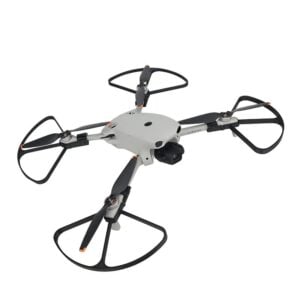
Propeller Protection Guards
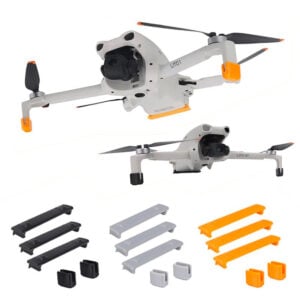
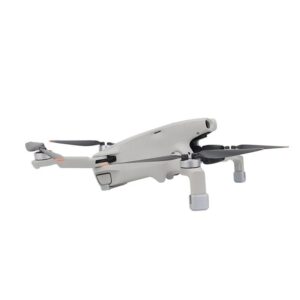
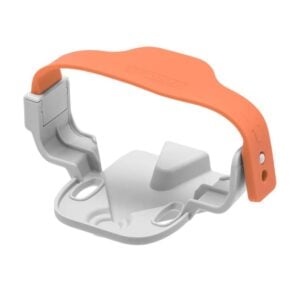
Accessories
DJI Lito 1 : Image
| Aerial work platform | 3-axis mechanical gondola |
| Sensor | 1/2-inch CMOS |
| Objective | Equivalent format 26.2 mm Aperture f/1.8 FOV 79° (in mm) |
| Photo resolution | 12 MP / 48 MP |
| Max. video resolution (horizontal) | 4K up to 60 fps (100 fps in Slow Motion mode) FHD up to 100 fps |
| Max. video resolution (vertical) | 2.7K up to 60 fps |
| ISO range | 100 à 12800 |
| Max. bit rate | 130 Mb/s |
| Digital zoom | Video: 1 to 3x (4K, 2.7K vertical), 1 to 4x (FHD) Photo: 1 to 3x (12/48 MP) |
| Photo format | JPEG / DNG (RAW) |
| Video format | MP4 (MPEG-4 AVC/H.264, HEVC/H.265) |
| Color profile | Normal (8 / 10 bits) |
Nacelle, sensor and resolution
The DJI Lito 1 features a 3-axis mechanical gondola, combined with a 1/2-inch CMOS sensor with f/1.8 aperture.
When it comes to photography, the drone can capture 12 or 48 megapixel images, with support for RAW (DNG) format for those wishing to further enhance their images.
On the video side, the Lito 1 can film in 4K at up to 60 frames per second, with the option of up to 100 fps in slow-motion mode. In Full HD, it can also shoot at up to 100 fps.
DJI also offers a 2.7K vertical mode at up to 60 fps. Unlike the Mini 3, Mini 4 Pro or Mini 5 Pro, however, the camera does not physically swivel vertically: here, the portrait format is based on cropping within the 4K image, and not on a dedicated rotating gondola.
The drone also offers digital zoom, up to 3x in 4K and 2.7K vertical, and up to 4x in Full HD. As always with this type of zoom, there’s a slight loss of quality when you push the magnification, but it’s still handy for quickly adjusting your framing without having to bring the drone closer.
One final note: the lens uses a fixed focus (from 4 m to infinity). In practice, this has no impact in the vast majority of flights, but subjects located less than 4 metres away may appear slightly less sharp.
Image quality
Overall, the DJI Lito 1 delivers very convincing image quality for a drone in its class. Images are detailed, with overall clean rendering and pleasing colors, without excessive processing.
The drone also performs well in most everyday situations. On the other hand, as it doesn’t offer a true HDR profile or a logarithmic profile like D-Log M (reserved for the Lito X1), high-contrast scenes can sometimes show their limits a little more quickly, particularly in backlighting or when certain areas are heavily exposed. Nothing dramatic here, but the most demanding post-production users are bound to notice a difference with more advanced models.
Nevertheless, the Lito 1 still has a real advantage: it supports RAW (DNG) photos, and video can be recorded in 8- or 10-bit, even with the Normal color profile. A good point for those who want to keep a bit of leeway when it comes to retouching, while remaining with a drone that’s simple and accessible to use.
Overall, for the vast majority of users, the rendering offered by the DJI Lito 1 will be more than sufficient for everyday video and photo shooting.
DJI Lito 1: Packs and prices
ℹ️ Note: some links in this section are Amazon affiliate links. As Amazon Associates, we earn from qualifying purchases, at no extra cost to you.
| Standard package | 339 € |
|
| Fly More Pack (DJI RC-N3) | 479 € |
|
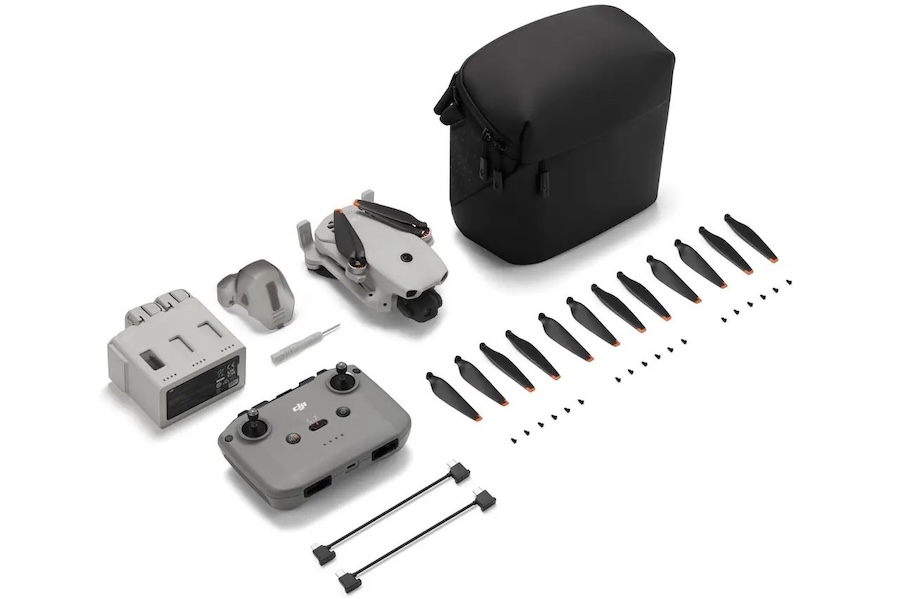
The DJI Lito 1 starts at €339, with a fairly simple approach: a standard package for beginners, and a Fly More bundle designed for those who want to fly longer and take off with more comprehensive equipment.
The standard package includes the DJI Lito 1 drone, the DJI RC-N3 remote control (with smartphone support), a standard battery, a nacelle protector, a pair of spare propellers and the usual cables.
For its part, the Fly More bundle includes all the contents of the standard pack, with several additional accessories:
- two additional batteries (three in all),
- two additional pairs of propellers,
- a charging station,
- as well as a shoulder bag.
One point to note: although the DJI Lito 1 is compatible with the DJI RC 2 with integrated screen, DJI does not currently offer a package that includes this remote control. So you’ll have to buy it separately if you want to take advantage of a controller with a directly integrated screen.
Conclusion DJI Lito 1: the new entry-level benchmark?
With the DJI Lito 1, DJI is not simply replacing the old Mini SE, Mini 2 SE or Mini 4K. The brand is clearly upgrading its entry-level range with a more modern, better-equipped and, above all, much more complete drone than before.
Where earlier models focused on simplicity and price, the Lito 1 now adds features previously found only on more advanced drones: subject tracking, omnidirectional obstacle detection, more comprehensive video modes, improved transmission and even more advanced automatic modes. All this, without losing what made the Mini series such a success: a compact size, a weight of less than 250 g and a grip that’s accessible to almost everyone.
Of course, not everything is perfect. The vertical mode is still based on simple cropping, there’s no D-Log M profile like on the Lito X1, and image performance remains logically a little more limited than on higher-end models. But for its price positioning, the DJI Lito 1 ticks a lot of boxes.
Who is the DJI Lito 1 designed for?
The DJI Lito 1 is aimed above all at those looking for a simple, compact, modern drone that can do a lot without becoming complicated to use.
It’s an excellent choice for beginners, for traveling light, or for replacing an aging entry-level drone. It’s also well suited to occasional content creators who want a drone that’s easy to take out and quick to use, while taking advantage of advanced features like subject tracking or automatic modes.
On the other hand, the most demanding photo, video or post-production users will probably be better off looking on the side of the DJI Lito X1 or the brand’s Pro models, which are more complete in terms of imaging.
Should I replace a Mini 2 SE or Mini 4K with the DJI Lito 1?
For anyone still using a Mini SE, Mini 2 SE or Mini 4K, the evolution brought about by the Lito 1 is far from insignificant. The gains are not limited to image quality: it’s above all the functionalities that completely change the experience.
Subject tracking, omni-directional obstacle detection, MasterShots, slow-motion mode and O4 transmission provide real added comfort for everyday use. The drone becomes easier to use, safer and, above all, much more modern in its operation.
On the other hand, if your use remains very basic – a few occasional flights and simple shots – a Mini 4K is still more than capable of doing the job. So it all depends on the importance you attach to the new functions offered by the Lito 1.
FAQ: DJI Lito 1
Is the DJI Lito 1 a good drone for beginners?
Yes. The DJI Lito 1 is one of DJI’s best drones for learning how to fly. It is easy to control, features excellent stabilization thanks to its 3-axis mechanical gimbal, and benefits from omnidirectional obstacle detection, a feature that is still rare in this price range.
Its intuitive interface, intelligent flight modes and numerous safety features make it easy to gain confidence from the very first flights. For most beginners, it offers an excellent balance between ease of use, safety and image quality.
Is the DJI Lito 1 compatible with the DJI RC 2 remote controller?
Yes. The DJI Lito 1 is compatible with the DJI RC-N3, DJI RC-N2 and DJI RC 2 remote controllers.
The DJI RC-N3 and RC-N2 use a smartphone as the display, while the DJI RC 2 features a built-in high-brightness screen. The latter provides a more comfortable flying experience, as you can start flying without connecting your phone before every flight.
Can the DJI Lito 1 automatically track a subject?
Yes. The DJI Lito 1 features ActiveTrack, allowing it to automatically follow a moving subject, including a person, vehicle or boat.
It also includes Spotlight and Point of Interest (POI) modes through FocusTrack, as well as several intelligent shooting modes such as QuickShots.
Is the DJI Lito 1 classified as C0 in Europe?
Yes. Weighing less than 250 g, the DJI Lito 1 carries the C0 class identification label, allowing it to benefit from the most flexible European regulations for recreational drones.
As with all camera drones, its use is still subject to local regulations, including operator registration in many European countries and compliance with authorized flight zones.
What is the difference between the DJI Lito 1 and the DJI Lito X1?
The DJI Lito X1 builds on the Lito 1 by adding several advanced features. These include a larger image sensor, a front-facing LiDAR system, ActiveTrack subject tracking, built-in internal storage and the D-Log M color profile, offering greater flexibility for video editing.
The DJI Lito 1 remains the more affordable option and is perfectly suited to pilots looking for a simple, reliable and easy-to-use drone without requiring these additional features.
Should you buy the DJI Lito 1 or an older DJI Mini (Mini SE, Mini 2 SE or Mini 4K)?
In most cases, the DJI Lito 1 is now the more compelling choice. It benefits from a newer platform, improved video transmission, better battery life and, above all, true omnidirectional obstacle detection, which is not available on older Mini models.
The DJI Mini SE, Mini 2 SE and Mini 4K are still excellent drones, but they are beginning to show their age compared with DJI’s new Lito series. Unless you find one of these older models at a particularly attractive price, the DJI Lito 1 will generally be the more future-proof investment.
💡 Also read
➡️ Looking for a more advanced version with a better camera, D-Log M and more powerful features? Discover our review of the DJI Lito X1.
➡️ Hesitating between the two models? Discover our DJI Lito 1 vs Lito X1 comparison.
➡️ Discover why the DJI Lito 1 is featured in our top drones 2026.
➡️ New to drones? Check out our guide to find the best beginner drone.
➡️ Wondering how the DJI Lito 1 compares to the DJI Mini 3? Check out our DJI Lito 1 vs Mini 3 comparison.
➡️ Not sure whether to choose the DJI Lito 1 or the DJI Neo 2? Check out our DJI Lito 1 vs Neo 2 comparison.
➡️ Considering a more advanced Mini drone? Check out our Lito X1 or Mini 5 Pro comparison.
➡️ Wondering whether the DJI Lito X1 can compete with DJI’s former flagship Mini drone? Check out our comparison DJI Mini 4 Pro vs Lito X1.
🛠️ For maintenance and repairs, you can find all compatible parts here:
DJI Lito 1 Parts

 Blog
Blog