
 Français
 Deutsch
 Español
 Italiano
 Parts & Accessories by Drone
 Drones
 Action camera
 Microphones
 Camera stabilizers
 VR Headsets
DJI Mini 5 Pro, full review: the Mini that thinks big!
Sep
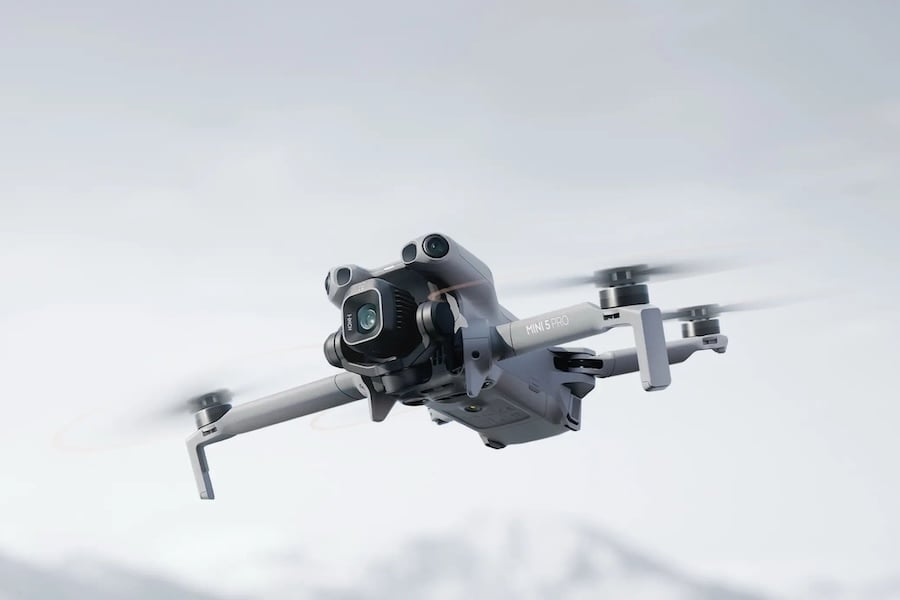
Like every year, the release of a new Mini by DJI is a major event, and this DJI Mini 5 Pro is no exception. Still weighing in at under 250 grams, it features a rotating gondola, a LiDAR system on the front, and above all a 1-inch sensor: a first for such a compact drone. What else is new? What’s it really worth? Is this the drone for you? And if you already have a Mini 4 Pro (or another Mini), is this upgrade worth it? All the answers in this detailed analysis.
DJI Mini 5 Pro: What you need to know
No time to read it all? Here are the key points to remember about the DJI Mini 5 Pro.
- 📸 New 1-inch CMOS sensor: a first on a drone weighing less than 250 g, with video up to 4K/60 and slow-motion 4K/120.
- 🔁 Rotating nacelle up to 225°: for unprecedented creative movements on the roll axis.
- 🔭 48 mm telephoto lens: a second focal length with no loss of quality for varying angles of view.
- 🛡️ Enhanced flight safety: LiDAR sensor to detect obstacles even in low light + intelligent RTH in the event of a weak GPS signal.
- 🎬 Enhanced features: new QuickShots + more customizable tracking with precise target selection.
- 🌪️ Increased speed and stability: faster in all directions (including uphill, downhill and tracking), with enhanced wind resistance.
- 💰 Unchanged launch price: identical to that of the Mini 4 Pro, despite the many new features.
📝 DJI Mini 5 Pro: the most complete sub-250g drone on the market, and a new benchmark for demanding creators.
DJI Mini 5 Pro : Design

| Weight | 249,9 g |
| Dimensions (folded, without helices) (L x W x H) | 157 × 95 × 68 mm |
| Dimensions (unfolded, with propellers) (L x W x H) | 304 × 380 × 91 mm |
| Internal storage | 42 GB |
| Class (UE) | C0 |
The DJI Mini 5 Pro remains faithful to the DNA of the range: folding arms, ultra-compact format, and still under the symbolic 250 gram mark(249.9 g to be precise). Quite a feat for DJI, especially when you consider that this model now features a 1-inch sensor. Its size is slightly larger than that of the Mini 4 Pro, but without any noticeable impact on handling, and its folded format (157 × 95 × 68 mm) remains as easy as ever to slip into a bag.
New features include a darker gray hue than on previous models, a rotating nacelle(more on this later), and a LiDAR sensor on the front. The propeller attachment system has also been redesigned: no more screws, just press down and turn a quarter-turn to remove them – simple and effective.
Another clever detail: it lights up as soon as the arms are unfolded, and switches off when they are folded. An appreciable time-saver in the field. And to make sure you don’t forget your SD card, DJI has integrated 42 GB of internal storage, enough to tide you over if you do.
One last intriguing detail: a small side button has appeared on the side of the device, right under the thumb when held in the hand. For the moment, it serves no purpose… but we suspect DJI is preparing a Flip-like function for future palm-launches. To be continued 👀
🚦 Regulatory note
The DJI Mini 5 Pro is classified as C0 in Europe: no training or exam is required, a simple online registration is sufficient, and flying is allowed in urban areas, including over isolated people (but not over crowds). The height remains limited to 120 m from the take-off point.
👉 Until the end of 2025, it was possible to unlock this limit by reclassifying the drone to C1 via the DJI Fly app. This option notably allowed exceeding 250 g and adding accessories without restrictions.
⚠️ However, DJI has since disabled this feature. It is therefore no longer possible, as of today, to reclassify the DJI Mini 5 Pro as C1.
DJI Mini 5 Pro: Transmission and radio controls

| Compatible radio controls | DJI RC-N3 DJI RC 2 DJI RC Pro 2 |
| Video transmission system | O4+ |
| Live preview quality | Up to 1080p at 60 fps |
| Max. transmission distance | FCC: 20 km CE: 10 km |
There are no surprises when it comes to radio control: the DJI Mini 5 Pro is delivered either with the DJI RC-N3, for connection to a smartphone, or with the DJI RC 2, which directly integrates a beautiful, luminous display. The latter solution is far more practical for those who want to fly without relying on a phone, while enjoying a fluid, responsive interface.
But the real evolution is invisible: the Mini 5 Pro adopts theDJI O4+ transmission protocol, recently inaugurated by the Mavic 4 Pro. Theoretical range reaches 20 km in FCC(10 km in CE), but it’s above all the signal stability that impresses. Available tests on the Mavic 4 Pro clearly highlight better resistance to interference and obstacles, even in dense or challenging environments.
Live video preview goes up to 1080p at 60 frames per second, offering smooth, detailed feedback for in-flight framing.
It’s official: the DJI Mini 5 Pro is now compatible with the DJI RC Pro 2, DJI’s high-end remote with a 2000-nit foldable ultra-bright screen. The perfect combo for those who want the best DJI has to offer.
DJI Mini 5 Pro: Autonomy
| Battery | 2788 mAh |
| Autonomy | 36 minutes |
| Charging time | 69 min (via drone + 65W charger) 46 min (1 battery via docking station + 65W charger) 115 min (3 battery via docking station + 65W charger) |
The DJI Mini 5 Pro features a 2788 mAh Li-ion battery, a little more generous than that of the Mini 4 Pro. DJI claims a theoretical autonomy of 36 minutes, measured in optimal conditions (hovering without wind).
But as is often the case, these figures are far from reflecting actual use, which can lead to confusion. The good news is that, for the first time, DJI has indicated a “typical flight time”, measured in a more realistic scenario (flight with recording in 4K/60 fps, automatic RTH triggered at the end of the session, a few movements at 10 m/s, the rest of the time hovering). Result: around 21 minutes, a figure consistent with published measurements and available user feedback (between 20 and 22 minutes depending on conditions).
📌 No real progress here: despite a higher-capacity battery, the Mini 5 Pro does no better than its predecessor. The 20 to 22 minutes are still decent for such a light drone, but don’t mark abreak with the previous generation.
🔋 A “Plus” battery reserved for certain countries
DJI is also offering a 4680 mAh Plus intelligent battery, capable of boosting autonomy to 52 minutes, while increasing drone performance(maximum speed of 19 m/s, or around 68 km/h, and descent at 8 m/s, or around 29 km/h). Bad news for European users, however: this battery will not be marketed in Europe. European users will have to make do with the standard version.
DJI Mini 5 Pro: In-flight performance
| Maximum speed | 18 m/s |
| Max. ascent speed | 10 m/s |
| Max. descent speed | 6 m/s |
| Max. wind resistance | 12 m/s |
The DJI Mini 5 Pro is more responsive, with a top speed of 18 m/s (64.8 km/h), compared with 16 m/s on previous Mini models. The same applies to climbing (10 m/s, or 36 km/h) and descending (6 m/s, or 21.6 km/h), where the Mini 4 Pro was limited to 5 m/s in both cases. In tracking mode, the speed can follow subjects at up to 15 m/s (54 km/h), making it easy to film a cyclist, runner or any other dynamic subject.
As for wind resistance, DJI has announced a wind resistance of up to 12 m/s (43.2 km/h), as for the Air 3S. Although both drones boast the same theoretical value, it’s hard to imagine the Mini 5 Pro fully competing with a larger, heavier drone that’s naturally more stable in gusts.
That said, user feedback and available comparisons show that the Mini 5 Pro performs very well overall, at least on par with previous generations. Even in windy conditions, its stability is considered convincing, with occasional minor adjustments but no loss of control or noticeable impact on image quality.

Discover our accessories for
DJI Mini 5 Pro
DJI Mini 5 Pro: Features
| Photo modes | Single shot, Auto exposure bracketing (AEB), Burst, Interval, Panoramas |
| Video modes | Normal video, Slow motion, Hyperlapse, QuickShots, MasterShots |
| Intelligent modes | Subject tracking, Waypoint |
| Obstacle detection | Omnidirectional binocular optical system + forward-looking LiDAR + infrared sensor under the drone |
Photo and video modes: continuity
No major upheavals on the creative side, but a few welcome refinements. The Mini 5 Pro retains most of the Mini 4 Pro’s modes, including panoramas, timelapses (Hyperlapse), MasterShots and slow motion. This time, a new QuickShot variation is added, made possible by the rotating gondola, for even more creative shots.
The package remains complete for such a compact drone, whether for manual or automated shooting. And for transferring your shots, the Mini 5 Pro now benefits from Wi-Fi 6, with speeds of up to 100 Mbps via QuickTransfer (compared with 30 Mbps for the Air 3S, still on Wi-Fi 5).
Subject tracking: better, but still room for improvement
DJI introduces a new version of ActiveTrack 360, capable of identifying the type of target (person, bike or skier), and dynamically adapting its trajectories. A real step forward on paper — and in practice, a noticeable improvement in motion smoothness is generally observed, especially in open environments.
But all is not yet perfect. When an obstacle is detected, the drone can make somewhat abrupt adjustments. Tracking is therefore better than before, but remains slightly behind that of the DJI Neo and Flip… which is a little surprising, given that all three are based on the same DJI technology. Let’s hope for an update to further refine these behaviors.
Obstacle detection: LiDAR on top of the game
Like its predecessor, the DJI Mini 5 Pro features a 360° detection system thanks to its omnidirectional binocular optical sensors. But one of the major new features of this model is the forward-facing LiDAR sensor – a first on such a compact drone. Already present on the DJI Air 3S and Mavic 4 Pro, this sensor measures distance to objects via laser pulses, enabling it to operate even in low-light conditions, where optical cameras reach their limits.
Another notable addition is the intelligent RTH, now capable of operating even without GPS. On take-off, the drone visually records its immediate surroundings, enabling it to find its starting point autonomously if the GPS connection is lost. A real added safety feature, especially in urban areas or forests.
Finally, DJI offers real-time visual assistance, with black-and-white feedback in the application from the sensors. This makes it possible to spot nearby obstacles proactively, even before the automatic intervention of avoidance algorithms.
⚠️ Despite this technological arsenal, the system is not infallible: collisions are still possible in complex environments. Nevertheless, the Mini 5 Pro is the most advanced drone in the Mini range in terms of safety.
OUR BEST SELLERS - DJI MINI 5 PRO


Bags Cases Straps
Sunnylife DJI Mini 5 Pro and RC-N1 / RC-N2 / RC-N3 / RC / RC 2 Remote Controls Individual Mini-Bags


DJI Mini 5 Pro : Image
| Sensor | 1-inch CMOS |
| Objective | 24mm equivalent format F/1.8 aperture FOV 84° (French only) |
| Photo resolution | 12 and 50 MP |
| Max. video resolution | 4K up to 120 fps 1080p up to 240 fps |
| ISO range | 100 à 12800 |
| Max. bit rate | 130 Mb/s |
| Digital zoom | 12 MP photo: 1 to 3x 4K: 1 to 3x FHD: 1 to 4x |
| Photo format | JPEG DNG (RAW) |
| Video format | MP4 (MPEG-4 AVC/H.264, HEVC/H.265) |
| Color profile | Normal (8 or 10 bits) HLG (10 bits) D-Log M (10 bits) |
A rotating gondola for greater creativity
As with the Mini 4 Pro, the Mini 5 Pro’s nacelle can be tilted vertically, enabling true portrait-format filming without cropping, using the entire sensor. A real asset for content creators.
But this time, DJI goes one step further: the Mini 5 Pro adopts a roll axis rotation of up to 225°, a feature unveiled with the Mavic 4 Pro. This new feature enables more dynamic camera effects, with tilts controlled directly during flight. This expands creative possibilities, even if the range is more limited than on pro models.
The first Mini with a 1-inch sensor
It’s a first for a drone weighing less than 250 g: the Mini 5 Pro features a 1-inch sensor, a major change for photo and video enthusiasts. It’s the same format as the main camera on the Air 3S, and a significant step forward in this range.
On the photo side, the drone can capture 12 or 50 megapixel images, depending on your needs. On the video side, you’ll find 4K at up to 60 frames per second, and even 4K 120 fps in slow-motion mode. Full HD (1080p) goes up to 240 fps for slow-motion effects.
Another interesting addition is a 2x digital telephoto lens equivalent to 48 mm, integrated into the DJI Fly application. This is neither a classic digital zoom nor a real telephoto lens: it’s a sensor crop or pixel binning, which maintains excellent image quality despite the enlargement. In practice, this amounts to a usable second focal length with no real loss of sharpness.
And what about image quality?
In good lighting conditions, images display pleasing colors, excellent sharpness and an overall rendering that is difficult to distinguish from that of the Mini 4 Pro. Quality is there, even for demanding users.
But it’s when the light falls that the Mini 5 Pro makes the difference: its 1-inch sensor offers an extended dynamic range. The result: more detail in dark areas, better management of highlights, and less noise in low light. Night scenes, sunsets and poorly lit interiors will be much better rendered than with previous Mini models.
DJI Mini 5 Pro: Packs and prices

ℹ️ Note: some links in this section are Amazon affiliate links. As Amazon Associates, we earn from qualifying purchases, at no extra cost to you.
| Standard package | 799 € |
|
| Fly More Pack (DJI RC-N3) | 999 € |
|
| Fly More Pack (DJI RC 2) | 1129 € |
|
Rarely enough to be highlighted: despite the arrival of new features and a much larger sensor, the DJI Mini 5 Pro is launched at the same price as the Mini 4 Pro.
Three packs are available:
- Standard pack (€799 ): drone, RC-N3 radio control system, battery, spare propellers, nacelle cover, two RC cables (USB-C + Lightning), USB-C cable.
- Fly More Pack (DJI RC-N3 – €999): adds two extra batteries (3 in total), a two-way charging station, a shoulder bag and a set of ND filters (ND8/32/128).
- Fly More pack (DJI RC 2 – €1129): same contents as the previous pack, with the DJI RC 2 radio control system with integrated display in place of the RC-N3.
🎁 Little bonus: both Fly More packs this time include ND filters, absent from the equivalent Mini 4 Pro packs.
Conclusion DJI Mini 5 Pro: Should you give in?
With the Mini 5 Pro, DJI is shaking up the ultra-light drone market. With a new 1-inch sensor, dual focal length, a nacelle that can rotate up to 225° on the roll axis, LiDAR sensor, increased speed and wind resistance, this new generation does better… almost everywhere.
Admittedly, photo and video modes have changed little, and battery life remains equivalent to that of the Mini 4 Pro. But in all other respects, DJI has made a notable move upmarket. And the icing on the cake: despite all these new features, DJI is maintaining the same launch price as the Mini 4 Pro.
With the Mini 5 Pro, DJI has created the most complete drone weighing less than 250 g on the market, setting a new benchmark for demanding creators.
Who is the DJI Mini 5 Pro designed for?
🎯 The DJI Mini 5 Pro is aimed above all at demanding creators looking for the best sub-250g drone available today, without compromising on image quality, flight features or safety.
An excellent choice for :
- Regular videographers who want to shoot high-quality footage, even in difficult conditions.
- Travelers, looking for a compact, discreet, but very complete drone.
- Avid pilots looking for a lightweight drone that’s just as advanced as a larger model.
- Professionals, who need a reliable tool for filming in the city or in restricted areas where the <250 g is an advantage.
In short, the Mini 5 Pro is for those who want to have it all in a mini format, without upgrading to the higher ranges like the Air 3S or Mavic 4 Pro.
I already have a Mini 4 Pro (or another Mini): should I upgrade to the DJI Mini 5 Pro?
👉 If you already own a Mini 4 Pro, upgrading to the Mini 5 Pro is not essential. Unless you feel a real need for one of the new features – such as the 1-inch sensor, ideal for low light, or LiDAR, handy for flying in complex areas – your current drone is still more than up to the job. The Mini 4 Pro continues to do the job very well for the majority of uses.
✅ On the other hand, if you come from an older model (Mini 3, Mini 3 Pro, Mini 2…), the leap is much more significant: much larger sensor, dual focal length, omnidirectional obstacle detection, better transmission, significantly enhanced automated flight functions… In short, the Mini 5 Pro marks a real leap forward, and is clearly worth considering if you’re planning to renew your equipment.
FAQ – DJI Mini 5 Pro
What is the real battery life of the DJI Mini 5 Pro?
DJI claims 36 minutes in ideal conditions, but in real-world use (4K recording, movement, automatic RTH), you should expect around 20 to 22 minutes of flight time.
What is the maximum speed of the DJI Mini 5 Pro?
The DJI Mini 5 Pro reaches 18 m/s (64.8 km/h). It climbs up to 10 m/s and descends at 6 m/s.
Is the DJI Mini 5 Pro classified as C0 or C1?
The DJI Mini 5 Pro is classified as C0 (under 250 g).
👉 It is no longer possible, as of today, to reclassify it as C1 via the DJI Fly app, as this option has been removed by DJI.
Is the DJI Mini 5 Pro Fly More Combo worth it?
Yes, if you plan to fly regularly: it includes two additional batteries, a charging hub and ND filters, significantly improving usability.
What is the transmission range of the DJI Mini 5 Pro?
With DJI O4+, the theoretical range reaches 10 km in CE and 20 km in FCC, with a 1080p 60 fps live feed.
💡 Also read
➡️ Want to compare with the previous generation? Discover our full DJI Mini 4 Pro review.
➡️ Still hesitating? Check out our best drone 2026 guide to compare all current models.
➡️ Discover why the DJI Mini 5 Pro is also part of our recommendations for beginner drones for adults.
➡️ Hesitating with the new Lito X1? Check out our DJI Lito X1 vs Mini 5 Pro comparison.

 Blog
Blog