
 Français
 Deutsch
 Español
 Italiano

 Parts & Accessories by Drone
 Drones
 Action camera
 Microphones
 Camera Stabilizers
 VR Headsets
Insta360 Luna Pro vs. DJI Osmo Pocket 4: Which One Should You Choose?
Nov
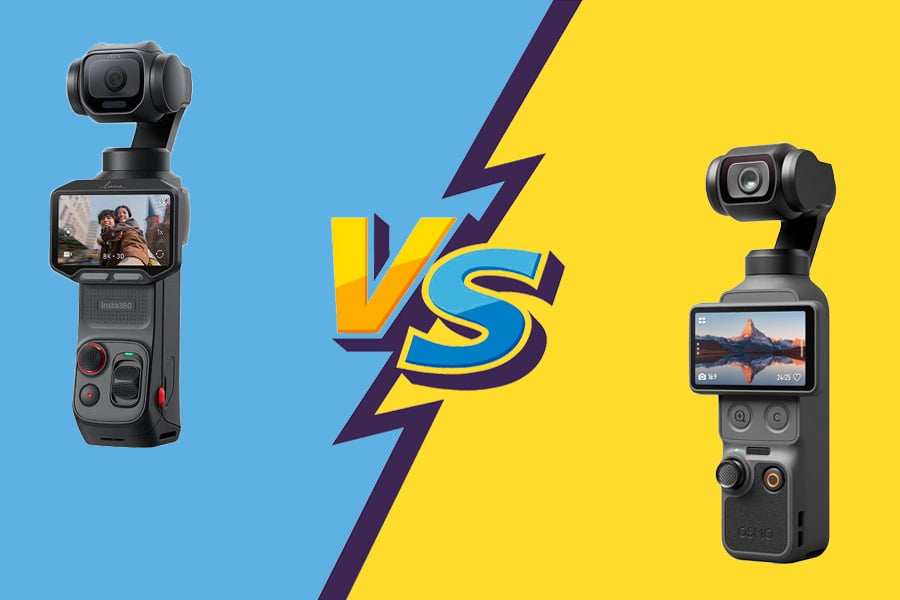
Long dominated by DJI and its Osmo Pocket line, the market for stabilized pocket cameras now has a major competitor: Insta360. With its new Luna line, the brand is directly challenging the Chinese manufacturer in a space it has largely dominated on its own until now. Up against the DJI Osmo Pocket 4, the Insta360 Luna Pro aims to establish itself as a credible alternative, with its own take on on-the-go video. But is this new competition enough to shake things up? What are the differences between the two cameras? And most importantly, which one should you choose? In this comparison Insta360 Luna Pro vs. DJI Osmo Pocket 4, we’ll compare the two models to help you make the best choice.
Insta360 Luna Pro vs. DJI Osmo Pocket 4: Key Takeaways
Don’t have time (or just can’t be bothered 😅) to read it all? Here are the key differences to keep in mind between the Insta360 Luna Pro and the DJI Osmo Pocket 4 👇
- 📐 The DJI Osmo Pocket 4 is slightly more compact and lightweight, weighing 190.5 g compared to the Luna Pro’s 215 to 218 g. It also has more internal storage, with 107 GB compared to 47 GB. Insta360 stands out, however, with its detachable touchscreen, which allows you to control the camera and monitor your shot remotely.
- 🔋 Both cameras are rated for the same maximum battery life of 240 minutes, under particularly favorable test conditions. The DJI charges slightly faster, reaching 80% battery capacity in 18 minutes, compared to 23 minutes for its competitor.
- 🤖 Both models offer a wide range of creative features and powerful automatic subject tracking. The Luna Pro stands out with its customizable framing grid and built-in microphone in the detachable screen, while the Pocket 4 focuses on gesture controls, spatial audio, and recording on up to four channels with compatible DJI microphones.
- 🎥 The Insta360 Luna Pro has the edge when it comes to video resolutions, with recording up to 8K at 30 fps, 4K at 120 fps, and 4K vertical video. The DJI Osmo Pocket 4 is limited to 4K60 for standard recording, but offers exceptionally high-speed slow-motion footage, up to 4K at 240 fps thanks to its dedicated mode.
- 📸 In terms of image quality, the two cameras deliver very similar results, both in daylight and in low light. The Luna Pro generally produces slightly more vivid colors and images that are sometimes brighter, while the Pocket 4 often favors a softer, more natural look. However, neither consistently comes out on top, particularly in high-contrast scenes.
- 💸 The DJI Osmo Pocket 4 is slightly more affordable, with a standard bundle priced at €499 compared to €529 for the Insta360 Luna Pro. Both manufacturers also offer several add-on bundles tailored for vlogging, travel, or other uses, with different accessories depending on the configuration.
📌 The Insta360 Luna Pro will particularly appeal to creators who want to take advantage of higher video resolutions and remote control thanks to its detachable screen. The DJI Osmo Pocket 4 is an excellent alternative for those who prefer 4K240 slow-motion, a slightly more compact design, and a more affordable price, without any major difference in image quality.
Insta360 Luna Pro vs. DJI Osmo Pocket 4: Design
| Insta360 Luna Pro | DJI Osmo Pocket 4 | |
| Dimensions (L x W x H) | 155.7 × 52.8 × 38.5 mm | 144.2 × 44.4 × 33.5 mm |
| Weight | 215 g (black) to 218 g (white) | 190,5 g |
| Touchscreen | Detachable 2-inch OLED | 2 inches |
| Storage | 47 GB built-in memory MicroSD card (up to 2 TB) | 107 GB built-in memory MicroSD card (up to 1 TB) |
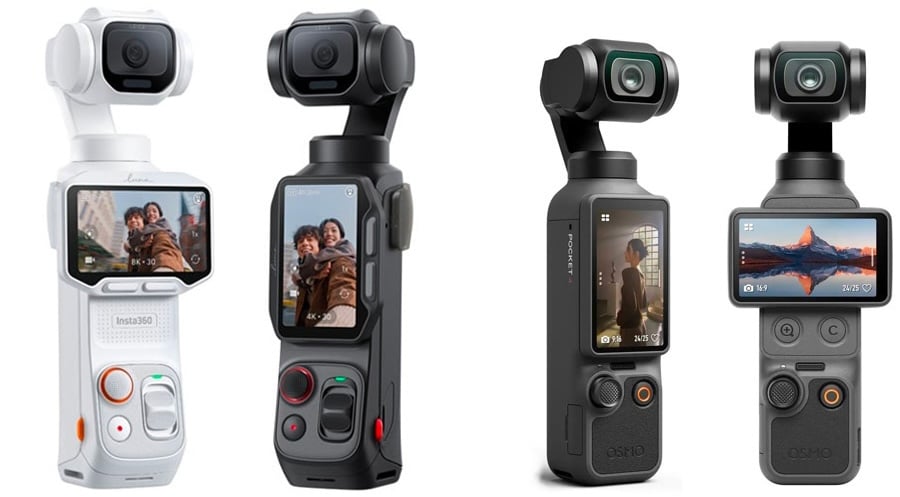
With their compact vertical form factor and three-axis stabilized gimbal, the two cameras share a fairly similar design. However, the DJI Osmo Pocket 4 is slightly more compact and lightweight, measuring 144.2 × 44.4 × 33.5 mm and weighing 190.5 g, compared to 155.7 × 52.8 × 38.5 mm and 215 to 218 g depending on the color for the Insta360 Luna Pro. The difference is modest, but it can make a difference for those who prefer equipment that’s as discreet as possible.
It’s on the side of the screen that Insta360 really shines. While both cameras feature a 2-inch OLED touchscreen, The Luna Pro’s cover can be completely removed. It then turns into a wireless remote control with video feedback up to about 20 meters, allowing you to control the camera and monitor its framing from a distance. Better yet, It has a built-in microphone to record your voice without having to stay near the device. A real plus for creators who film themselves! The Pocket 4, on its side, retains a rotating screen, which is especially handy for quickly switching between landscape and portrait modes and turning the camera on or off with a single gesture.
The physical controls are also well-designed on both models. The Luna Pro features a clickable joystick, a dedicated zoom slider, and two customizable buttons. The Pocket 4 also offers a dedicated zoom control, as well as a customizable button and a joystick that adjusts the gimbal’s movement speed based on the pressure applied. These are two slightly different approaches, but both keep the main functions within easy reach, without having to constantly navigate through menus.
Finally, the Pocket 4 has significantly more internal storage— 107 GB compared to the Luna Pro’s 47 GB. This is a significant advantage for recording more videos without a memory card. Insta360 stands out, however, for its expandability, as its camera supports microSD cards up to 2 TB, compared to 1 TB for DJI. In both cases, storage capacity remains ample.
🏆 Insta360 Luna Pro: Its detachable screen offers more options for framing and remote control.
🏆 DJI Osmo Pocket 4: More compact and lighter, with significantly more internal storage.
Check out our accessories for
Insta360 Luna Pro
Insta360 Luna Pro vs. DJI Osmo Pocket 4: Battery Life and Charging
| Insta360 Luna Pro | DJI Osmo Pocket 4 | |
| Battery | Main battery: 1550 mAh Detachable touchscreen: 210 mAh | 1545 mAh |
| Battery life | 240 minutes | 240 minutes |
| Charging time | 80% in 23 minutes, 100% in 35 minutes | 80% in 18 minutes, 100% in 32 minutes |
On paper, it’s hard to tell the two cameras apart. The Insta360 Luna Pro features a 1, 550 mAh battery, compared to 1,545 mAh for the DJI Osmo Pocket 4—a negligible difference. Both manufacturers also claim exactly the same maximum battery life of 240 minutes, or four hours of recording. That’s a pretty impressive figure for such compact devices, but it should be taken with a grain of salt: it’s based on particularly favorable test conditions—1080p at 24 fps, with the screen and wireless connections turned off.
In practice, battery life will inevitably be more limited with demanding video settings. An independent test of the Luna Pro, for example, achieved approximately 1 hour and 30 minutes of 8K recording at 30 fps with the screen on, which is still an impressive performance. However, actual battery life will depend on the settings used, particularly the resolution, frame rate, and whether wireless connections are in use. A unique feature of the Insta360: the detachable screen has its own 210 mAh battery, whose battery life depends largely on whether it’s being used as a remote video monitor.
On the side of charging, DJI remains slightly ahead. The Osmo Pocket 4 reaches 80% battery capacity in just 18 minutes and fully charges in 32 minutes, compared to 23 and 35 minutes, respectively, for the Luna Pro. That’s a five-minute difference in reaching 80%—a gap that’s fairly negligible in everyday use. In both cases, a short break is enough to restore a good portion of the battery life.
🤝 Tie: Both models offer the same maximum battery life and very fast charging, with DJI having a slight edge on the latter point.
Insta360 Luna Pro vs. DJI Osmo Pocket 4: Features
| Insta360 Luna Pro | DJI Osmo Pocket 4 | |
| Photo modes | Photo (Standard/UltraPhoto), Live Frame, Panorama | Panorama, Self-timer |
| Video modes | Video, PureVideo, Slow Motion, Time-Lapse, TimeShift, Barrel Roll | ActiveTrack 7.0 subject tracking, Slow motion, Timelapse, Motionlapse, Hyperlapse, Low light video, Slow shutter video |
| Audio modes | Wind Reduction, Voice Enhancement, Original Audio | Spatial audio, Zoom audio, 4-channel recording (with DJI Mic) |
| Number of microphones | 4 (3 on the stabilizer + 1 on the detachable screen) | 3 |
Photo and Video Modes
Both cameras offer a wide range of shooting modes, with a few features unique to each manufacturer. Both models include Panorama, Slow Motion, and Time-Lapse, but Insta360 and DJI each have a few extra tricks up their sleeves.
The Luna Pro features PureVideo mode, designed to improve footage in low-light environments, as well as TimeShift for creating time-lapse sequences in motion. More uniquely, the Barrel Roll mode automatically rotates the frame in a style inspired by FPV footage. On the photo side, Insta360 also offers UltraPhoto and Live Frame, two features not found on the Pocket 4.
DJI responds with Motionlapse and Hyperlapse modes, as well as a Slow Shutter Video mode that lets you create motion blur or light trails. The Pocket 4 also features a mode designed for low-light scenes and can stream live video via the DJI Mimo app. Both cameras thus offer a wide range of creative possibilities, with features that will appeal to a variety of users.
Subject Tracking
To automatically keep a subject in the frame, the Luna Pro uses Deep Track 5.0, while the Pocket 4 uses ActiveTrack 7.0. In both cases, the gimbal tracks the subject’s movements to keep it in the frame, even when zooming.
Insta360 stands out in particular for its 3 × 3 framing grid, which allows you to precisely choose the subject’s position rather than always keeping it in the center. This is a useful feature for varying your compositions without sacrificing automatic tracking.
DJI takes a side that focuses on ease of use, with a double-tap on the screen to start tracking a person, an animal, or a vehicle. The Pocket 4 also offers gesture control , which is particularly handy when filming yourself: a “V” sign takes a photo or starts recording, while a palm swipe turns subject tracking on or off.
Audio
Both manufacturers have also paid close attention to audio quality. The Pocket 4 features three built-in microphones, compared to four on the Luna Pro, one of which is built directly into its detachable screen. This fourth microphone is an interesting feature from Insta360, as it allows you to record your voice remotely without having to immediately add an external microphone.
The Luna Pro offers several audio processing features, including wind noise reduction and voice enhancement. It can also record in 32-bit and connect directly to the Insta360 Mic Air and Mic Pro wireless microphones.
DJI, on its side, offers other audio features, includingSpatial Audio and Audio Zoom, which emphasizes the subject’s sounds as you zoom in. The Pocket 4 can also connect directly to DJI Mic transmitters and record up to four audio channels simultaneously, allowing you to keep multiple separate tracks for editing.
🤝 A tie: two exceptionally feature-rich cameras, each with different creative and audio features that could make all the difference depending on individual needs.
OUR BEST SELLERS - Insta360 Luna Pro


Accessories
Insta360 Luna Pro vs. DJI Osmo Pocket 4: Image
| Insta360 Luna Pro | DJI Osmo Pocket 4 | |
| Lens | 1-inch sensor, 20 mm f/1.8 | 1-inch sensor, 20 mm f/2.0 |
| Minimum Focus Distance | 9 cm | 20 cm |
| Photo resolution | Up to 37 MP | Up to 38 MP |
| Video resolution | 8K up to 30 fps 4K up to 120 fps 3K up to 60 fps 2.7K up to 120 fps 1080p up to 240 fps | 4K up to 60 fps 3K vertical up to 60 fps 1080p up to 60 fps |
| Idle speed | 4K up to 120 fps 2.7K up to 120 fps 1080p up to 240 fps | 4K up to 240 fps 1080p up to 240 fps |
| Digital zoom | Up to 4× | Up to 4× for video, 2× for photos |
| ISO range | 100 to 6400 | 50 to 25,600 |
| Photo format | jpg, jpg+RAW | JPEG, DNG, JPEG+DNG |
| Video format | MP4 | MP4 (HEVC) |
| Color profiles | Standard, Dolby Vision, 10-bit I-Log | Normal, D-Log 10-bit |
| Max. bit rate | 120 Mb/s | 180 Mb/s |
Sensors and resolutions
In terms of hardware, the two cameras are very similar. Both the Insta360 Luna Pro and the DJI Osmo Pocket 4 feature a 1-inch sensor paired with a 20mm-equivalent lens. However, the Insta360 has a slightly wider aperture— f/1.8 versus f/2.0 on the DJI—as well as a minimum focusing distance of just 9 cm, compared to 20 cm for its competitor. That’s a slight advantage for fans of close-up shots.
It’s especially on the side of video resolution that the Luna Pro stands out. It can record up to 8K at 30 frames per second, whereas the Pocket 4 is limited to 4K60 in standard recording mode. Insta360 also offers 4K at up to 120 fps, compared to 60 fps for DJI in the same mode. The Pocket 4 still has a strong advantage when it comes to slow-motion footage, however, as it can reach 240 fps in 4K thanks to its dedicated mode, compared to 120 fps for the Luna Pro. Both cameras can also reach up to 240 fps in 1080p.
For social media content creators, the Luna Pro also offers an interesting feature with its 4K30 vertical recording, derived from an oversampled 6K image. The Pocket 4, on the other hand, offers a vertical mode up to 3K60. Insta360 prioritizes resolution, while DJI allows for filming at a higher frame rate in this format. On the photo side, the two models are very similar, with a maximum resolution of 37 MP for the Luna Pro and up to 38 MP for the Pocket 4.
The zoom capabilities are also comparable on paper. Both cameras can achieve 4× digital zoom in video mode, with a 2× zoom designed to preserve more detail. Beyond that, quality naturally depends on cropping and software processing. Finally, users who want to edit their footage in post-production have access to 10-bit profiles on both models: I-Log on the Insta360 and D-Log on the DJI. The Luna Pro also adds support for Dolby Vision.
Image quality
In broad daylight, both cameras deliver particularly impressive image quality, with excellent detail and generally comparable sharpness. However, the various comparison clips available show some differences in how they process images. The Luna Pro tends to produce slightly more vivid colors and, at times, a higher-contrast image, while the Pocket 4 generally favors a slightly softer and more natural look. Nothing drastic, but a difference in rendering that may matter depending on individual preferences.
When it comes to faces, the differences sometimes become more noticeable. In certain brightly lit scenes, the Luna Pro produces a slightly brighter image, while the Pocket 4 maintains a more subdued rendering. This tendency is particularly noticeable when a subject is standing in the shade against a very bright background: Insta360 seems to prioritize facial visibility, whereas DJI opts for a more conservative exposure. This isn’t necessarily an advantage for one over the other, but rather two different ways of handling a tricky situation.
High-contrast scenes confirm this impression. In sequences featuring a very bright sky, sunlit vegetation, and deeply shaded areas all at once, both cameras manage to retain a good level of detail. The Luna Pro sometimes produces a slightly brighter image, while the Pocket 4 seems to preserve certain nuances in the shadows slightly better. However, neither consistently has the edge in dynamic range; the differences observed remain fairly subtle and may also depend on exposure settings.
In low light, the comparison becomes particularly interesting. Both manufacturers offer a dedicated mode— PureVideo from Insta360 and Low-Light Video from DJI—designed to improve visibility in dark scenes while minimizing digital noise. Comparisons show that both systems are effective, though results vary depending on the situation. The Luna Pro sometimes manages to produce a slightly brighter image, particularly on faces, while the Pocket 4 maintains higher contrast and slightly more natural colors in certain scenes.
In nighttime footage with artificial lighting, the differences are generally subtle. Both cameras successfully capture the details of the scene, even if their handling of light sources and dark areas isn’t always identical. The Luna Pro sometimes seems to brighten certain parts of the image more, while the Pocket 4 produces a slightly darker result. Again, it’s difficult to declare a clear winner, as the results depend so much on the scene and shooting conditions.
Finally, both cameras offer real possibilities for videographers who want to edit their footage in post-production. The Luna Pro features its 10-bit I-Log profile, while the Pocket 4 features 10-bit D-Log, with a dynamic range claimed by DJI to reach up to 14 stops. These profiles allow for greater flexibility during color grading, particularly when adjusting colors, highlights, and shadows. Both models therefore offer strong selling points for users who prefer to have control over their final output rather than relying solely on automatic settings.
🏆 Insta360 Luna Pro: 8K30, 4K120, and 4K vertical recording give it even more video capabilities.
🏆 DJI Osmo Pocket 4: Its 4K240 slow-motion mode lets you capture slow-motion footage at twice the speed in 4K.
Insta360 Luna Pro vs. DJI Osmo Pocket 4: Bundles and Prices
ℹ️ Note: some links in this section are Amazon affiliate links. As Amazon Associates, we earn from qualifying purchases, at no extra cost to you.
| Insta360 Luna Pro | DJI Osmo Pocket 4 | |
| Standard package | 529 € | 499 € |
| Other Themed Packages | From €579 to €639 | From €523 to €627 |
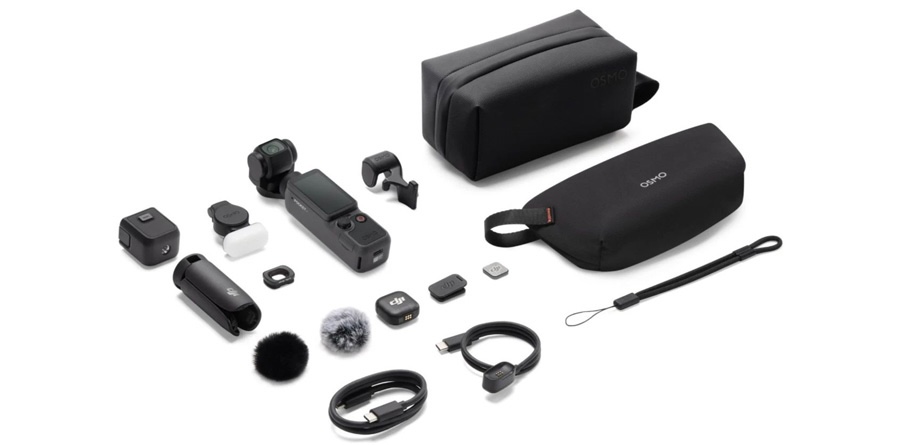
The DJI Osmo Pocket 4 starts at €499, compared to €529 for the Insta360 Luna Pro—a difference of €30 in DJI’s favor. Both standard bundles include everything you need to start filming, including a gimbal case, a handle with a 1/4” thread, a wrist strap, and a carrying pouch. The included equipment is therefore quite similar, although the protective accessories differ slightly in design.
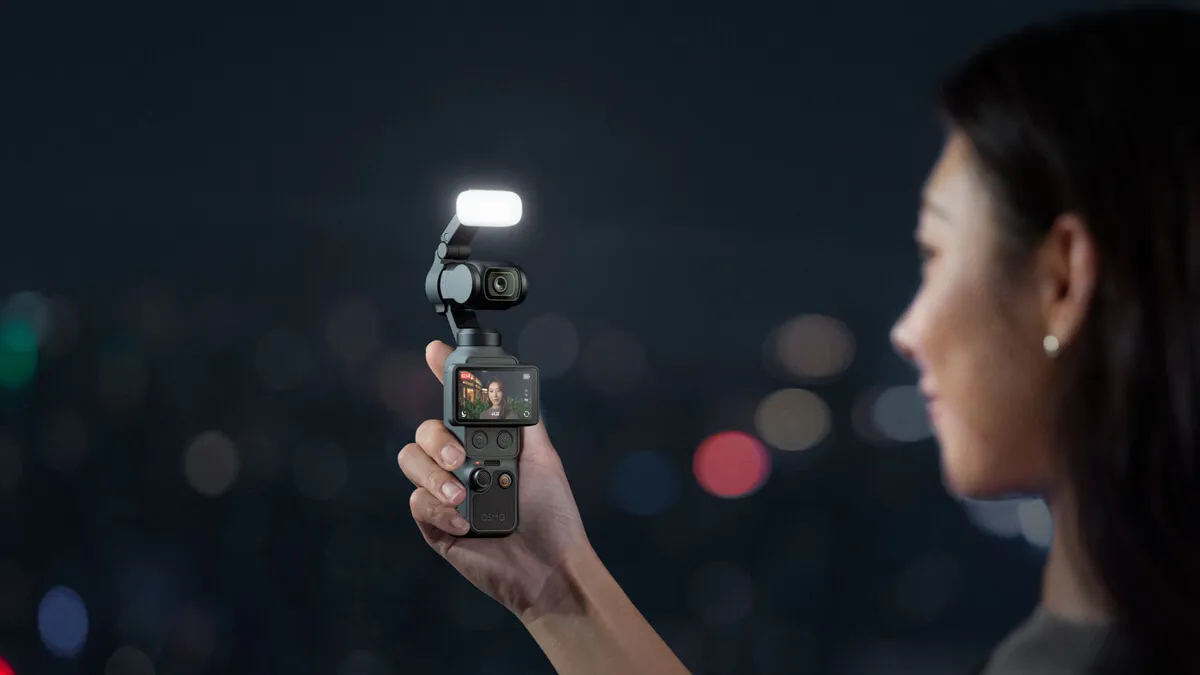
Both manufacturers also offer several packages designed for different uses. At Insta360, the Additional Lighting Package for €579 includes a mini light and a Black Mist filter, while other configurations are geared toward battery life, vlogging, or POV shots, with prices reaching up to €639. DJI offers, in particular, a Creator Bundle for €619, including a DJI Mic 3 transmitter, a wide-angle lens, a mini tripod, and a magnetic fill light. Other bundles are also available for travel, streaming, or content creation, with prices up to €627. In either case, Many accessories from previous generations remain compatible, which can result in significant savings for users who already have the equipment.
🏆 DJI Osmo Pocket 4: a starting price that’s €30 lower, with comparable standard features and a wide selection of add-on bundles.
Discover our accessories for
DJI Osmo Pocket 4
Conclusion: Insta360 Luna Pro vs. DJI Osmo Pocket 4—Which One Should You Choose?
With the Luna Pro, Insta360 proves that it is now possible to seriously compete with DJI in the market for stabilized pocket cameras. Both models offer excellent image quality, comparable battery life, and a feature set rich enough to meet the needs of most content creators. Yet, despite their many similarities, their approaches differ in several key ways.
TheInsta360 Luna Pro focuses above all on versatility and creative possibilities. Its detachable screen is a truly unique feature, particularly useful for filming yourself or controlling your shots remotely. It also stands out in terms of recording resolutions, notably offering 8K30, 4K120, and 4K vertical video. On the side, the DJI Osmo Pocket 4 still has some strong selling points, including 4K240 slow motion, a slightly more compact and lightweight design, and a lower starting price. It also has more generous internal storage.
Ultimately, neither camera truly stands out across the board. The Luna Pro will particularly appeal to those who want to expand their shooting options and take advantage of its exceptionally convenient remote control. The Pocket 4 is an equally compelling alternative for those who prioritize ultra-high-frame-rate slow-motion, a compact design, and a slightly more affordable price. The choice will therefore depend primarily on your filming habits and the features that will actually be useful to you.
Choose the Insta360 Luna Pro if…
- You want to shoot in 8K30 or 4K120, which gives you more options for your videos and cropping.
- You regularly film yourself and want to control the framing remotely, without having to stay behind the camera.
- You regularly create content for social media and want to take advantage of 4K vertical recording.
Choose the DJI Osmo Pocket 4 if…
- You want to capture exceptionally smooth slow-motion footage in 4K at up to 240 fps.
- You prefer equipment that’s as compact and lightweight as possible, with a camera weighing just 190.5 g.
- You’re looking for a slightly more affordable camera, with a starting price that’s €30 lower.
💡 To learn more, check out our in-depth reviews of both cameras in this Insta360 Luna Pro vs. DJI Osmo Pocket 4 comparison:
➡️ Everything you need to know about the Insta360 Luna Pro
➡️ Everything you need to know about the DJI Osmo Pocket 4
OUR BEST SELLERS - DJI Osmo Pocket 4


Action camera


 Blog