
 Français
 Deutsch
 Español
 Italiano

 Parts & Accessories by Drone
 Drones
 Action camera
 Microphones
 Camera Stabilizers
 VR Headsets
GoPro MISSION 1 PRO vs. DJI Osmo Action 6: Which One Should You Choose?
Oct
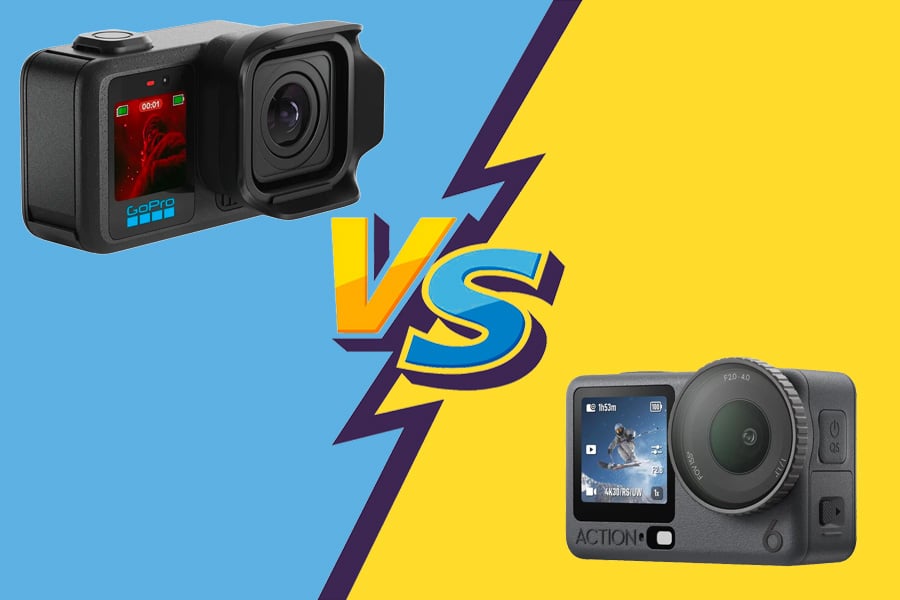
With its new MISSION lineup, GoPro is opening a new chapter in its history and is determined to reclaim a leading position in the action camera market. But the competition has changed significantly! Standing in the way of the MISSION 1 Pro is, in particular, the DJI Osmo Action 6, considered by many to be one of the best action cameras available today. So, can this new generation of GoPros make a difference against such a formidable competitor? And most importantly, which one should you choose? Design, battery life, features, image quality, price… Check out our comprehensive comparison. GoPro MISSION 1 Pro vs. DJI Osmo Action 6 to find out which one to choose!
GoPro MISSION 1 PRO vs. DJI Osmo Action 6: Key Takeaways
Don’t have time (or just can’t be bothered 😅) to read it all? Here are the key differences to keep in mind between the GoPro MISSION 1 PRO and the DJI Osmo Action 6 👇
- 📐 The DJI Osmo Action 6 is significantly more compact and lightweight, weighing just 149 g compared to the GoPro’s 207 g. It also features two touchscreens and 64 GB of internal storage. The MISSION 1 PRO, however, stands out for its three built-in mounting systems, which offer greater versatility.
- 🔋 In practice, the two cameras have fairly similar battery life, despite GoPro’s advertised figures being more impressive. The DJI charges slightly faster, reaching 80% battery capacity in 22 minutes, compared to 27 minutes for its competitor.
- 🤖 The GoPro MISSION 1 PRO offers even more creative possibilities, particularly thanks to its shooting modes and highly advanced slow-motion capabilities. It also stands out for its 32-bit floating-point audio recording, while DJI focuses on practical features such as gesture controls and direct connection to two compatible wireless microphones.
- 🎥 The GoPro has the edge in video performance, with its 1-inch sensor, recording up to 8K at 60 fps, and 4K slow-motion at 240 fps. The DJI Osmo Action 6, equipped with a 1/1.1-inch sensor and a variable aperture, also offers 8K—but at a maximum of 30 fps—as well as 4K at 120 fps.
- 🌙 When it comes to image quality, the two cameras take different approaches. The GoPro generally favors a more natural look, while the DJI produces brighter, higher-contrast images. The DJI performs particularly well in low light with its SuperNight mode, as well as underwater, where its images often appear clearer.
- 💸 The DJI Osmo Action 6 is significantly more affordable, with a standard bundle priced at €436 compared to €699.99 for the GoPro MISSION 1 PRO. That’s a difference of nearly €264, which is a compelling argument for budget-conscious users.
📌 The GoPro MISSION 1 PRO will appeal above all to demanding users looking for high resolution, advanced slow-motion capabilities, and a wide range of creative possibilities. The DJI Osmo Action 6 stands out as the most well-rounded choice for most users, thanks to its compact size, impressive image quality, and significantly lower price.
GoPro MISSION 1 PRO vs. DJI Osmo Action 6: Design
| GoPro MISSION 1 PRO | DJI Osmo Action 6 | |
| Dimensions (W x H x D) | 80.1 x 52.1 x 44.3 mm | 72.8 × 47.2 × 33.1 mm |
| Weight | 207 g | 149 g |
| Screens | Back: 2.59-inch OLED touchscreen Front: 1.4-inch LCD | Back: 2.5-inch OLED touchscreen Front: 1.46-inch LCD |
| Storage | microSD card up to 1 TB | 64 GB internal storage (50 GB available) microSD card up to 1 TB |
| Operating temperature | -20 °C to 45 °C | -20 to 45° C |
| Water resistance | 20 meters | 20 meters |
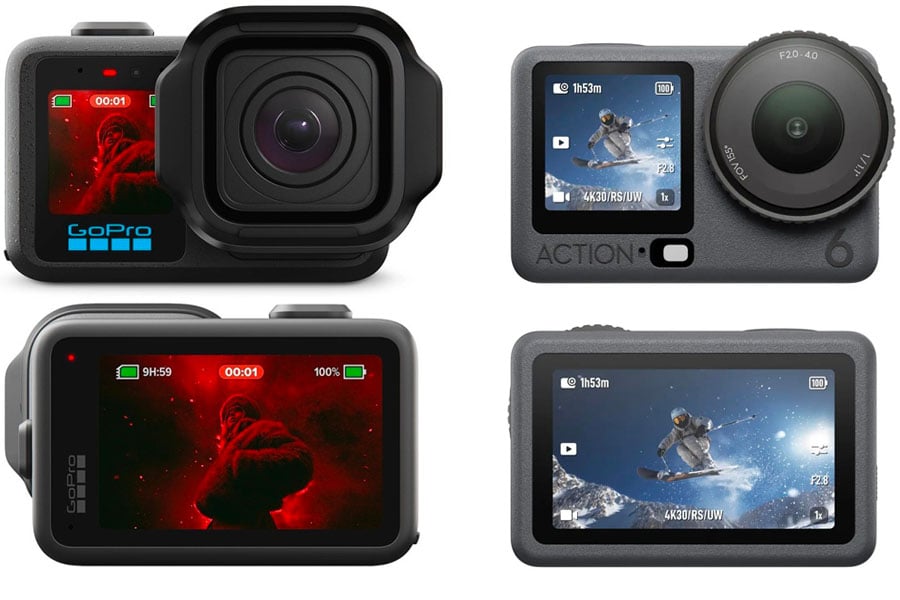
At first glance, the two cameras seem to have quite different approaches. The GoPro MISSION 1 PRO is significantly larger, measuring 80.1 × 52.1 × 44.3 mm and weighing 207 g, compared to 72.8 × 47.2 × 33.1 mm and just 149 g for the DJI Osmo Action 6. The latter is therefore more compact and above all 58 g lighter, a noticeable difference when mounting the camera on a helmet or carrying it on long outings. The GoPro also stands out because its lens protrudes further from the body, making it bulkier.
On the display side, the two models are very similar on paper. The GoPro features a 2.59-inch OLED touchscreen on the back and a 1.4-inch LCD screen on the front. The DJI, on the other hand, features two OLED screens: a 2.5-inch one on the back and a 1.46-inch one on the front. Its main advantage is the touchscreen on the front panel, which provides direct access to settings when the rear screen is inaccessible—particularly when the camera is mounted in certain configurations. On the GoPro, the front screen is primarily used for framing shots and viewing shooting information.
When it comes to mounting, however, GoPro clearly has the edge. The MISSION 1 PRO features three built-in mounting systems: the traditional GoPro mounting brackets, a quick-release magnetic mount, and a 1/4″ tripod thread. This versatility is particularly handy for quickly changing setups without adding an adapter. The DJI Osmo Action 6 relies primarily on its magnetic quick-release system: to use a standard GoPro mount or a screw-on tripod, you’ll need an additional accessory.
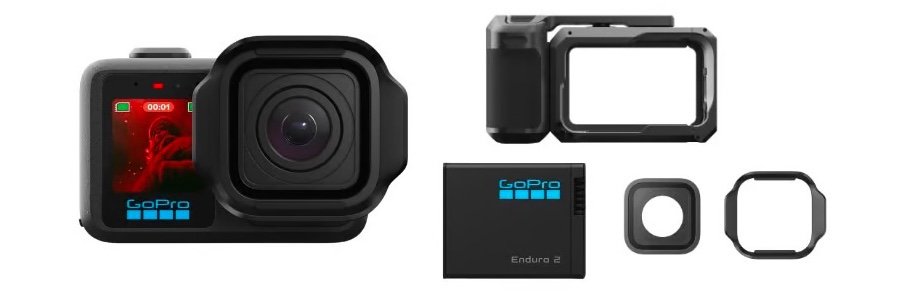
Both cameras also feature a screw-on, replaceable lens cover, which is a plus for their durability. GoPro also includes a removable lens hood in the standard package, which is useful for reducing unwanted glare and providing additional protection around the lens. On the durability side, there are no major differences: both models are waterproof up to 20 meters without a housing and can operate between -20 °C and 45 °C.
Finally, the DJI Osmo Action 6 has one last significant advantage: its 64 GB of internal storage, of which about 50 GB is actually available. That’s enough to record footage even without a memory card—unlike the GoPro MISSION 1 PRO, which requires a microSD card. However, both cameras support cards with a maximum capacity of 1 TB.
🏆 DJI Osmo Action 6: More compact and lightweight, with two touchscreens and internal storage.
Check out our accessories for
GoPro MISSION 1 and MISSION 1 PRO
GoPro MISSION 1 PRO vs. DJI Osmo Action 6: Battery Life and Charging
| GoPro MISSION 1 PRO | DJI Osmo Action 6 | |
| Battery | Enduro 2 2150 mAh | 1,950 mAh |
| Battery Life | Up to 5 hours in 1080p at 30 fps (Endurance Mode) More than 3 hours in 4K at 30 fps Up to 1 hour and 30 minutes in 8K at 30 fps | Up to 4 hours in 1080p at 24 fps |
| Charging time | 80% in 27 minutes, 100% in 60 minutes | 80% in 22 minutes, 100% in 52 minutes |
The GoPro MISSION 1 PRO features a new 2,150 mAh Enduro 2 battery, compared to the DJI Osmo Action 6’s 1,950 mAh battery. However, this difference in capacity does not necessarily translate to an equivalent difference in battery life, since power consumption also depends on each camera’s components and settings.
On paper, GoPro boasts particularly impressive specs, with up to 5 hours of recording in 1080p at 30 fps thanks to Endurance mode, over 3 hours in 4K at 30 fps, and about 1 hour and 30 minutes in 8K at 30 fps. On the other side, DJI claims up to 4 hours of recording in 1080p at 24 fps. However, these figures are difficult to compare directly, as the testing conditions and recording modes are not identical.
In practice, the two cameras seem much closer in performance than these figures suggest. In a side-by-side test conducted by a videographer, both cameras generally stopped at roughly the same time, with a possible slight edge for the GoPro. This is an interesting observation, though it should be viewed in the context of different resolutions and usage conditions.
On the side of charging, the DJI Osmo Action 6 has a slight edge: it reaches 80% battery capacity in just 22 minutes, compared to 27 minutes for the GoPro using a compatible fast charger. A full charge also takes slightly less time with the DJI, at about 52 minutes compared to 60 minutes for its competitor.
Finally, both brands have the advantage of offering batteries that are compatible with multiple generations of cameras. In particular, GoPro’s new Enduro 2 retains the same format used by the HERO13 Black, while the Osmo Action 6’s battery can be used with several DJI models, including the Osmo Action 3, 4, and 5 Pro.
🤝 Tie: Battery life is comparable in practice, with a slight advantage possibly for GoPro, but faster charging with DJI.
GoPro MISSION 1 PRO vs. DJI Osmo Action 6: Features
| GoPro MISSION 1 PRO | DJI Osmo Action 6 | |
| Photo Modes | Single Shot (Night Mode), Interval, Burst | Single Shot, Self-Timer, Burst |
| Video Modes | Video, Low Light, Slow Motion, Slow Motion Burst, HLG HDR, Subject Tracking, Loop, Endurance | Slow Motion, Subject Tracking, SuperNight, Pre-recording, Loop Recording |
| Time-Lapse Modes | Time-lapse / Night Time-lapse (moving or on a tripod), Star Trails, Light Painting, Vehicle Light Trails | Time-Lapse, Hyperlapse |
Both cameras offer a full range of photo and video modes, including slow motion, subject tracking, loop recording, and various time-lapse modes. The GoPro MISSION 1 PRO stands out for its many creative possibilities, including star trails, light painting, and vehicle light trails. It also features a Dive mode designed for underwater shooting, while the DJI Osmo Action 6 uses its color temperature sensor to automatically adjust color rendering underwater.
Recording Formats and Subject Tracking
The GoPro MISSION 1 PRO introduces Open Gate recording, which allows you to capture 4:3-aspect-ratio footage at up to 8K at 30 fps or 4K at 120 fps. This approach offers greater freedom during editing, since the same footage can later be cropped to a horizontal or vertical aspect ratio without having to choose the final framing while filming.
The DJI Osmo Action 6 offers a similar feature with its 4K Custom mode, which uses its square sensor to record a 3840 × 3840-pixel image at up to 60 fps. It also allows you to choose your framing after recording, although GoPro still offers superior capabilities in terms of resolution and frame rate.
On the side of subject tracking, both models can automatically crop the image to keep a person in the center of the frame. GoPro is introducing this feature with the MISSION 1 PRO, using face and body detection, while DJI is reusing a system already found on the Action 5 Pro, which crops the 4K footage down to 2.7K. These are two practical solutions for creators filming on their own, although their effectiveness depends on the situation.
Slow Motion and Controls
The GoPro MISSION 1 PRO is particularly impressive for its slow-motion capabilities, recording up to 4K at 240 fps and 1080p at 480 fps. It can even reach 960 fps in 1080p for clips limited to 10 seconds, allowing you to create truly spectacular slow-motion footage.
On the other side, the DJI Osmo Action 6 records video in up to 4K at 120 fps or in 1080p at 240 fps. It also offers a super slow-motion mode equivalent to 960 fps, but this mode relies on image interpolation from a 240 fps recording, unlike GoPro’s native capture.
Both cameras also offer voice commands to control certain functions without touching them. The GoPro MISSION 1 PRO stands out for its support of 11 languages, compared to just English and Chinese for the DJI Osmo Action 6. The latter, however, has an additional advantage with its gesture controls, which allow users to start or stop recording with a simple hand gesture.
Audio and Microphones
The GoPro MISSION 1 PRO features four built-in microphones and supports 32-bit floating-point audio recording, compared to three microphones and 16-bit AAC recording for the DJI. This format offers greater flexibility in post-production, particularly when recovering significant variations in sound levels.
Both cameras can also accommodate wireless microphones without requiring an external receiver. The GoPro is compatible with its new Bluetooth microphone system, while the DJI Osmo Action 6 can directly connect up to two compatible DJI microphones using OsmoAudio.
GoPro also retains the option to use microphones from different brands via a compatible external receiver, offering more freedom to creators who already have their own equipment.
🏆 GoPro MISSION 1 PRO: Significantly improved slow-motion capabilities, 8K Open Gate, and 32-bit floating-point audio recording.
OUR BEST SELLERS - GoPro MISSION 1 and MISSION 1 PRO



GoPro MISSION 1 PRO vs. DJI Osmo Action 6: Image
| GoPro MISSION 1 PRO | DJI Osmo Action 6 | |
| Sensor | 1 inch | 1/1.1-inch |
| Lens | 15–27 mm, fixed f/2.5 aperture | Variable aperture f/2 to f/4 |
| Maximum photo resolution | 50 MP | 38 MP |
| Video resolution | 8K up to 60 fps 4K up to 240 fps 1440p up to 480 fps 1080p up to 480 fps | 8K up to 30 fps 4K up to 120 fps 2.7K up to 120 fps 1080p up to 240 fps |
| Photo format | JPG (standard), GPR (RAW) | JPEG, RAW |
| Video format | MP4 | MP4 |
| Color profiles | Vivid, Natural, Cinematic, Neutral, GP-Log2 | Normal (10-bit), D-Log M (10-bit) |
| Maximum video bitrate | 240 Mb/s | 120 Mb/s |
| ISO Range | Photo: 100 to 3200 Video: 25 to 6400 | Photo: 100 to 25600 Video: 100 to 51200 |
Sensors and resolutions
The GoPro MISSION 1 PRO features a 1-inch, 50-megapixel sensor, which is slightly larger than the DJI Osmo Action 6’s 1/1.1-inch, 38-megapixel sensor. Both cameras thus feature sensors that are particularly large for action cameras, capable of capturing a significant amount of light. The main difference, however, lies in their lenses: GoPro opts for a fixed aperture of f/2.5, while DJI offers a Variable aperture from f/2 to f/4. In particular, this feature allows for better management of exposure in direct sunlight and enables the image to be further adapted to the shooting conditions.
When it comes to video performances, GoPro remains a step ahead, with recording up to 8K at 60 fps, versus 8K at 30 fps for the DJI Osmo Action 6. However, the latter limits 8K recording to the 16:9 aspect ratio, while the GoPro also offers a Open Gate recording in 8K in 4:3 aspect ratio. The MISSION 1 PRO also offers particularly impressive slow-motion capabilities, with 4K at 240 fps and the 1080p at 480 ips, compared to 120 and 240 ips, respectively, for its competitor. Not to mention its slow-motion burst mode, which can occasionally reach 960 ips in 1080p. These features offer greater flexibility for slowing down footage or cropping shots during editing.
The GoPro also supports a maximum video bitrate of 240 Mbit/s, which is double the 120 Mbit/s offered by DJI. This capability can help preserve more detail in complex scenes, although a higher bitrate does not always guarantee better image quality. The Osmo Action 6, on the other hand, has an advantage for close-up shots, with a minimum focus distance of about 20 cm, compared to 60 cm for the MISSION 1 PRO. This is a significant difference for on-camera vlogs or when filming small objects at close range.
Image quality
In good lighting conditions, both cameras produce excellent-quality images, though with noticeably different processing styles. The GoPro MISSION 1 PRO generally favors a softer, more natural look, with less saturated colors and more gradual transitions between light and dark areas. On the other side, the DJI Osmo Action 6 often produces a brighter, higher-contrast image that may appear sharper at first glance. Outdoor comparisons show, however, that the differences remain relatively minor in most situations, and that the choice will depend primarily on individual preferences.
In low light, the differences become much more pronounced. The GoPro generally produces a darker image, with subtle processing that better preserves the nighttime atmosphere. In contrast, DJI’s SuperNight mode aims to brighten scenes and make more details visible in dark areas. The result is often more immediately usable, especially when filming a person at dusk or in a dimly lit environment. However, this approach comes with more pronounced noise reduction, which can give the image a more digital look and soften certain details.
Underwater shots also reveal a notable difference. In the comparisons we reviewed, the DJI Osmo Action 6 generally produces a clearer, higher-contrast image, with deeper blues and more vivid underwater details. The GoPro MISSION 1 PRO produces a softer, sometimes slightly hazy image, which some may, however, find more natural. The GoPro features a dedicated Dive mode, while DJI automatically adjusts colors underwater using its color temperature sensor.
Finally, both cameras offer advanced features for users who want to edit their footage in post-production. The GoPro features its GP-Log2 profile, while the DJI offers D-Log M; both support 10-bit recording. These profiles allow for greater flexibility in adjusting colors and contrast during editing, though they require additional color grading work. Both models also offer ready-to-use profiles to achieve a look tailored to your preferences right away.
🏆 GoPro MISSION 1 PRO: Higher frame rates and more advanced slow-motion capabilities.
🏆 DJI Osmo Action 6: Brighter images in low light and more impressive underwater footage.
GoPro MISSION 1 PRO vs. DJI Osmo Action 6: Bundles and Prices
ℹ️ Note: some links in this section are Amazon affiliate links. As Amazon Associates, we earn from qualifying purchases, at no extra cost to you.
| GoPro MISSION 1 PRO | DJI Osmo Action 6 | |
| Standard package | €699.99 | €436 |
| Other Themed Packs | From €739.99 to €1,199.99 | From €426 to €694 |
The price difference between the two cameras is particularly significant. With a standard bundle priced at €699.99, the GoPro MISSION 1 PRO costs nearly €264 more than the DJI Osmo Action 6, which is priced at €436. This substantial price difference could heavily influence users’ decisions.
On the side of GoPro, the standard package includes the camera, an Enduro 2 battery, a removable sun visor, a curved adhesive mount, a mounting strap, and a USB-C cable. DJI offers a fairly similar basic kit, including a battery, a quick-release bidirectional mounting bracket, a curved adhesive mount, a mounting screw, a USB-C cable, and non-slip pads.
Both manufacturers also offer a wide range of themed kits tailored to various activities such as scuba diving, mountain biking, motorsports, and vlogging. GoPro’s prices range from €739.99 to €1,199.99, including a Grip Edition equipped with a handle that makes handheld shooting easier, as well as more comprehensive Creator Editions. DJI, on its side, offers bundles ranging from €426 to €694, including Adventure, Vlog, Freediving & Snorkeling, and Motorcycle & Mountain Biking editions, each featuring different accessories depending on the intended use.
🏆 DJI Osmo Action 6: A significantly lower price for comparable basic features.

Discover our accessories for
DJI Osmo Action 6
Conclusion: GoPro MISSION 1 PRO vs. DJI Osmo Action 6—Which One Should You Choose?
With the MISSION 1 PRO, GoPro is back in the spotlight with a particularly ambitious action camera. Its 1-inch sensor, new GP3 processor, 8K recording at 60 fps, and impressive slow-motion capabilities demonstrate a significant leap forward. It also stands out for its numerous creative possibilities, its mounting versatility, and its 32-bit floating-point audio recording. These are strong selling points for demanding users who want maximum flexibility both during shooting and editing.
In practice, however, the DJI Osmo Action 6 is every bit as good. More compact and lightweight, it features two touchscreens and internal storage. Its image quality is also very impressive, often producing brighter images in low light and particularly impressive results underwater. While the GoPro still has the edge in frame rates and slow-motion capabilities, the DJI already more than meets the needs of most users.
Finally, there’s the question of price, and that’s probably where the difference lies. With a price significantly lower than that of the GoPro MISSION 1 PRO, the DJI Osmo Action 6 seems like the most reasonable choice for most users. The GoPro, however, remains a compelling option for those who want to take advantage of its additional video capabilities and are willing to invest more to enjoy them.
Choose the GoPro MISSION 1 PRO if:
- Are you looking for high video resolutions and extremely slow-motion footage?
- You want to take advantage of 8K Open Gate recording to crop your videos during editing.
- You place particular importance on 32-bit floating-point audio recording.
Choose the DJI Osmo Action 6 if:
- You’re looking for a high-performance action camera at a much more affordable price.
- You prefer a compact, lightweight camera, especially for sports activities.
- You regularly shoot in low light or underwater and appreciate bright, high-contrast footage that’s ready to use right away.
💡 To learn more, check out our in-depth reviews of the two cameras in this GoPro MISSION 1 PRO vs. DJI Osmo Action 6 comparison:
➡️ Everything you need to know about the GoPro MISSION 1 PRO
➡️ Everything you need to know about the DJI Osmo Action 6
OUR BEST SELLERS - DJI Osmo Action 6


Action camera


Action camera

 Blog