
 Français
 Deutsch
 Español
 Italiano
 Parts & Accessories by Drone
 Drones
 Action camera
 Microphones
 Camera Stabilizers
 VR Headsets
Insta360 Luna Pro, Full Review: More Affordable, a Better Balance?
Sep
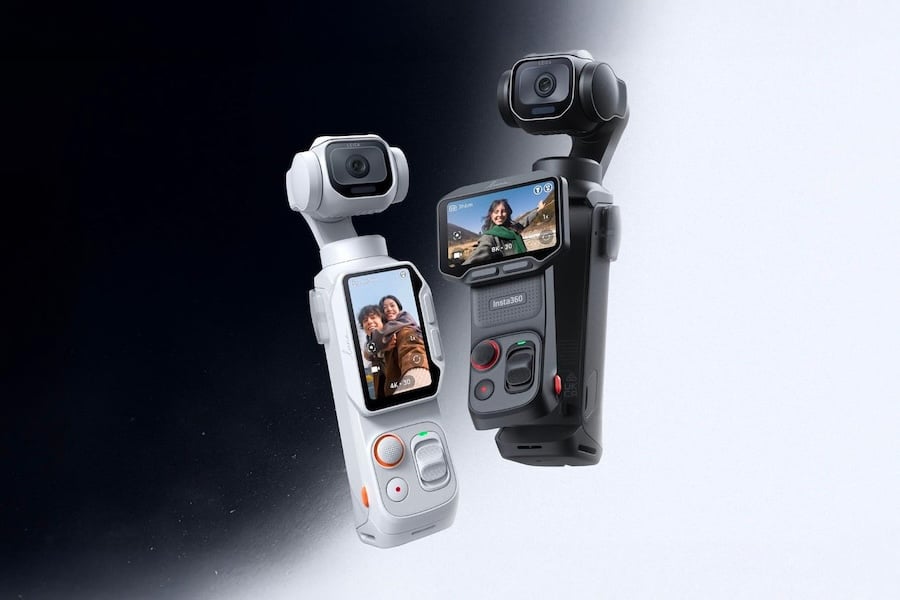
A few months after entering the stabilized camera market with the Luna Ultra, Insta360 is already expanding its new lineup with the Insta360 Luna Pro. While the Ultra featured a unique dual-lens design to compete with the DJI Osmo Pocket, this new version returns to a more traditional single-lens setup, all at a more affordable price. But how does the Luna Pro actually perform in real-world use? Has Insta360 made the right trade-offs to lower the price, and does this newcomer have enough strengths to stand out in a market that’s now particularly competitive? Design, battery life, features, and image quality: we’re analyzing the Insta360 Luna Pro from every angle to find out what it really has to offer.
Insta360 Luna Pro: Key Takeaways
Don’t have time (or just can’t be bothered 😅) to read it all? Here are the key takeaways about the Insta360 Luna Pro 👇
🧳 Three-axis stabilized pocket camera with a detachable 2-inch OLED touchscreen, 47 GB of built-in storage, and microSD support up to 2 TB
💡 Detachable screen that can be used as a remote control, remote video monitor, and wireless microphone, with a range of about 20 meters
🔋 Up to 240 minutes of battery life (as advertised ) and fast charging that restores 80% of the battery in just 23 minutes
🎬 Comprehensive video modes, including PureVideo, Slow Motion, Timelapse, TimeShift, and Barrel Roll—inspired by FPV footage
🎯 Deep Track 5.0 for automatic subject tracking
🎤 Four built-in microphones, including one in the detachable screen, with direct compatibility with the Insta360 Mic Air and Mic Pro
📷 1-inch 50 MP sensor with a 20 mm f/1.8 lens, but no second telephoto lens like on the Luna Ultra
🎞️ Photos up to 37 MP, video up to 8K30, 4K120, and 1080p240, including 4K30 in the 9:16 vertical aspect ratio
🌙 Excellent image quality both during the day and in low light, with PureVideo specifically designed for dark scenes
🎨 10-bit I-Log, Dolby Vision, and RAW for more post-production options
💸 Several bundles are available starting at €529, which is €200 less than the Standard version of the Luna Ultra
📌 A more affordable Luna Ultra that retains its excellent 1-inch sensor, detachable screen, and most of its features, primarily omitting the second telephoto lens to lower the price.
Insta360 Luna Pro: Design
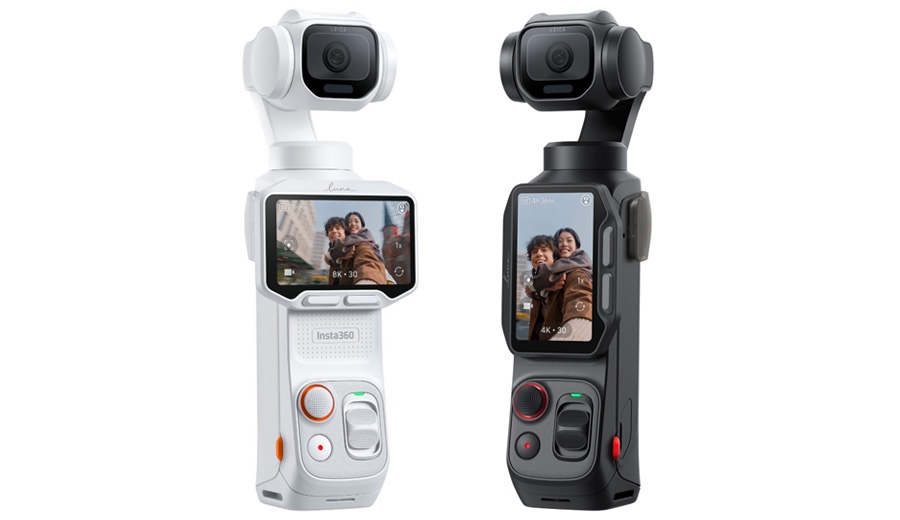
| Dimensions (L x W x H) | 52.8 × 155.7 × 38.5 mm |
| Weight | 215 g (black) to 218 g (white) |
| Touch screen | Detachable 2-inch OLED display |
| Storage | 47 GB built-in memory MicroSD card (up to 2 TB) |
Measuring 52.8 × 155.7 × 38.5 mm and weighing between 215 and 218 g depending on the color, the Insta360 Luna Pro has a form factor very similar to that of the Luna Ultra. However, the removal of the second lens allows the camera to be slightly shorter and about 20 grams lighter. As a result, it remains compact and easy to carry around in everyday life.
Fortunately, the most unique feature of the line is still there: the 2-inch OLED touchscreen can be completely detached from the camera. It then becomes a full-fledged wireless remote control that lets you operate the Luna Pro and view the live feed from up to about 20 meters away. Its built-in microphone can also be used to record your voice remotely—a particularly handy feature when filming yourself alone or when the camera needs to be placed several meters away from you.
The ergonomics also follow the design introduced by the Luna Ultra. Below the screen are a clickable joystick for controlling the gimbal, a zoom slider, the record button, and two customizable controls. This setup allows for quick access to key functions without having to rely solely on the touchscreen.
Finally, the Luna Pro features 47 GB of internal storage, allowing you to start filming without having to install a memory card right away. It also includes a microSD card slot that supports cards up to 2 TB, providing more than enough capacity for even the largest recordings.
Insta360 Luna Pro: Battery Life and Charging
| Battery | Main battery: 1550 mAh Detachable touchscreen: 210 mAh |
| Autonomy | 240 min |
| Recharge time | 80% in 23 minutes, 100% in 35 minutes |
The Insta360 Luna Pro features a 1,550 mAh battery and is rated for up to 240 minutes of battery life. This is a particularly high figure, but it was achieved under very favorable conditions—recording in 1080p at 24 fps, with the screen and Wi-Fi turned off. You should therefore expect significantly shorter battery life when using the most demanding video modes.
An independent test conducted in 8K at 30 fps With the screen on, this allowed for approximately 1 hour and 30 minutes of continuous recording. This battery life is still comfortable given the resolution used and should naturally increase with settings that consume less power. The detachable touchscreen also has its own 210 mAh battery, separate from that of the main stabilizer.
The Luna Pro may get slightly warm during extended recording sessions in 8K30 or 4K120, though this does not appear to be a real issue during normal use. During an independent 8K test, the camera ran continuously for more than 75 minutes before shutting down. The tester also reported no specific overheating issues during more typical use.
Finally, charging is particularly fast: Insta360 claims the battery reaches 80% capacity in just 23 minutes and fully charges in 35 minutes using a 45 W USB-C charger compatible with PD 3.0 PPS. That’s enough to restore a good portion of the battery life during a short break between filming sessions.
Check out our accessories for
Insta360 Luna Pro
Insta360 Luna Pro: Features
| Photo modes | Photo (Standard/UltraPhoto), Live Frame, Panorama |
| Video modes | Video, PureVideo, Slow Motion, Time-Lapse, TimeShift, Barrel Roll |
| Audio modes | Wind Reduction, Voice Enhancement, Original Audio |
| Number of microphones | 4 (3 on the stabilizer + 1 on the detachable screen) |
Photo and video modes
The Insta360 Luna Pro offers a particularly comprehensive set of shooting modes. For photos, these include UltraPhoto, Live Frame, and Panorama, with the option to save images in JPEG or RAW format.
For video, the camera offers PureVideo, Slow Motion, Timelapse, TimeShift, and Barrel Roll. The latter automatically creates dynamic frame rotations inspired by FPV shots, while PureVideo uses the camera’s image processing to improve results in low-light environments.
Subject follow-up
The Luna Pro also features Deep Track 5.0, the automatic tracking system already used on the Luna Ultra. This system allows the camera to recognize and track different types of subjects while using the gimbal’s movements to keep them in the frame.
In particular, users can choose the subject’s position in the image using a 3 × 3 framing grid, rather than having to keep it centered at all times. Tracking can also continue to work when zooming, which offers greater freedom in composing shots.
Audio
The Luna Pro features four microphones, three of which are built into the main stabilizer and one directly into the detachable touchscreen. This allows the touchscreen to be used to record voice when it’s being operated remotely—a particularly useful feature for vlogs or solo shoots.
Three processing options are available: wind reduction, voice enhancement, and original audio. The camera can also record in mono or stereo and supports 32-bit audio recording, a useful feature for preserving more information during post-production audio processing.
Finally, the Luna Pro can be paired directly with the Insta360 Mic Air and Mic Pro for users who want audio recording better suited to demanding shoots, especially outdoors.
Insta360 Luna Pro: Image
| Objective | 1-inch sensor, 20 mm f/1.8 |
| Minimum Focus Distance | 9 cm |
| Photo resolution | Up to 37 MP |
| Video resolution | 8K up to 30 fps 4K up to 120 fps 3K up to 60 fps 2.7K up to 120 fps 1080p up to 240 fps |
| Digital zoom | Up to 4× |
| ISO range | 100-6400 |
| Photo format | jpg, jpg+RAW |
| Video format | MP4 |
| Color profiles | Standard, Dolby Vision, 10-bit I-Log |
| Max. bit rate | 120 Mbps |
Sensors and resolutions
The Insta360 Luna Pro features a 1-inch, 50-megapixel sensor paired with a 20mm-equivalent lens with an f/1.8 aperture . This is the same configuration as the Luna Ultra’s main lens, but without the 60mm telephoto lens, which is one of the Ultra’s key features. The minimum focusing distance remains exceptionally short, at just 9 cm, making it easy to capture close-up shots.
The camera can record up to 8K at 30 fps and in 4K at 120 fps, while 1080p can reach up to 240 fps for slow-motion footage. On the still-image side, UltraPhoto mode allows you to capture images up to 37 MP, with the option to save simultaneously in JPEG and RAW. Creators who want to edit their images in post-production also have access to the 10-bit I-Log profile, alongside the Standard and Dolby Vision profiles.
The Luna Pro also stands out for its ability to record directly in 4K at 30 fps in a 9:16 vertical aspect ratio. To achieve this, the camera starts with a 6K image and then upscales it to 4K. The Luna Ultra is currently limited to 3K60 in this format, but Insta360 has announced that vertical 4K will also be added to it at a later date via an update.
Finally, the Luna Pro offers up to 4× digital zoom, with a 2× Clarity Zoom mode designed to preserve more detail. Beyond that level, image degradation becomes noticeably more apparent, which means that the highest magnifications are best reserved for situations where framing takes priority over maximum image quality.
Image quality
In good lighting conditions, the Luna Pro delivers detailed and precise images, with results very similar to those obtained with the Luna Ultra’s main lens. This is hardly surprising, since both cameras share the same 1-inch sensor and the same 20 mm f/1.8 lens. The various comparisons available sometimes show slight variations in color or exposure between the two models, but without revealing any consistent difference in quality in favor of one or the other.
The large sensor also helps maintain an impressive dynamic range, with a good level of detail in both the bright and darker areas of the image. The Standard profile produces a colorful, high-contrast image right out of the camera, while Dolby Vision and, especially, 10-bit I-Log offer more options for users who want to fine-tune their images in post-production.
In low light, the Luna Pro features PureVideo mode, which uses AI-assisted processing to reduce noise and preserve more detail in dark scenes. However, the Pro uses a dual-chip AI architecture, compared to the three chips in the Luna Ultra. Despite this hardware difference, initial comparisons again show very similar results between their main cameras, with bright and detailed images even when conditions become more challenging.
Insta360 Luna Pro: Bundles and Prices
ℹ️ Note: some links in this section are Amazon affiliate links. As Amazon Associates, we earn from qualifying purchases, at no extra cost to you.
| Standard package | 529 € |
|
| Auxiliary Light Kit | 579 € |
|
| Other theme packs | From €615 to €635 |
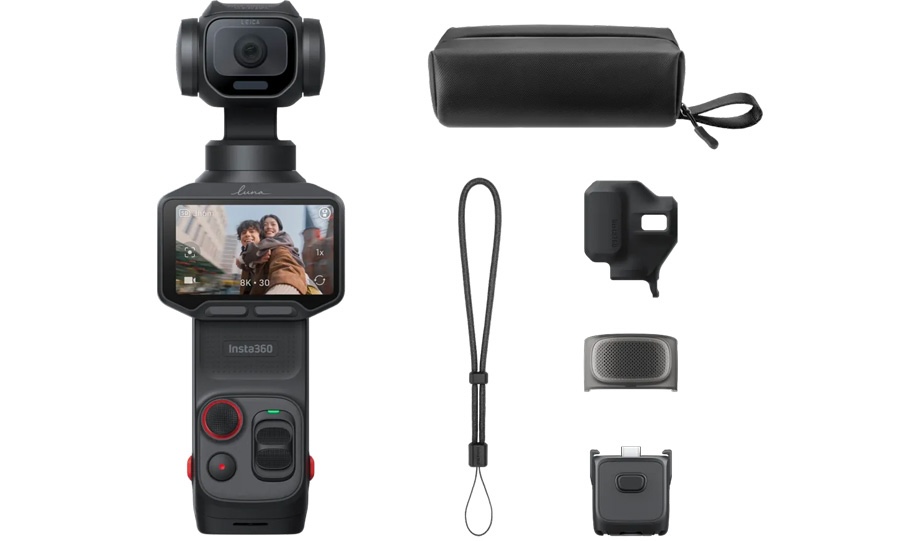
The Insta360 Luna Pro starts at €529 with the Standard Bundle, which is €200 less than the Luna Ultra’s Standard Bundle. It thus offers a significantly more affordable entry point into the lineup. The Standard Bundle includes the camera, a protective case, a carrying pouch, a windshield, a handle with a 1/4-inch thread, and a wrist strap. The included case is significantly more compact than that of the Luna Ultra: it primarily protects the top of the camera and its gimbal, rather than enveloping the entire device.
The Bonus Light Bundle, priced at €579, includes everything in the Standard Bundle plus a mini bonus light and a Black Mist filter. It’s also the bundle that Insta360 is particularly highlighting on the side of the Standard version.
Other configurations allow the Luna Pro to be adapted for different uses. The Endurance Pack, for example, adds a grip with a built-in battery to extend battery life, while the Vlog Pack focuses more on audio with a wireless microphone. The POV Pack, meanwhile, includes a mount that lets you wear the camera around your neck, making it easier to capture first-person footage. Prices range from €615 to €635.
Finally, many of the accessories designed for the Luna Ultra’s mounting system are compatible with the Luna Pro, making it easy to switch between the two models. Accessories that are directly related to the lenses are, of course, the exception, since the two cameras do not share the same optical configuration.
OUR BEST SELLERS - Insta360 Luna Pro


Accessories
Conclusion: Should You Buy the Insta360 Luna Pro?
With the Luna Pro, Insta360 has managed to retain most of the Luna Ultra’s key features in a slightly more compact—and, above all, more affordable—camera. Notably, it features the same excellent detachable OLED screen, comprehensive subject tracking, a comfortable battery life, and a wide range of features. The user experience, therefore, remains very similar to that of the high-end model.
Image quality is also top-notch. Using the same 1-inch sensor and 20 mm f/1.8 lens as the Luna Ultra’s main camera, the Pro delivers detailed images in daylight and also performs very well in low-light conditions. Features like 8K30, 4K120, 10-bit I-Log, and PureVideo mode provide more than enough capabilities to meet the needs of even the most demanding creators.
Of course, there are some trade-offs. The removal of the 60 mm telephoto lens significantly limits the zoom and framing options compared to the Luna Ultra, and the digital zoom quickly reaches its limits beyond 2×. But this is ultimately the main compromise made by Insta360, and it doesn’t undermine the camera’s fundamental qualities.
Priced starting at €529— €200 less than the Standard version of the Luna Ultra —the Insta360 Luna Pro thus emerges as a particularly attractive alternative for those who like the Ultra’s design but don’t need its dual-lens system. It retains much of what makes the line unique and appealing, while significantly lowering the entry price.
Who is the Insta360 Luna Pro designed for?
The Insta360 Luna Pro is primarily aimed at content creators, vloggers, and travelers looking for a stabilized camera capable of producing high-quality footage without the need for a lot of accessories. Its detachable screen, which doubles as a remote control and microphone, its Deep Track 5.0 tracking, and its wide range of shooting modes make it particularly well-suited for people who regularly film themselves alone.
It’s also an attractive option for those who prioritize the quality of the main sensor over the versatility of a second lens. Users who frequently switch between different focal lengths or want to take much closer shots will be better off choosing the Luna Ultra. For everyone else, the Luna Pro offers the essence of the Luna experience at a significantly more affordable price.
💡 See also
➡️ Want to check out the top-of-the-line model? Read our review of the Insta360 Luna Ultra.

 Blog
Blog