
 Français
 Deutsch
 Español
 Italiano
 Parts & Accessories by Drone
 Drones
 Action camera
 Microphones
 Camera stabilizers
 VR Headsets
DJI Osmo Pocket 4, full review: what’s new?
Jun
Since its launch, the DJI Osmo Pocket range has established itself as a benchmark for content creators looking for a compact, stabilized camera that’s easy to take anywhere. With this fourth generation, DJI intends to build on this success by making a number of improvements to a formula that has already proved its worth. But what is the DJI Osmo Pocket 4 really worth? What’s new compared to the previous generation? And above all, is it the right camera for your videos, your travels or your everyday content creation? All the answers in this article.
DJI Osmo Pocket 4: What you need to know
No time (or laziness 😅 ) to read it all? Here are the key points to remember about the DJI Osmo Pocket 4 👇
- 🧳 As compact as ever , with just 190.5 g, 2-inch rotating touchscreen and 107 GB of built-in storage
- 🔋 Up to 240 minutes of autonomy and ultra-fast recharging: 80% in 18 minutes, 100% in 32 minutes
- 🎬 C omprehensive video modes with 4K slow motion up to 240 fps, Timelapse, Motionlapse, Hyperlapse, low-light video and slow shutter video
- 🎯 ActiveTrack 7.0 for automatic tracking of people, animals and vehicles
- 🎤 Three built-in microphones, direct connection to DJI Mic, spatial audio and Zoom audio function
- 📷 1 -inch CMOS sensor, photos up to 38 MP and 4K video with 10-bit D-Log profile
- 🎨 Six predefined cinematic tones for fast, stylized rendering
- 💡 New magnetic auxiliary light available in some packs, powered directly by the camera
- 💸 S everal bundles available from €499, including a particularly comprehensive Creator Pack for content creators
📌 A successful evolution of the Osmo Pocket 3 that improves almost every aspect of the formula without revolutionizing the concept.
DJI Osmo Pocket 4 : Design
| Dimensions (L x W x H) | 144.2 × 44.4 × 33.5 mm |
| Weight | 190,5 g |
| Touch screen | Size: 2.0 inches Resolution: 556 × 314 Brightness: 1000 nits |
| Storage | 107 GB built-in memory microSD card (up to 1 TB) |
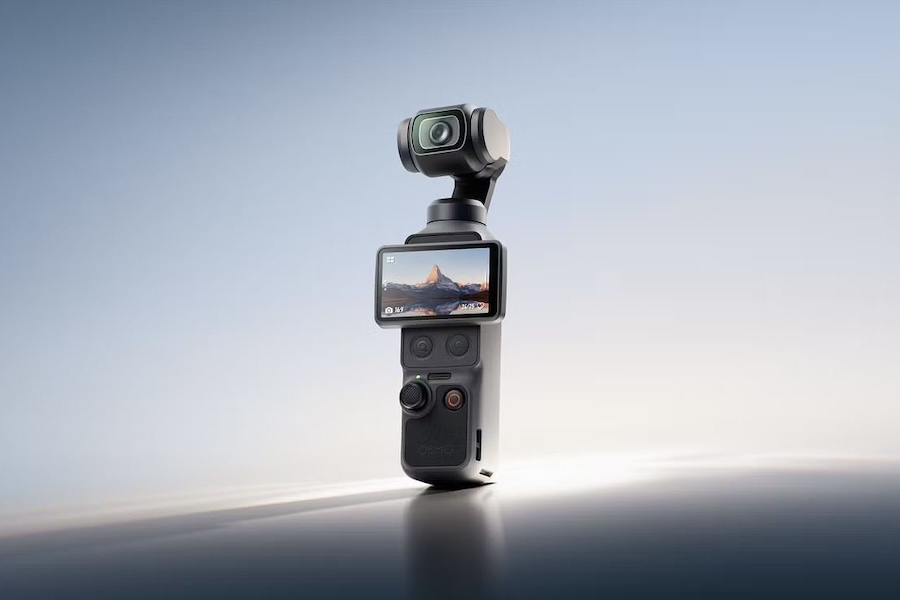
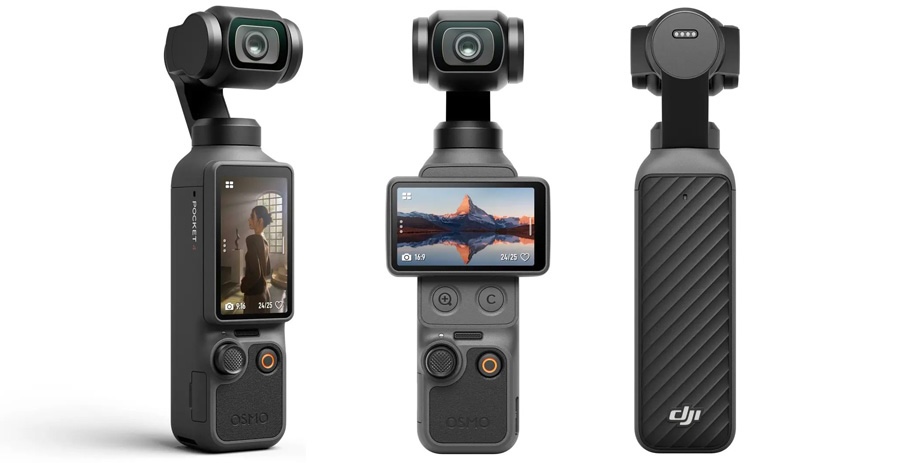
DJI has not sought to reinvent the recipe with this Osmo Pocket 4. It features the same compact format as the previous generation, with a camera mounted on a stabilized pod and an integrated rotating screen. With dimensions of 144.2 × 44.4 × 33.5 mm and a weight of 190.5 grams, it’s easy to carry and use on a daily basis. However, DJI has slightly revised its proportions, with the Pocket 4 a little taller than the previous generation.
While the differences are discreet at first glance, a few details make it possible to distinguish this new version. DJI has slightly reworked the finish of the casing, while maintaining the same overall style. One of the easiest ways to identify this Pocket 4 at first glance is the “OSMO ” lettering under the screen.
Its 2-inch OLED touchscreen is still there, and now boasts a brightness of 1000 nits, making it easy to use outdoors. As with the Pocket 3, simply rotate the screen to switch on the camera and start filming.
DJI has also made several welcome ergonomic improvements. In particular, Pocket 4 gains two new physical buttons below the screen when used in landscape mode: a dedicated zoom button and a customizable button that can trigger different functions depending on whether it is pressed once, twice or three times. The joystick has also been improved. From now on, the speed at which the gondola moves varies according to the pressure exerted, allowing both rapid movements and more precise adjustments. A discreet evolution on paper, but one that should make control more pleasant when shooting.
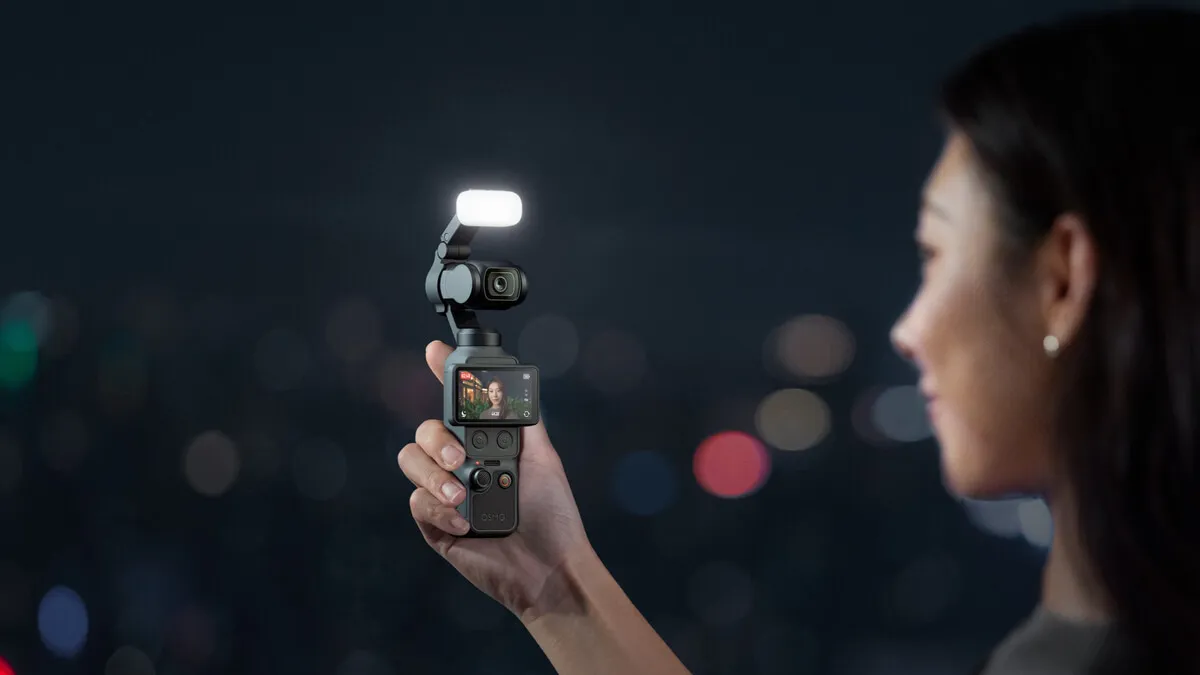
DJI has also added a magnetic system and connectors to the nacelle arm to accommodate the new auxiliary light offered in the Creator Pack. Once attached, the light is powered directly by the camera and switches on automatically.
Last but not least, Pocket 4 boasts 107 GB of internal storage, which is particularly useful for recording several hours of video without immediately relying on a memory card. Of course, it retains a microSD slot compatible up to 1TB, now protected by a dedicated cover.
DJI Osmo Pocket 4: Autonomy and recharging
| Battery | 1545 mAh |
| Autonomy | 240 minutes |
| Recharge time | 18 min up to 80%, 32 min up to 100%. |
Autonomy is one of the areas where improvements have been made on this Osmo Pocket 4. Despite a format very similar to that of the previous generation, DJI has succeeded in integrating a 1,545 mAh battery, compared with 1,300 mAh previously, an increase in capacity of around 20%.
According to DJI, the new battery provides up to 240 minutes of recording time, or almost 4 hours of autonomy. This figure was measured under specific conditions, with 1080p recording at 24 fps, screen off and wireless connections deactivated. Although actual autonomy will naturally depend on the settings used, early feedback suggests that the Pocket 4 offers very satisfactory endurance for such a compact camera.
Recharging is also very fast. Pocket 4 can recover 80% of its battery in just 18 minutes, and reach full charge in 32 minutes. This means less waiting between shooting sessions, and quicker resumption of shooting when the battery runs out.
Discover our accessories for
DJI Osmo Pocket 4
DJI Osmo Pocket 4 : Features
| Photo modes | Panorama, Self-timer |
| Video modes | ActiveTrack 7.0 subject tracking, Slow motion, Timelapse, Motionlapse, Hyperlapse, Low light video, Slow shutter video |
| Audio modes | Spatial audio, Zoom audio, 4-channel recording (with DJI Mic) |
| Number of microphones | 3 |
Photo and video modes
The DJI Osmo Pocket 4 includes most of the shooting modes already present on previous generations, including Panorama, Timelapse, Motionlapse, Hyperlapse and Self-timer modes. DJI has also added a Low Light Video mode, available in 4K at up to 30 frames per second, to enhance results in dark scenes.
The slow-motion mode has also improved. The Pocket 4 can now record up to 4K at 240 frames per second, enabling slow-motion shots up to eight times slower while maintaining excellent image quality. A particularly impressive performance for a camera in this format.
DJI also introduces a Slow Shutter Video mode, which allows the shutter speed to be manually adjusted by up to 4 seconds. This function can be used to create motion blur effects, capture streaks of light or accentuate the sensation of movement in certain scenes.
DJI also improves zoom. The no-loss 2× zoom is now available in more shooting modes and can be used during video recording, offering greater framing flexibility.
Finally, file transfers are made even faster thanks to Wi-Fi 6 and USB 3.1 compatibility. DJI claims speeds of up to 90 Mb/s wireless and 800 Mb/s wired, so you can quickly export your photos and videos to a smartphone or computer.
Subject follow-up
Subject tracking also benefits from several improvements thanks to the arrival ofActiveTrack 7.0. A simple double-tap on the subject on the screen automatically starts tracking, whether it’s a person, an animal or even a vehicle.
DJI has also extended tracking capabilities to more shooting modes than ever before. Early feedback shows tracking to be particularly reliable and responsive, even when the subject is moving quickly or temporarily leaving the center of the frame.
Gesture control
Pocket 4 also retains gesture control functions, which are useful when shooting alone. Two gestures are currently supported: the “V” sign , used to trigger a photo or start recording, and the palm of the hand, used to activate or deactivate subject tracking.
These are simple functions, but they’re always appreciated by vloggers, content creators and users who want to film themselves remotely without having to touch the camera.
Audio
Audio is another of the Osmo Pocket 4’s strong points. The camera has three built-in microphones and can connect directly to DJI Mic transmitters, without the need for an additional receiver.
This makes it possible to record two wireless microphones simultaneously, while retaining an audio track from the camera’s built-in microphones to capture the surrounding ambience. This provides several separate tracks for editing.
DJI is also introducing a Spatial Audio mode, designed to enhance immersion when listening through headphones, as well as an Audio Zoom function that progressively accentuates the sounds of the subject as the user zooms in.
OUR BEST SELLERS - DJI Osmo Pocket 4


Action camera


Action camera
DJI Osmo Pocket 4 : Image
| Sensor | 1-inch CMOS |
| Objective | 20mm equivalent, f/2.0 aperture |
| Photo resolution | 33 MP (16:9), 38 MP (1:1) |
| Video resolution | 4K up to 60 fps 3K vertical up to 60 fps 1080p up to 60 fps |
| Idle speed | 4K up to 240 fps 1080p up to 240 fps |
| Digital zoom | 4× (video) 2× (photo) |
| ISO range | 50 à 25600 |
| Photo format | JPEG / DNG / JPEG+DNG |
| Video format | MP4 (HEVC) |
| Color profiles | Normal, 10-bit D-Log |
| Max. bit rate | 180 Mb/s |
Sensors and resolutions
DJI retains the 1-inch CMOS sensor introduced with the Osmo Pocket 3. The same 20 mm equivalent f/2.0 lens is also used. Hardware evolutions are therefore limited, DJI having chosen to retain a formula that had already proved so convincing on the previous generation.
Pocket 4 can capture photos up to 38 MP in square format (1:1) and 33 MP in 16:9 format. On the video side, it records up to 4K at 60 fps in standard mode, and offers a vertical 3K mode at up to 60 fps for social networking. In slow motion, Pocket 4 can record up to 240 frames per second in 4K.
DJI has also announced a dynamic range of 14 f-stops, as well as 10-bit color depth with the D-Log profile. On paper, then, the main evolution is not in the sensor itself, but rather in image processing and the new possibilities offered by this fourth generation.
Image quality
In good lighting conditions, the DJI Osmo Pocket 4 is capable of producing detailed, pleasing images. However, the differences with the Pocket 3 remain relatively discreet in this type of situation. It’s in the most demanding scenes, such as high-contrast or low-light shots, that DJI’s improvements seem to be most apparent.
In particular, DJI points to better dynamic range management, and the first available comparisons point in this direction. In high-contrast scenes, such as a sunset or a subject filmed against the light, the Pocket 4 seems capable of retaining more detail in both the highlights and the darkest areas of the image.
The Low Light Video mode is also one of the most interesting new features of this Pocket 4. DJI promises better management of digital noise and more detailed reproduction of dark scenes. Initial comparisons seem to confirm a visible gain in this area, with a brighter image, more detail in dark areas and better-controlled digital noise. A particularly welcome improvement for content creators who regularly shoot indoors or after sunset.
The camera also benefits from a new 10-bit D-Log profile, more advanced than the D-Log M offered on the Pocket 3. Users wishing to perform color grading in post-production will thus have greater scope for adjusting colors, highlights or shadows.
DJI has also added six predefined cinematographic tones, allowing you to quickly obtain different visual renderings without having to go through a complex editing or color-grading phase. A feature that should appeal to content creators looking for a more polished rendering straight out of the camera.
DJI Osmo Pocket 4: packs and prices
ℹ️ Note: some links in this section are Amazon affiliate links. As Amazon Associates, we earn from qualifying purchases, at no extra cost to you.
| Standard package | 499 € |
| |
| Creator Pack | 619 € |
| |
| Other theme packs | From €523 to €627 |
Which pack to choose?
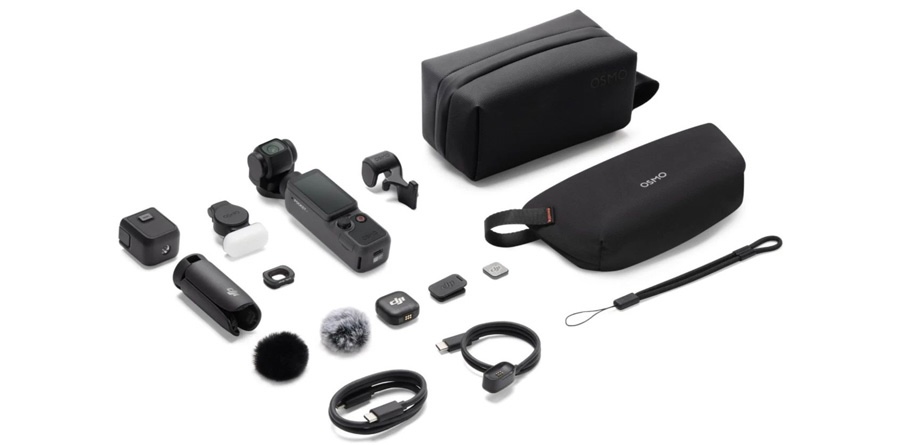
The DJI Osmo Pocket 4 Standard Pack starts at €499. This includes the camera, a handle with 1/4″ thread, a nacelle protector, a wrist strap, a carrying pouch and essential charging accessories.
For regular content creators, DJI also offers a Creator Pack for €619. In addition to the elements of the standard pack, this adds a DJI Mic 3 transmitter, a wide-angle lens, a mini tripod, a magnetic auxiliary light and a more complete carry bag.
DJI also markets several themed bundles for specific uses such as travel, vlogging, streaming, portraiture or audio. Depending on the version, these packs can include ND filters, a battery grip, an additional microphone or various accessories dedicated to content creation.
Accessories and compatibility
Good news for Osmo Pocket 3 owners: a large number of accessories remain compatible with this new generation. The filters, battery grip and many other existing accessories can be reused with the Osmo Pocket 4.
Among the new features, DJI introduces a magnetic accent light available in certain bundles, including the Creator Pack. Directly powered by the camera when attached to the nacelle arm, it offers three brightness levels and three color temperatures, providing practical back-up lighting for selfies, vlogs or indoor shooting.
Conclusion DJI Osmo Pocket 4: should you buy it?
Without overturning the formula that made the Osmo Pocket 3 such a success, DJI’s Pocket 4 is a more mature, more accomplished version of its pocket camera. The recipe remains broadly the same, but numerous improvements enhance the experience: improved autonomy, integrated internal storage, faster transfers, improved subject tracking, 4K slow-motion up to 240 fps, new 10-bit D-Log profile and enhanced low-light performance.
The most noticeable improvements concern difficult situations, where Pocket 4 manages to better preserve detail in highlights, shadows and dimly lit scenes. DJI has also fine-tuned many practical aspects of the product, with new physical buttons, better integration of accessories and an ever more complete ecosystem.
Yet this fourth generation is no revolution. The sensor remains identical to that of the Pocket 3, and some of the developments we might have hoped for are still absent, such as a true vertical mode exploiting the entire sensor surface. Owners of the previous generation will therefore not discover a radically different camera.
That hasn’t stopped the Osmo Pocket 4 from establishing itself as one of the most complete cameras in its category. More versatile, more powerful and more pleasant to use on a daily basis, it has all the qualities needed to becomethe new benchmark in pocket cameras for vlogging and content creation.
Who is the DJI Osmo Pocket 4 designed for?
The DJI Osmo Pocket 4 is aimed above all at vloggers, content creators, travelers and, more generally, anyone who wants to get a quality image without the hassle of a camera or a bulkier camcorder.
Its pocket format, three-axis mechanical stabilization and subject tracking also make it a particularly interesting solution for people who film themselves, whether for YouTube, TikTok, Instagram or simply to immortalize their travels and everyday moments.
It will also suit users looking for a more versatile alternative to a classic action camera. Where a camera such as a GoPro is primarily concerned with sports activities and extreme shots, the Osmo Pocket 4 focuses more on image quality, subject tracking, audio and day-to-day ease of use.
I already have the Osmo Pocket 3: should I upgrade to the Osmo Pocket 4?
If you already own an Osmo Pocket 3, the answer depends above all on what you expect from this new generation. The Pocket 4 brings a number of improvements, none of which fundamentally alter the experience offered by the previous model.
The most convincing reasons for upgrading to Pocket 4 are the new features. 4K slow-motion at up to 240 frames per second, 10-bit D-Log profile, advances in low-light shooting and improved subject tracking could be real selling points for some content creators.
On the other hand, other improvements such as internal storage, faster transfers and longer battery life are more comfort-enhancing than sufficient reasons to change cameras.
In short, if your Osmo Pocket 3 already meets your needs perfectly, there’s probably no rush to upgrade to Pocket 4. On the other hand, if one of the new features addresses a specific need or limitation you’re facing today, this new generation may well be worth the detour.
💡 Also read
➡️ Curious to see what the previous generation had to offer? Check out our review of the Osmo Pocket 3.
➡️ Wondering whether the new generation is really worth it? Check out our DJI Osmo Pocket 4 vs Pocket 3 comparison.
➡️ DJI is no longer alone in the stabilized pocket camera market. Discover our complete analysis of the Insta360 Luna Ultra.
🎤 Want to improve your Pocket’s audio quality? Discover our comparison DJI Mic Mini or DJI Mic 2: which one should you choose?

 Blog
Blog