
 Français
 Deutsch
 Español
 Italiano
 Parts & Accessories by Drone
 Drones
 Action camera
 Microphones
 Camera Stabilizers
 VR Headsets
DJI Osmo Pocket 4P vs. Pocket 4: What Are the Differences?
Aug
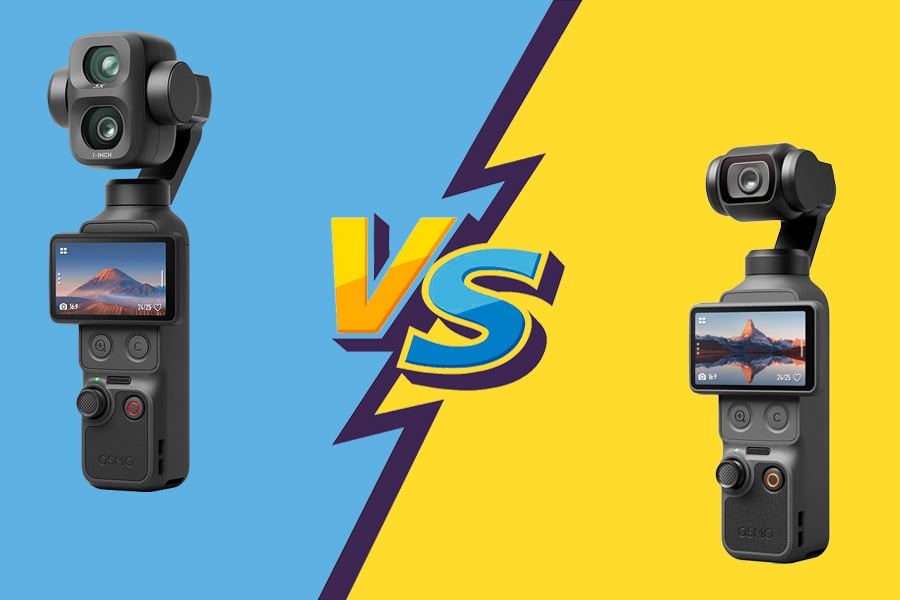
Just a few months after the launch of the DJI Osmo Pocket 4, DJI is already back with a new variant called the Osmo Pocket 4P, sometimes also referred to as the DJI Osmo Pocket 4 Pro. While the two cameras share many of the same specs, this “Pro” version introduces a major upgrade: a dual-camera system, a first for the Osmo Pocket lineup. But does this new feature really justify the price difference? Does the Pocket 4P offer better image quality, or is it simply aimed at a more demanding audience? And most importantly, which one should you choose based on your needs? In this DJI Osmo Pocket 4P vs. Pocket 4 comparison, we’ll walk you through all their differences to help you choose the model that best suits your needs.
DJI Osmo Pocket 4P vs. Pocket 4: Key Takeaways
Don’t have time (or just can’t be bothered 😅) to read it all? Here are the key differences to keep in mind between the DJI Osmo Pocket 4P and the DJI Osmo Pocket 4 👇
- 🧳 Both cameras retain the same pocket-sized design and the same three-axis mechanical stabilization, but the Pocket 4P is bulkier and heavier due to its dual-camera setup.
- 🔋 The DJI Osmo Pocket 4 offers longer battery life with up to 240 minutes of recording time, compared to 210 minutes for the Pocket 4P, while still charging just as quickly.
- 🎬 Both models offer a comprehensive set of features, but the Pocket 4P adds Live Photo mode and the new ActiveTrack 8.0 smart tracking feature.
- 📷 The Pocket 4P clearly has the edge when it comes to image quality, thanks to its dual camera, 60 mm telephoto lens, much more powerful zoom, and new D-Log 2 profile, which offers more creative possibilities and greater flexibility in post-production.
- 💸 The DJI Osmo Pocket 4 is €100 cheaper in the Standard Bundle (€499 vs. €599), while the Pocket 4P now comes with a fill light included as standard and a particularly comprehensive Vlog Bundle.
📌 The DJI Osmo Pocket 4 remains the best choice for most users thanks to its excellent value for the price. The Pocket 4P is geared more toward content creators who want to take advantage of the versatility offered by its dual camera and more advanced features.
DJI Osmo Pocket 4P vs. Pocket 4: Design
| DJI Osmo Pocket 4P | DJI Osmo Pocket 4 | |
| Dimensions (L x W x H) | 159.5 × 63.3 × 33.5 mm | 144.2 × 44.4 × 33.5 mm |
| Weight | 230 g | 190,5 g |
| Touch screen | Size: 2.0 inches Resolution: 556 × 314 Brightness: 1000 nits | Size: 2.0 inches Resolution: 556 × 314 Brightness: 1000 nits |
| Storage | 103 GB built-in memory microSD card (up to 1 TB) | 107 GB built-in memory microSD card (up to 1 TB) |
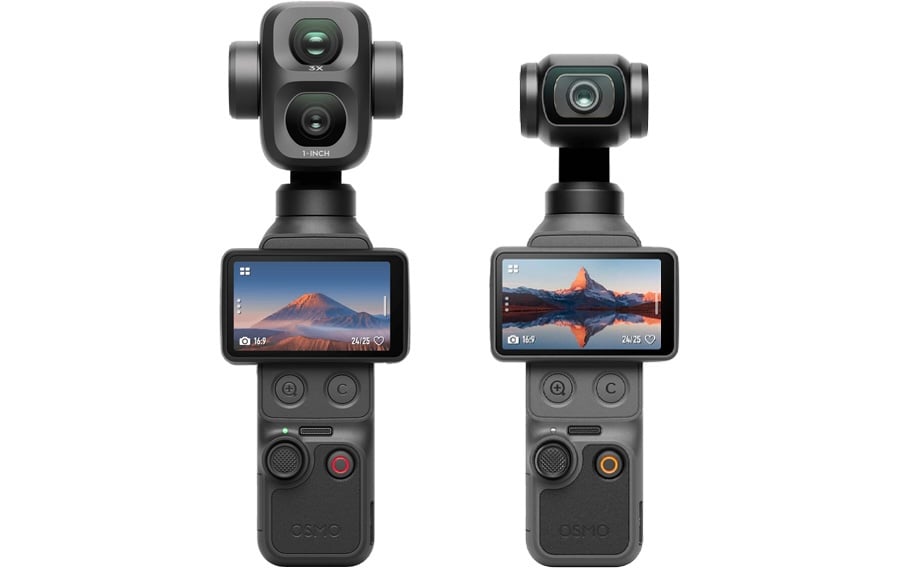
Both cameras feature the core elements that made the Osmo Pocket line a success: a compact design, a three-axis stabilized gimbal, and a 2-inch rotating touchscreen that can instantly switch between landscape and portrait modes while also serving as a power button to turn the camera on or off. They also feature the same maximum brightness of 1,000 nits, ensuring good visibility outdoors, as well as a very similar ergonomic design with a precise joystick and two additional buttons in landscape mode, one of which is customizable.
The main difference lies in the Pocket 4P’s dual camera. The inclusion of a second lens requires a larger camera module, which results in larger dimensions (159.5 × 63.3 × 33.5 mm versus 144.2 × 44.4 × 33.5 mm) and an increase in weight from 190.5 to 230 grams. This added weight is also noticeable when holding the device, as the Pocket 4P is slightly less well-balanced due to the weight being concentrated in its upper section.
On the other hand, this development allows the Pocket 4P to offer a level of versatility that the Pocket 4 simply cannot match, thanks to its built-in telephoto lens. We’ll discuss the benefits of this dual-camera system in more detail in the section on image quality.
Finally, both models feature generous internal storage , supplemented by a microSD slot that supports cards up to 1 TB. The Pocket 4 has slightly more built-in storage (107 GB versus 103 GB), but this difference is completely negligible in everyday use.
🏆 DJI Osmo Pocket 4: more compact, lighter, and slightly more comfortable to hold.
Check out our accessories for the
DJI Osmo Pocket 4P
DJI Osmo Pocket 4P vs. Pocket 4: Battery Life and Charging
| DJI Osmo Pocket 4P | DJI Osmo Pocket 4 | |
| Battery | 1545 mAh | 1545 mAh |
| Autonomy | 210 minutes | 240 minutes |
| Recharge time | 18 min up to 80%, 32 min up to 100%. | 18 min up to 80%, 32 min up to 100%. |
Both cameras use the same 1,545 mAh battery, but their battery life differs slightly. While the Pocket 4 can record for up to 240 minutes, the Pocket 4P is rated for 210 minutes—a decrease of about 30 minutes. This slight difference is most likely due to the inclusion of the dual camera.
As always, these figures are based on DJI’s testing protocol, conducted at 1080p and 24 frames per second, with the screen off and Wi-Fi disabled. In practice, battery life will naturally depend on the settings used, but both models offer excellent battery life for such compact cameras. The advertised 3 hours and 30 minutes for the Pocket 4P is more than enough for most uses.
Charging, on the other hand, is exactly the same for both models. It takes just 18 minutes to reach 80% battery capacity and 32 minutes to reach a full charge, effectively minimizing downtime between shooting sessions.
🏆 DJI Osmo Pocket 4: Slightly longer battery life, without compromising on charging speed.
DJI Osmo Pocket 4P vs. Pocket 4: Features
| DJI Osmo Pocket 4P | DJI Osmo Pocket 4 | |
| Photo modes | Panorama, Self-Timer, Live Photo | Panorama, Self-timer |
| Video modes | ActiveTrack 8.0 Subject Tracking, Slow Motion, Time-Lapse, Motion-Lapse, Hyperlapse, Low-Light Video, Slow Shutter Speed Video, Live Streaming | ActiveTrack 7.0 Subject Tracking, Slow Motion, Time-Lapse, Motion-Lapse, Hyperlapse, Low-Light Video, Slow Shutter Speed Video, Live Streaming |
| Audio modes | Spatial Audio, Audio Zoom, 4-Channel Recording (with DJI Mic via OsmoAudio) | Spatial Audio, Audio Zoom, 4-Channel Recording (with DJI Mic via OsmoAudio) |
| Number of microphones | 3 | 3 |
On paper, the two cameras offer very similar features. Both feature a wide range of shooting modes, including Panorama, Self-Timer, Slow Motion, Time-Lapse, Motion-Lapse, Hyperlapse, Low-Light Video, Slow Shutter Speed Video, and live streaming via the DJI Mimo app.
The Pocket 4P stands out, however, thanks to the addition of Live Photo mode. Just like Apple smartphones, this feature automatically records a short 1.5-second clip before and after the shutter is released to bring a still photo to life. An interesting new feature, even if it will likely remain a minor one for most users.
The second difference concerns subject tracking. While the Pocket 4 features ActiveTrack 7.0, the Pocket 4P upgrades to ActiveTrack 8.0. This new version notably improves tracking when using the telephoto lens and handles scenes with multiple people more effectively by automatically incorporating new subjects that enter the frame. As a result, tracking is even smoother and requires less user intervention.
Otherwise, the two models are very similar. They both feature gesture controls, three built-in microphones, compatibility with the DJI Mic via OsmoAudio,Spatial Audio, Audio Zoom, and recording of up to four audio channels, offering a virtually identical experience in all these areas.
🏆 DJI Osmo Pocket 4P: a few welcome new features, including a handy Live Photo mode and an even more powerful ActiveTrack 8.0.
OUR BEST SELLERS - DJI Osmo Pocket 4P


DJI Osmo Pocket 4P vs. Pocket 4: Image
| DJI Osmo Pocket 4P | DJI Osmo Pocket 4 | |
| Sensors | Wide-angle: 1” CMOS; Telephoto: 1/1.28” CMOS | 1-inch CMOS |
| Objectives | Wide-angle: 20 mm f/2.0 Telephoto: 60 mm f/1.8 | 20 mm f/2.0 |
| Clarification | Wide-angle: 9 cm to ∞ Telephoto: 20 cm to ∞ | 20 cm to ∞ |
| Photo resolution | Up to 37 MP | Up to 37 MP |
| Video resolution | 4K up to 60 fps 3K vertical up to 60 fps 1080p up to 60 fps | 4K up to 60 fps 3K vertical up to 60 fps 1080p up to 60 fps |
| Idle speed | Wide-angle: 4K up to 240 fps Telephoto: 4K up to 200 fps | 4K at up to 240 fps |
| Digital zoom | Up to 12× for video Up to 9× for photos | Up to 4× for video Up to 2× for photos |
| ISO range | Wide-angle: 100 to 25,600 (up to 51,200 in low-light video) Telephoto: 50 to 12,800 (up to 25,600 in low light) | 50 à 25600 |
| Photo format | JPEG / DNG / JPEG+DNG | JPEG / DNG / JPEG+DNG |
| Video format | MP4 (HEVC) | MP4 (HEVC) |
| Color profiles | Normal (10 bits), D-Log (10 bits), D-Log 2 (10 bits) | Normal (10 bits), D-Log (10 bits) |
| Max. bit rate | 180 Mb/s | 180 Mb/s |
Sensors and Resolutions: The Dual Camera Makes All the Difference
The main difference between these two cameras lies here. While the DJI Osmo Pocket 4 retains an excellent 1-inch CMOS sensor paired with a 20mm f/2.0 lens, the Pocket 4P takes a major step forward by adding a second camera equipped with a 60mm f/1.8 telephoto lens. This upgrade truly transforms the shooting experience by offering two complementary focal lengths, whereas the Pocket 4 relies solely on its wide-angle lens.
This dual-camera system opens up new creative possibilities. The telephoto lens allows you to take more flattering portraits and more natural close-ups, while producing a much more pronounced background blur (bokeh effect). It also makes it possible to film distant subjects without relying solely on digital zoom, offering a level of versatility that the Pocket 4 simply cannot match.
In fact, the zoom is one of the most notable differences between the two models. The Pocket 4 is limited to a digital zoom of up to 4× for video and 2× for photos, while the Pocket 4P retains the 2× lossless zoom of the main sensor, plus a true 3× telephoto lens. This allows for a zoom of up to 6× while maintaining excellent image quality, and can reach up to 12× with the digital zoom.
On the other hand, the two cameras are very similar in terms of the resolutions they offer. Both record 4K video at up to 60 frames per second, feature a vertical 3K mode at up to 60 fps, and offer 4K slow-motion at up to 240 fps. The Pocket 4P simply adds slow-motion up to 200 fps with its telephoto lens.
Image quality: differences are most noticeable in low-light conditions and during post-production
In broad daylight, the differences in image quality remain relatively subtle. Both models produce a highly detailed image, with excellent sharpness and convincing color reproduction. However, available comparisons show that the Pocket 4P seems to preserve details slightly better in high-contrast scenes and produces a slightly brighter image in certain situations, though it doesn’t create a dramatic gap compared to the Pocket 4.
The differences become more apparent in low light. Initial tests show that the Pocket 4P produces a slightly brighter image, with better noise control and better preservation of detail in dark areas. The differences are subtle, but they can make all the difference in the most challenging scenes.
The Pocket 4P also offers an advantage in post-production thanks to the introduction of the D-Log 2 profile, available exclusively on its main sensor. More advanced than the Pocket 4’s D-Log, it offers a dynamic range of up to 17 stops, compared to approximately 14 stops on the Pocket 4. Videographers looking to perform advanced color grading will thus have greater latitude to recover detail in both the highlights and the shadows of the image.
🏆 DJI Osmo Pocket 4P: dual camera, significantly improved zoom, and D-Log 2
DJI Osmo Pocket 4P vs. Pocket 4: Bundles and Prices
ℹ️ Note: some links in this section are Amazon affiliate links. As Amazon Associates, we earn from qualifying purchases, at no extra cost to you.
| DJI Osmo Pocket 4P | DJI Osmo Pocket 4 | |
| Standard package | €599 | 499 € |
| Premium Package | €689 (Vlog Bundle) | €619 (Creator Bundle) |
In this regard, the two cameras take a slightly different approach. The DJI Osmo Pocket 4P is available in two versions: a Standard Pack for €599 and a Vlog Bundle for €689. The DJI Osmo Pocket 4, meanwhile, starts at €499 for the Standard Pack, with a Creator Bundle priced at €619 serving as the most comprehensive version.
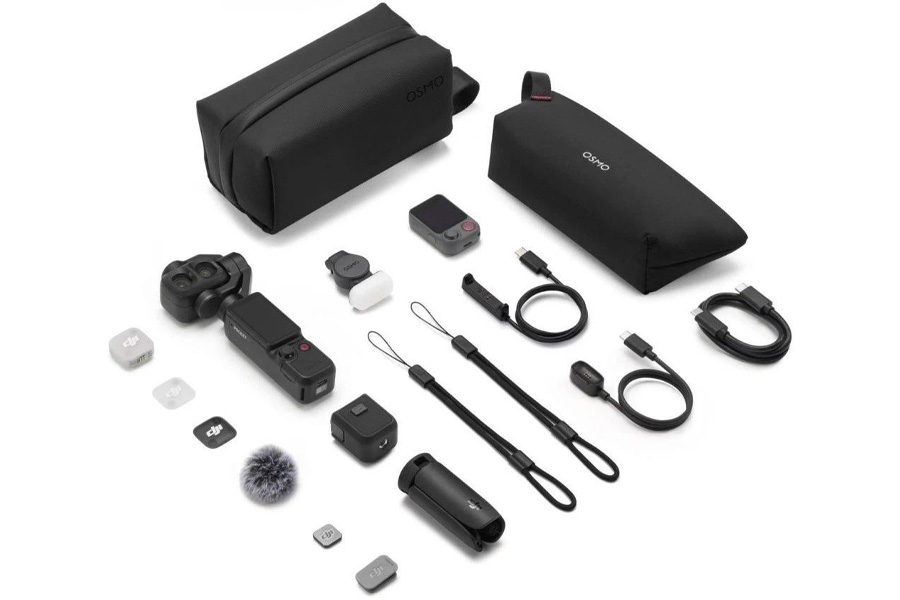
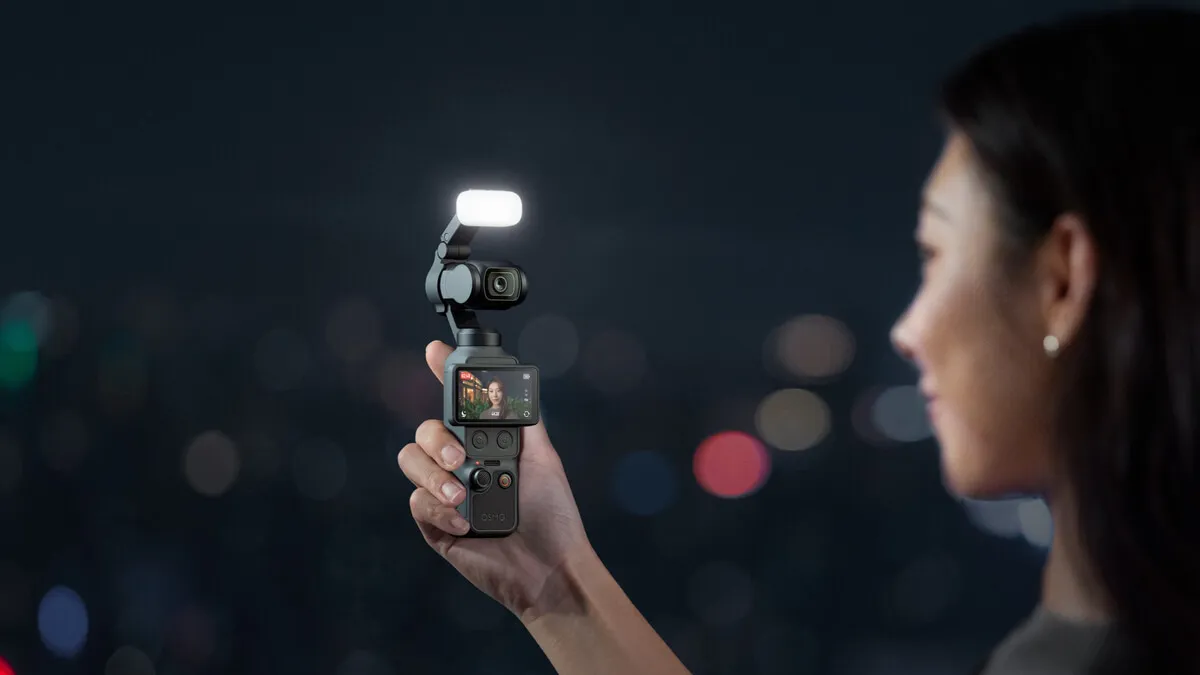
The Standard Pack will suit the majority of users in both cases. The Pocket 4P stands out, however, as it now includes the magnetic auxiliary light starting with this version, whereas it was previously exclusive to the Pocket 4 Creator Bundle.
On the side of the premium bundles, both models are clearly aimed at content creators. The Pocket 4P Vlog Bundle includes a DJI Mic Mini 2 and the new FrameTap remote control, which is particularly handy for controlling the camera remotely. The Pocket 4 Creator Bundle, meanwhile, includes a magnetic fill light, the DJI Mic 3, and a wide-angle lens, offering a very comprehensive package for content creators as well.
The DJI Osmo Pocket 4 also offers a wider selection of bundles, with several themed packs (Travel, Vlog, etc.) tailored to different uses. The Pocket 4P is currently available in only two versions, but DJI will likely expand its lineup gradually over the coming months.
🏆 DJI Osmo Pocket 4: a much more affordable price.
Discover our accessories for
DJI Osmo Pocket 4
Conclusion: DJI Osmo Pocket 4P vs. Pocket 4—Which One Should You Choose?
On paper, the two cameras are very similar. They share the same design philosophy: a pocket-sized form factor, three-axis mechanical stabilization, excellent image quality, and particularly well-designed ergonomics. If you’re simply looking for a compact camera to film your travels, capture memories, or create vlogs, the DJI Osmo Pocket 4 remains a solid choice today, especially since it’s available at a more affordable price.
However, the Pocket 4P isn’t a replacement for the Pocket 4—it complements it. With its dual camera, 60 mm telephoto lens, much more versatile zoom, and D-Log 2 profile, it’s primarily aimed at content creators who want more creative possibilities. The differences in image quality are relatively subtle in most situations, but the new focal lengths and additional tools provide real added value in everyday use.
Ultimately, the choice will depend mainly on how you plan to use it. If you’re on a tight budget or don’t need a telephoto lens, the Pocket 4 is probably the best value for the money. On the other hand, if you’re looking for the most versatile camera in the Osmo Pocket lineup and plan to take full advantage of its new framing and post-production capabilities, the Pocket 4P fully justifies its higher-end positioning.
Choose the DJI Osmo Pocket 4P if…
- you want to take advantage of a dual-camera system that offers more creative possibilities;
- You’re looking for a much more powerful zoom thanks to the telephoto lens;
- You’d like to use the D-Log 2 profile for your video editing.
Choose the DJI Osmo Pocket 4 if…
- You’re looking for the most affordable camera in the lineup;
- you prefer a more compact and lightweight model;
- You don’t need the features offered by the Pocket 4P’s dual camera.
I already have a DJI Osmo Pocket 4: Should I upgrade to the Pocket 4P?
If you already own a DJI Osmo Pocket 4, the answer depends primarily on how you use it.
If you mainly shoot with a wide-angle lens and your Pocket 4 already meets your needs perfectly, there isn’t necessarily a reason to switch models. Both cameras share the same design philosophy, excellent image quality, highly effective mechanical stabilization, and many of the same features.
On the other hand, if you’re looking for more creative possibilities, the DJI Osmo Pocket 4P ( or Pocket 4 Pro) represents a real step forward. Its telephoto lens, dual camera system, much more powerful zoom, and D-Log 2 profile offer real added value, both while filming and in post-production.
In short, the Pocket 4P is not a replacement for the Pocket 4: it is primarily intended for users who want to take their video creation to the next level. If these new features meet your needs, upgrading is definitely worth it.
💡 To learn more, check out our in-depth reviews of the two cameras in this DJI Osmo Pocket 4P vs. Pocket 4 comparison:
➡️ Learn everything there is to know about the DJI Osmo Pocket 4P.
➡️ Learn everything there is to know about the DJI Osmo Pocket 4.
💡 See also
➡️ Are you also trying to decide between the first two versions of this fourth generation? Check out our comparison of the Osmo Pocket 3 and 4.
➡️ Looking for an alternative to DJI? Discover our Insta360 Luna Ultra review and pricing.
OUR BEST SELLERS - DJI Osmo Pocket 4


Action camera

 Blog
Blog