
 Français
 Deutsch
 Español
 Italiano
 Parts & Accessories by Drone
 Drones
 Action camera
 Microphones
 Camera Stabilizers
 VR Headsets
DJI Osmo Pocket 4P, Full Review: The Dual Camera That Changes Everything
Aug
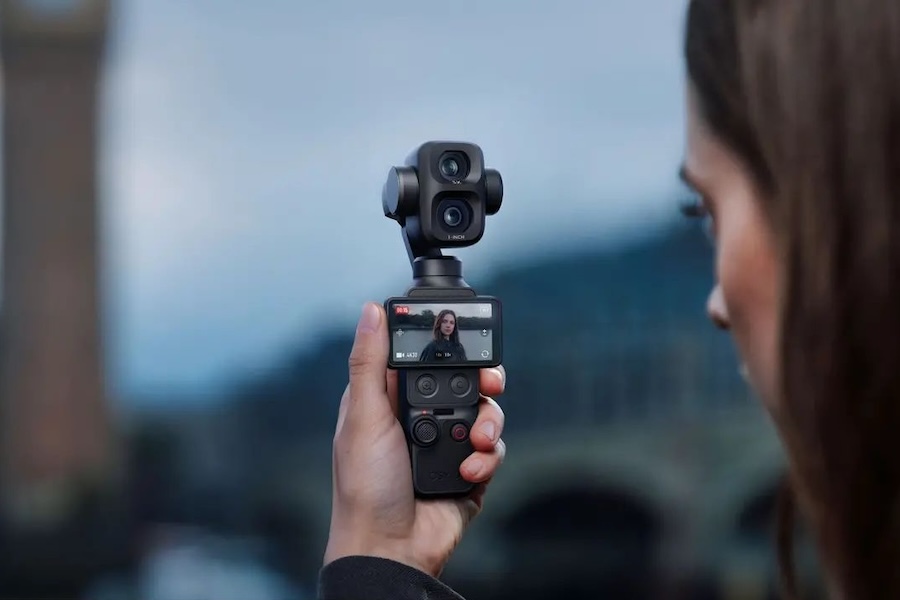
With the DJI Osmo Pocket 4P, DJI is incorporating a dual-lens system into its famous pocket camera for the first time. This is a major advancement that might even have been a world first had Insta360 not launched the Luna Ultra a few weeks earlier. The two models are now in direct competition in the market for stabilized compact cameras. But how does the DJI Osmo Pocket 4P really stack up? Do its new features justify upgrading to this “Pro” version? And most importantly, is it the compact camera you need? Find all the answers in our comprehensive review.
DJI Osmo Pocket 4P: Key Takeaways
Don’t have time (or just can’t be bothered 😅) to read the whole thing? Here are the key takeaways about the DJI Osmo Pocket 4P 👇
- 🧳 Still just as compact despite the addition of a dual camera, weighing only 230 g, with a 2-inch rotating touchscreen and 103 GB of built-in storage
- 🔋 Up to 210 minutes of battery life (as advertised) and charging that’s just as fast as ever: 80% in 18 minutes, 100% in 32 minutes
- 🎬 A wide range of video modes, including ActiveTrack 8.0, 4K slow motion at up to 240 fps, Timelapse, Motionlapse, Hyperlapse, Low-Light Video mode, and live streaming
- 🎤 Three built-in microphones, direct connection to DJI Mic via OsmoAudio, spatial audio, audio zoom, and recording of up to 4 channels
- 📷 New dual-camera system with a 1-inch CMOS sensor and a 60 mm f/1.8 telephoto lens, offering more creative possibilities and a stunning bokeh effect for portraits
- 🎨 New D-Log 2 profile combined with LOFIC technology, enabling a dynamic range of up to 17 stops for greater flexibility in post-production
- 🌙 Excellent image quality, even in low light, with well-controlled digital noise and a telephoto lens that effectively complements the wide-angle lens
- 💡 The magnetic fill light is now included in the Standard Pack, while the Vlog Bundle adds, among other things, a DJI Mic Mini 2 and the new FrameTap remote control
- 💸 Two packages available starting at €599, including a Vlog Bundle that’s particularly appealing to content creators who want a complete setup right out of the box
📌 With its exceptionally well-designed dual-lens system and excellent image quality, the DJI Osmo Pocket 4P represents a major leap forward for the Osmo Pocket lineup and stands out as one of the most advanced vlogging cameras available today.
DJI Osmo Pocket 4P: Design
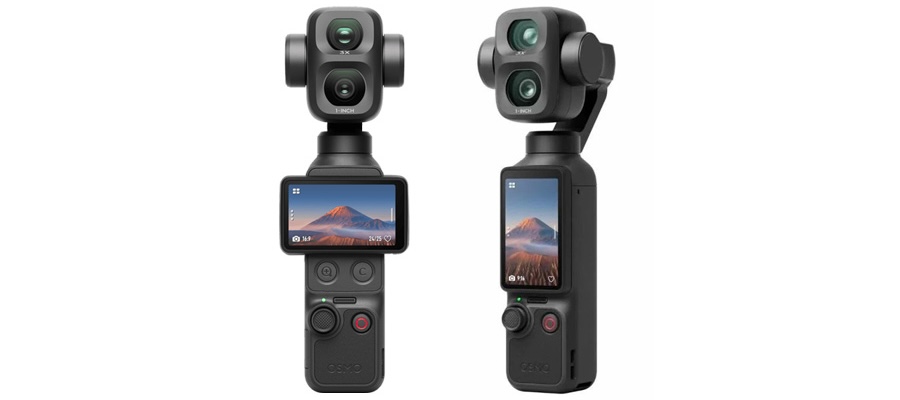
| Dimensions (L x W x H) | 159.5 × 63.3 × 33.5 mm |
| Weight | 230 g |
| Touch screen | Size: 2.0 inches Resolution: 556 × 314 Brightness: 1000 nits |
| Storage | 103 GB built-in memory microSD card (up to 1 TB) |
While the Pocket 4P has evolved in several ways, DJI has retained what made the Osmo Pocket line so successful: an ultra-compact design combined with a three-axis stabilized gimbal. Easy to carry and use in everyday life, this new version stays true to the spirit of its predecessors while introducing a major upgrade.
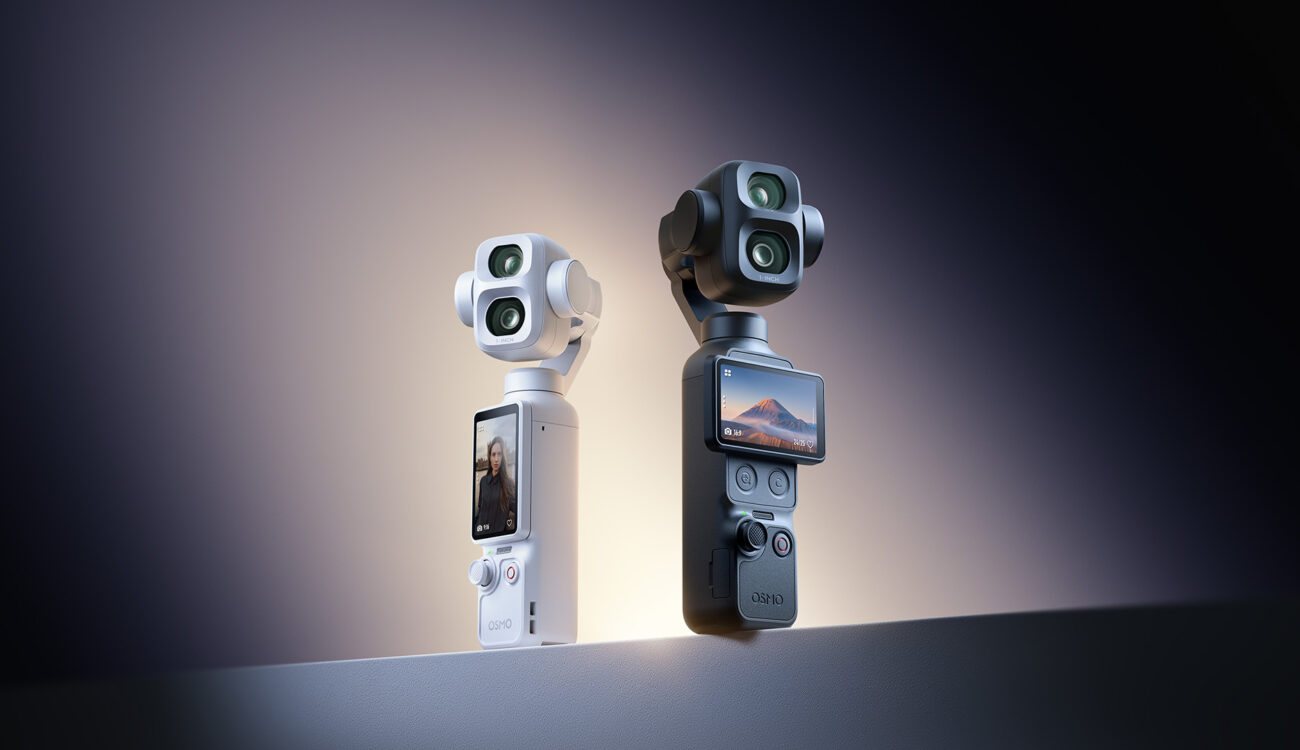
The main new feature of the Pocket 4P is, of course, its new dual-lens system—a first for a camera in the Osmo Pocket lineup. However, this upgrade makes the camera slightly bulkier than the Pocket 4. It is taller, wider, and now weighs 230 grams, compared to 190.5 grams for the previous generation.
However, this change does have an impact on how the camera feels in your hand. The camera module shifts more of the weight to the upper part of the camera, making it slightly less well-balanced than the Pocket 4. On the other hand, this design choice allows for the inclusion of a true telephoto lens, providing a level of versatility that previous models simply couldn’t offer. We’ll discuss the many advantages of this dual-camera system in more detail later in this article.
Otherwise, DJI has stuck with a design that has more than proven itself. It featuresa 2-inchrotating touchscreen that can instantly switch between landscape and portrait modes while also serving as a power button to turn the camera on or off. Its maximum brightness of 1,000 nits ensures good readability outdoors.
Ergonomics also remains one of the Pocket 4P’s strengths. The joystick still allows for precise control of the gimbal, while the physical buttons provide easy access to key functions. The two additional buttons accessible in landscape mode are still there, including a customizable button that provides quick access to your settings or favorite profiles.
Finally, DJI has retained several popular features from the Pocket 4, such as compatibility with the magnetic fill light, which is now included in the Standard Pack. The camera also features 103 GB of internal storage, to which you can add a microSD card of up to 1 TB, providing more than enough capacity to record long shooting sessions.
DJI Osmo Pocket 4P: Battery Life and Charging
| Battery | 1545 mAh |
| Autonomy | 210 minutes |
| Recharge time | 18 min up to 80%, 32 min up to 100%. |
DJI has retained the 1, 545 mAh battery introduced with the Pocket 4. While its capacity remains the same, the advertised maximum flight time has decreased from 240 minutes to 210 minutes. This slight decrease is likely due to the integration of the new dual-lens system and the additional electronics it requires. Despite this, the Pocket 4P is still capable of recording for up to 3 hours and 30 minutes, which remains an excellent performance for such a compact camera.
As always, the battery life specified by DJI is based on a specific testing protocol, conducted at 1080p and 24 frames per second, with the screen off and Wi-Fi disabled. In real-world use, it will naturally vary depending on your settings and how you film. In any case, the Pocket 4P still offers excellent battery life for a camera of this size, allowing you to confidently plan for several hours of filming.
Charging, meanwhile, remains unchanged and just as fast as ever. It takes just 18 minutes to reach 80% battery capacity and 32 minutes to reach a full charge, thereby minimizing downtime between filming sessions.
Finally, as with previous models in the lineup, the battery is built directly into the camera and therefore cannot be replaced. For long days of filming, however, DJI offers an optional battery grip that significantly extends the battery life.
Check out our accessories for the
DJI Osmo Pocket 4P
DJI Osmo Pocket 4P: Features
| Photo modes | Panorama, Self-Timer, Live Photo |
| Video modes | ActiveTrack 8.0 Subject Tracking, Slow Motion, Time-Lapse, Motion-Lapse, Hyperlapse, Low-Light Video, Slow Shutter Speed Video, Live Streaming |
| Audio modes | Spatial Audio, Audio Zoom, 4-Channel Recording (with DJI Mic via OsmoAudio) |
| Number of microphones | 3 |
Photo and video modes
The DJI Osmo Pocket 4P features a wide range of shooting modes for both photos and videos. These include Panorama, Self-Timer, Slow Motion, Time-Lapse, Motion-Lapse, Hyperlapse, Low-Light Video, and Slow Shutter Video—all of which were already available on the Pocket 4.
Among the new features is a Live Photo mode, which automatically records a short 1.5-second clip before and after the shutter is released. Similar to Apple’s Live Photos, this feature brings a still photo to life by capturing a few moments of movement around the shot.
The camera also retains the live-streaming feature, making it easy to share videos on compatible platforms via the DJI Mimo app. This is always a welcome feature for content creators who want to stream their videos in real time.
Like the previous generation, the Pocket 4P also retains gesture controls. This makes it possible to take a photo or start recording with a simple hand gesture, as well as to enable or disable subject tracking without touching the camera. This is always a handy feature for content creators who film themselves.
Even more effective tracking of the subject
The Pocket 4P now features ActiveTrack 8.0, DJI’s next-generation intelligent tracking system. As before, simply tapping on the subject allows the camera to track it automatically, whether it’s a person, an animal, or a vehicle.
However, this new version includes several improvements. Tracking now remains functional regardless of the zoom level used, including when using the telephoto lens. ActiveTrack 8.0 is also better able to handle group scenes by detecting people who enter the frame and automatically including them in the tracking. These enhancements make framing more natural and reduce the need for manual adjustments during filming.
Sound recording that’s as meticulous as ever
DJI has paid particular attention to audio quality, featuring three built-in microphones capable of capturing clear sound while effectively reducing background noise.
The Pocket 4P is also compatible with the DJI Mic ecosystem via OsmoAudio, allowing you to connect wireless microphones directly without using an external receiver. This makes it possible to record up to four audio channels simultaneously, offering greater flexibility during editing.
Finally, there are the Spatial Audio features, designed to enhance immersion when listening with headphones, as well as Audio Zoom, which gradually amplifies sounds coming from the subject being filmed as you zoom in.
DJI Osmo Pocket 4P: Image
| Sensors | Wide-angle: 1” CMOS Telephoto: 1/1.28” CMOS |
| Objectives | Wide-angle: 20 mm f/2.0 Telephoto: 60 mm f/1.8 |
| Clarification | Wide-angle: 9 cm to ∞ Telephoto: 20 cm to ∞ |
| Photo resolution | Up to 37 MP |
| Video resolution | 4K up to 60 fps 3K vertical up to 60 fps 1080p up to 60 fps |
| Idle speed | Wide-angle: 4K up to 240 fps Telephoto: 4K up to 200 fps |
| Digital zoom | Up to 12× for video Up to 9× for photos |
| ISO range | Wide-angle: 100 to 25,600 (up to 51,200 in low-light video) Telephoto: 50 to 12,800 (up to 25,600 in low light) |
| Photo format | JPEG / DNG / JPEG+DNG |
| Video format | MP4 (HEVC) |
| Color profiles | Normal (10 bits), D-Log (10 bits), D-Log 2 (10 bits) |
| Max. bit rate | 180 Mb/s |
A dual-camera system that’s a real game-changer
Like previous Osmo Pocket models, the Pocket 4P features a three-axis gimbal. The major new feature of this generation, however, is the addition of a second camera, offering two distinct focal lengths on a model in the lineup for the first time.
It features a 1-inch CMOS sensor paired with a wide-angle lens equivalent to 20 mm with an f/2.0 aperture, along with a telephoto lens equivalent to 60 mm with an f/1.8 aperture based on a 1/1.28-inch CMOS sensor. This combination allows you to instantly switch from a very wide-angle view to a focal length better suited for portraits, close-ups, or distant subjects, without having to rely solely on digital zoom.
Thanks to its 60 mm equivalent focal length and its wide f/1.8 aperture, the telephoto lens also produces a much more natural background blur (bokeh effect) than a wide-angle lens. This makes it easier to highlight a face, take more flattering portraits, or isolate a subject from its surroundings. This second lens alone opens up new shooting possibilities that were lacking in previous generations.
The zoom capabilities have also improved. As with the Pocket 4, the main sensor still allows for 2× lossless zoom. The addition of the telephoto lens provides a true 3× optical zoom, as well as zoom up to 6× that maintains excellent image quality thanks to cropping from the second sensor. Beyond that, the camera can reach 12× using a digital zoom assisted by image processing, although the best results are still achieved up to 6×.
The Pocket 4P captures photos at up to 37 MP and records 4K video at up to 60 frames per second, as well as vertical 3K video at up to 60 fps for social media. Slow-motion enthusiasts will still enjoy a 4K mode at up to 240 fps with the wide-angle lens and up to 200 fps with the telephoto lens.
Excellent image quality, day or night
In practice, image quality is undoubtedly one of the Pocket 4P’s main strengths . Initial tests highlight excellent detail, convincing color reproduction, and very clean images, whether using the wide-angle lens or the new telephoto lens.
One of the main new features is the D-Log 2 profile, available exclusively with the main sensor. With a flatter curve than the D-Log profile already found on the Pocket 4, it offers even greater flexibility in post-production. This new profile leverages the LOFIC technology built into the main sensor, which allows for the capture of more information in high-contrast scenes. DJI thus announces a dynamic range of up to 17 stops, compared to 14 with the standard D-Log. Videographers looking to perform advanced color grading will thus have access to more information in both the highlights and the shadows of the image.
The telephoto lens does not support the D-Log 2 profile, but it remains compatible with the Normal and D-Log profiles, while still delivering excellent image quality. Above all, it serves as a valuable complement to the wide-angle lens, offering a very different look that allows you to vary your framing without sacrificing quality.
In low light, it’s naturally the 1-inch main sensor that delivers the best results. Initial tests show a clean, well-detailed image with exceptionally well-controlled digital noise, even in high-contrast scenes. Combined with the Low-Light Video mode, the Pocket 4P seems perfectly at ease when filming indoors or after sunset.
DJI Osmo Pocket 4P: Bundles and Prices
ℹ️ Note: some links in this section are Amazon affiliate links. As Amazon Associates, we earn from qualifying purchases, at no extra cost to you.
| Standard package | €599 |
|
| Vlog Pack | €689 |
|
Which pack to choose?
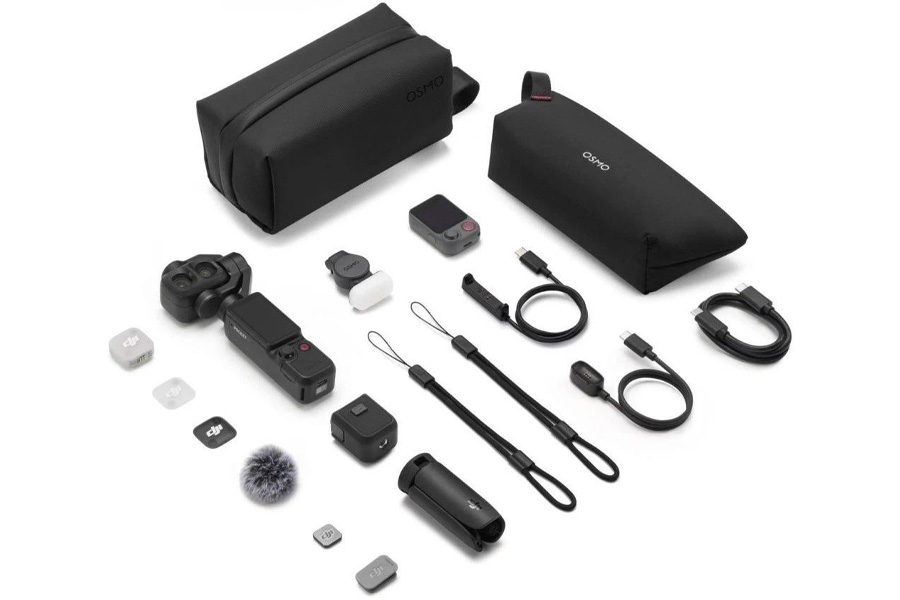
The DJI Osmo Pocket 4P is available starting at €599 in its Standard Bundle. The Standard Pack includes the camera, a grip with a 1/4-inch threaded mount, a wrist strap, a carrying pouch, a USB-C cable, and the new magnetic fill light, now included as standard. Powered directly by the camera, the light offers three brightness levels and three color temperatures—a real bonus for selfies, vlogs, or indoor shots.
DJI also offers a Vlog Bundle for €689. In addition to everything included in the Standard Pack, this bundle includes a DJI Mic Mini 2 with accessories, a mini tripod, a more spacious carrying case, and the new FrameTap.
While the Standard Pack will suit most users, the Vlog Bundle is geared more toward content creators who want a more complete set of equipment right from the start. The addition of the wireless microphone and mini tripod makes it a particularly attractive option for those who film regularly.
Accessories and compatibility
Good news for Osmo Pocket 4 owners: the Pocket 4P remains compatible with most accessories from the previous generation. This means that grips, tripods, and many other accessories can still be used, helping to keep the cost of a potential upgrade down.
Among the new features is the FrameTap, a remote control included with the Vlog Bundle. It allows you to control the gimbal remotely, start recording, and quickly access certain camera functions. This is a particularly handy accessory for content creators who film themselves solo or regularly use their Pocket 4P on a tripod.
OUR BEST SELLERS - DJI Osmo Pocket 4P


Conclusion: DJI Osmo Pocket 4P—Should You Buy It?
With the Pocket 4P, DJI isn’t just upgrading its pocket camera—the brand is taking things to the next level by introducing a dual-lens system to the Osmo Pocket lineup for the first time. This advancement truly transforms the shooting experience by offering more creative possibilities, whether you’re taking portraits with a beautiful blurred background (bokeh effect), experimenting with different framing options, or using a true telephoto lens to film subjects farther away.
Beyond its dual-camera setup, the Pocket 4P retains everything that has made the Osmo Pocket lineup so successful: excellent image quality, highly effective subject tracking, a comfortable battery life, and an accessory ecosystem that’s as comprehensive as ever. The introduction of the new D-Log 2 profile is also a particularly interesting development for content creators looking for greater flexibility during post-production color grading.
Of course, this new generation isn’t without its compromises. Its size and weight have increased slightly due to the addition of a second camera module, while the maximum resolution remains limited to 4K. These choices may disappoint some users, but they seem to have allowed DJI to prioritize image quality over a mere race for more pixels.
All in all, the DJI Osmo Pocket 4P stands out as one of the most sophisticated pocket cameras on the market. Faced with increasingly stiff competition—particularly with the arrival of the Insta360 Luna Ultra—DJI offers a highly versatile camera, whose image quality is undoubtedly one of its main selling points.
Who is the DJI Osmo Pocket 4P designed for?
The DJI Osmo Pocket 4P is primarily aimed at content creators, vloggers, travelers, and, more generally, anyone looking for a compact camera capable of delivering excellent image quality without the hassle of a bulkier device.
Its pocket-sized design, three-axis mechanical stabilization, exceptionally effective subject tracking, and new telephoto lens also make it an ideal solution for people who film themselves or want to easily vary their shots. Fans of portraits, cinematic videos, or close-ups will especially appreciate the new possibilities offered by this dual-camera system.
It’s also a good choice for users looking for a more versatile alternative to a traditional action camera. Whereas a camera like the GoPro focuses primarily on sports and extreme shooting, the Pocket 4P places greater emphasis on image quality, subject tracking, audio recording, and ease of use in everyday situations.
I already have the DJI Osmo Pocket 4: Should I upgrade to the Pocket 4P?
If you already own a DJI Osmo Pocket 4, the answer will depend mainly on how you use it.
If you mainly shoot with the wide-angle lens and your Pocket 4 already meets your needs perfectly, there’s probably no rush to upgrade. The two cameras share many features, particularly in terms of stabilization, ergonomics, and battery life.
On the other hand, if you’re looking for more creative possibilities, the Pocket 4P has a lot to offer. Its 3× telephoto lens, new zoom capabilities, and D-Log 2 profile open the door to a wider variety of shots and provide greater freedom in post-production.
In short, the Pocket 4P isn’t just an upgrade from the Pocket 4—it’s a more ambitious version, designed for users who want to take their video creation to the next level. If these new features meet your needs, upgrading is definitely worth it.
💡 See also
➡️ Hesitating between it and its main competitor? Discover our DJI Osmo Pocket 4P vs Insta360 Luna Ultra comparison.
➡️ Want to check out the single-lens version of this fourth-generation model? Check out our review of the DJI Osmo Pocket 4, and discover our DJI Osmo Pocket 4P vs Pocket 4 comparison.
➡️ Not sure which generation to choose? Check out our DJI Osmo Pocket 3 or 4 comparison.

 Blog
Blog