
 Français
 Deutsch
 Español
 Italiano
 Parts & Accessories by Drone
 Drones
 Action camera
 Microphones
 Camera Stabilizers
 VR Headsets
DJI Osmo Pocket 4P vs. Insta360 Luna Ultra: Which One Should You Choose?
Aug
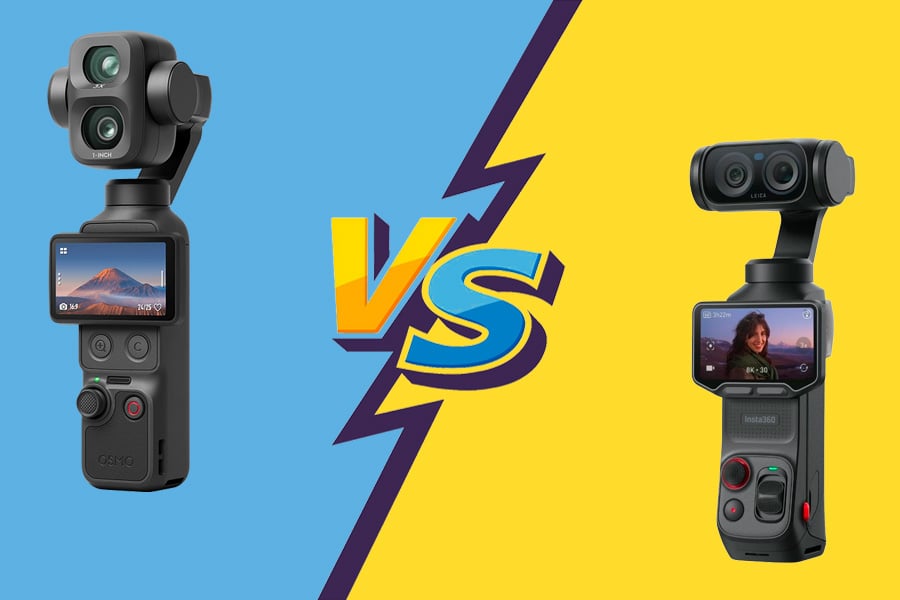
With the Insta360 Luna Ultra and the DJI Osmo Pocket 4P launching just a few weeks apart, the market for stabilized pocket cameras is undergoing one of its most significant shifts in several years. For the first time, two dual-camera models are in direct competition, both with the same goal: to offer more creative possibilities while remaining compact enough to take anywhere. But which one delivers the best image quality? Which one offers the best balance of features, battery life, and price? And most importantly, which one best meets your needs? In this DJI Osmo Pocket 4P vs. Insta360 Luna Ultra comparison, we’ll pit the two cameras against each other point by point to determine which one truly deserves your preference.
DJI Osmo Pocket 4P vs. Insta360 Luna Ultra: Key Takeaways
Don’t have time (or just can’t be bothered 😅) to read it all? Here are the key differences to keep in mind between the DJI Osmo Pocket 4P and the Insta360 Luna Ultra 👇
- 📱 Both cameras are very similar in size and weight, but the Luna Ultra stands out thanks to its detachable OLED screen—which can be used as a monitor, remote control, and even a wireless microphone—as well as its particularly handy dedicated zoom slider.
- 🔋 The Luna Ultra offers the longest battery life, with up to 240 minutes of recording time compared to 210 minutes for the Pocket 4P. The Pocket 4P, however, charges a little faster, reaching 80% in 18 minutes compared to 23 minutes.
- 🤖 Both cameras offer a particularly comprehensive set of features, including powerful subject tracking, a wide range of shooting modes, and the ability to connect wireless microphones directly. It’s hard to really tell them apart in this regard.
- 🎥 The Pocket 4P has the edge in image quality, with more natural rendering, greater detail, a particularly impressive telephoto lens, and more advanced post-production capabilities—thanks in large part to D-Log 2. The Luna Ultra, however, stands out for its excellent image processing software and its PureVideo mode, which is particularly effective in low light.
- 🎬 The Luna Ultra is the only one that can record up to 8K at 30 fps, while the Pocket 4P is significantly more impressive for slow-motion footage, offering 4K at up to 240 fps on its wide-angle lens and 200 fps on its telephoto lens.
- 💸 The Pocket 4P is significantly more affordable, starting at €599 compared to €729 for the Luna Ultra. The price difference is as high as €240 between the DJI Vlog Bundle at €689 and the Insta360 Creator Pack at €929.
📌 The DJI Osmo Pocket 4P is the most compelling choice for those who prioritize image quality, creative possibilities, and value for the money above all else. The Luna Ultra remains an excellent alternative for those who place greater importance on ergonomics, its detachable screen, and images that are ready to use right away.
DJI Osmo Pocket 4P vs. Insta360 Luna Ultra: Design
| DJI Osmo Pocket 4P | Insta360 Luna Ultra | |
| Dimensions (L x W x H) | 159.5 × 63.3 × 33.5 mm | 169.9 × 52.4 × 38.5 mm |
| Weight | 230 g | 233 g (black) to 235 g (white) |
| Touch screen | Size: 2.0 inches Resolution: 556 × 314 Brightness: 1000 nits | Size: 2.0 inches Type: Detachable OLED |
| Storage | 103 GB built-in memory microSD card (up to 1 TB) | 47 GB built-in memory microSD card (up to 1 TB) |
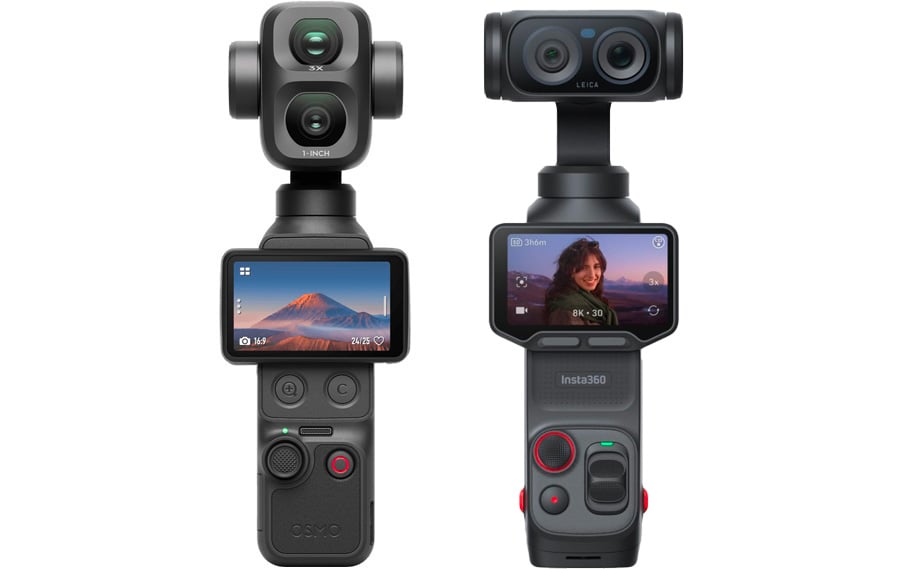
Both cameras feature a fairly similar design, with a compact vertical form factor, a three-axis stabilized gimbal, and a large dual-lens module at the top. The DJI Osmo Pocket 4P is, however, the more compact of the two, measuring 159.5 × 63.3 × 33.5 mm, compared to 169.9 × 52.4 × 38.5 mm for the Luna Ultra. The difference in weight, on the other hand, is virtually negligible: 230 g for the Pocket 4P versus 233 to 235 g for the Luna Ultra, depending on the color chosen. In both cases, these cameras are compact and lightweight enough to be easily carried around on a daily basis.
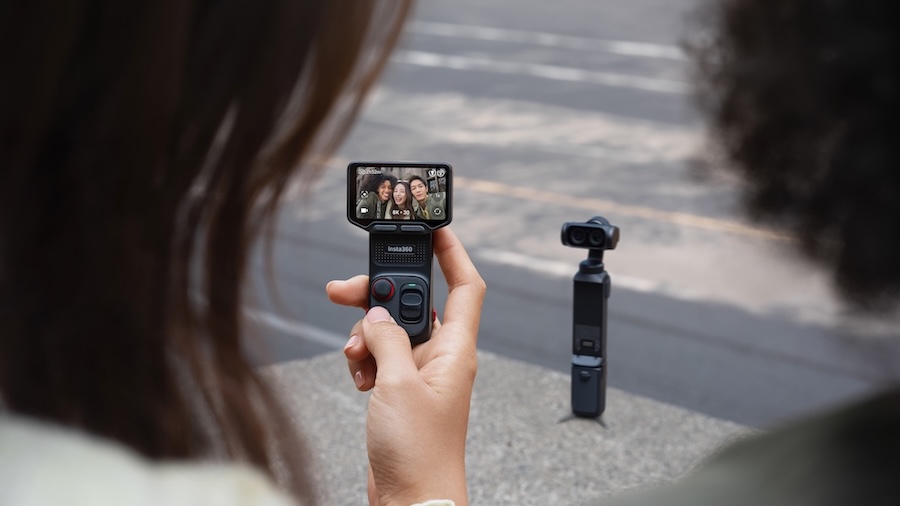
It’s especially in terms of the screen that Insta360 stands out. Both models feature a 2-inch OLED touchscreen, but the Luna Ultra’s screen is fully detachable. Once removed, it can serve as a remote control and a remote live view, allowing you to frame your shot and control the camera when it’s mounted on a tripod or out of reach. It can even function as a wireless microphone. In practice, this system proves particularly convenient and is one of the Luna Ultra’s key ergonomic advantages . The Pocket 4P, meanwhile, retains its rotating screen, which allows you to quickly switch between horizontal and vertical orientations and turn the camera on or off by rotating it.
The physical controls are also quite similar, notably featuring a joystick for controlling the gimbal and several buttons that provide quick access to key functions. The Luna Ultra, however, has a slider specifically dedicated to zooming, whereas the Pocket 4P uses its joystick for this purpose. Several comparative tests highlight that the Insta360 solution allows for more gradual and fluid zooming in and out, which again gives it a slight edge in terms of ergonomics. The Pocket 4P nevertheless retains a particularly intuitive user experience, notably featuring two additional buttons accessible when the screen is in landscape mode, one of which is customizable.
Finally, DJI clearly takes the lead when it comes to internal storage. The Pocket 4P comes with 103 GB of storage, more than double the 47 GB offered by the Luna Ultra. Fortunately, both cameras have a microSD slot compatible with cards up to 1 TB, which makes this difference much less significant when a memory card is used.
🏆 Insta360 Luna Ultra: Detachable screen and more convenient zoom control, despite being slightly larger.
Check out our accessories for the
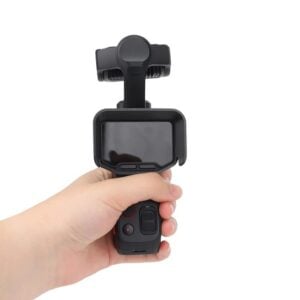
DJI Osmo Pocket 4P
DJI Osmo Pocket 4P vs. Insta360 Luna Ultra: Battery Life and Charging
| DJI Osmo Pocket 4P | Insta360 Luna Ultra | |
| Battery | 1545 mAh | 1,550 mAh |
| Autonomy | 210 minutes | 240 minutes |
| Recharge time | 18 min up to 80%, 32 min up to 100%. | 23 minutes to 80% |
Both cameras feature batteries with nearly identical capacities: 1,545 mAh for the DJI Osmo Pocket 4P and 1,550 mAh for the Insta360 Luna Ultra. The difference is therefore negligible on paper, but it proves to be more significant in terms of battery life. Insta360 claims up to 240 minutes of recording time , compared to 210 minutes for the Pocket 4P—4 hours and 3 hours and 30 minutes, respectively.
However, these figures were obtained under specific test conditions, with recording at 1080p at 24 frames per second. In real-world use, battery life will naturally vary depending on resolution, frame rate, screen usage, and wireless connections. In both cases, battery life remains excellent for such compact cameras, but the Luna Ultra retains a theoretical advantage of about 30 minutes.
There is, however, one unique feature to keep in mind with the Luna Ultra: its detachable screen has its own 210-mAh battery. Insta360 does not provide an official battery life estimate for it, but early feedback suggests it lasts about 30 minutes when used continuously as a remote live view monitor. This limitation obviously applies only to the screen when it is detached and does not affect the camera’s overall battery life.
The Pocket 4P, on the other hand, has the edge when it comes to charging. It reaches 80% in just 18 minutes, compared to 23 minutes for the Luna Ultra. DJI also reports a full charge time of 32 minutes, while Insta360 does not provide a comparable figure. In both cases, however, fast charging allows you to recharge a significant portion of the battery in about 20 minutes.
🏆 Insta360 Luna Ultra: up to 30 additional minutes of battery life, despite slightly slower charging.
DJI Osmo Pocket 4P vs. Insta360 Luna Ultra: Features
| DJI Osmo Pocket 4P | Insta360 Luna Ultra | |
| Photo modes | Standard Photo, Panorama, Self-Timer, Live Photo | Photo (Standard/UltraPhoto), Live Frame, Panorama |
| Video modes | Standard Video, ActiveTrack 8.0 Subject Tracking, Slow Motion, Time-Lapse, Motion-Lapse, Hyperlapse, Low-Light Video, Slow Shutter Speed Video, Live Streaming | Standard Video, PureVideo, Slow Motion, Time-Lapse, TimeShift, Barrel Roll |
| Audio modes | Spatial Audio, Audio Zoom, 4-Channel Recording (with DJI Mic via OsmoAudio) | Wind reduction, voice enhancement, original audio |
| Number of microphones | 3 | 4 (3 on the stabilizer + 1 on the detachable screen) |
Photo and video modes
Both cameras offer a particularly comprehensive range of shooting modes, though their approaches differ slightly. Both include the main modes you’d expect, such as Panorama, Slow Motion, and Time-Lapse, to which each manufacturer adds its own features.
The DJI Osmo Pocket 4P features Motionlapse andHyperlapse, as well as aSlow Shutter Video mode that lets you create motion effects or light trails. It also features a Low-Light Video mode and retains the ability to stream live directly through the DJI Mimo app. On the photo side, its Live Photo mode lets you capture a short clip around the moment the shutter is released.
The Luna Ultra offers several unique features. Its PureVideo mode uses AI-assisted processing to enhance low-light shots, while TimeShift lets you create time-lapse sequences in motion. More uniquely, the Barrel Roll mode uses the gimbal to automatically rotate the frame, inspired by FPV shots. It also offers Live Frame for photos, but does not currently support Motionlapse.
On this point, it’s hard to truly decide between the two cameras. The Pocket 4P and the Luna Ultra both offer a particularly wide range of modes, with a few exclusive features that might tip the scales depending on each person’s preferences.
Subject follow-up
The Pocket 4P features ActiveTrack 8.0, while the Luna Ultra uses Deep Track 5.0. In both cases, tracking remains active across different zoom levels, allowing you to adjust your framing without automatically losing the subject.
Both systems also offer advanced features. ActiveTrack 8.0, for example, improves group shot management by detecting people who enter the frame, while Deep Track 5.0 allows you to precisely select the subject’s position using a grid of nine locations. This means the subject does not necessarily have to remain in the center of the frame, which offers greater freedom in composition.
In practice, both tracking systems have proven to be particularly effective. Some comparative tests have noted slightly smoother motion with the Pocket 4P, while the Luna Ultra can sometimes be more responsive. However, these are subtle differences that can vary depending on the shooting situation and do not allow for a clear determination of which system is superior.
Audio
Audio recording relies on three microphones built into the body of each of the two cameras. When recording up close, their audio quality is very similar, with no difference significant enough to truly distinguish between them.
Both manufacturers also allow users to pair their cameras with their own wireless microphones. The Pocket 4P can connect directly to the DJI Mic via OsmoAudio, without requiring an external receiver, while the Luna Ultra is compatible with the Insta360 Mic Air and Mic Pro. DJI stands out in particular for its ability to record up to four channels simultaneously, as well as for its Spatial Audio and Audio Zoom features. Insta360, on the other side, offers several built-in processing features, including wind reduction and voice enhancement.
The Luna Ultra does, however, have one interesting feature: a fourth microphone is built directly into its detachable screen. This allows it to be placed close to the user and used as a wireless microphone when the camera is filming from a distance, without having to immediately use an external microphone.
🤝 A tie: It’s hard to choose between the two cameras, both of which are exceptionally well-rounded and high-performing.
OUR BEST SELLERS - DJI Osmo Pocket 4P


DJI Osmo Pocket 4P vs. Insta360 Luna Ultra: Image
| DJI Osmo Pocket 4P | Insta360 Luna Ultra | |
| Sensors | Wide-angle: 1-inch Telephoto: 1/1.28-inch | Wide-angle: 1-inch Telephoto: 1/1.3-inch |
| Objectives | Wide-angle: 20 mm f/2.0 Telephoto: 60 mm f/1.8 | Wide-angle: 20 mm f/1.8 Telephoto: 60 mm f/2.0 |
| Clarification | Wide-angle: 9 cm to ∞ Telephoto: 20 cm to ∞ | Wide-angle: 9 cm to ∞ Telephoto: 15 cm to ∞ |
| Photo resolution | Up to 37 MP | Up to 37 MP |
| Video resolution | 4K up to 60 fps 3K vertical up to 60 fps 1080p up to 60 fps | 8K up to 30 fps 4K up to 120 fps 1080p up to 240 fps |
| Idle speed | Wide-angle: 4K up to 240 fps Telephoto: 4K up to 200 fps | 4K up to 120 fps 1080p up to 240 fps |
| Digital zoom | Up to 12× for video Up to 9× for photos | Up to 12× |
| ISO range | Wide-angle: 100 to 25,600 (up to 51,200 in low-light video) Telephoto: 50 to 12,800 (up to 25,600 in low light) | 100 à 6400 |
| Photo format | JPEG / DNG / JPEG+DNG | jpg / jpg+RAW |
| Video format | MP4 (HEVC) | MP4 |
| Color profiles | Normal (10 bits), D-Log (10 bits), D-Log 2 (10 bits) | Standard, Dolby Vision, 10-bit I-Log |
| Max. bit rate | 180 Mb/s | 120 Mb/s |
Sensors and resolutions
Both cameras are mounted on a three-axis mechanical gimbal, one of the features that sets them apart from traditional action cameras. In practice, their stabilization is excellent in both cases, and various tests have not revealed any significant difference between them in this regard.
Their optical designs are also surprisingly similar. Both the DJI Osmo Pocket 4P and the Insta360 Luna Ultra feature a 1-inch main sensor paired with a 20mm-equivalent wide-angle lens, complemented by a 60mm-equivalent telephoto lens. The sensor in the DJI model is very slightly larger, measuring 1/1.28 inch compared to 1/1.3 inch in the Insta360 model—a difference that is, however, minimal.
The aperture settings, however, follow opposite approaches. On the wide-angle lens, the Luna Ultra has a maximum aperture of f/1.8, compared to f/2.0 for the Pocket 4P. With the telephoto lens, the situation is reversed: f/1.8 for DJI and f/2.0 for Insta360. These differences notably affect brightness and background blur, as we’ll see in the section on image quality.
On the side of resolution, the Luna Ultra is the only one of the two capable of shooting in 8K at up to 30 frames per second. This is an interesting option for those seeking maximum resolution or more flexibility when cropping their footage, although the 4K resolution offered by both cameras will remain more than sufficient for most uses.
The Pocket 4P, on the other hand, really stands out when it comes to slow-motion footage. Its wide-angle lens can record in 4K at up to 240 frames per second, compared to 120 fps on the Luna Ultra, allowing for exceptionally smooth slow-motion footage without sacrificing resolution. Even its telephoto lens can reach 200 fps in 4K. The Luna Ultra, however, still offers the option to shoot up to 240 fps in 1080p. On the still photo side, both models offer a maximum resolution of 37 MP.
Finally, the zoom capabilities are very similar on paper. Both cameras offer a 1x wide-angle view, a 2x frame, a true 3x telephoto lens, and then 6x and 12x zoom levels. However, the differences in image quality at these various zoom levels are very real, as we’ll see in the next section.
Image quality
When it comes to image quality, both the DJI Osmo Pocket 4P and the Insta360 Luna Ultra deliver excellent results, but with quite different approaches. In good lighting conditions, the Luna Ultra generally produces a higher-contrast, more pronounced image, with processing that notably enhances sharpness and colors. The Pocket 4P, on the other hand, offers a more natural and softer look, which gives users more flexibility for post-production editing.
This difference is also evident in color reproduction. The Pocket 4P tends to produce more natural and balanced hues, particularly with skin tones, while the Luna Ultra favors a more pronounced and instantly flattering look. This isn’t necessarily a flaw for the Luna Ultra, however: its image may actually appeal more to creators who want to quickly produce a result that’s ready to share, whereas the Pocket 4P seems better suited for videographers seeking a more customizable look.
The differences become even more interesting with the telephoto lens. With its 60 mm equivalent focal length and f/1.8 aperture, the Pocket 4P produces a particularly soft and natural background blur, with a beautiful separation between the subject and its surroundings. The Luna Ultra, whose 60 mm telephoto lens has an f/2.0 aperture, also produces convincing bokeh, but it generally appears less natural and more heavily influenced by image processing. The situation is reversed with the wide-angle lens, since the Luna Ultra has an f/1.8 aperture compared to the Pocket 4P’s f/2.0, allowing it to capture more light and achieve a slightly more pronounced background blur. However, this advantage is less significant at a 20mm focal length, which is better suited for wide shots than for achieving pronounced bokeh.
The Pocket 4P also performs particularly well when you increase the zoom level. While both cameras already offer very good quality with their 3× telephoto lens, available comparisons show that the DJI model generally retains more detail at 6×, with better-defined textures and fine details. The difference remains noticeable at 12×, despite the much greater reliance on digital processing at this magnification level. For users who plan to regularly use long focal lengths, the Pocket 4P therefore has a fairly clear advantage.
In low light, the results are particularly interesting. Without a specific mode, the Pocket 4P generally performs better, with a cleaner image and better detail reproduction as light levels drop. But the balance shifts when the dedicated modes are activated. DJI’s Low-Light Video mode and Insta360’s PureVideo mode both rely heavily on software processing to brighten the image and reduce digital noise, but PureVideo proves particularly effective: in the most challenging scenes, it generally produces a brighter, better-balanced image, with better color preservation and excellent noise handling. The Pocket 4P, however, has an additional advantage for close-up shots thanks to its included magnetic fill light, which is especially useful for lighting a face during a nighttime vlog.
For videographers who want to do more post-production work on their footage, both cameras also offer 10-bit profiles, but DJI goes a step further here. The Luna Ultra features its own I-Log profile, while the Pocket 4P offers Normal, D-Log, and —most notably— D-Log 2 profiles. Available with the main sensor, the D-Log 2 profile utilizes LOFIC technology and allows DJI to claim a dynamic range of up to 17 stops, compared to 14 with the standard D-Log. The Pocket 4P thus offers more possibilities for videographers looking to push the limits of color grading and extract as much detail as possible from both highlights and shadows.
Ultimately, the Pocket 4P has the edge when it comes to optical quality, natural rendering,telephoto capabilities, and detail preservation, while the Luna Ultra stands out more for its software processing and its ability to produce a very flattering image right out of the camera. Its PureVideo mode is a particular highlight in low-light conditions. These are two different approaches, then, and which one you prefer may tip the scales on one side or the other, depending on whether you prioritize control over the final image in post-production or an image that’s immediately ready to use.
🏆 DJI Osmo Pocket 4P: more natural-looking footage, greater detail, and a particularly impressive telephoto lens.
DJI Osmo Pocket 4P vs. Insta360 Luna Ultra: Bundles and Prices
ℹ️ Note: some links in this section are Amazon affiliate links. As Amazon Associates, we earn from qualifying purchases, at no extra cost to you.
| DJI Osmo Pocket 4P | Insta360 Luna Ultra | |
| Standard package | €599 | €729 |
| Premium Package | €689 (Vlog Bundle) | €929 (Creator Pack) |
There is a significant price difference between the two cameras. The DJI Osmo Pocket 4P starts at €599 for the Standard Pack, compared to €729 for the Insta360 Luna Ultra—a difference of €130. Both cameras are clearly high-end models, but the Pocket 4P is still significantly more affordable.
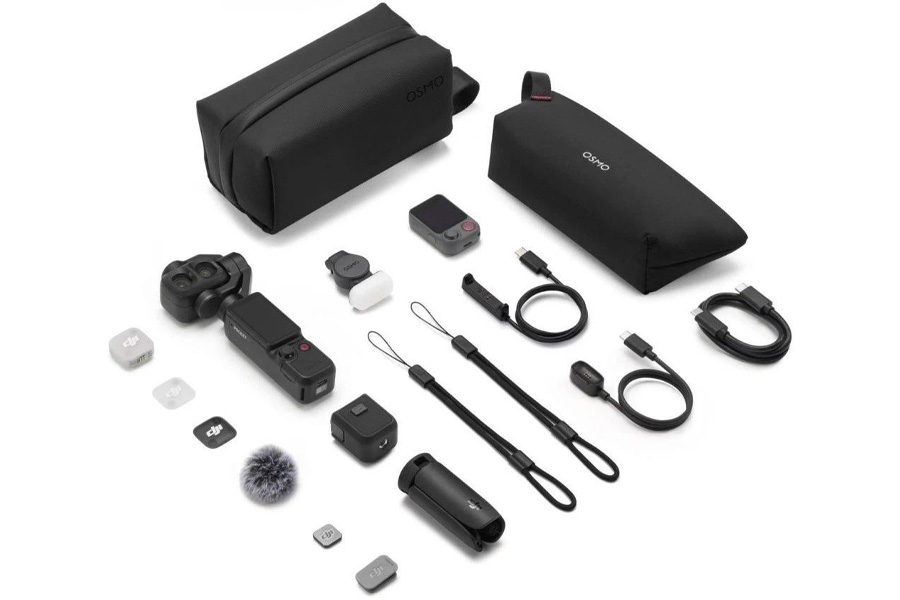
The contents of the Standard Packs differ slightly. Both include a handle with a 1/4-inch threaded mount and a wrist strap, but each also has its own small advantage. DJI includes its magnetic fill light, which is particularly handy for vlogs or close-up shots in low light. On the other side, Insta360 chooses to include a protective case—which is missing from the Pocket 4P Standard Pack—as well as a windscreen. The auxiliary light is also available for the Luna Ultra, but it must be purchased separately or obtained with a dedicated bundle.
The price gap widens even further with the premium bundles. At €689, the Pocket 4P Vlog Bundle mainly includes the FrameTap remote control and a DJI Mic Mini 2, plus a mini tripod and a more comprehensive carrying case. The Luna Ultra Creator Pack , priced at €929, includes an Insta360 Mic Pro, a wide-angle lens, and a grip with a built-in battery, as well as a carrying case. Both bundles therefore share the same goal of offering creators a more complete setup, but with quite different accessories and, most notably, a €240 price difference in DJI’s favor.
Insta360, on the other hand, offers a much wider selection of bundles. In addition to the Standard and Creator Bundles, the Luna Ultra is available in several themed configurations, including the Endurance, Essentials, Vlog, Fill Light, and POV bundles. DJI is keeping things much simpler for now, offering only the Standard Bundle and the Pocket 4P Vlog Bundle.
🏆 DJI Osmo Pocket 4P: significantly less expensive, whether you choose the standard bundle or the premium bundle.
Check out our accessories for
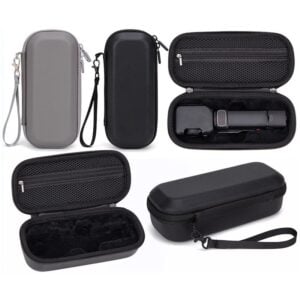
Insta360 Luna Ultra
Conclusion: DJI Osmo Pocket 4P vs. Insta360 Luna Ultra—Which One Should You Choose?
The DJI Osmo Pocket 4P and the Insta360 Luna Ultra have established themselves as the two leading models in the stabilized pocket camera market. Very similar in design—both featuring a mechanical gimbal and a dual-camera setup combining a wide-angle and telephoto lens—they differ primarily in their design philosophy and a few technical choices that can really tip the scales.
The Luna Ultra stands out primarily for its ergonomic design, featuring an excellent detachable screen that can serve as a remote control, video monitor, and even a remote microphone, as well as a dedicated slider that makes controlling the zoom particularly enjoyable. It also boasts slightly longer battery life and highly effective software features, starting with PureVideo, which is particularly effective in low light. Finally, it is the only one of the two capable of shooting in up to 8K.
However, the Pocket 4P has the edge when it comes to overall image quality. Its more natural rendering, better detail retention, excellent telephoto lens, and performance at high zoom levels make it a particularly compelling choice for demanding videographers. It also goes a step further in terms of slow-motion and post-production, thanks in particular to D-Log 2. Above all, its significantly more affordable price compared to the Luna Ultra is a major selling point when making a decision.
Our take: Which one should you choose?
If we had to choose just one, we believe the DJI Osmo Pocket 4P is the most practical choice for most users. It doesn’t outperform its competitor in every area, but it has the edge in two criteria that are particularly important for this type of device: image quality and The price. At €130 less than the Standard Pack, we believe it offers a better balance between image quality, versatility, and price.
The Luna Ultra is nonetheless an excellent alternative and even offers several features we’d like to see from DJI. Its detachable screen is particularly well-designed, its zoom slider truly improves usability, and PureVideo showcases Insta360’s expertise in software processing. Depending on your priorities and filming style, these advantages may well justify its higher price.
Choose the DJI Osmo Pocket 4P if…
- Above all, you’re looking for the best image quality, with a more natural look and greater detail.
- You plan to use the telephoto lens and the various zoom levels on a regular basis.
- You want to take advantage of D-Log 2 and enjoy more post-production options.
- Are you looking for the best balance between performance and price, with a starting price that’s €130 lower?
Choose the Insta360 Luna Ultra if…
- You place a lot of importance on the detachable screen, which can be used as a video monitor, remote control, and even a remote microphone.
- You’d rather getexcellent results straight out of the camera, especially with the outstanding PureVideo mode in low light.
- You want to shoot in up to 8K, a resolution that the Pocket 4P doesn’t offer.
💡 To learn more, check out our in-depth reviews of both cameras in this DJI Osmo Pocket 4P vs. Insta360 Luna Ultra comparison:
➡️ Read our detailed review of the DJI Osmo Pocket 4P.
➡️ Check out our detailed review of the Insta360 Luna Ultra.
OUR BEST SELLERS - Insta360 Luna Ultra
Accessories
Insta360 Luna Ultra
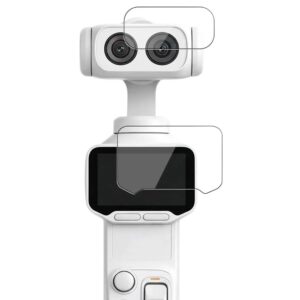
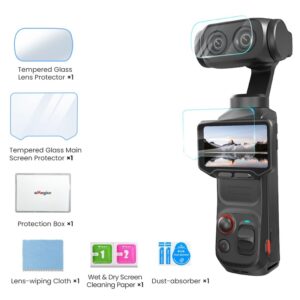
Tempered Glass Screen and Lens Protectors for the Insta360 Luna Ultra
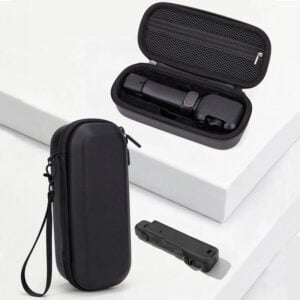
Insta360 Luna Ultra
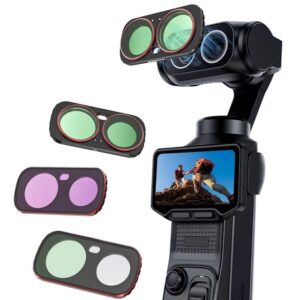
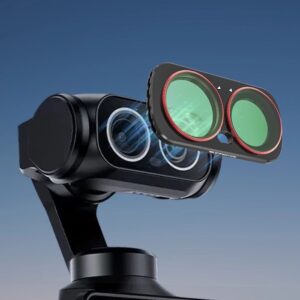
Insta360 Luna Ultra
Sunnylife Magnetic Camera Lens Filters (UV / CPL / ND / Black Mist) for Insta360 Luna Ultra

 Blog
Blog