
 Français
 Deutsch
 Español
 Italiano

 Parts & Accessories by Drone
 Drones
 Action camera
 Microphones
 Camera Stabilizers
 VR Headsets
DJI Osmo Pocket 4 vs. Pocket 3: What Are the Differences?
Jun
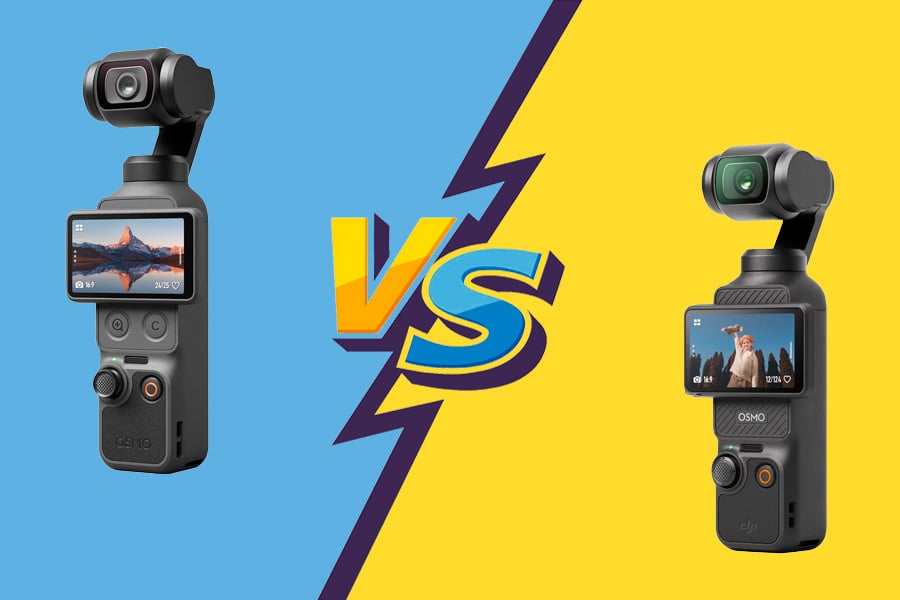
Since its launch in 2023, the DJI Osmo Pocket 3 has established itself as one of the leading pocket cameras for vloggers and content creators. Three years later, DJI is finally introducing a successor with the arrival of the highly anticipated Osmo Pocket 4. But what new features does this new generation offer? What are the differences between the DJI Osmo Pocket 4 and the Pocket 3? And most importantly, is it really worth it for Osmo Pocket 3 owners to upgrade to the Pocket 4? Find all the answers in this DJI Osmo Pocket 4 vs. Pocket 3 comparison.
DJI Osmo Pocket 4 vs. Pocket 3: Key Takeaways
Don’t have time (or just can’t be bothered 😅) to read it all? Here are the main differences between the DJI Osmo Pocket 4 and the DJI Osmo Pocket 3 👇
- 📏 Design: The two models are very similar in size, but the Pocket 4 is slightly larger, heavier, and features new physical controls
- ☀️ Display: 2-inch rotating touchscreen on both cameras, but brightness increased to 1,000 nits on the Pocket 4 compared to 700 nits on the Pocket 3
- 💾 Storage: 107 GB of internal storage on the Pocket 4, compared to no built-in storage on the Pocket 3
- 🔋 Battery life: up to 240 minutes on the Pocket 4, compared to 166 minutes on the Pocket 3
- 🎬 Slow motion: 4K at up to 240 fps on the Pocket 4, compared to 120 fps on the Pocket 3
- 🎯 Subject Tracking: ActiveTrack 7.0 on the Pocket 4 vs. ActiveTrack 6.0 on the Pocket 3
- 🎤 Audio: Spatial Audio and Zoom Audio—exclusive to the Pocket 4
- 🌙 Low light: Better performance in dark scenes on the Pocket 4
- 🎨 Colorimetry: 10-bit D-Log profile on the Pocket 4 versus D-Log M on the Pocket 3
- 💸 Price: The Pocket 3 has become significantly more affordable since the release of the Pocket 4
📌 Verdict: The Pocket 4 is the better camera of the two, but the Pocket 3 is probably still the best choice for those looking for the best value for the money.
DJI Osmo Pocket 4 vs. Pocket 3: Design
| DJI Osmo Pocket 4 | DJI Osmo Pocket 3 | |
| Dimensions (L x W x H) | 144.2 × 44.4 × 33.5 mm | 139.7 x 42.2 x 33.5 mm |
| Weight | 190,5 g | 179 g |
| Touch screen | Size: 2 inches Resolution: 556 × 314 Brightness: 1000 nits | Size: 2 inches Resolution: 314 x 556 Brightness: 700 nits |
| Storage | 107 GB built-in memory microSD card (up to 1 TB) | Micro SD card (up to 1 TB) |
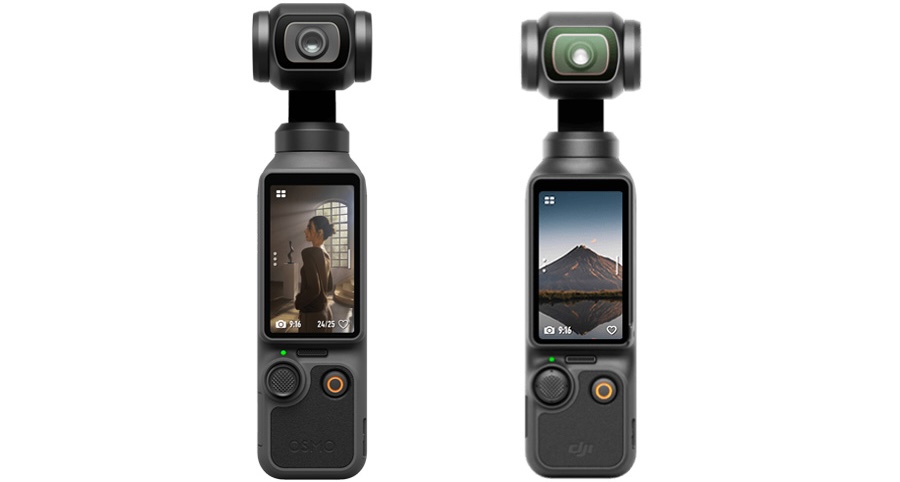
At first glance, it’s hard to tell these two cameras apart. DJI has stayed true to its design philosophy, featuring a camera mounted on a three-axis stabilized gimbal, a 2-inch rotating screen, and a pocket-sized, easy-to-carry design. The differences in dimensions are also very minor: the Pocket 4 is slightly taller and a bit heavier, weighing 190.5 g compared to 179 g for the Pocket 3.
One of the most noticeable changes is the display. Both models feature a 2-inch OLED touchscreen that can rotate between landscape and portrait modes, but the Pocket 4 now boasts a brightness of 1,000 nits, up from 700 nits previously. This is a welcome improvement for users who regularly film outdoors or in bright sunlight.
DJI has also revised several ergonomic features in this new generation. Notably, the Pocket 4 features two additional physical buttons below the screen when used in landscape mode: a dedicated zoom button and a customizable button that can trigger different actions depending on how many times it is pressed. The joystick has also been improved and now allows for more precise control of the gimbal’s movements.
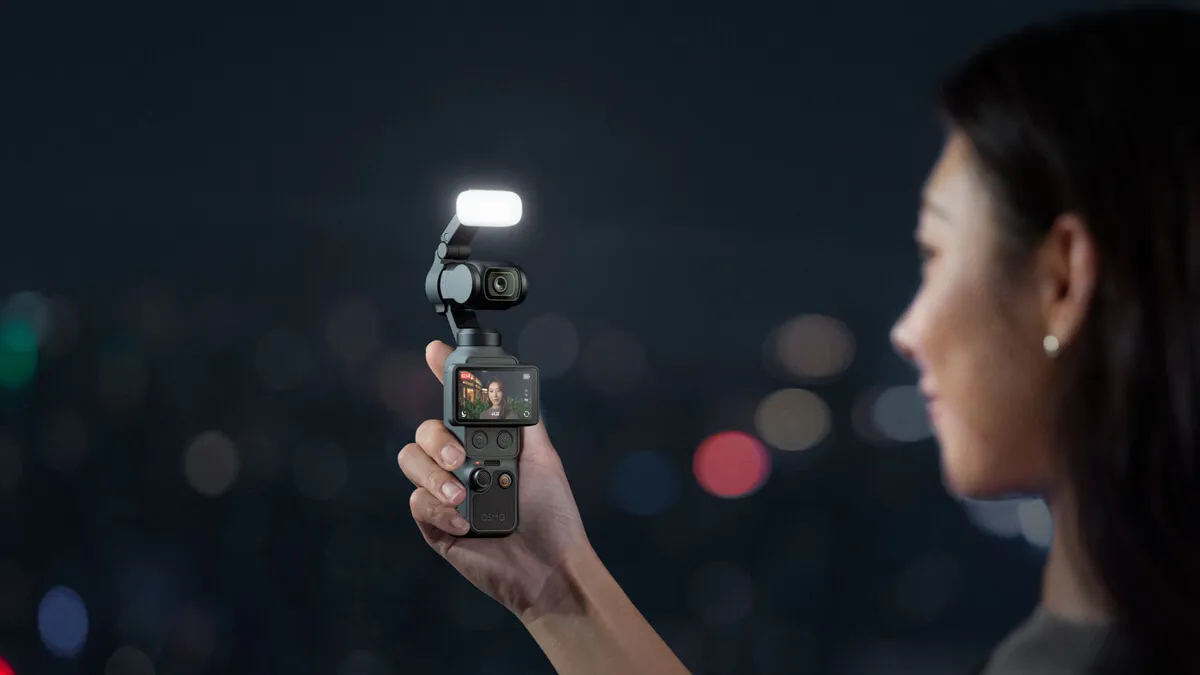
The Pocket 4 also introduces a magnetic system with connectors on the gimbal arm to accommodate the new auxiliary light included in certain bundles. This feature, which was absent from the Pocket 3, further enriches the accessory ecosystem of this new generation.
Finally, the most noticeable difference in everyday use is probably related to storage. While the Pocket 3 relies exclusively on a microSD card with a capacity of up to 1 TB, the Pocket 4 comes with 107 GB of built-in storage in addition to its microSD slot, which supports cards up to 1 TB. This is a particularly handy feature that lets you keep filming even if you’ve forgotten your memory card or it’s full.
🏆 DJI Osmo Pocket 4: a brighter screen, improved ergonomics, and 107 GB of internal storage.
Discover our accessories for
DJI Osmo Pocket 4
DJI Osmo Pocket 4 vs. Pocket 3: Battery Life and Charging
| DJI Osmo Pocket 4 | DJI Osmo Pocket 3 | |
| Battery | 1545 mAh | 1,300 mAh |
| Autonomy | 240 minutes | 166 minutes |
| Recharge time | 18 min up to 80%, 32 min up to 100%. | 16 minutes to 80%, 32 minutes to 100% |
Battery life is one of the areas where the DJI Osmo Pocket 4 has improved the most compared to the Pocket 3. DJI has increased the battery capacity from 1,300 mAh to 1,545 mAh—an increase of about 20%—which directly translates to longer battery life in the field.
According to figures released by the manufacturer, the Pocket 4 can record for up to 240 minutes, compared to 166 minutes for the Pocket 3. Although these figures were obtained under specific test conditions, the difference remains significant and ranks the Pocket 4 among the longest-lasting pocket cameras on the market.
This extra battery life could prove particularly useful during trips, filming days, or long vlogging sessions, when it isn’t always possible to easily recharge the camera between shots.
Charging, however, remains very similar between the two generations. Both models take 32 minutes to fully charge, while the Pocket 3 reaches 80% battery capacity in 16 minutes, compared to 18 minutes for the Pocket 4. This difference is negligible in practical use, as both cameras offer particularly fast charging times.
🏆 DJI Osmo Pocket 4: up to 240 minutes of battery life, compared to 166 minutes for the Pocket 3.
DJI Osmo Pocket 4 vs. Pocket 3: Features
| DJI Osmo Pocket 4 | DJI Osmo Pocket 3 | |
| Photo modes | Panorama, Self-timer | Panorama, Self-timer |
| Video modes | ActiveTrack 7.0 subject tracking, Slow motion, Timelapse, Motionlapse, Hyperlapse, Low light video, Slow shutter video | ActiveTrack 6.0 Subject Tracking, Slow Motion, Time-Lapse, Motion-Lapse, Hyperlapse, Low-Light Video |
| Audio modes | Spatial audio, Zoom audio, 4-channel recording (with DJI Mic) | – |
| Number of microphones | 3 | 3 |
Photo and video modes
Both cameras already offer a very comprehensive set of features, including Panorama, Self-Timer, Timelapse, Motionlapse, Hyperlapse, and a Low-Light Video mode designed to improve results in dark scenes. Overall, the user experience remains quite similar between the two generations.
The Pocket 4 stands out, however, thanks to several new features. Notably, it introduces a Slow Shutter Video mode, which allows you to manually adjust the shutter speed up to 4 seconds to create motion blur or light trail effects. DJI has also improved the zoom, which can now be used in more shooting modes and during video recording.
Another major improvement involves slow motion. While the Pocket 3 was limited to 120 fps in 4K, the Pocket 4 can now reach 240 fps in 4K, offering slow-motion footage up to eight times slower while maintaining excellent image quality.
Finally, the Pocket 4 offers faster file transfers thanks to its support for Wi-Fi 6 andUSB 3.1, whereas the Pocket 3 falls a bit short in this regard.
Subject follow-up
The Pocket 3 already features an excellent tracking system thanks to ActiveTrack 6.0, which can effectively track a person or object in a variety of situations. The Pocket 4, however, takes things a step further with the introductionof ActiveTrack 7.0 and expanded compatibility with more shooting modes.
DJI has also retained the gesture control features that allow users to start recording or activate remote tracking with a simple hand gesture. These features are particularly useful for vloggers and content creators who film themselves.
Audio
Both cameras feature three built-in microphones and can be paired with DJI Mic wireless microphones. The Pocket 4, however, adds several new features withSpatial Audio, designed to enhance immersion when listening through headphones, as well as an Audio Zoom feature that gradually amplifies sounds from the subject as the user zooms in.
🏆 DJI Osmo Pocket 4: ActiveTrack 7.0 and new audio features.

Discover our accessories for
DJI Osmo Pocket 3
DJI Osmo Pocket 4 vs. Pocket 3: Image
| DJI Osmo Pocket 4 | DJI Osmo Pocket 3 | |
| Sensor | 1-inch CMOS | 1-inch CMOS |
| Objective | 20mm equivalent, f/2.0 aperture | 20mm equivalent, f/2.0 aperture |
| Photo resolution | 33 MP (16:9), 38 MP (1:1) | 8 MP (16:9), 9.4 MP (1:1) |
| Video resolution | 4K up to 60 fps 3K vertical up to 60 fps 1080p up to 60 fps | 4K up to 600 fps 2.7K up to 60 fps 3K vertical up to 60 fps 1080p up to 60 fps |
| Idle speed | 4K up to 240 fps 1080p up to 240 fps | 4K up to 120 fps 2.7K up to 120 fps 1080p up to 240 fps |
| Digital zoom | 4× (video) 2× (photo) | 2x |
| ISO range | 50 à 25600 | 50 to 16,000 |
| Photo format | JPEG / DNG / JPEG+DNG | JPEG / JPEG+DNG |
| Video format | MP4 (HEVC) | MP4 (H.264/HEVC) |
| Color profiles | Normal (10 bits), D-Log (10 bits) | Normal (8- or 10-bit), HDR HLG (10-bit), D-Log M (10-bit) |
| Max. bit rate | 180 Mb/s | 130 Mb/s |
Sensors and resolutions
In terms of hardware, the two cameras are very similar. The DJI Osmo Pocket 4 retains the same 1-inch CMOS sensor and the same 20mm-equivalent lens with an f/2.0 aperture as the Pocket 3. DJI has therefore chosen not to alter the formula that was largely responsible for the success of the previous generation.
The main difference lies in the photo resolution. The Pocket 4 can capture images up to 38 MP in square format (1:1) and 33 MP in 16:9 format, compared to 9.4 MP and 8 MP , respectively, on the Pocket 3.
On the video side, both models offer recording up to 4K at 60 fps in standard mode, as well as a 3K vertical mode at 60 fps designed for social media. However, the gap widens on the side of slow-motion. While the Pocket 3 is limited to 120 fps in 4K, the Pocket 4 can now reach 240 fps in 4K, offering slow-motion footage up to eight times slower while maintaining excellent image quality.
The Pocket 4 also features a maximum video bitrate of 180 Mb/s, compared to 130 Mb/s on the Pocket 3, allowing it to preserve more detail in complex or highly detailed scenes.
Image quality
Under good lighting conditions, both cameras deliver excellent image quality. Thanks to their 1-inch sensors, they produce detailed images with good color reproduction and very impressive sharpness. The differences between the two generations remain relatively subtle in this type of situation.
The differences become more apparent in high-contrast or low-light scenes, where the Pocket 4 clearly has the edge. Initial comparisons show better dynamic range handling, with more detail preserved in both the highlights and the darkest areas of the image.
The Pocket 4 also improves low-light performance. Its redesigned Low-Light Video mode produces a brighter image, with better noise control and more detail in dark scenes. This is a significant advantage for creators who regularly film indoors or after sunset.
Another significant development concerns color profiles. The Pocket 3 already offered HLG and D-Log M profiles, which provide a certain amount of latitude in post-production. However, the Pocket 4 introduces 10-bit D-Log, DJI’s most advanced color profile. This gives the most demanding users greater flexibility to adjust colors, highlights, and shadows during color grading.
Finally, the Pocket 4 introduces several preset cinematic looks , a new feature not found on the Pocket 3. These filters allow you to quickly achieve different visual styles directly from the camera, without having to go through an editing or color grading process.
🏆 DJI Osmo Pocket 4: Best low-light performance, 10-bit D-Log profile, and 4K slow motion up to 240 fps.
DJI Osmo Pocket 4 vs. Pocket 3: Bundles and Prices
ℹ️ Note: some links in this section are Amazon affiliate links. As Amazon Associates, we earn from qualifying purchases, at no extra cost to you.
| DJI Osmo Pocket 4 | DJI Osmo Pocket 3 | |
| Standard package | 499 € | 369 € |
| Creator Pack | 619 € | 469 € |
| Other theme packs | From €523 to €627 | From €402 to €528 |
Which bundle should you choose?
Since the release of the DJI Osmo Pocket 4, the Osmo Pocket 3 has become significantly more affordable than it was at launch. It is now a particularly appealing option for users who want to enjoy the Osmo Pocket experience while staying within a limited budget.
The standard version of the DJI Osmo Pocket 4 starts at €499, compared to €369 for the Pocket 3. This price difference is also reflected in the Creator Packs, priced at €619 and €469, respectively . The various themed bundles follow the same trend, with prices generally higher for the new generation.
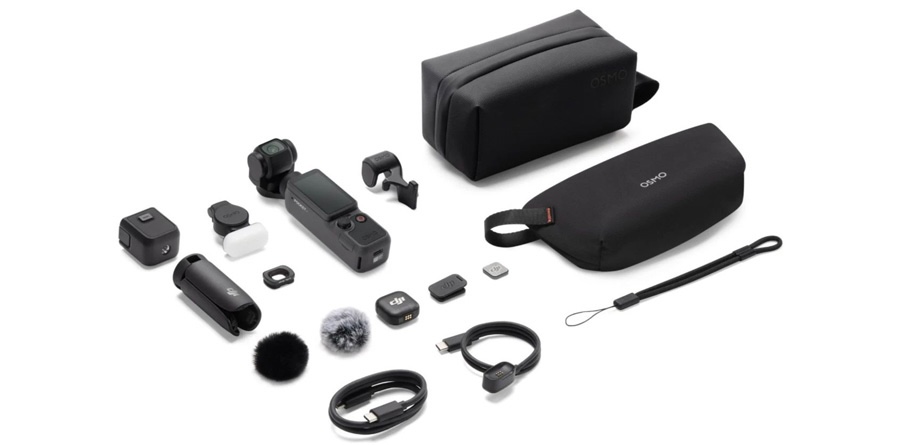
In both cases, the Standard Pack includes everything you need to start filming: a camera, a grip with a 1/4” thread, a gimbal protector, a wrist strap, and charging accessories. The Creator Packs, on the other hand, add several accessories that are particularly useful for content creators, such as a DJI Mic, a wide-angle lens, a mini tripod, and a more comprehensive carrying case.
The Pocket 4 stands out, however, with the addition of a new magnetic fill light, available in certain bundles such as the Creator Pack. Powered directly by the camera, it offers several brightness levels and color temperatures to improve shots taken indoors or in low light.
Accessory compatibility
Good news if you already own an Osmo Pocket 3: most accessories remain compatible with the Pocket 4. Handles, mini tripods, DJI Mic transmitters and accessories using the standard 1/4-inch thread can all continue to be used. However, some accessories designed specifically for the Pocket 4, such as the new magnetic fill light, rely on its integrated magnetic connectors and are therefore not compatible with the Pocket 3.
🏆 DJI Osmo Pocket 3: Prices are now much more affordable, while its features remain very similar to those of the Pocket 4.
OUR BEST SELLERS - DJI Osmo Pocket 4


Action camera


Conclusion: DJI Osmo Pocket 4 vs. Pocket 3—Which One Should You Choose?
The DJI Osmo Pocket 4 builds on the fundamentals that made the Pocket 3 a success while introducing several welcome improvements. It features the same compact design, the same 1-inch sensor, and the same content-creation-focused approach, but with longer battery life, built-in internal storage, improved subject tracking, new audio features, and, most notably, 4K slow-motion at up to 240 fps.
That said, the differences between the two generations are smaller than one might imagine. The Pocket 4 is certainly the better camera of the two, but the Pocket 3 still has a lot going for it, especially since its price has become much more affordable.
💡 Our take: If you’re simply looking for the best pocket camera DJI currently offers, the Pocket 4 is the obvious choice. However, if you’re on a tighter budget, the Pocket 3 is still a great deal and offers an experience that’s actually very similar in many ways.
Should you upgrade from the Osmo Pocket 3 to the Pocket 4?
If you already own a DJI Osmo Pocket 3, the answer mainly depends on how you use it. In most situations, image quality remains very similar between the two generations thanks to their shared 1-inch CMOS sensor. For everyday use such as travel, vlogging, family videos or social media content, the Pocket 3 is still an exceptionally capable camera.
However, the DJI Osmo Pocket 4 becomes a much more compelling upgrade if you want to benefit from 4K slow motion at up to 240 fps, 107 GB of built-in storage, significantly longer battery life, ActiveTrack 7.0, new audio features or improved low-light performance. Rather than being a complete revolution, it is an evolution that refines many aspects of the user experience without fundamentally changing what made the Pocket 3 so successful.
Choose the DJI Osmo Pocket 4 if:
- You want to enjoy 4K slow-motion at up to 240 fps
- You regularly film in low light
- You want to take advantage of the 10-bit D-Log profile to take your post-production to the next level
- You’ll appreciate the improvements in user experience, such as 107 GB of internal storage, longer battery life, and new features
Choose the DJI Osmo Pocket 3 if:
- Are you looking for the best value for your money?
- You don’t need the new features exclusive to the Pocket 4
- You want a camera that’s very similar to the Pocket 4 while saving a significant amount of money
Which camera should you choose based on your needs?
| Your profile | Recommended camera | Why? |
|---|---|---|
| You’re looking for the best value for money | DJI Osmo Pocket 3 | It delivers image quality that remains very close to the Pocket 4 while now being available at a much lower price. |
| You already own an Osmo Pocket 3 | Keep your Osmo Pocket 3 (unless you have specific needs) | Upgrading to the Pocket 4 mainly makes sense if you want internal storage, 4K 240 fps slow motion or ActiveTrack 7.0. |
| You regularly create content for YouTube, TikTok or Instagram | DJI Osmo Pocket 4 | Its longer battery life, built-in storage, improved subject tracking and new audio features make everyday shooting easier. |
| You often shoot in low light | DJI Osmo Pocket 4 | It offers better noise control, a wider dynamic range and the more advanced 10-bit D-Log profile. |
| You want impressive slow-motion footage | DJI Osmo Pocket 4 | It can record in 4K at up to 240 fps, compared with 120 fps on the Pocket 3. |
| You’re new to video creation | DJI Osmo Pocket 3 | It’s still extremely easy to use and delivers excellent image quality at a lower price. |
FAQ – DJI Osmo Pocket 4 vs Pocket 3
What is the main difference between the DJI Osmo Pocket 4 and the Pocket 3?
The DJI Osmo Pocket 4 builds on the Pocket 3 with several significant improvements, including much longer battery life, 107 GB of built-in storage, a brighter display, 4K slow motion at up to 240 fps, ActiveTrack 7.0, and new audio features such as Audio Zoom and Spatial Audio.
Does the DJI Osmo Pocket 4 deliver better image quality than the Pocket 3?
Yes. The Pocket 4 generally delivers better image quality, especially in low-light scenes and high-contrast situations. It also introduces the 10-bit D-Log profile, a higher video bitrate, and 4K recording at up to 240 fps. In good lighting conditions, however, the differences remain relatively subtle, and the Pocket 3 still produces excellent results.
Should you upgrade from the DJI Osmo Pocket 3 to the Pocket 4?
Upgrading is mainly worthwhile if you want features such as built-in storage, longer battery life, 4K slow motion at 240 fps, or ActiveTrack 7.0. If you’re already happy with your Pocket 3 and mostly shoot standard 4K videos, the improvements are noticeable but not essential.
Is the DJI Osmo Pocket 3 still worth buying in 2026?
Yes. Even after the release of the Pocket 4, the Pocket 3 remains an excellent pocket camera. Its 1-inch sensor, three-axis mechanical stabilization, and excellent image quality still make it one of the best options available, especially now that its price has dropped.
Which camera is better for vlogging: the Pocket 3 or the Pocket 4?
Both cameras are excellent for vlogging. However, the Pocket 4 is the better choice for demanding creators thanks to its longer battery life, improved subject tracking, built-in storage, and enhanced audio features. If you’re on a tighter budget, the Pocket 3 remains an outstanding option.
Are Pocket 3 accessories compatible with the Pocket 4?
Most universal accessories, such as tripods, threaded handles, and DJI Mic transmitters, remain compatible with both cameras. However, some accessories designed specifically for the Pocket 4, such as the new magnetic fill light, are exclusive to the newer model.
Which is the better camera overall: the DJI Osmo Pocket 3 or the Pocket 4?
The DJI Osmo Pocket 4 is objectively the more capable camera thanks to its numerous improvements. However, the Pocket 3 still offers outstanding value for money and remains an excellent choice for users who don’t necessarily need the latest features.
💡 To learn more, check out our in-depth reviews of both cameras in this DJI Osmo Pocket 4 vs. Pocket 3 comparison:
➡️ Read our review of the DJI Osmo Pocket 4
➡️ Read our review of the DJI Osmo Pocket 3
💡 Also read
➡️ DJI now also offers a dual-camera version. Discover our DJI Osmo Pocket 4P review.
🎤 Want to improve your Pocket’s audio quality? Discover our comparison DJI Mic Mini vs Mic 2.

 Blog