
 Français
 Deutsch
 Español
 Italiano
 Parts & Accessories by Drone
 Drones
 Action camera
 Microphones
 Camera Stabilizers
 VR Headsets
DJI Lito 1 vs. Mini 3: Which Drone Should You Choose?
Jul
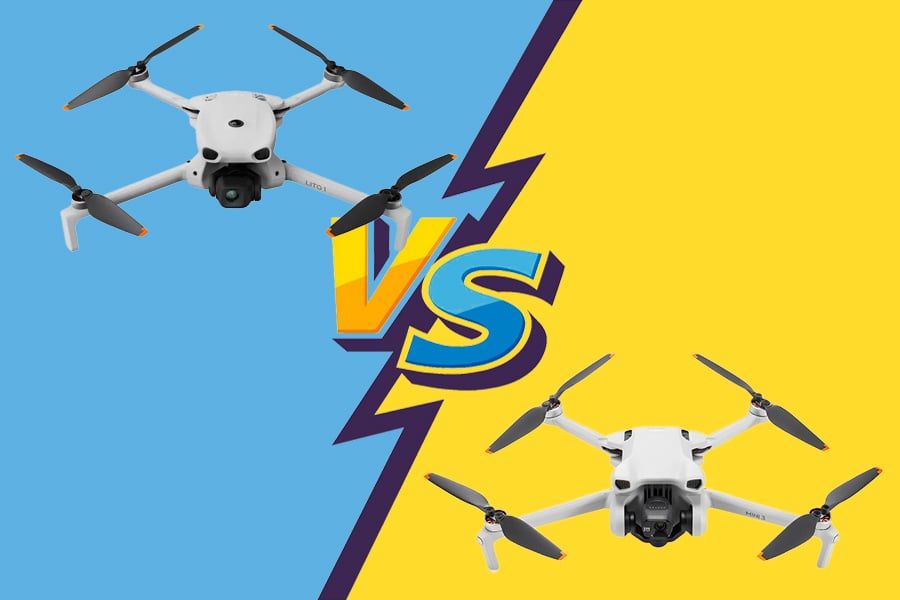
With the DJI Lito 1, DJI is modernizing its entry-level drone lineup by offering a compact, affordable model packed with features previously reserved for more advanced models. In comparison, the DJI Mini 3 remains a solid choice thanks to its excellent value for money, its 4K camera, and its rotating gimbal. So, what are the main differences between these two drones? Which one offers the best flying experience, the most interesting features, and the best image quality? And most importantly, which one is best suited for your needs? Find all the answers in this DJI Lito 1 vs. Mini 3 comparison.
DJI Lito 1 vs. Mini 3: Key Takeaways
Don’t have time (or just can’t be bothered 😅) to read it all? Here are the key differences to keep in mind between the DJI Lito 1 and the Mini 3 👇
- 🛩️ Both drones weigh less than 250 g, fall under Category C0, and are equally easy to carry.
- 📡 The DJI Lito 1 features the newer DJI O4 transmission system, offering a greater theoretical range as well as 1080p video feed at 60 fps, compared to 720p at 30 fps for the Mini 3.
- 🔋 The DJI Mini 3 offers slightly longer battery life, although the two drones perform very similarly in real-world conditions.
- 🚀 The DJI Lito 1 is slightly faster in flight and boasts higher climb and descent rates, while maintaining the same wind resistance as the Mini 3.
- 🎮 The DJI Lito 1 is significantly more feature-rich, with ActiveTrack subject tracking, omnidirectional obstacle detection, MasterShots, Hyperlapse, and other creative modes.
- 🎥 The DJI Mini 3 has the edge in image quality thanks to its 1/1.3-inch CMOS sensor and true 4K vertical video via its rotating gimbal. The Lito 1, however, counters with 4K at up to 60 fps and the ability to shoot in 10-bit.
- 💸 Both drones start at €339. The Lito 1 is available with a Fly More bundle for €479, while the Mini 3 comes in several bundles that include a remote controller with a built-in screen.
📌 If you’re looking for the most advanced and feature-rich drone, the DJI Lito 1 is our top recommendation. If your top priority is image quality and 4K vertical video, the DJI Mini 3 remains an excellent alternative.
DJI Lito 1 vs. Mini 3: Design
| DJI Lito 1 | DJI Mini 3 | |
| Weight | 249 g (standard battery) 340 g (Plus battery) | < 249 g |
| Dimensions (folded, without helices) (L x W x H) | 149 × 94 × 62 mm | 148 x 90 x 62 mm |
| Dimensions (unfolded) (L x W x H) | 183 × 251 × 79 mm (without propellers) | 251 x 362 x 72 mm (with propellers) |
| Storage | microSD card (up to 1TB) | microSD card (up to 512 GB) |
| Class (Europe) | C0 | C0 |
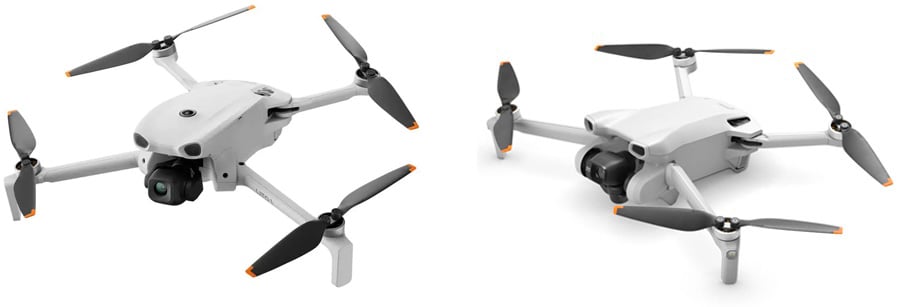
In terms of size, the DJI Lito 1 and the DJI Mini 3 are clearly in the same class. Both weigh less than 250 g, are C0-certified in Europe, and feature a foldable design intended for easy transport. When folded, their dimensions are very similar, making it easy to slip them into a small bag or backpack.
The Lito 1, however, stands out thanks to its more recent design. It features two optical modules positioned above and below the drone, capable of monitoring its surroundings in all directions. The Mini 3 retains a simpler design, with lower sensors primarily dedicated to position holding and landing.
On the storage side, both drones use a microSD card, but the Lito 1 supports cards up to 1 TB, compared to the Mini 3’s official limit of 512 GB. In practice, however, this difference will have little impact for most users, as these capacities are already more than enough to store plenty of photos and videos.
🏆 Tie: Two compact, foldable, and lightweight drones that are easy to carry around every day.
Discover our accessories for
DJI Lito 1
DJI Lito 1 vs. Mini 3: Transmission and Remote Controls
| DJI Lito 1 | DJI Mini 3 | |
| Compatible radio controls | DJI RC-N2/RC-N3, DJI RC 2 | DJI RC-N1, DJI RC |
| Video transmission system | DJI O4 | DJI O2 |
| Max. transmission distance | 15 km (IC), 8 km (CE / SRRC / MIC) | 10 km (FCC), 6 km (CE / SRRC / MIC) |
| Live preview quality | up to 1080p at 60 fps | up to 720p at 30 fps |
The DJI Lito 1 features a newer transmission system than the DJI Mini 3. It is equipped with the DJI O4, while the Mini 3 uses the DJI O2. Although the latter technology is still recognized for its reliability, the DJI O4 offers several improvements, including a greater theoretical range, higher-quality video feed, and an even more robust connection.
On paper, DJI lists a maximum range of 15 km (IC) and 8 km (CE) for the Lito 1, compared to 10 km (FCC) and 6 km (CE) for the Mini 3. In practice, these distances will never be reached under normal use, since a drone must remain within the pilot’s line of sight. Nevertheless, they provide an idea of the performance of each transmission system.
One of the most noticeable differences is the video feed. With the Lito 1, the live view can reach 1080p at 60 frames per second, compared to 720p at 30 frames per second on the Mini 3. The result is a smoother image that’s more enjoyable to watch while flying.
On the side of remote controls, both drones offer a choice between a smartphone-based version and a remote control with a built-in screen. The Lito 1 is compatible with the DJI RC-N2, DJI RC-N3, and DJI RC 2, while the Mini 3 works with the DJI RC-N1 and DJI RC. In practice, the user experience is very similar from one model to the next; the differences stem mainly from compatibility with their respective generations of transmitters.
🏆 DJI Lito 1: DJI O4 transmission system, greater theoretical range, and higher-quality video feed.
DJI Lito 1 vs. Mini 3: Battery Life and Charging
| DJI Lito 1 | DJI Mini 3 | |
| Battery | Standard battery: 2590 mAh Plus battery: 4680 mAh | Standard battery: 2453 mAh Plus battery: 3850 mAh |
| Maximum autonomy | 36 minutes (standard battery) 52 minutes (Plus battery) | 38 minutes (standard battery) 51 minutes (Plus battery) |
| Typical autonomy | 23 minutes (standard battery) 37 minutes (Plus battery) | Not communicated |
| Charging time (standard battery) | Direct 73 min / Station 45 min (1 battery), 87 min (3 batteries) (65W charger) | Direct: 64 min / Station: 56 min (DJI 30 W USB-C charger) |
| Charging time (Plus battery) | Direct 102 min / Station 56 min (1 battery, 130 min (3 batteries) (65W charger) | Direct: 101 min / Station: 78 min (DJI 30 W USB-C charger) |
With their standard batteries, the DJI Lito 1 and the DJI Mini 3 offer very similar flight times. DJI claims up to 36 minutes of flight time for the Lito 1, compared to 38 minutes for the Mini 3. As with all drones, these figures are based on tests conducted under ideal conditions and should be viewed with some caution in real-world use.
However, the Lito 1 introduces a new feature: DJI now reports a so-called “typical” flight time, which is intended to reflect usage conditions closer to real-world scenarios. The manufacturer reports 23 minutes with the standard battery, taking into account flight movements, video recording, and various flight assistance features. On the other side, the Mini 3 does not have this official estimate, but tests conducted by reviewers and users generally report a flight time of between 25 and 30 minutes.
Both models can also be equipped with a Plus battery, bringing their theoretical flight time to 52 minutes for the Lito 1 and 51 minutes for the Mini 3. There is one important difference, however: DJI does not support this battery on the Lito 1 in the European Union and the United Kingdom. On the Mini 3, when used, this battery causes the drone to exceed the 250-gram limit, with the regulatory consequences that entails.
Charging times are also quite similar. It takes about 73 minutes to charge the Lito 1’s standard battery directly, compared to 64 minutes for the Mini 3. When using their respective charging stations, DJI reports 45 minutes for the Lito 1 and 56 minutes for the Mini 3. However, it’s important to keep in mind that these measurements were taken using chargers with different power ratings, which limits the comparison.
🏆 DJI Mini 3: Slightly longer battery life.
OUR BEST SELLERS - DJI Lito 1
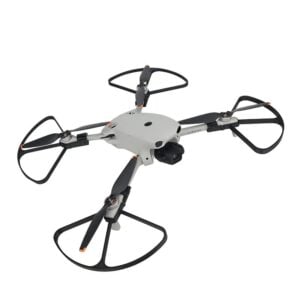
Propeller Protection Guards
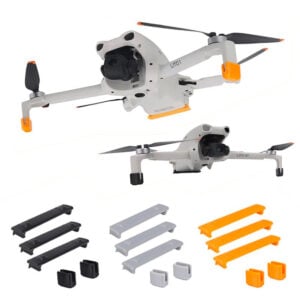
Accessories
DJI Lito 1 vs. Mini 3: Flight Performance
| DJI Lito 1 | DJI Mini 3 | |
| Maximum speed | 18 m/s (Sport mode) 12 m/s (Normal / Tracking mode) | 16 m/s (Sport mode) |
| Max. ascent speed | 7 m/s (Sport mode) 5 m/s (Normal mode) 3 m/s (Cine mode) | 5 m/s |
| Max. descent speed | 7 m/s (Sport mode) 5 m/s (Normal mode) 3 m/s (Cine mode) | 3.5 m/s |
| Max. wind resistance | 10.7 m/s (level 5) | 10.7 m/s (level 5) |
Despite weighing less than 250 g, both the DJI Lito 1 and the DJI Mini 3 offer stable and reassuring flight performance. They both offer the same wind resistance up to level 5 (10.7 m/s), allowing them to maintain good stability in most recreational flying conditions.
The Lito 1, however, performs slightly better when pushed to its limits. In Sport mode, it can reach 18 m/s (about 65 km/h), compared to 16 m/s (about 58 km/h) for the Mini 3. This difference doesn’t radically change the flying experience, but it does allow you to reach a point of interest or return to the starting point a little faster.
The difference is more pronounced in terms of ascent and descent speeds. The Lito 1 climbs and descends at speeds of up to 7 m/s in Sport mode, while the Mini 3 is limited to 5 m/s on the ascent and 3.5 m/s on the descent. This advantage is particularly noticeable when flying in environments with steep slopes, such as in the mountains or along a cliff edge.
In everyday use, however, these differences are relatively subtle. Both drones are a pleasure to fly, stable, and powerful enough to meet the needs of the vast majority of users.
🏆 DJI Lito 1: Maximum speed, faster ascent and descent.
DJI Lito 1 vs. Mini 3: Features
| DJI Lito 1 | DJI Mini 3 | |
| Photo modes | Single shot, Burst, Auto exposure bracketing (AEB), Interval, Panorama | Single Shot, Auto Exposure Bracketing (AEB), Interval, Panorama |
| Video modes | Slow motion, QuickShots, MasterShots, Hyperlapse, ActiveTrack subject tracking | QuickShots |
| Obstacle detection | Omnidirectional monocular optical system + downward-looking infrared sensor | Lower optical system |
Beyond their flight performance, the differences between the DJI Lito 1 and the DJI Mini 3 are most noticeable in their onboard features. While the Mini 3 focuses primarily on simplicity, the Lito 1 offers a richer experience with more shooting modes, true automatic subject tracking, and significantly more advanced flight assistance.
Photo and video modes
The Mini 3 covers the essentials with Single Photo, AEB, Interval, Panorama, and QuickShots modes. The Lito 1 naturally includes all these features, but adds a Burst mode for photos as well as several additional video options, such as MasterShots, Slow Motion, andHyperlapse.
These features allow for greater variety in shooting styles and make it easier to capture dynamic footage without complex manual adjustments.
Intelligent functions
The Lito 1 also stands out for its ActiveTrack subject tracking feature, which is not available on the Mini 3. This allows the drone to automatically track a person, a bicycle, or a vehicle while keeping the subject in the frame, opening the door to shots that would be impossible to capture with the Mini 3 without the help of a second pilot.
The difference is just as significant when it comes to obstacle detection. The Lito 1 is equipped with an omnidirectional optical system, supplemented by a downward-facing infrared sensor, allowing it to monitor its surroundings in all directions. Depending on the pilot’s preferences, it can either stop in front of an obstacle or automatically navigate around it to continue on its path.
In contrast, the Mini 3 is equipped only with a basic optical system, designed primarily to improve stability at low altitudes and during landing. It therefore lacks both true obstacle avoidance and the automatic tracking features offered by the Lito 1.
🏆 DJI Lito 1: Subject tracking, omnidirectional obstacle detection, and more creative modes.

Discover our accessories for
DJI Mini 3
DJI Lito 1 vs. Mini 3: Image
| DJI Lito 1 | DJI Mini 3 | |
| Aerial work platform | 3-axis mechanical gondola | 3-axis mechanical gondola |
| Sensor | 1/2-inch CMOS | 1/1.3-inch CMOS |
| Objective | 35mm equivalent focal length: 26.2 mm; Aperture: f/1.8; Field of view: 79° | 24 mm equivalent focal length, f/1.7 aperture, 82.1° field of view |
| Photo resolution | 12 MP / 48 MP | 12 MP / 48 MP |
| Max. video resolution (horizontal) | 4K up to 60 fps (100 fps in slow-motion mode) FHD up to 100 fps | 4K up to 30 fps 2.7K up to 60 fps FHD up to 60 fps |
| Max. video resolution (vertical) | 2.7K at up to 60 fps (cropped) | 4K at up to 30 fps (rotating gimbal) |
| ISO range | 100 à 12800 | 100 à 12800 |
| Max. bit rate | 130 Mb/s | 100 Mb/s |
| Digital zoom | 4K: 1 to 3x FHD: 1 to 4x Photo: 1 to 3x | 4K: 2x 2.7K: 3x FHD: 4x |
| Photo format | JPEG / DNG (RAW) | JPEG / DNG (RAW) |
| Video format | MP4 (MPEG-4 AVC/H.264, HEVC/H.265) | MP4 (H.264) |
| Color profile | Normal (8 / 10 bits) | Normal (8 bits) |
Nacelle, sensor and resolution
Both drones are equipped with a 3-axis mechanical gimbal, ensuring smooth and well-stabilized video footage. However, the DJI Mini 3 has the edge in sensor size, featuring a 1/1.3-inch CMOS sensor , compared to the Lito 1’s 1/2-inch sensor. Its lens also has a slightly wider aperture (f/1.7 versus f/1.8), allowing it to capture more light, especially in challenging conditions.
When it comes to photos, both models can capture images at 12 or 48 MP and support the RAW (DNG) format. The differences are most noticeable when it comes to video. The Lito 1 can record 4K video at up to 60 frames per second and reach 100 fps in slow-motion mode, while the Mini 3 is limited to 4K at 30 fps and Full HD at 60 fps.
The vertical format also highlights DJI’s different design choices. Thanks to its rotating gimbal, the Mini 3 records 4K vertical videos directly, without cropping. The Lito 1 also offers a portrait mode, but this relies on cropping the image, with a resolution limited to 2.7K.
Image quality
Overall, both drones produce very high-quality images for their class. Thanks to its larger sensor, however, the Mini 3 retains a slight edge in overall image quality. It offers better dynamic range handling and performs better in low-light conditions, with generally less noticeable digital noise.
The Lito 1 isn’t to be outdone, however. Its 4K recording at up to 60 frames per second and the ability to shoot in 8- or 10-bit, even with the Normal color profile, offer greater flexibility for creating smooth videos or making minor adjustments in post-production. For the vast majority of users, it delivers detailed, pleasing results that are more than sufficient for casual use.
🏆 DJI Mini 3: Larger sensor and true 4K vertical video thanks to its rotating gimbal.
DJI Lito 1 vs. Mini 3: Bundles and Prices
| DJI Lito 1 | DJI Mini 3 | |
| Standard Package (with standard radio control) | 339 € | €339 (RC-N1) |
| Standard Package (with built-in screen) | – | €439 (DJI RC) |
| Fly More Pack (with standard radio control) | €479 (RC-N3) | – |
| Fly More Pack (with built-in screen) | – | 569 € (DJI RC) |
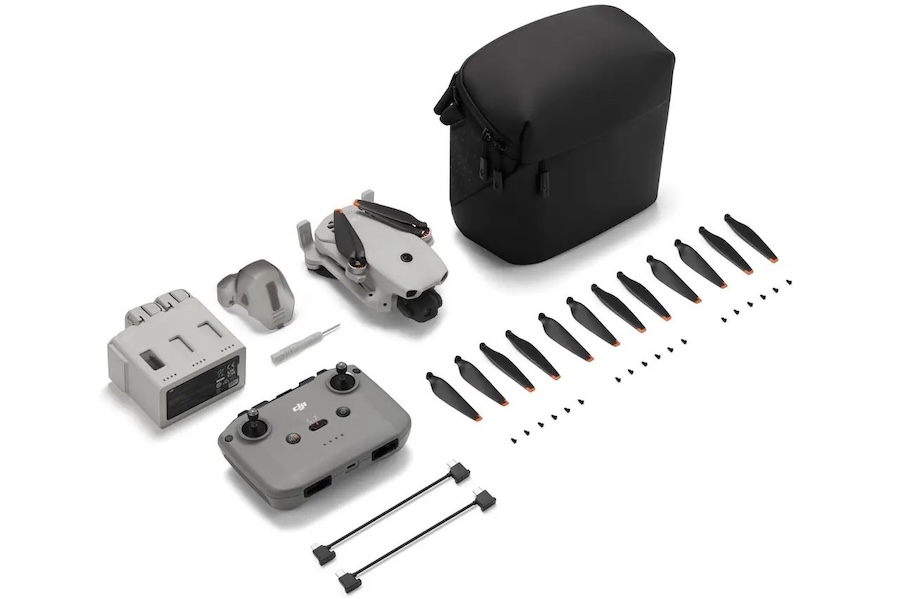
Both drones are offered at the same starting price: €339 for their standard bundle, which includes a smartphone-based remote controller (DJI RC-N3 for the Lito 1, DJI RC-N1 for the Mini 3). For the same price, each offers a complete starter kit.
The difference then lies in the available bundles. The DJI Lito 1 is offered as part of a Fly More bundle for €479, which includes two additional batteries, a charging station, spare propellers, and a carrying case. The DJI Mini 3 does not have an equivalent Fly More bundle with a standard remote controller, but DJI does offer versions equipped with the DJI RC with a built-in screen, priced at €439 for the standard bundle and €569 for the most comprehensive bundle.
It’s also worth noting that the Lito 1 remains compatible with the DJI RC 2, even though DJI does not currently offer any official bundle that includes it. Users who want a remote controller with a screen will therefore need to purchase it separately.
🏆 Equality: the same entry price, with packages tailored to different needs.


Conclusion: DJI Lito 1 vs. Mini 3—Which One Should You Choose?
The DJI Lito 1 and the DJI Mini 3 currently have the same starting price, but they don’t quite offer the same experience. The Mini 3 remains an excellent drone geared toward photography, with a larger sensor, true 4K vertical video, and image quality that still sets the standard in this price range.
On the side, the Lito 1 represents a newer generation. It features a DJI O4 transmission system, omnidirectional obstacle detection, ActiveTrack subject tracking, numerous additional creative modes, and slightly improved flight performance. All these improvements make it easier to use, more versatile, and safer for everyday use.
🏆 Our Pick: DJI Lito 1
At a comparable price point, we believe the DJI Lito 1 is currently the best choice for most users. Although the Mini 3 still has a slight edge in terms of image quality, the Lito 1’s many additional features make it much more user-friendly and offer more possibilities, whether you’re just starting out or looking to take your skills to the next level.
Choose the DJI Lito 1 if…
- ✅ You want to take advantage of ActiveTrack subject tracking and omnidirectional obstacle detection.
- ✅ You’re looking for a drone that offers more creative modes, such as MasterShots,Hyperlapse, or Slow Motion.
- ✅ You want to take advantage of the newer DJI O4 transmission system, which offers smoother video feed and a greater theoretical range.
Choose the DJI Mini 3 if…
- ✅ Image quality is your top priority.
- ✅ You regularly shoot vertical videos in native 4K for social media.
- ✅ You don’t need advanced features like subject tracking or obstacle detection.
💡 To learn more, check out our in-depth reviews of the two drones featured in this DJI Lito 1 vs. Mini 3 comparison:
➡️ Our review of the DJI Lito 1
➡️ Our review of the DJI Mini 3
🛠️ For maintenance and repairs, you can find all compatible parts here:
DJI Lito 1 Replacement Parts
DJI Mini 3 Replacement Parts
💡 Read also
➡️ Looking at a more advanced model? Check out our DJI Lito X1 or Mini 5 Pro comparison.
➡️ Wondering whether the DJI Mini 4 Pro is still worth buying compared to DJI’s latest model? Check out our comparison Mini 4 Pro vs Lito X1.

 Blog
Blog