
 Français
 Deutsch
 Español
 Italiano

 Parts & Accessories by Drone
 Drones
 Action camera
 Microphones
 Camera Stabilizers
 VR Headsets
DJI Osmo 360 II vs. Insta360 X6: Which 360-degree camera should you choose?
Oct
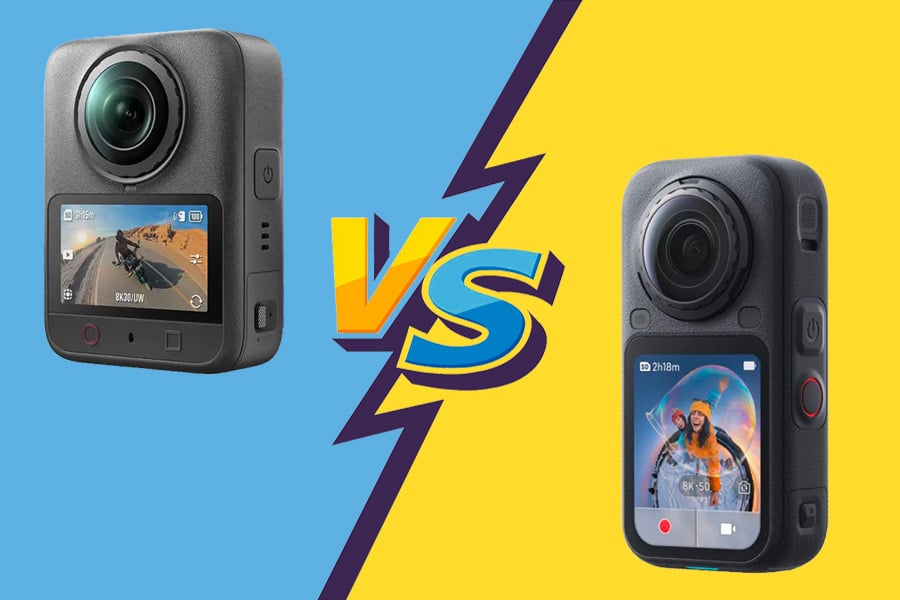
Long dominated by Insta360, the 360° camera market has seen the arrival of a major competitor with DJI and its first Osmo 360. And the battle has only just begun! Following the launch of the Insta360 X6, DJI is stepping up its game with the Osmo 360 II, determined to take on the industry’s long-standing leader. But what are the real differences between these two models? Do their performance levels justify the price difference, and most importantly, which one should you choose based on your needs? Find all the answers in our comprehensive comparison of the DJI Osmo 360 II vs. the Insta360 X6.
DJI Osmo 360 II vs. Insta360 X6: Key Takeaways
Don’t have time (or just can’t be bothered 😅) to read it all? Here are the key differences to keep in mind between the DJI Osmo 360 II and the Insta360 X6 👇
- 📐 The Insta360 X6 stands out with its larger OLED screen (2.32 inches vs. 2 inches) and its water resistance up to 20 meters, compared to 10 meters for the DJI. The DJI model, however, is slightly lighter (183 vs. 196 g) and has twice as much internal storage (128 vs. 64 GB).
- 🔋 The X6 clearly has the edge in battery life, offering up to 140 minutes of 8K recording at 30 fps thanks to Endurance Mode, compared to 100 minutes for the Osmo 360 II. However, both cameras charge almost as quickly.
- 🤖 Insta360 makes it even easier to create and share videos, thanks in particular to InstaFrame 2.0 and AI Director, while DJI stands out for its advanced creative modes, such as Spotlight and Vortex. Both offer comprehensive editing tools, but Insta360 relies more on automation to quickly produce videos that are ready to share.
- 🎬 The DJI Osmo 360 II leads in frame rates, offering 8K at 60 fps compared to 50 fps for the X6, and slow-motion footage up to 4K at 240 fps compared to 100 fps. However, the Insta360 regains the advantage with its single lens, thanks to its 5K resolution at 60 fps, compared to the DJI’s 4K at 120 fps.
- 🎥 When it comes to image quality, it’s hard to pick a winner! Both cameras feature 1/1.1-inch sensors and deliver excellent results in both daylight and low light. The X6 sometimes seems slightly sharper, while the DJI does a better job of preserving certain highlights. The differences, however, are fairly subtle.
- 💸 The DJI Osmo 360 II is significantly more affordable, with a starting price of €589 compared to €699 for the Insta360 X6. A price difference of €110 is particularly appealing given their generally comparable performance.
📌 The DJI Osmo 360 II stands out for its excellent value for money, video performance, and wide range of creative possibilities. The Insta360 X6 stands out for its longer battery life and its particularly user-friendly editing tools. Both are excellent 360° cameras: the best choice depends primarily on your needs and budget.
DJI Osmo 360 II vs. Insta360 X6: Design
| DJI Osmo 360 II | Insta360 X6 | |
| Dimensions (L x W x H) | 61 × 36.3 × 81 mm | 50 × 40 × 100 mm |
| Weight | 183 g | 196 g |
| Touchscreen | 2 inches | 2.32 inches (OLED) |
| Storage | Internal storage: 128 GB (105 GB available) MicroSD card (up to 1 TB) | 64 GB internal storage (47 GB available) MicroSD card (up to 1 TB) |
| Operating temperature | -20 to 45° C | -20 to 40° C |
| Water resistance | 10 meters | 20 meters |
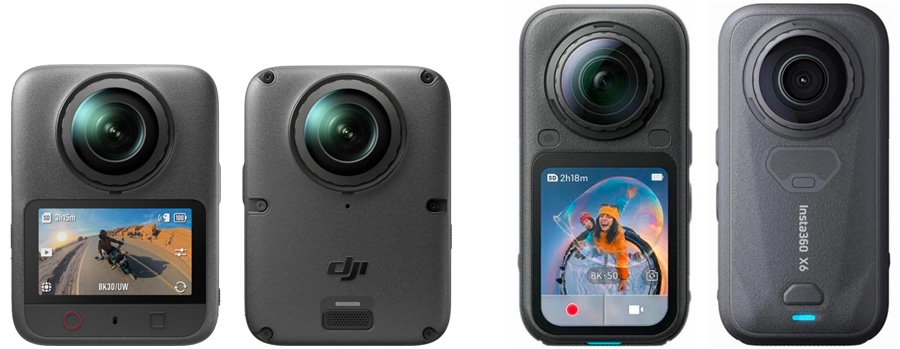
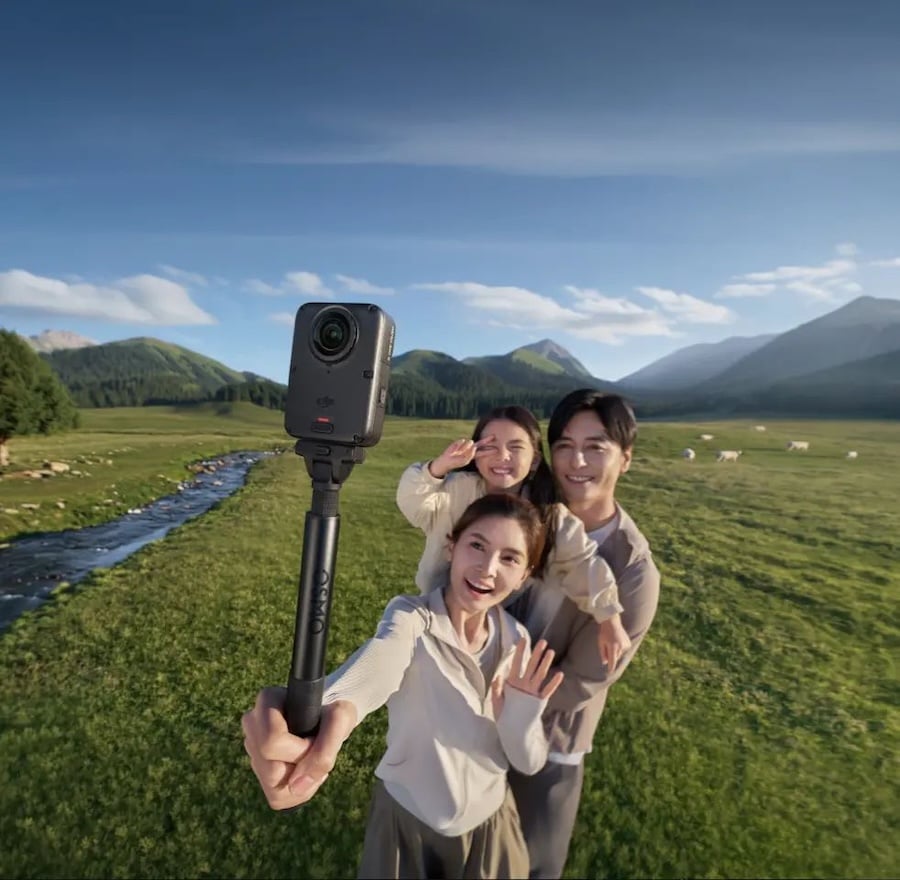
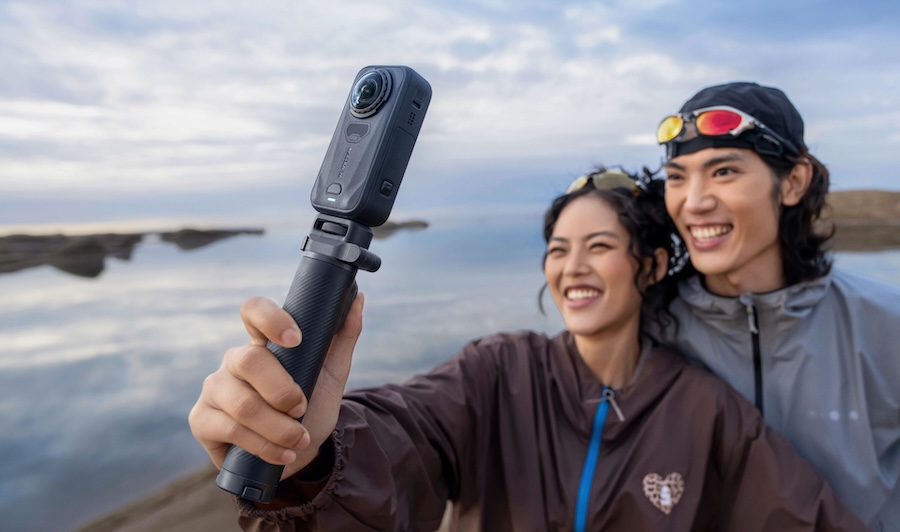
Two cameras, two designs… but their form factors are actually quite similar! With its now more compact and less elongated silhouette, the Insta360 X6 is closer in size to the DJI Osmo 360 II, which, on the other side, retains a wider, more square body. Weighing 183 g compared to 196 g, the DJI is slightly lighter, although this 13-gram difference is unlikely to be noticeable during use. Both models remain compact enough to be easily carried and used on the end of a selfie stick.
The difference is also evident in the displays. The Insta360 X6 stands out with its 2.32-inch OLED touchscreen, compared to the Osmo 360 II’s 2-inch screen. Its larger display and OLED technology are advantages for viewing images and navigating menus. DJI, however, sticks with a simple interface featuring three physical buttons, while Insta360 relies on pressure-sensitive haptic controls and an additional record button on the side. This is a more modern approach on the X6, but it may take a little time to get used to.
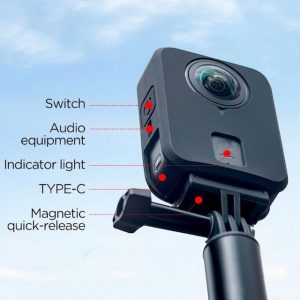
As for mounts, both cameras feature a standard 1/4-inch threaded mount and a quick-release magnetic system. This makes it easy to switch between mounts, even though the magnetic accessories are specific to their respective ecosystems.
Replaceable lenses represent a major improvement for the DJI Osmo 360 II, addressing one of the first-generation model’s main weaknesses. At Insta360, this feature was already available on the X5, but the X6 takes it a step further with lenses that are said to be five times more scratch-resistant and can now be replaced without special tools. In both cases, this is a significant advantage for 360° cameras, whose domed lenses remain particularly vulnerable to impacts.
On the side of water resistance, the Insta360 X6 is more durable, capable of being submerged up to 20 meters without a housing, compared to 10 meters for the DJI Osmo 360 II. With their respective dive housings, these depths increase to 60 and 50 meters. Note, however, that for both models, using a suitable housing is still recommended for 360° underwater filming to minimize issues with refraction and image stitching.
Finally, the DJI Osmo 360 II has twice as much internal storage—128 GB compared to the Insta360 X6’s 64 GB—which translates to 105 GB and 47 GB of actual available space, respectively. Both cameras also support microSD cards up to 1 TB, but this additional storage is a significant advantage for the DJI when you want to film without a card or extend a recording session.
🤝 Tie: The Insta360 X6 stands out for its larger OLED screen and superior water resistance, while the DJI Osmo 360 II offers more internal storage in a slightly lighter body.
Check out our accessories for
DJI Osmo 360 II
DJI Osmo 360 II vs. Insta360 X6: Battery Life and Overheating
| DJI Osmo 360 II | Insta360 X6 | |
| Battery | 2150 mAh | 2,600 mAh |
| Battery Life | Up to 100 min (8K at 30 fps) | Up to 140 min (8K at 30 fps, Endurance mode) |
| Charging time | 80% in 22 min | 80% in 24 minutes, 100% in 35 minutes |
When it comes to battery life, the Insta360 X6 has a lot going for it! With its 2,600 mAh battery— compared to the DJI Osmo 360 II ’s 2,150 mAh —it promises up to 140 minutes of 8K recording at 30 fps, versus 100 minutes for its competitor. A 40-minute difference is far from negligible, even if the X6 achieves this runtime thanks to its Endurance mode. Independent tests also tend to confirm the battery life figures announced by both manufacturers.
However, the DJI still has one interesting advantage: its batteries are compatible with those of the first Osmo 360 and several recent Osmo Action cameras. This is a significant advantage for users who already own DJI equipment, as it allows them to share their batteries across multiple devices. Conversely, the new battery for the Insta360 X6 is not compatible with the one for the X5.
What about overheating on the side? Both cameras seem to manage their temperature well at 8K and 30 fps; several tests allowed for continuous recording until the battery ran out, with no interruptions due to overheating. However, things get more complicated when you push the frame rates to their maximum. At 8K and 60 fps, the DJI Osmo 360 II may eventually shut down to cool off, while the Insta360 X6 also reaches its limits at 8K and 50 fps. Some comparative tests suggest that the X6 has better heat resistance, but the DJI records at a higher frame rate, which makes it impossible to conclude that it is truly superior in this regard. In both cases, ambient temperature and shooting conditions play an important role.
Finally, both models charge particularly quickly. The DJI Osmo 360 II reaches 80% in just 22 minutes, compared to 24 minutes for the Insta360 X6, which can also reach a full charge in 35 minutes with a compatible charger. A two-minute difference at 80%—in other words, the difference is negligible.
🏆 Insta360 X6 Advantage: Its significantly longer battery life is a real plus for long recording sessions. The DJI, however, still offers the benefit of batteries that are compatible with several other cameras from the brand.
OUR BEST SELLERS - DJI Osmo 360 II


Action camera


DJI Osmo 360 II vs. Insta360 X6: Features
| DJI Osmo 360 II | Insta360 X6 | |
| Photo Modes | 360° Panorama, Single Lens | Interval, Starlapse |
| Video Modes | Panorama, Single Lens, Video Boost, SuperNight 2.0, Selfie Mode, Spotlight Tracking, Slow Motion, Timelapse/Hyperlapse, Vortex, Dual Recording, Pre-recording, Loop Recording | 360°: PureVideo, Timelapse, TimeShift, Bullet Time, Loop, Route Mode Standard Video: InstaFrame 2.0, PureVideo, FreeFrame Video, Loop |
| Stabilization | RockSteady 3.0, HorizonSteady | FlowState, 360° Horizon Lock |
Photo and Video Modes
It’s hard to run out of creative possibilities with these two cameras! Both the DJI Osmo 360 II and the Insta360 X6 offer a wide selection of shooting modes, ranging from classic time-lapse and slow-motion to more spectacular effects. Each also has its own set of features to take full advantage of 360° video, with approaches that can sometimes be quite different.
At DJI, several modes stand out for their performance. Slow motion can reach 4K at 240 fps in 360°, while Vortex mode lets you create rotation effects at up to 8K at 120 fps. There’s also SuperNight 2.0 for nighttime scenes, 360° time-lapse that can be exported at up to 16K, and Video Boost, which transforms the camera into a standard action cam capable of shooting in 4K at 120 fps with a single lens.
But one of the most interesting new features is undoubtedly Spotlight Tracking. This feature allows you to automatically track a person and prepare the framing in DJI Mimo or DJI Studio. There’s no longer any need to manually set keyframes to keep the subject centered—simply export the raw video, up to 4K at 30 fps. The Osmo 360 II also introduces a dual-recording mode, which is particularly well-suited for vlogs, as it allows you to simultaneously show the scene and the reaction of the person filming.
The Insta360 X6 is certainly no slouch! It retains features such as Bullet Time, TimeShift, Timelapse, and PureVideo, but it’sInstaFrame 2.0 that really stands out. This feature lets you directly generate a flat video in up to 4K, with automatic subject tracking, while retaining the full 360° recording if needed. It’s a particularly convenient solution for quickly getting a video ready to share without giving up the option to choose a different framing later on.
Both manufacturers are therefore seeking to simplify automatic cropping, but Insta360 makes it even easier to create videos that are ready to share, since the X6 can directly produce a usable flat video. The X6 also offers a variety of ways to trigger the camera, including voice commands, gestures, rotating the mount (Twist to Shoot), or tapping the screen, accompanied by haptic feedback.
Applications and Installation
Shooting 360° video is great. But you still need to be able to easily work with your footage! And in this area, both manufacturers now offerparticularly comprehensivesoftware ecosystems : DJI Mimo and DJI Studio on one side, and the Insta360 app along withInsta360 Studio on the other.
On smartphones, both apps let you crop 360° videos, track a subject, add effects, and prepare clips for social media. DJI now makes it easier to connect to Mimo using NFC, while Insta360 places a particular emphasis on automated editing.
One of the X6’s key features is AI Director, a function that analyzes footage recorded throughout the day while the camera is plugged in to recharge, then automatically creates a montage that can be viewed in the app. DJI Mimo also offers AI-assisted editing tools, but based on available feedback, their results seem even less consistent. Insta360 thus maintains a slight edge for those who want to quickly produce edited videos with minimal effort.
On a computer, the competition is closer. DJI Studio offers some interesting tools, particularly for automatic subject tracking and creating slow-motion footage at up to 64× using image interpolation. Insta360 Studio, however, has more experience with 360° editing and remains particularly popular for its cropping capabilities and user interface. Opinions differ, however, on the usability and responsiveness of the two programs, making it difficult to declare a clear winner.
One difference, however, is worth noting: Insta360 Studio allows for ProRes export, unlike DJI Studio. This is a valuable feature for videographers who want to integrate their 360° footage into a more professional post-production workflow.
Audio and Connectivity
On the audio side, both cameras feature built-in microphones and offer various options for improving voice capture. The DJI Osmo 360 II is equipped with four microphones and features OsmoAudio technology, which allows you to connect compatible DJI wireless microphones directly, without the need for an additional receiver. In particular, you can use two of them simultaneously to record an interview or a vlog with two people, while still capturing the ambient sound picked up by the camera.
The Insta360 X6 places greater emphasis on wind noise reduction, featuring a new 360° microphone system and several dedicated audio processing features. It also offers a mode that’s particularly useful for motorcyclists, designed to reduce wind noise while preserving the sound of the engine. The available tests are encouraging in this regard, although the windiest conditions remain difficult to handle with built-in microphones.
To take things a step further, the X6 can also be paired with the Insta360 Mic Air and Mic Pro wireless microphones. Both manufacturers thus offer solutions tailored to content creators, with DJI benefiting in particular from an already well-developed ecosystem of microphones.
🤝 Tie: The Insta360 X6 prioritizes simplicity with InstaFrame 2.0 and AI Director, while the DJI Osmo 360 II stands out for its advanced creative modes and Spotlight tracking.
Check out our accessories for
Insta360 X6
DJI Osmo 360 II vs. Insta360 X6: Image
| DJI Osmo 360 II | Insta360 X6 | |
| Sensors | 2 1/1.1-inch CMOS sensors | 2 1/1.1-inch square CMOS sensors |
| Aperture | f/1.9 | f/2.0 |
| Max. photo resolution | 120 MP (360°), 30 MP (single lens) | 120 MP (360°), 42 MP (single lens) |
| Max. video resolution (360°) | 8K up to 60 fps 6K up to 60 fps 4K up to 240 fps (Slow Motion mode) | 8K up to 50 fps 6K up to 60 fps 4K up to 100 fps |
| Max. video resolution (single lens) | 4K up to 120 fps (Video Boost mode) 2.7K up to 120 fps (Video Boost mode) | 5K up to 60 fps 4K up to 120 fps 2.7K up to 120 fps |
| Photo format | JPEG, RAW | INSP, DNG (RAW) |
| Video format | OSV, MP4 (HEVC) | INSV (360°), MP4 (flat video) |
| Color profiles | Normal, D-Log M | Standard (Rec. 709), Dolby Vision, I-Log |
| Maximum video bitrate | 220 Mb/s | 240 Mb/s |
| ISO range | 100 to 51,200 | 100 to 6,400 |
Sensors and resolutions
On paper, the two competitors are now in the same league. The DJI Osmo 360 II and the Insta360 X6 each feature two 1/1.1-inch square CMOS sensors, paired with lenses with maximum apertures of f/1.9 and f/2.0, respectively. While DJI has retained the sensors from its first Osmo 360, Insta360 has taken a major step forward with sensors that are about 33% larger than those in the X5.
But it’s mainly on the side of resolution and frame rates that the differences become apparent. Both cameras shoot in 8K at 360°, but DJI goes up to 60 frames per second, compared to 50 fps for Insta360. This difference allows the Osmo 360 II to capture 2× slow-motion footage in 8K when exported at 30 fps. It also extends slow-motion capabilities up to 4K at 240 fps, whereas the X6 is limited to 100 fps at that resolution.
On the other hand, the Insta360 X6 takes the lead when using a single lens. It can record in 5K at 60 fps, while the DJI is limited to 4K at 120 fps in Video Boost mode. Both cameras can reach 120 fps in 4K, but the Insta360 offers higher resolution for those who want to use their 360° camera as a traditional action camera.
When it comes to photography, both models can capture 120 MP panoramas. However, the X6 offers a higher resolution with a single lens— 42 MP compared to 30 MP for the DJI. Both also allow you to save images in RAW, a format that’s particularly useful for maintaining greater flexibility during post-processing.
Image quality
So how do they perform in real-world conditions? Because the numbers don’t tell the whole story! With sensors of similar size and a shared 8K resolution, both cameras produce particularly impressive images in daylight, but there are some interesting differences in their image quality.
In real-world comparisons, the Insta360 X6 sometimes appears to produce a slightly sharper and more precise image, particularly with complex textures such as foliage or distant objects. Some tests also highlight better control of distortion after optical correction. The differences, however, remain fairly subtle: in many scenes, you have to examine the images closely to distinguish between the two competitors.
Handling high-contrast scenes reveals another difference. The DJI Osmo 360 II seems to preserve detail better in certain very bright areas, especially when the sun appears in the frame. The Insta360 X6 sometimes favors a more generous exposure, which helps illuminate subjects and dark areas better but can also result in a loss of detail in the highlights. So it’s not necessarily a matter of one camera being consistently better than the other, but rather two image-processing systems that don’t always make the same choices.
And when there isn’t enough light? The DJI Osmo 360 II relies on SuperNight 2.0, a mode that uses a new AI-powered noise reduction algorithm, while the Insta360 X6 counters with PureVideo, which takes advantage of its larger sensors and 10-bit support. In both cases, the results are remarkable for such compact cameras, with relatively detailed nighttime footage and well-controlled digital noise.
However, the available comparisons show a particularly close contest. The X6 sometimes seems to produce slightly more balanced and natural images, while the DJI manages, in certain scenes, to reveal more detail in dark areas. Some tests give Insta360 a slight edge in low light, though they sometimes note a greenish or yellowish cast in its images. Neither camera consistently outperforms the other, and the results depend significantly on lighting, settings, and the processing applied.
There is, however, one important difference for those who regularly shoot at night: SuperNight 2.0 allows you to record up to 8K at 60 fps, compared to 30 fps for PureVideo on the X6. This is a significant advantage for maintaining smoother footage or creating slow-motion clips when subjects are in motion.
Finally, both models offer useful tools for those who want to adjust their colors in post-production. The DJI has its own profile 10-bit D-Log M, while the Insta360 X6 offers, among other features, theI-Log, with 10-bit support across all shooting modes. These profiles produce a less contrasty image during recording to allow for greater flexibility during color grading. Please note, however, that D-Log M is not available when SuperNight 2.0 is enabled. For those who prefer to shoot and share their videos immediately, the standard profiles are, of course, still available.
🤝 Tie: The DJI Osmo 360 II stands out for its higher frame rates—particularly in 8K and in low light—as well as its effective handling of highlights. The Insta360 X6 counters with 5K in single-lens mode and imagery that is at times more precise or natural. Two excellent 360° cameras, whose differences in image quality remain subtle enough that there is no clear-cut winner.
DJI Osmo 360 II vs. Insta360 X6: Bundles and Prices
ℹ️ Note: some links in this section are Amazon affiliate links. As Amazon Associates, we earn from qualifying purchases, at no extra cost to you.
| DJI Osmo 360 II | Insta360 X6 | |
| Standard package | 589 € | €699 |
| Other bundles | From €609 to €771.96 | From €748 to €942 |
On the pricing side, the DJI Osmo 360 II really stands out! Starting at €589 for the Standard Bundle, it costs €110 less than the Insta360 X6, which retails for €699 in its Standard Pack. That’s a significant difference between two high-end cameras with performance levels that are often very similar, as we’ve seen throughout this comparison.
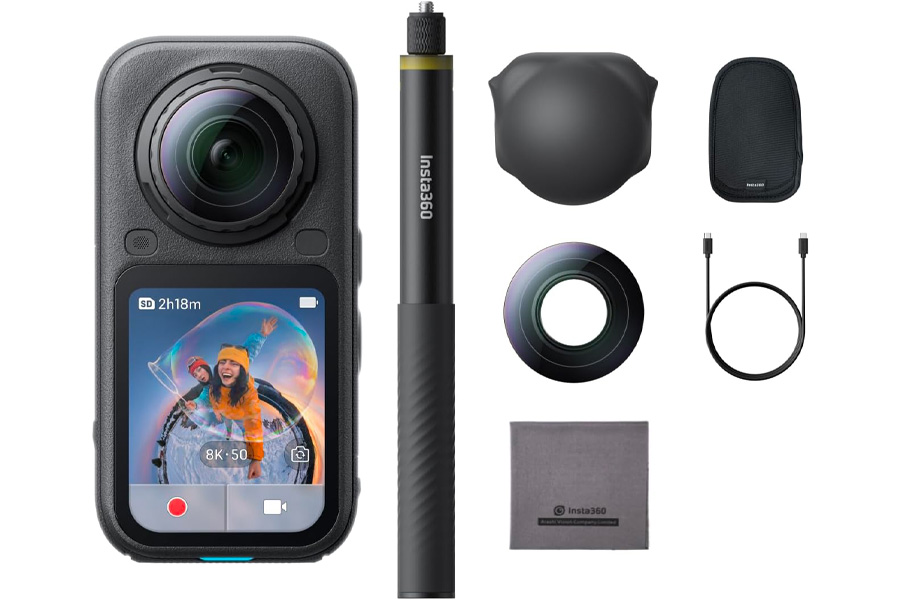
Both standard bundles include the essentials you need to start filming: the camera, a battery, a USB-C cable, and a protective pouch. DJI, however, adds a silicone lens cap and a cleaning cloth. The included equipment is therefore quite similar, with a few extra accessories on the DJI side.
For those looking to expand their gear, both manufacturers offer a wide range of bundles tailored to different uses. DJI sells its bundles for between €609 and €771.96, including configurations designed for motorcycles, bicycles, skiing, and even Vortex effects. On the other side, Insta360 offers bundles ranging from €748 to €942, with accessories suited for travel, sports, or diving.
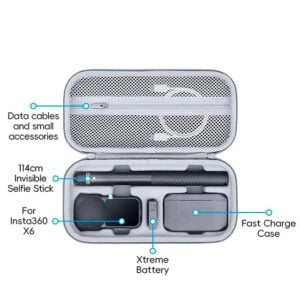
The Insta360 X6 comes with an Essential Pack priced at €799, which includes a second battery, a fast-charging case, a 114-cm invisible selfie stick, and a lens cap. This is an attractive option for getting a more complete set of gear right away. DJI also offers an Explorer Bundle that includes a 1-meter invisible selfie stick, allowing you to enjoy this accessory without having to buy it separately.
Finally, there’s one detail worth noting regarding repairs: DJI offers lens replacement kits for €25 each or €39 per pair. This is a cost-effective solution for replacing a damaged lens yourself, even though the Insta360 X6 also features replaceable lenses.
🏆 Advantage of the DJI Osmo 360 II: With a starting price that’s €110 lower, it offers particularly good value for money compared to the Insta360 X6, while also providing a wide range of bundles for different uses.
OUR BEST SELLERS - INSTA360 X6
Insta360
Conclusion: DJI Osmo 360 II vs. Insta360 X6—Which One Should You Choose?
It’s hard to choose between these two 360° cameras—they’re both so impressive! With their large 1/1.1-inch sensors, 8K recording, and numerous creative features, the DJI Osmo 360 II and the Insta360 X6 deliver top-notch performance. Ultimately, their differences come down more to specific use cases than to pure image quality, where neither one really manages to come out on top.
The Insta360 X6 still has plenty going for it, including its longer battery life, large OLED screen, water resistance up to 20 meters, and particularly user-friendly editing tools. On the other side, the DJI Osmo 360 II impresses with its video capabilities, including 8K at 60 fps, slow-motion footage up to 4K at 240 fps, and advanced creative modes like Spotlight and Vortex. It also features more generous internal storage and excellent integration with the DJI ecosystem.
But one final factor tips the scales: the price! With a starting price of €589, compared to €699 for the Insta360 X6, the DJI Osmo 360 II offers a significant advantage in terms of value for money. It’s therefore a particularly attractive choice for users who want to enjoy high-end video performance without spending more. The Insta360 X6, however, remains an equally compelling alternative for those who prioritize battery life and ease of editing.
Choose the DJI Osmo 360 II if…
- You’re looking for the best value for your money, with a high-end 360° camera priced €110 less than its competitor.
- You prioritize video performance and creative capabilities, including 8K at 60 fps, 4K slow-motion at 240 fps, and Spotlight Tracking.
- You already own compatible DJI gear, such as the original Osmo 360 or certain Osmo Action models, and want to reuse your batteries and accessories.
Choose the Insta360 X6 if…
- You’ll want to easily create and share your 360° videos using InstaFrame 2.0, AI Director, and the editing tools in the Insta360 ecosystem.
- You’re looking for longer battery life, with up to 140 minutes of 8K recording at 30 fps in Endurance Mode, compared to 100 minutes for the DJI.
- You regularly use your camera with a single lens and want to take advantage of 5K resolution at 60 fps to shoot just like with a traditional action camera.
💡 To learn more, check out our in-depth reviews of both cameras in this DJI Osmo 360 II vs. Insta360 X6 comparison:
➡️ Everything you need to know about the DJI Osmo 360 II
➡️ Everything you need to know about the Insta360 X6

 Blog