
 Français
 Deutsch
 Español
 Italiano
 Parts & Accessories by Drone
 Drones
 Action camera
 Microphones
 Camera Stabilizers
 VR Headsets
GoPro MISSION 1 PRO, Full Review: Is This GoPro’s Big Comeback?
Sep
It took a while, but GoPro is finally back with a new generation of cameras. After a period during which the brand seemed to struggle to truly reinvent itself, while competition grew ever more intense, the GoPro MISSION 1 PRO was inevitably highly anticipated. With this model, GoPro is opening a new chapter in its history and clearly signaling its ambition to regain the lead in a market it has long dominated. But does the MISSION 1 PRO truly mark the hoped-for revival? How does it perform in real-world use, and does it justify its premium positioning? Design, image quality, battery life, features, and price: we analyze the GoPro MISSION 1 PRO from every angle to help you decide if it’s worth your investment.
GoPro MISSION 1 PRO: Key Takeaways
Don’t have time (or just can’t be bothered 😅) to read it all? Here are the key takeaways about the GoPro MISSION 1 PRO 👇
- 📐 It’s larger than previous GoPro HERO models, weighing in at 207 g, but features a new 2.59-inch OLED touchscreen on the back and buttons that are easier to use
- 💧 Waterproof up to 20 meters without a housing, with a replaceable lens cover and three built-in mounting systems
- 🔋 New Enduro 2 battery with a capacity of 2,150 mAh, offering over 3 hours of playback in 4K30 and up to 1 hour and 30 minutes in 8K30, as well as fast charging that reaches 80% in 27 minutes
- ⚡ New GP3 processor, which notably improves the camera’s responsiveness, with faster startup, navigation, and recording initiation
- 🎬 New features, including Low-Light and Dive modes, as well as subject tracking with face and body detection
- 📱 Open Gate in 8K30 and 4K120, to capture a taller 4:3 image and have more freedom to crop your videos horizontally or vertically afterward
- 🎙️ Four microphones and 32-bit floating-point audio, with the ability to connect wireless systems from other brands—including the DJI Mic and Insta360 Mic—via USB-C
- 📷 New 1-inch 50 MP sensor, with video recording up to 8K60, 4K240, and 1080p480, plus a mode that can occasionally reach 960 fps at 1080p
- 🎨 Image quality that sets a new standard in the action camera market, with more natural and less aggressive processing than some competitors, significant improvements in low-light performance, and a new GP-Log2 profile for post-production
- 💸 Priced starting at €699.99—about twice the price of some of its direct competitors—making it one of the most expensive action cameras on the market
📌 With its new 1-inch sensor, GP3 processor, significantly enhanced video capabilities, and numerous new features, the GoPro MISSION 1 PRO marks a true break from the latest HERO generations and signals GoPro’s return to the forefront—though at a price point that makes it accessible primarily to the most demanding users.
GoPro MISSION 1 PRO: Design
| Dimensions (W x H x D) | 80.1 x 52.1 x 44.3 mm |
| Weight | 207 g |
| Screens | Back: 2.59-inch OLED touchscreen Front: 1.4-inch LCD |
| Storage | microSD card up to 1 TB |
| Operating temperature | -20 °C to 45 °C |
| Waterproofing | 20 meters |
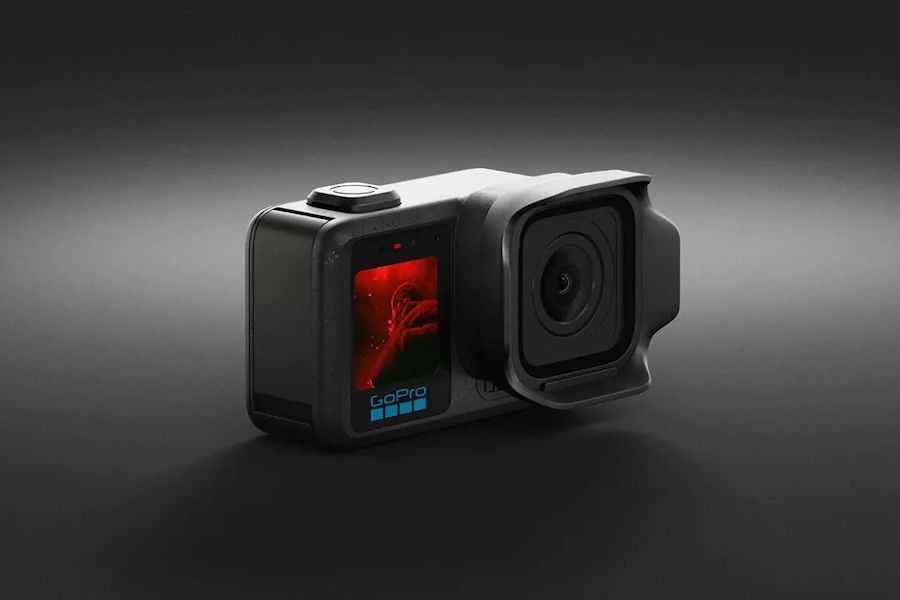
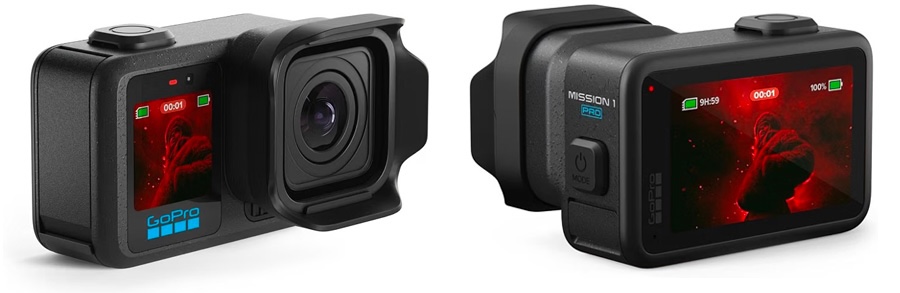
Measuring 80.1 x 52.1 x 44.3 mm and weighing 207 g, the GoPro MISSION 1 PRO is a rather large camera for its class. It’s larger and heavier than the latest GoPro HERO models, as well as some of its main competitors, such as the DJI Osmo Action 6 and the Insta360 Ace Pro 2, and its lens protrudes quite noticeably from the body. This makes it one of the bulkiest action cameras on the market, though it still retains its compact and easily portable nature.
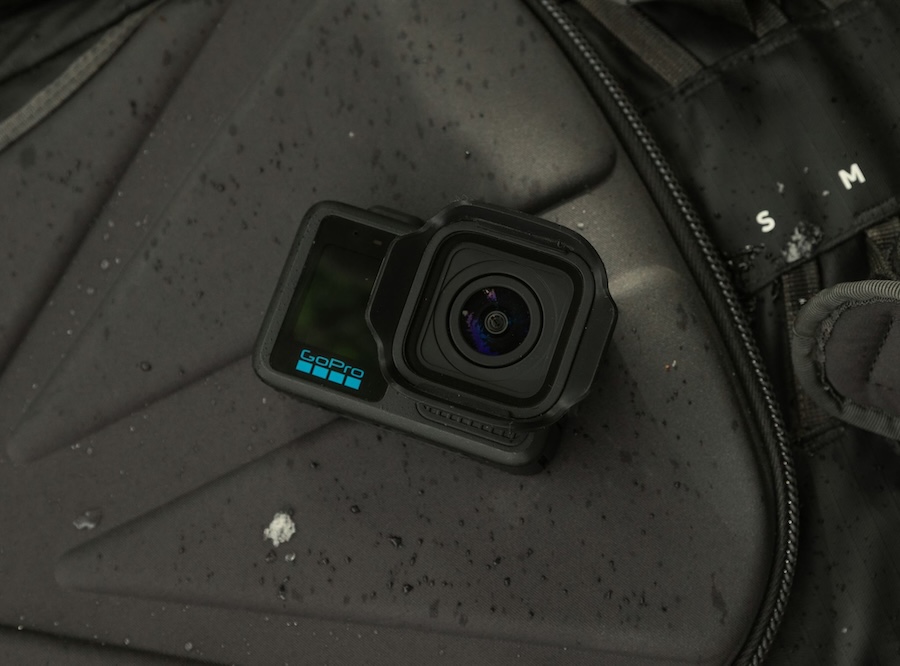
GoPro has also made several minor design changes. The two standard buttons are now more prominent, making them easier to locate and press, especially when wearing gloves. Small openings have also been added to allow water to drain out and prevent the buttons from getting stuck during underwater use. The MISSION 1 PRO is waterproof up to 20 meters without a housing, which already makes it suitable for most water activities and even great diving sessions without additional protection.
On the back, there is now a 2.59-inch OLED touchscreen, which is significantly larger than the 2.27-inch screen on the HERO13 Black. User feedback also indicates that the interface is more responsive than before. The 1.4-inch non-touch front LCD screen , meanwhile, retains the same dimensions as the one on the HERO13 Black. It allows you to check your framing while filming, as well as quickly view key settings and shooting information.
The lens cover is replaceable and features a water-repellent coating designed to minimize the buildup of water droplets in front of the lens. GoPro also includes a removable rubber lens hood with the standard version, primarily intended to reduce unwanted glare. In practice, this also provides welcome protection around the lens and reduces the risk of scratches or direct impacts.
On the mounting side, GoPro retains the excellent versatility introduced in its previous generations with three solutions built directly into the camera: the traditional GoPro mounts, a quick-release magnetic system, and a 1/4″ tripod thread. This makes it very easy to switch from one setup to another without needing multiple adapters.
Finally, the MISSION 1 PRO has no internal memory; therefore, a microSD card is required to record footage, with a maximum supported capacity of 1 TB.
GoPro MISSION 1 PRO: Battery Life and Charging
| Battery | Enduro 2 2150 mAh |
| Autonomy | Up to 5 hours in 1080p at 30 fps (Endurance Mode) More than 3 hours in 4K at 30 fps Up to 1 hour and 30 minutes in 8K at 30 fps |
| Charging time | 27 min to 80% 60 min to 100% |
The MISSION 1 PRO introduces a new 2 , 150 mAh Enduro 2 battery, which offers significantly greater capacity than previous GoPro batteries and also exceeds that of most of its direct competitors. Good news for existing users: it retains the same form factor as the previous Enduro battery and remains compatible with models that use it, such as the HERO13 Black, while their batteries can also be used with the MISSION 1 PRO.
This superior performance, combined with the optimizations introduced by the new generation, allows GoPro to announce an exceptionally impressive battery life: up to 5 hours of recording in 1080p at 30 fps in Endurance mode, over 3 hours in 4K at 30 fps, and up to 1 hour and 30 minutes in 8K at 30 fps. Independent tests generally confirm the camera’s excellent performance in this area, although battery life naturally varies significantly depending on the resolution, frame rate, and features used.
Another major development: GoPro has finally adopted fast charging. With a PPS-compatible charger, the battery can reach 80% of its capacity in just 27 minutes, while a full charge takes about an hour. This is a particularly welcome improvement in the field, since a short break is now enough to restore a large portion of the available battery life.
Check out our accessories for
GoPro MISSION 1 PRO
GoPro MISSION 1 PRO: Features
| Photo modes | Single Shot (Night mode), Interval, Burst |
| Video modes | Video, Low Light, Slow Motion, Slow-Motion Burst, HLG HDR, Subject Tracking, Loop, Battery Life |
| Time-Lapse Modes | Time-lapse / Nighttime time-lapse (moving or on a fixed mount), Star trails, Light painting, Vehicle headlight trails |
| Audio modes | Stereo |
At the heart of the MISSION 1 PRO is the new GP3 processor, which does more than just boost the camera’s processing power. It also improves its overall responsiveness: navigating menus, booting up, and starting recording are all faster than with previous generations.
Photo and video modes
The MISSION 1 PRO offers a variety of modes suited to different situations, including Low Light, HLG HDR, Loop, and Endurance. Time-lapse enthusiasts will also find TimeWarp, Night Time-lapse, Star Trails, Light Painting, and Car Light Trails.
This generation introduces several new specialized modes . Low-Light mode automatically adjusts image processing for dark scenes to minimize noise while preserving as much detail as possible. A Diving mode has also been added; it adjusts the white balance and contrast underwater, while adapting the stabilization settings for this type of shooting.
Open Gate and Follow-Up on the Topic
Another major new feature: GoPro is adoptingOpen Gate for the first time. Rather than recording directly in a traditional wide aspect ratio, the MISSION 1 PRO can capture a taller 4:3 image, up to 8K at 30 fps or 4K at 120 fps. The benefit is especially evident during editing: a single clip offers much more flexibility to later create a horizontal 16:9 video, a vertical 9:16 video, or apply various crops without having to anticipate each format at the time of shooting. It’s also possible to extract still images of up to 44.2 MP from an 8K Open Gate video.
The MISSION 1 PRO also introduces subject tracking directly within the camera. Using face and body detection, it can identify a subject and then automatically adjust the framing to keep the subject in the shot as it moves. This feature is particularly useful for vlogging, solo shoots, or scenes where it’s impossible to constantly monitor the framing.
Audio
GoPro has also improved the audio capabilities with four built-in microphones, featuring wind noise reduction and directional audio capture. The camera can record multiple audio tracks, offering more options during editing.
The MISSION 1 PRO primarily supports 32-bit floating-point audio, a format that is particularly useful when sound levels vary significantly, as it offers much more flexibility for adjusting a recording that was captured too loudly or too quietly during editing.
Finally, the USB-C port allows you to directly connect the receiver of a compatible wireless microphone, including competing models such as those from the DJI Mic or Insta360 Mic lines. This means that content creators who already have the necessary equipment aren’t forced to adopt a new audio ecosystem to use their gear with the MISSION 1 PRO.
GoPro MISSION 1 PRO: Image
| Sensor | 1 inch |
| Objective | 15–27 mm, f/2.5 |
| Photo resolution | 12 MP, 50 MP |
| Video resolution | 8K up to 60 fps 4K up to 240 fps 1440p up to 480 fps 1080p up to 480 fps |
| Photo format | .JPG (standard), .GPR (RAW) |
| Video format | .MP4 |
| Color profiles | Vivid, Natural, Cinematic, Neutral, GP-Log2 |
| Maximum video bit rate | 240 Mbit/s |
| ISO range | Video: 25 to 6,400 Photo: 100 to 3,200 |
Sensor and resolution
This is likely where one of the most significant upgrades to the MISSION 1 PRO lies. GoPro has replaced the small sensor found in its previous action cameras with a new 1-inch, 50-megapixel sensor, paired with an f/2.8 lens. On paper, this is a major upgrade, particularly in terms of improving light capture and performance in challenging conditions.
The maximum resolution has also taken a giant leap forward, as the camera can now shoot in 8K at up to 60 fps, compared to 5.3K on the HERO13 Black. The range of resolutions has also been simplified: the old 5.3K and 2.7K formats are gone, and users now mainly choose between 1080p, 4K, and 8K, plus 1440p in 4:3. The 8:7 aspect ratio found on previous GoPro models has also been replaced by 4:3, which is notably used by the new Open Gate mode we discussed earlier.
Slow-motion enthusiasts are particularly well-served. The MISSION 1 PRO reaches 240 ips in 4K and 480 ips in 1080p, while still offering access to key advanced settings such as 10-bit recording and GP-Log2. The Slow-Motion Burst mode even lets you temporarily boost the frame rate up to 960 ips in 1080p for 10 seconds, resulting in slow motion of up to 32×.
GoPro also supports video bitrates of up to 240 Mbit/s, which allows for more detail to be captured in the most demanding scenes—though, of course, this results in particularly large files.
However, this large sensor comes with a trade-off: the minimum focusing distance increases significantly, to around 60 cm. Subjects positioned very close to the lens may therefore appear blurry, which is something to keep in mind for close-up vlogs or when photographing small objects.
Image quality
In good lighting conditions, the MISSION 1 PRO produces some of the best footage currently available from an action camera. The level of detail is high, but it’s GoPro’s image processing that really makes the difference. Unlike some competitors, GoPro doesn’t focus on immediately producing a highly saturated, dramatic image; instead, its results are generally more natural and less “digital.”
Comparisons with the DJI Osmo Action 6 and the Insta360 Ace Pro 2 clearly illustrate this difference in philosophy. At first glance, the latter two may sometimes appear sharper or have higher contrast, while the GoPro places greater emphasis on subtle nuances and less aggressive processing. That doesn’t mean it consistently outperforms its competitors: depending on the scene and the settings used, the differences are sometimes quite small, and personal preference will also play a role in which look you prefer.
The improvement is also significant when light is scarce. The new Low-Light mode applies more processing to the image to reduce noise and enhance image quality, but GoPro takes a relatively restrained approach. Compared to the night modes of some competitors, the image may appear darker, but also more natural, without systematically trying to turn a nighttime scene into an artificially lit one. The various test clips available show a clear improvement over the HERO13 Black and now place GoPro among the best action cameras in these conditions.
Finally, the MISSION 1 PRO offers several color profiles— Vivid, Natural, Cinematic, Neutral, and GP-Log2— allowing you to directly tailor the look to your preferences. The new GP-Log2 profile is even flatter than the GP-Log profile on the HERO13 Black and is primarily intended for users who want to perform their own color grading. Combined with 10-bit recording, it offers significantly greater latitude in post-production, while the Cinematic profile is an attractive alternative for achieving a more polished look right out of the camera without spending as much time in editing.
GoPro MISSION 1 PRO: Bundles and Prices
ℹ️ Note: some links in this section are Amazon affiliate links. As Amazon Associates, we earn from qualifying purchases, at no extra cost to you.
| Standard package | €699.99 |
|
| Grip Pack | €779.99 |
|
| Other theme packs | From €739.99 to €1,199.99 |
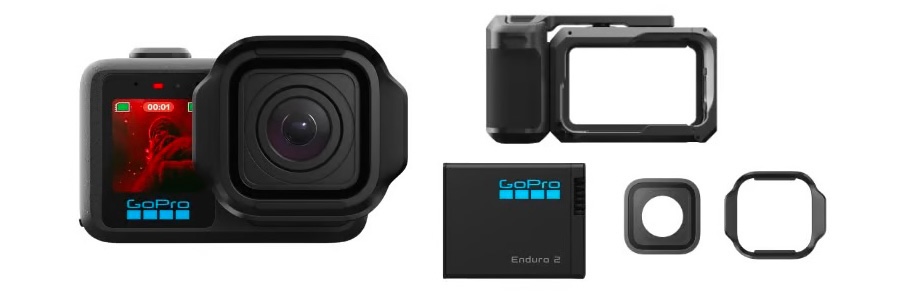
The GoPro MISSION 1 PRO is priced at €699.99 in its standard bundle. The package includes the camera, an Enduro 2 battery, a removable sunshield, and the essential accessories you need to get started, including a curved adhesive mount, a mounting strap, and a USB-C cable.
For €779.99,the Grip Edition includes all of this content and, most importantly, adds the Compact Camera Grip, along with a lanyard and a carrying case. This grip provides a feel more similar to that of a traditional camera and is particularly useful for shooting handheld, vlogging, or simply when the camera isn’t mounted on a tripod.
GoPro also offers a range of bundles tailored to different uses, with prices ranging from €739.99 to €1,199.99. Editions designed for diving, mountain biking, and motorsports include the camera along with mounts and protective gear suited to each activity. The Creator Editions, which are significantly more expensive, are geared more toward creators who want a complete set of accessories for their camera, including solutions for audio, lighting, and handling.
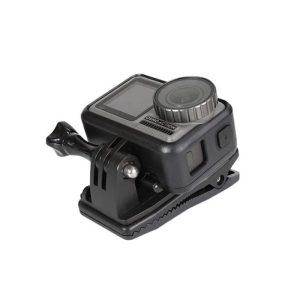
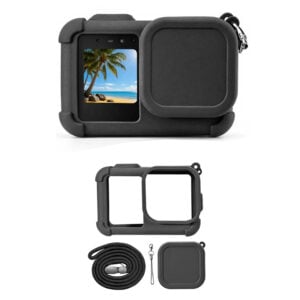
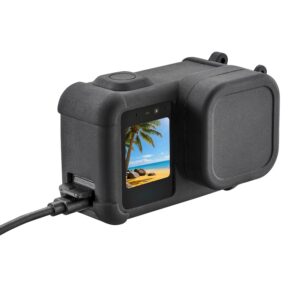
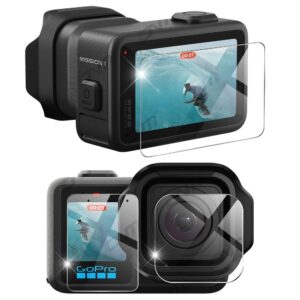
When it comes to accessories, the MISSION 1 PRO retains the mounting systems from previous GoPro models, allowing users to reuse many of the mounts, harnesses, and helmet and bike mounts they already own. However, its new sensor—and especially the different design of its optical unit—means that the HERO13 Black’s lens accessories are incompatible. ND filters specifically designed for the MISSION 1 PRO are already available, but the optical ecosystem remains less developed than that of previous generations for the time being.


GoPro MISSION 1 PRO Review: Is It Worth Buying?
With the MISSION 1 PRO, GoPro has clearly succeeded in giving its lineup the refresh it needed. This isn’t just a simple upgrade from the HERO13 Black: a new 1-inch sensor, GP3 processor, 8K at 60 fps, significantly more advanced slow-motion capabilities, Open Gate, subject tracking, longer battery life, fast charging, and new audio features… this time, the improvements touch on virtually every aspect of the camera.
Image quality is obviously one of its main selling points. The MISSION 1 PRO produces detailed and exceptionally natural images, with image processing that is generally less aggressive than that of some competitors, while delivering significant improvements in low-light conditions. For the most demanding users, the camera also offers the new GP-Log2, 10-bit recording , and a bitrate of up to 240 Mbit/s, allowing for greater flexibility in post-production.
However, it’s not all perfect. The camera is bulkier and heavier than most of its competitors, its large sensor significantly increases the minimum focusing distance, and some optical accessories from previous GoPro models are no longer compatible. But its main drawback is likely its particularly high price point: the MISSION 1 PRO costs about twice as much as some of its direct competitors, making it a particularly significant investment.
Still, GoPro needed a real breakthrough to get back in the spotlight, and the MISSION 1 PRO undoubtedly marks a huge leap forward compared to the latest HERO models. It doesn’t consistently outperform its competitors in every situation, but its excellent image quality, video performance, battery life, and wide range of features make it one of the most well-rounded and ambitious action cameras available today.
Who is the GoPro MISSION 1 PRO designed for?
The MISSION 1 PRO is designed primarily for demanding users, content creators, and imaging enthusiasts who are ready to take full advantage of its advanced capabilities. Its 8K resolution, high frame rates, Open Gate, GP-Log2, 32-bit floating-point audio, and extensive editing capabilities are particularly valuable for those who want to go beyond casual use.
If you’re just looking to film your vacations, bike rides, or some sports activities without editing the footage, it will be much harder to justify such an investment. Significantly less expensive action cameras already offer excellent image quality and may therefore be a more sensible choice, including for many users who will never actually take full advantage of the MISSION 1 PRO’s advanced features.
I already have a GoPro HERO13 Black: should I upgrade to the MISSION 1 PRO?
The upgrade to the MISSION 1 PRO is much easier to justify than with the most recent annual updates to the HERO lineup. The 1-inch sensor, 8K60, slow-motion up to 4K240, Open Gate, improvements in low-light performance, the new processor, longer battery life, and fast charging represent a true generational leap.
That said, the HERO13 Black is still an excellent action camera. If it already meets your needs perfectly and you mainly shoot in 4K under good lighting conditions, there’s no need to replace it— especially since upgrading to the MISSION 1 PRO represents a significant investment. The upgrade becomes much more appealing if you’re looking for better image quality, more flexibility in post-production, improved low-light performance, or the new capabilities offered by its sensor and video modes.
💡 See also
➡️ Want to learn more about the previous generation? Check out our in-depth review of the GoPro HERO13 Black.

 Blog
Blog