
 Français
 Deutsch
 Español
 Italiano
 Parts & Accessories by Drone
 Drones
 Action camera
 Microphones
 Camera Stabilizers
 VR Headsets
GoPro MAX 2, full review: GoPro back in 360°!
Nov
Six years after the first GoPro MAX was released at the end of 2019, the GoPro MAX 2 is finally here. It’s been a long time coming, and in that time, Insta360 and more recently DJI have largely taken over the 360 camera market. Suffice to say, this new GoPro was eagerly awaited by fans of the brand. But what is the MAX 2 really worth? Is it a real comeback or just a new coat of paint? Is it the camera you need for 360, POV or vlogging? All the answers in this article.
GoPro MAX 2 : What you need to know
No time (or laziness 😅 ) to read it all? Here are the key points to remember about the GoPro MAX 2 👇
- 🎨 Square design, very similar to the first GoPro MAX
- 🧲 New protective lens system removable and replaceable without tools
- 🔋 Good autonomy: approx. 75 minutes at 8K30, but very slow recharging (over 2h30 for a full charge).
- 📷 1 /2.3″ sensors: video up to 8K/30, 5.6K/60 and 4K/100, with 10-bit GP-Log profile for the most demanding post-prod users
- 📸 Photo and video modes similar to those of the latest GoPro HERO
- 🌞 Very good image quality in daylight, but very limited low-light performance
- 📱 GoPro Quik mobile app does the job, but desktop software lags behind the competition
- 🎙️ Clear audio thanks to 6 built-in microphones, with direct AirPods and Bluetooth headset compatibility
- 📦 Available from €519.99, with themed packs for different uses (travel, drone, action…).
📌 A 360 camera aimed primarily at those who film outdoors, in daylight, and who already use GoPro products.
GoPro MAX 2 : Design
| Dimensions (W x H x D) | 64 x 69.7 x 48.7 mm |
| Weight | 195 g |
| Touch screen | 1.82 inches |
| Number of microphones | 6 |
| Storage | microSD card |
| Operating temperature | -10° to 35° C |
| Waterproofing | 5 meters |
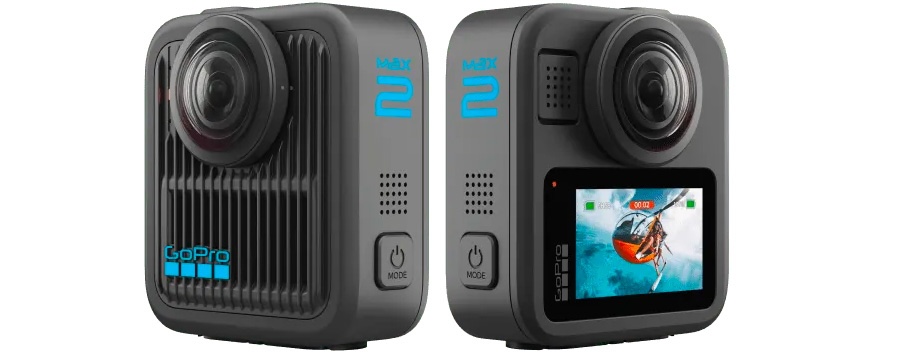
The GoPro MAX 2 retains the recognizable look of the first MAX: a square format, two prominent curved lenses and a dark gray plastic coating. At first glance, it’s the same… or almost. The lenses are now perfectly centered, and a ventilation grille has been added to the rear.
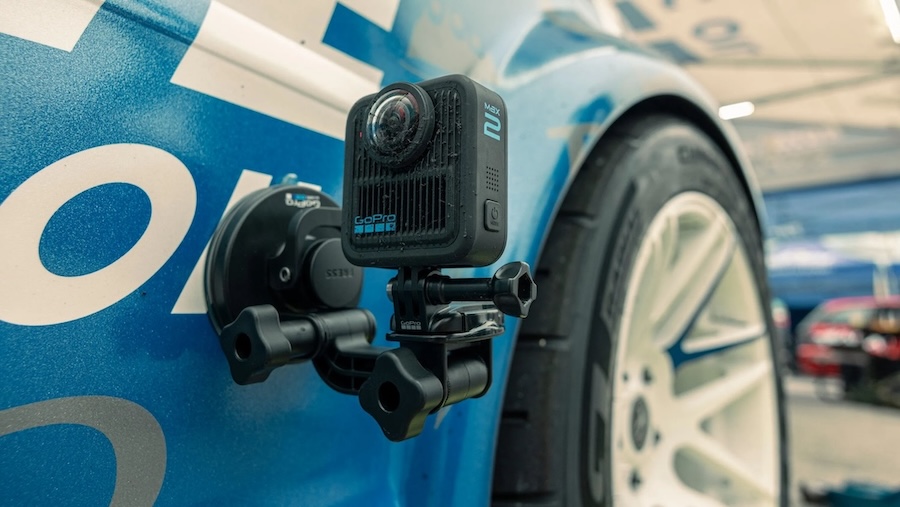
The interface remains true to GoPro form: two large physical buttons to manage power and recording, plus a 1.82″ touchscreen on the rear for navigating menus and checking your shots. When it comes to mounts, the choice is yours: no less than three integrated options. The classic GoPro brackets, a standard 1/4″ screw thread for tripods, and a practical magnetic mount for placing the camera just about anywhere.
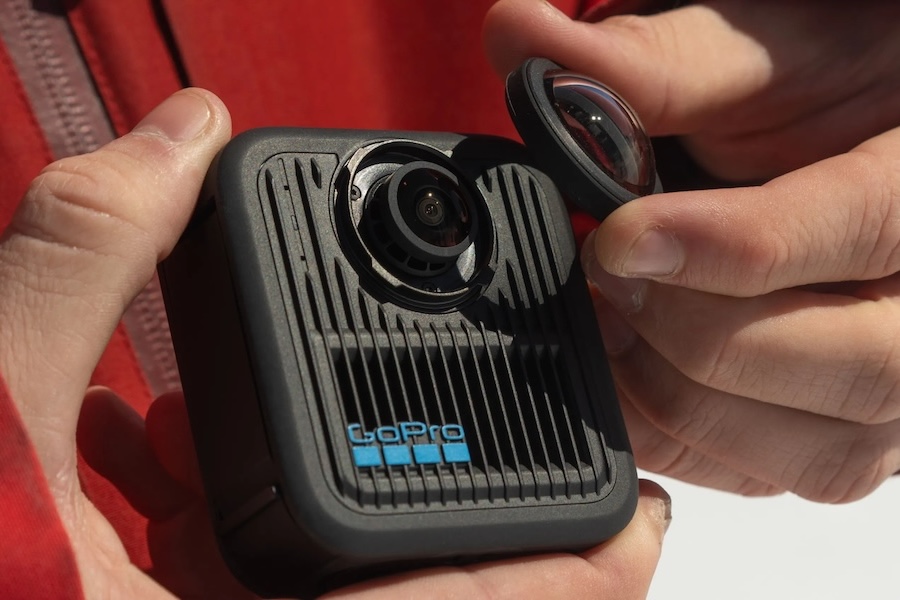
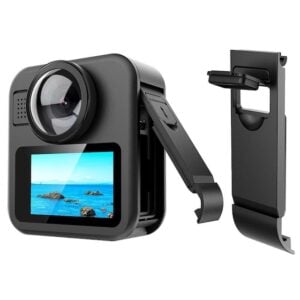
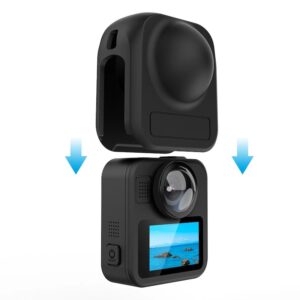
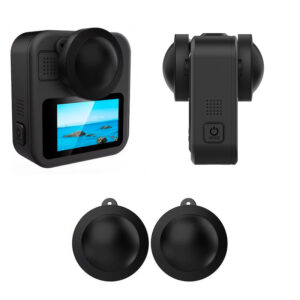
But the really good idea comes from the lenses: the protectors can now be replaced without tools, in just two seconds. A real relief for a 360 camera, where a scratch on the lens can quickly ruin a shot. Here, GoPro has the edge over the competition: even the Insta360 X5 doesn’t make it so easy.
Finally, the MAX 2 is waterproof up to 5 meters and can withstand temperatures between -10°C and +35°C. A word of warning, however: as is often the case with curved lenses, the image becomes blurred underwater. To film properly underwater, you’ll need to consider a diving housing.
🧠 An aging GP2 chip?
The GoPro Max 2 embeds the GP2 chip, launched in 2021 with the HERO 10. It handles all operations: interface, menus, responsiveness, but above all image processing. So far, there’s nothing to complain about in terms of fluidity, but after four years of waiting, we could have hoped for better. Many users were hoping to see the arrival of the long-awaited GP3, which is still a long way off. The question is: how long will this Max 2 hold up against future developments?
GoPro MAX 2 : Autonomy and overheating
| Battery | 1960 mAh |
| Autonomy | 8K / 30 fps: 66 min 5.6K / 60 fps: 59 min 5.6K / 30 fps: 90 min 4K / 100 fps: 76 min |
Autonomy and recharging
The GoPro MAX 2 uses a new 1,960 mAh battery, specific to this model. It is not compatible with the first GoPro MAX, nor with any of the brand’s other cameras, including the GoPro HERO series. Too bad: you won’t be able to reuse your old batteries, even if you’re already equipped with a GoPro.
As for battery life, the official figures (communicated by GoPro, although absent from the main product sheet) remain honest: up to 90 minutes in 5.6K at 30 fps, just over an hour in 8K at 30 fps, or around an hour and a half in 4K at 100 fps.
But the real weak point is recharging. There’s no fast charging, whereas most of our competitors already allow you to recover 80% of your battery in just a few dozen minutes. Here, according to user feedback, it takes around 2h30 to fully recharge from 0 to 100%. This is a real handicap for those who plan to shoot for long periods: it’s better to plan to buy extra batteries to be able to take a series of shots without waiting for hours.
Thermal management
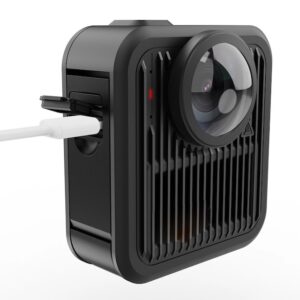
The ventilation grille that appeared on the rear of the MAX 2 raised hopes of an improvement in heat dissipation… but it doesn’t work miracles. According to several testers’ feedbacks, the camera heats up during prolonged recording, especially indoors, without ventilation. At 8K/30 fps, automatic shutdowns can occur after around 20 to 30 minutes.
This kind of behavior is still common on action cameras, especially in static use. However, there’s no need to worry about this under the usual conditions of use for this type of camera: outdoors, in motion, with good ventilation all around.
Discover our accessories for
GoPro MAX 2
GoPro MAX 2 : Image
| Sensor | 1/2.3 inch |
| Objective | Aperture f/1.8, Equivalent 14 to 26 mm |
| Max. photo resolution | 12 MP (single lens) / 29 MP (360°) |
| Max. video resolution (360°) | 8K up to 30 fps 5.6K up to 60 fps 4K up to 100 fps |
| Max. video resolution (single target) | 4K up to 60 fps 1080p up to 60 fps |
| Photo format | .36P, .JPG, .GPR |
| Video format | H.265 (HEVC) |
| Color profiles | Standard, GP-Log |
| Maximum video bit rate | 120 Mbit/s |
| ISO range | 100 à 6400 |
Sensors and resolutions
The GoPro MAX 2 features a 1/2.3″ sensor. Compared with the competition, this is clearly the smallest of the three: the Insta360 X5 offers a 1/1.28″ sensor, and the DJI Osmo 360 a 1/1.1″ sensor. A difference that can come into play in certain shooting conditions (we’ll come back to this later in the “Image quality” section).
On the video side, the MAX 2 films in 8K at up to 30 fps in 360°, with options in 5.6K/60 and 4K/100. In single-lens mode, we find 4K/60 or 1080p/60. For photos, 12 MP (single lens) or 29 MP in 360°.
As far as slow motion is concerned, the camera goes up to 100 fps in 4K, which is still enough to slow down the action slightly. But this is a far cry from traditional action cameras, which sometimes reach 240 fps, with much smoother, sharper slow-motion. Something to bear in mind if this is important to you.
Image quality: very good… as long as it’s daylight.
In daylight, the GoPro Max 2 offers excellent video quality. Colors are faithful, sharpness is crisp and images can be used straight away without retouching. GoPro confirms its expertise here, with little flare, little distortion, and very clean overall rendering, even in 8K. If you mainly shoot during the day, this is clearly one of the best 360° cameras on the market today.
As soon as the light fades, however, the MAX 2 falls well behind its rivals. The image becomes darker, digital noise quickly appears in low-light areas, and dynamic range collapses: the sky can easily be burnt in high-contrast scenes. Unlike the competition, no night mode is offered here, which doesn’t help make up for the small sensor’s weaknesses. Perhaps we should also point the finger at the aging GP2 chip, which is starting to look dated. In short, if low light is an important criterion for you, the Max 2 is clearly not the best choice.
OUR BEST SELLERS - GoPro MAX 2

Action camera

Action camera

Action camera
GoPro MAX 2 : Features
| Stabilization | HyperSmooth Max with 360° horizon lock |
| Photo modes | Standard photo, Burst photo, Night photo |
| Video modes | Standard video, POV, Selfie, Loop, TimeWarp, Accelerated, Accelerated night, Star trails, Light Painting, Vehicle light trails |
| Audio modes | 360° Audio, Stereo |
Photo and video modes
The GoPro Max 2 offers the main photo and video modes already found on the latest HERO models: Burst, POV, Selfie, Loop, TimeWarp, Accelerated, etc., as well as the manufacturer’s famous night modes such as Accelerated Night, Star Streaks or Light Painting, which make it easy to create original visual effects. The brand’s signature modes are well mastered, but there’s nothing really new to report here.
📍 Note: the Max 2 integrates GPS, unlike its direct competitors. This not only enables files to be
Applications: not up to Insta360 standards
The GoPro Max 2 is compatible with theQuik mobile app (iOS/Android), which enables fast, intuitive editing, with AI-driven tools for cropping, exporting or subject tracking. It also works with GoPro Player software on the PC, designed for more complete post-production.
In practice, these two solutions do the job, but remain a notch below Insta360. On the computer, in particular, GoPro Player hasn’t really evolved since the MAX 1: dated interface, limited functions, less fluid, sometimes unstable… and still no automatic tracking, which has become standard with the competition.
It’s a shame, because editing is a big part of the 360 experience. If you intend to work on your videos regularly in post-prod, the software suite is likely to frustrate you in the long run, especially when compared to the far more accomplished Insta360 Studio.
Audio: microphones to match?
The GoPro Max 2 incorporates six microphones distributed around the body, with 360° or stereo audio modes as required. Sound is generally clear and well-defined in quiet environments, but noise reduction can still be improved, especially outdoors: as soon as the wind picks up, hiss or noise can appear despite the built-in processing.
The Max 2 is also compatible with AirPods and other Bluetooth headphones, enabling the use of a wireless microphone in addition. A welcome solution for improving audio performance in difficult conditions, such as when filming on the move or in windy conditions.
GoPro MAX 2 : Packs and prices
ℹ️ Note: some links in this section are Amazon affiliate links. As Amazon Associates, we earn from qualifying purchases, at no extra cost to you.
| Standard package | 519,99 € |
|
| Theme packs | From € 569.99 to € 656.99 |
The GoPro MAX 2 starts at €519.99. For this price, you’ll get the standard pack, which includes the camera, two lens covers, a curved adhesive mount, an Enduro battery, a microfiber cloth, a USB-C cable, the classic mounts (short loop + screws), and four GoPro stickers.
This price places the MAX 2 between the more expensive Insta360 X5 and the more affordable DJI Osmo 360, clearly positioned to compete with its direct rivals.
Several theme packs are also available, with prices ranging from €569.99 to €656.99 depending on the accessories included. These include, for example:
- MAX 2 + accessories pack (€569.99): adds a 1.2 m telescopic pole, two Enduro batteries and a 64 GB microSD card, a practical package for long shooting without worrying about autonomy or storage.
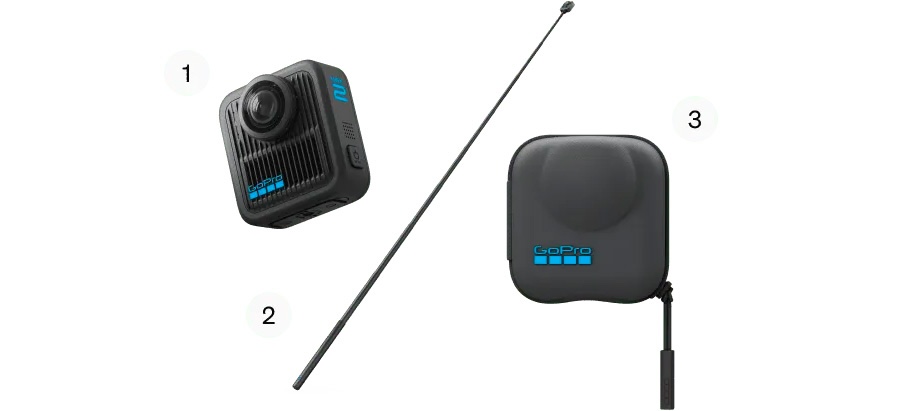
- MAX 2 pack “Perfect for drone-style aerial images” (€639.99): this pack caught our attention as drone enthusiasts, with its long 2.7 m telescopic boom and protective case, perfect for spectacular shots.
Other packs, designed for travel, winter sports or multi-purpose use, complete the range.
🎁 O ne year’s GoPro Premium subscription included
The purchase of the GoPro MAX 2 entitles you to a free GoPro Premium subscription for one year, normally charged at €49.99 per year. It entitles you to unlimited cloud storage, camera replacement in the event of damage, discounts of up to 50% on GoPro accessories, and other subscriber-only benefits.
Conclusion GoPro MAX 2: Should you give in?
The GoPro MAX 2 marks GoPro’s long-awaited return to the world of 360 cameras, more than six years after the launch of the first MAX. It’s a welcome return for those who’ve been hoping for a new version for a long time, and it’s a pretty good one, provided you shoot in the right conditions.
But what’s most impressive is undoubtedly the simplicity and effectiveness of its new removable protective lens system. In two seconds, they can be replaced without tools, which changes everything for a 360 camera destined to move. In this respect, GoPro puts everyone in agreement.
A few shortcomings remain: a GP2 chip that’s starting to look dated, very limited low-light performance, very slow recharging and a desktop software suite that still lags behind the competition. The GoPro MAX 2 remains a good 360 camera, but it also hints at areas for improvement in the future.
🎯 For whom?
- You already have a GoPro and can take advantage of the ecosystem (bindings, mobile app, accessories)
- You mainly shoot outdoors and during the day, in favourable lighting conditions.
- You want a 360° camera designed to move, with easily replaceable lenses
🚫 Avoid if…
- If you often shoot indoors or in low light: performance drops off rapidly
- You need fast recharging to keep plugging in
- You edit on a computer: the GoPro suite is still limited in this respect
💡 S till unsure which 360° camera to choose? Read also our full tests of the main competitors 👇
➡️ Our complete analysis of the Insta360 X5
➡️ Our detailed review of the DJI Osmo 360

 Blog
Blog