
 Français
 Deutsch
 Español
 Italiano
 Parts & Accessories by Drone
 Drones
 Action camera
 Microphones
 Camera Stabilizers
 VR Headsets
DJI Osmo 360, full review: a real rival for Insta360?
Aug
DJI reigns supreme in the world of drones, and has made a name for itself in the world of action cameras with its Osmo Action range. Now, the brand is expanding its playground and tackling the 360° camera market, dominated until now by Insta360. Meticulous design, 8K… what is this newDJI Osmo 360 really worth? Is it the camera you need for all your adventures? Verdict in this article.
DJI Osmo 360: What you need to know
No time to read it all? Here’s what you need to know about the DJI Osmo 360 in a few key points:
- 🎥 Impressive image quality: 1/1.1-inch square sensor, video up to 8K at 50 fps, stills up to 120 MP, 10-bit recording, and D-Log M profile for maximum post-prod flexibility.
- 🌙 Excellent low-light management, thanks in particular to SuperNight mode, which significantly improves exposure and detail at night or indoors.
- 🧊 C ompact, rugged design: 183 g square housing, 2″ touchscreen, IP68 waterproofing (10 meters), 1/4″ thread and quick magnetic attachment identical to that on the Osmo Action 5 Pro – perfect for reusing your existing accessories.
- 🔋 So lid autonomy: up to 100 minutes at 8K/30ips, 190 minutes at 6K/24ips.
- 🎬 Various video modes: Selfie, Vortex, Timelapse, SuperNight, Boost (ultra-wide FOV), pre-recording, loop recording… Enough to cover all creative uses.
- 📱 Two effective apps: DJI Mimo (mobile) for quick editing, and DJI Studio (PC/Mac) for more in-depth work on your 360° footage.
- 🎤 Well-managed audio, with 4 built-in microphones and DJI Mic 2 / Mic Mini compatibility for capturing up to 2 speakers with full sound control.
- 💸 More affordable than the Insta360 X5: the DJI Osmo 360 starts at €479.99 for the standard package.
- ⚠️ Main drawback: the lenses are not replaceable. A shock or a scratch will require a return to the after-sales service. Beware, too, of the blurred image underwater without a housing, despite the waterproofing.
DJI Osmo 360 : Design
| Dimensions (L x W x H) | 61 × 36.3 × 81 mm |
| Weight | 183 g |
| Touch screen | 2 inches |
| Storage | 128 GB internal storage microSD card (up to 1 TB) |
| Operating temperature | -20 to 45° C |
| Waterproofing | 10 meters |
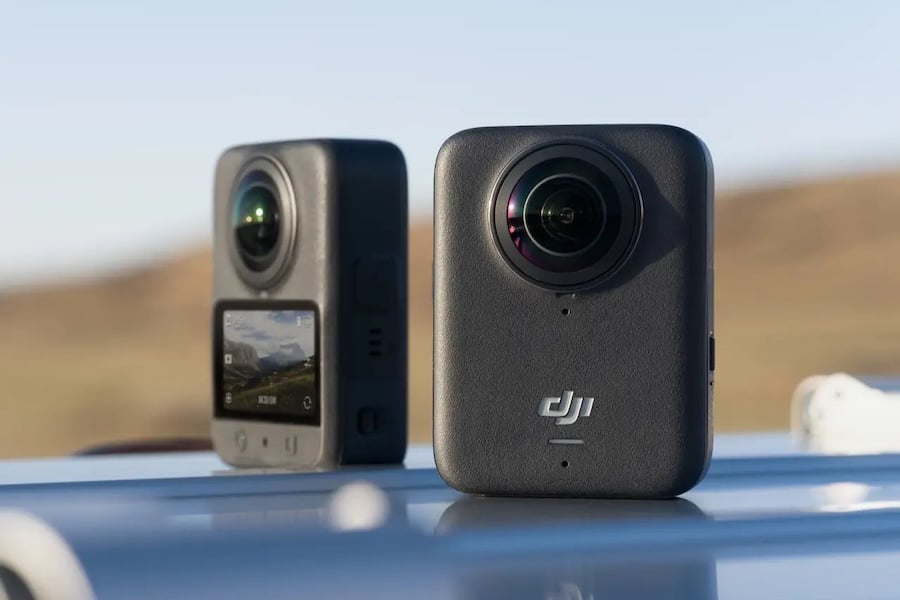
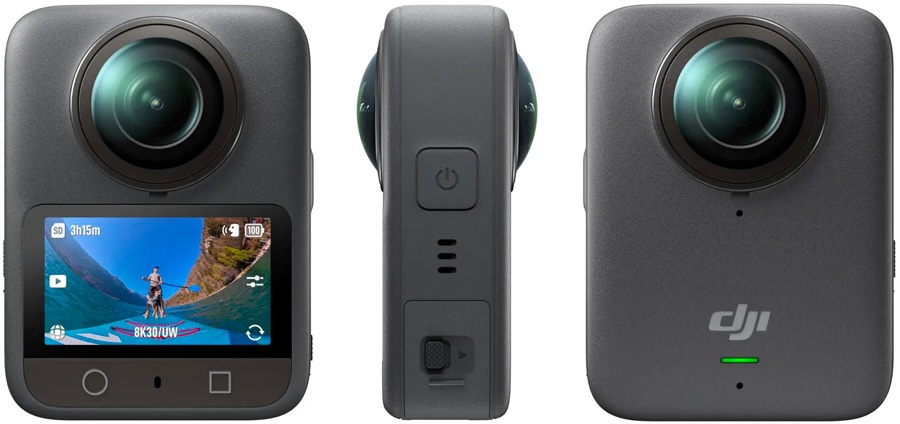
The DJI Osmo 360 adopts a compact, square format immediately reminiscent of the GoPro Max. But it’s also reminiscent of the Insta360 range, with its domed fisheye lenses on either side of the body, characteristic of modern 360° cameras. The housing is made of dark gray plastic, with a solid, well-finished construction.
The rear panel features a 2-inch color touchscreen in landscape format. It’s bright (800 nits), easy to read even in bright sunlight, and a pleasure to use.
The camera controls are simple and effective, with three clearly identifiable physical buttons :
- Power button (also used to change shooting mode)
- Trigger (with circular icon)
- Toggle button between the two lenses (square icon)
Two flaps protect the connectors: one hides the USB-C port, the other gives access to the removable battery and microSD card reader (up to 1TB). DJI has also added 128 GB of internal storage, which comes in handy for backup purposes.
Underneath the camera is a standard tripod screw thread (1/4″), as well as the magnetic quick-release fas tener already seen on the Osmo Action 5 Pro – handy for switching from one support to another without wasting time.
In terms of resistance, the Osmo 360 is certified to IP68: waterproof up to 10 meters, and capable of operating between -20°C and +45°C. DJI warns, however, that convex lenses may cause distortion or assembly errors underwater. We’ll come back to this in the section on image quality.
One small regret: unlike the Insta360 X5, the lenses are not interchangeable. In the event of scratches, breakage or damage, it will be impossible to replace them yourself: a visit to DJI’s after-sales service will be essential.
DJI Osmo 360: Autonomy and overheating
| Battery | 1950 mAh |
| Autonomy | 8K/30 fps: up to 100 minutes 6K/24 fps: up to 190 minutes |
Battery and autonomy
The Osmo 360 uses the same 1950 mAh Extreme Plus battery as the Osmo Action 5 Pro. Good news for users equipped with both models, since they can share batteries and chargers without worry.
DJI claims up to 100 minutes of recording in 8K30 and up to 190 minutes in 6K24. According to published tests and available feedback, the observed battery life in 8K30 generally ranges between 90 and 100 minutes, without interruptions or thermal warnings. A convincing performance for such a compact 360° camera.
Overheating: a cause for concern?
Powerful 360° cameras are often prone to overheating, especially at high resolutions. Some testers have reported recording stops in 8K25, after 30 to 35 minutes, in poorly ventilated rooms at over 26°C.
Based on several tests carried out indoors at around 25 °C, in 8K25 and 8K30, without specific ventilation, no significant overheating issues were observed, with continuous recording until the battery was depleted. A good indicator of thermal stability under typical conditions.
⚠️ Beware, however: things could be different if you let the camera film continuously in full sunlight, for example for a motionless summer timelapse.

Discover our accessories for
DJI Osmo 360
DJI Osmo 360 : Image
| Sensor | 1/1.1-inch CMOS |
| Opening | f/1,9 |
| Max. photo resolution | 120 MP (360°), 30 MP (single lens) |
| Max. video resolution (360°) | 8K up to 50 fps 6K up to 60 fps 4K up to 100 fps |
| Max. video resolution (single lens) | 5K up to 60 fps 4K up to 60 fps 2.7K up to 60 fps |
| Photo format | JPEG |
| Video format | OSV, MP4 (HEVC) |
| Color profiles | Normal, D-Log M |
| Maximum video bit rate | 170 Mb/s |
| ISO range | 100 à 51200 |
Sensors and resolutions
The DJI Osmo 360 introduces a brand-new 1/1.1-inch square sensor, specially designed for this camera. This unprecedented format makes better use of the sensor’s surface area – up to 25% more usable area than a traditional rectangular sensor – while maintaining a 360° field of view. At 2.4 µm, the pixels are twice as large as those of the Insta360 X5, considerably improving light management, especially in low light.
In 360° video, the camera can shoot up to 8K at 50 frames per second, with 6K modes up to 60 fps and 4K up to 100 fps, for those who prefer fluidity. In single-lens mode, it shoots up to 5K at 60 fps, with several variations in 4K and 2.7K depending on the ratio chosen.
When it comes to photography, the DJI Osmo 360 offers a 120 MP high-definition mode, obtained by pixel binning, a technique that combines several pixels to generate a more detailed image. This mode is to be preferred in conditions of good luminosity, as in darker or more complex scenes, there is a risk of losing sharpness and precision. 💡 House tip: for more consistent results, it’s best to opt for the 30 MP mode, especially in contrasting scenes (areas of light and shadow), where activating the HDR mode will bring a real gain in dynamic range.
The camera records video in 10-bit, either with the Normal profile or the flat D-Log M profile (note that the X5 is limited to 8-bit on all its profiles). D-Log M, in particular, is ideal for users who wish to calibrate their own colors in post-production or apply LUTs: it’s clearly the profile to choose if you’re looking for maximum flexibility in image processing.
Image quality: is it up to scratch?
Yes, the image quality is spot on, whether in photos or video. In daylight, the Osmo 360 delivers detailed, well-exposed, natural-looking images. 360° videos are crisp, with rich, bright colors. The rendering is flattering right out of the camera, while retaining good detail reproduction.
In low light, the camera does very well for a 360° camera. Thanks to Super Night mode, images are better exposed, with less noise than on the Insta360 X5, and more detail visible in dark areas. A great improvement in these often tricky conditions.
What’s more, the rendering is very similar to that of other DJI cameras. Whether you’re using a DJI drone or an Osmo Action 5 Pro, you’ll find consistent image processing, making it easy to edit videos with shots from different devices.
Last but not least, stabilization is excellent. The Osmo 360 incorporates RockSteady 3.0 and HorizonSteady technologies, ensuring smooth, stable video, even on the move. All without any floating or unstable effects.
🐠 Small note for fans of underwater videos
DJI makes it clear that, despite IP68 waterproofing up to 10 meters, the Osmo 360 is not ideal for underwater shots without a housing. This is due to the convex shape of the fisheye lenses, which causes light to refract abnormally underwater, resulting in image distortion and stitching errors. Available tests and demonstrations show that image quality becomes blurry and difficult to use underwater without a housing. For underwater shooting, the use of a waterproof housing is therefore strongly recommended.
DJI Osmo 360 : Features
| Photo modes | Standard, Selfie mode |
| Video modes | Video Single Lens, Panoramic Video, Boost, SuperNight, Selfie Mode, Timelapse/Hyperlapse, Vortex, Pre-recording, Loop Recording |
| Stabilization | RockSteady 3.0, HorizonSteady |
Photo and video modes
In addition to the classic modes (standard photo, panoramic video or single-lens), the Osmo 360 offers a number of well-thought-out special modes that add real value in a variety of conditions:
- Selfie mode: allows automatic framing on the person being filmed, whether in photo or video, to keep the subject centered at all times without having to intervene. Ideal for vlogs and face-to-face videos.
- Boost mode: exploits the single lens to offer an ultra-wide 170° field of view with smooth 4K sequences at up to 120 fps. Ideal for capturing the action like a classic sports camera.
- SuperNight mode: active only in 360°, this mode greatly improves low-light rendering, with less noise, better exposure and enhanced detail, whether indoors or at night.
- Vortex mode: use a special accessory to make the camera rotate around you, for a spectacular effect inspired by Matrix-style“bullet-time”.
- Timelapse / Hyperlapse: capture the passage of time, either from a fixed point or in motion.
- Pre-recording: records a few seconds before pressing the REC button, useful for unexpected scenes.
- Loop recording: useful for dashcam or surveillance use, this mode records continuously, replacing old footage.
👉 Please note: the camera can be controlled by voice commands (in English only) or gestures, allowing you to launch a recording or take a photo without having to touch the device.
Applications : DJI Mimo and DJI Studio
The Osmo 360 works with DJI Mimo, a mobile application already familiar to Osmo camera users. It lets you control the camera remotely, browse videos and photos, apply updates and access an integrated video editor. The latter offers essential functions: creation of cropped or panoramic clips, insertion of key points, subject tracking by AI, transitions, music, etc. It’s not the most advanced application on the market, but it remains fluid, intuitive and more than sufficient for quick editing.
Added to this is DJI Studio, a brand-new free application for Mac and Windows, launched at the same time as the camera. It takes up the principle of 360° editing in a desktop version, with the ability to set key images, use intelligent tracking, adjust framing, add filters and music, then export everything in classic or 360° format. The interface is clear, easy to learn and well adapted to the needs of designers who prefer to work on the computer.
Audio and connectivity
The DJI Osmo 360 incorporates four microphones that deliver surprisingly clean audio capture in the right conditions. Ambient sounds and voices are well reproduced, even if wind remains a limiting factor.
But it’s above all the compatibility with DJI Mic 2 and Mic Mini that makes the difference: you can connect up to two microphones simultaneously, a real plus for interviews or shoots with two people. It’s even possible to adjust gain levels, activate noise reduction and preview audio directly from the screen, for precise control even on location.
DJI Osmo 360: Packs and prices

ℹ️ Note: some links in this section are Amazon affiliate links. As Amazon Associates, we earn from qualifying purchases, at no extra cost to you.
| Standard package | 479,99 € |
|
| Adventure Pack | 629,99 € |
|
| Theme packs | From € 509.98 to € 676.99 |
The DJI Osmo 360 is available in several versions to suit your needs and budget:
- Standard Pack – €479.99: this basic pack includes the camera, Extreme Plus battery, lens cover, USB-C PD cable, carrying pouch and cleaning cloth. A simple configuration to get you started.
- Adventure Pack – €629.99: this more complete pack adds a second battery, a charging case, a 1.2 m invisible pole and an adjustable magnetic mount. Ideal for filming longer and in more varied conditions.
DJI also offers a number of themed packs (not available from all retailers), each geared to a particular practice or use. These include the Vlog Pack, the Bike Pack, the Ski Pack and the Vortex Pack, each with a selection of dedicated accessories: helmet mount, handlebar mount, rotating boom, magnetic grip, etc. Prices range from €509.98 to €676.99, depending on composition.
📌 Good to know: another strong point of the Osmo 360 is its compatibility with many existing accessories in the DJI ecosystem. In particular, it uses the same quick-release magnetic mounting system as the Osmo Action models (notably the Action 4 and Action 5). This means you can reuse existing brackets, shells or grips.
OUR BEST SELLERS - DJI Osmo 360


Action camera
Conclusion DJI Osmo 360: Should you give in?
With excellent overall performance, a user-friendly design, effective applications and an attractive price tag, DJI’s first 360° camera is a success. It doesn’t surpass the Insta360 X5 in every respect, but comes very close, and does even better in low light, with very convincing image quality in these conditions. For users already equipped with a DJI Mic Mini, Mic 2 or other DJI accessories, this is simply a logical option. A very good first attempt from DJI.
The main drawback of the Osmo 360 is theabsence of replaceable lenses: in the event of scratches or impact, you’ll have to go to the DJI after-sales service. This is a real weak point for high-risk shooting (committed sports, abrasive environments, etc.). There are also a few limitations compared to the Insta360 X5: fewer advanced functions integrated into the camera (no live mode, no AEB), and less advanced editing applications (fewer assisted editing or AI tools, for example). Last but not least, image quality underwater without housing remains very average, despite the announced waterproofing.
🎯 For whom?
- Those who want to shoot 360° at the best price: performance similar to that of the X5, but at a much more affordable price.
- Those already equipped with DJI equipment: DJI Mic Mini, DJI Mic 2 or other compatible accessories.
- Those who often shoot in low light: excellent night-time rendering thanks to the square sensor and SuperNight mode.
🚫 Avoid if…
- If you’re planning to use your equipment in extreme or high-risk conditions: without replaceable lenses, a scratch or impact can be a problem.
- If you already own an Insta360 X5: the DJI Osmo 360 is an excellent alternative, but not necessarily worth replacing.
You already have an Insta360 X5: should you upgrade?
Not necessarily. If you’re happy with your Insta360 X5, the DJI Osmo 360 won’t revolutionize the industry. On the other hand, if you regularly shoot in low light or are already part of the DJI ecosystem (Mic 2, Mic Mini…), it becomes a serious alternative, just as powerful… and more affordable.
💡 Also worth reading
👉 Want to know more about the DJI Osmo 360’s direct competitor? Discover our complete Insta360 X5 test.

 Blog
Blog