
 Français
 Deutsch
 Español
 Italiano
 Parts & Accessories by Drone
 Drones
 Action camera
 Microphones
 Camera Stabilizers
 VR Headsets
DJI Osmo Nano, full review: a new challenger in the mini format
Oct
The action camera market is constantly evolving. Alongside more classic models such as the GoPro Hero or DJI Osmo Action, renowned for their robustness and endurance, a new generation of more compact, modular cameras is emerging. Following on from the success of the Insta360 GO, DJI is now unveiling its vision of the miniature format with the DJI Osmo Nano, a two-in-one camera designed to accompany creators on all their adventures. But what is this newcomer really worth? What does it offer the competition? Is it the ideal camera for your everyday videos? All the answers in this article.
DJI Osmo Nano: What you need to know
No time to read it all? Here are the essential points to remember about the DJI Osmo Nano :
- 🧲 Modular magnetic camera, consisting of a 52 g main housing and a multifunction Vision Dock (screen, recharge, remote control)
- 📺 1 .96″ touchscreen, bright and fluid, but a little small for real visual comfort or easy navigation, especially with large fingers
- 💦 Waterproof up to 10 m without housing, but Vision Dock is splashproof (IPX4)
- 🔋 Autonomy correct: approx. 90 min solo, up to 200 min with dock, fast recharge to 80% in 20 minutes
- 🎥 1 /1.3″ sensor, 4K video at up to 120 fps, slow motion at up to 240 fps, 10-bit D-Log M profile for the most demanding users
- 🌅 Good image quality in bright light; SuperNight mode extends use into the night
- 🎙️ Correct stereo audio, with direct DJI Mic Mini, Mic 2 and Mic 3 compatibility without receiver
- 📦 Available from €279, with theme packs between €309 and €419 to suit different uses
📌 A compact, well-thought-out camera, ideal as a secondary solution for capturing discreet, creative shots or at angles inaccessible to conventional cameras, especially if you’re already a user of the DJI ecosystem.
DJI Osmo Nano : Design

| Dimensions (L x W x H) | Camera: 57.3 × 29.5 × 28 mm Vision Dock: 59.1 × 42.2 × 22.3 mm |
| Weight | Camera: 52 g Vision Dock: 72 g |
| Touch screen | 1.96 inches, 800 nits |
| Storage | microSD card (up to 1TB) 64 or 128 GB internal storage (depending on version) |
| Operating temperature | -20 to 45 °C |
| Waterproofing | Camera: up to 10 m Camera + Vision Dock: splashproof (IPX4) |
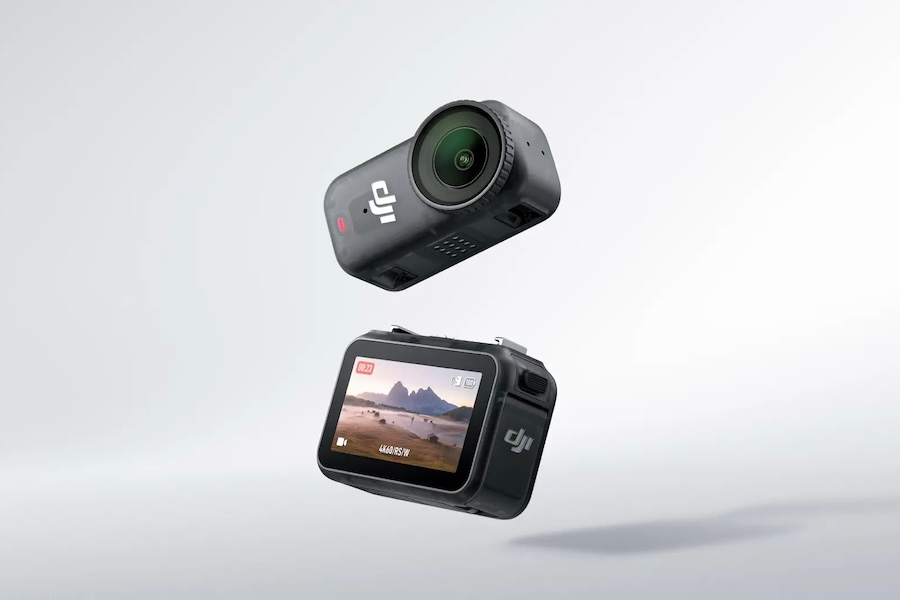
It’s hard not to think of the Insta360 GO range when discovering the DJI Osmo Nano. The principle is similar: a modular, magnetic design combining a 52 g mini-camera and a 72 g screen case, the Vision Dock. This is not DJI’s first attempt, however, as the brand had already explored this approach with the DJI Action 2, which laid the foundations for this 2-in-1 architecture. Here, the Vision Dock acts as control screen, remote control and charging station in one.
The system allows the camera to be fixed in either direction, depending on the type of shot: inward for vlogging or selfie shots, and outward for filming the scene. The magnetic attachment, reinforced by two side clips, guarantees a secure hold even on the move. What’s more, the mount is compatible with the entire DJI Osmo range (Action 3, Action 4, Action 5 Pro and Osmo 360), making it easy to re-use existing accessories.
The Vision Dock ‘s 1.96-inch touchscreen (800 nits) is bright, fluid and responsive, ideal for quickly adjusting settings or checking framing. On the other hand, its reduced diagonal does limit display comfort, especially when compared with that of the Insta360 GO Ultra, which is larger (2.5 inches) and more comfortable to handle.
The overall construction remains true to DJI know-how, with a textured casing that offers a better grip, two physical buttons (one on the camera, the other on the dock, also serving as a power supply) and a small side flap protecting the USB 3.1 port and microSD reader.
In terms of resistance, the camera alone is waterproof up to 10 meters (IPX8), while the Vision Dock is limited to splash resistance (IPX4). The whole unit can be used between -20°C and 45°C, covering most shooting conditions. In wet or underwater environments, it’s best to use the camera only.
The DJI Osmo Nano offers 64 or 128 GB of internal storage , depending on the version, as well as a microSD slot supporting cards of up to 1 TB. To view files directly, however, the camera must be reconnected to the Vision Dock, as remote playback is not possible. Finally, the screw-on lens cover is replaceable, a welcome choice to avoid damaging the main lens in the event of a scratch.
DJI Osmo Nano: Autonomy and overheating
| Battery | Camera: 530 mAh Vision Dock: 1300 mAh |
| Autonomy | Camera: 90 min Camera + Vision Dock: 200 min |
Autonomy and recharging
The DJI Osmo Nano offers decent battery life for such a compact camera. Its 530 mAh internal battery, combined with that of the Vision Dock (1300 mAh), provides around 90 minutes alone and almost 200 minutes with the base. In real-life conditions, we’re looking at aroundan hour at 4K 60 fps, a little less than on larger models like the DJI Osmo Action 5 Pro, but still quite satisfactory for everyday creative use.
The Vision Dock also enables rapid recharging of the camera, up to 80% in around twenty minutes, so you can get back to shooting in no time. The battery is fixed and non-removable, so it’s best to keep the base handy for all-day use.
Overheating under control
According to available feedback, the DJI Osmo Nano shows good thermal stability. Even during long 4K recording sessions or extended timelapses, the camera may warm up slightly, but without any noticeable impact on recording. Unexpected shutdowns or error messages do not appear to be common issues.
Overall, overheating does not seem to be a limiting factor on this model, which is reassuring for such a compact camera.
Discover our accessories for
DJI Osmo Nano
DJI Osmo Nano : Image
| Sensor | 1/1.3-inch CMOS |
| Objective | F/2.8 aperture, 143° FOV |
| Max. photo resolution | 35 MP |
| Max. video resolution | 4K up to 120 fps 2.7K up to 120 fps 1080p up to 240 fps |
| Photo format | JPEG/RAW |
| Video format | MP4 (HEVC) |
| Color profiles | Normal (8 or 10 bits) D-Log M (10 bits) |
| Maximum video bit rate | 120 Mb/s |
| ISO range | 100 à 25600 |
Sensors and resolutions
The DJI Osmo Nano features a 1/1.3-inch CMOS sensor, the same size as that used in the Osmo Action 5 Pro and DJI Mini 4 Pro. Its f/2.8 aperture and 143° field of view deliver a wide, immersive image, perfect for vlogging or action scenes.
On the recording side, the Nano shoots in 4K at up to 60 frames per second, with the option of going up to 120 fps in slow-motion mode, or 240 fps in 1080p for even smoother slow-motion. Photos reaches 35 megapixels, and the maximum video bit rate of 120 Mb/s ensures smooth, detailed capture, even in fast motion.
The camera lets you shoot either in Normal profile (8 or 10 bits), for automatic, ready-to-use rendering, or in D-Log M 10 bits, DJI’s typical pro touch. A real plus for those who like to retouch their images, work on colorimetry in post-production and maintain perfect consistency with other DJI equipment.
Image quality
In good light, the DJI Osmo Nano does very well. Colors are natural, detail remains constant, and there’s relief in both shadows and highlights. The dynamic range, announced at 13.5 stops, clearly does the job, offering a balanced, pleasing image, in line with that of the Osmo Action 5 Pro. There’s just a slight tendency to underexpose faces, but nothing to worry about for normal use.
In low light, SuperNight mode effectively reduces noise, enabling us to capture images that are still usable until nightfall. Once it’s completely dark, grain quickly becomes more prominent and sharpness suffers. Note, however, that SuperNight mode is limited to 30 frames per second in 4K, which somewhat restricts flexibility in low light.
DJI Osmo Nano : Features
| Photo modes | Standard photo, Self-timer, Burst |
| Video modes | Standard video, Slow motion, Hyperlapse, Timelapse, Pre-recording, Loop recording, SuperNight |
| Stabilization | RockSteady 3.0, HorizonBalancing |
Modes and controls
The DJI Osmo Nano is all about simplicity: fewer modes than some Insta360 cameras, but the essentials are there. There are the classic standard photo modes, self-timer, burst, and on the video side: slow motion, timelapse, hyperlapse, loop recording, pre-recording and the now SuperNight mode for low light.
Remote control adds real convenience. Voice commands react quickly in quiet environments; you can start recording with a simple “start recording”. In a noisy environment, however, you need to raise your voice. Gestures are just as practical: a double tap on the camera turns it on and starts recording, while a nod of the head triggers recording when it’s attached to the head. Discreet and effective.
Audio and application
The two built-in microphones deliver clear, balanced stereo sound, more than sufficient for close-up shots. Voice pick-up is good as long as the camera remains close, but as soon as you move away, it rapidly loses clarity: a wireless microphone becomes indispensable. The Nano can be connected directly to the DJI Mic range, including the Mic 2, Mic Mini and Mic 3, without the need for an additional receiver, as well as to other compatible models.
On the software side, the DJI Mimo application remains a model of stability and reliability. Less playful than Insta360’s, it features a more sober, pro-oriented interface, with all the essential tools: live feedback, settings and quick editing. It’s clear that DJI has chosen efficiency over fantasy, a choice that will appeal to those who like to keep control of their images.
DJI Osmo Nano: Packs and prices

ℹ️ Note: some links in this section are Amazon affiliate links. As Amazon Associates, we earn from qualifying purchases, at no extra cost to you.
| Standard pack (64 GB) | 279 € |
|
| Standard pack (128 GB) | 309 € | |
| Theme packs | From €308.99 to €418.98 |
Priced at €279 for the 64GB version and €309 for the 128GB version, the DJI Osmo Nano offers a very competitive entry-level price. By way of comparison, its direct rival, the Insta360 GO Ultra, starts at €429, without integrated memory. Here, DJI has made a more affordable choice, integrating 64 or 128 GB of storage depending on the version, so you can start filming straight out of the box without the need for a microSD card.
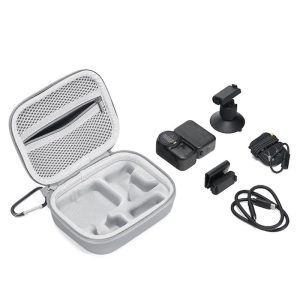
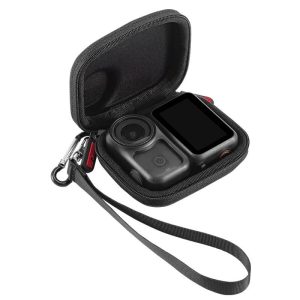
At this price, DJI delivers a standard package that’s already very complete, allowing you to get started without adding anything: the camera and its Vision Dock module, a magnetic cap clip, a magnetic cord, a bi-directional articulated magnetic mount, a USB-C cable (USB 3.1) and a protective case. A well-thought-out package for everyday use, whether in vlog, stroll or content-on-the-fly mode.
For those with more specific needs, DJI also markets several themed packs, priced between €308.99 and €418.98, each with accessories dedicated to a particular use:
- Running Pack: magnetic headband for hands-free filming on the move.
- Vlog pack: 70 cm selfie pole and DJI Mic Mini, ideal for creative people.
- Cycling Pack: magnetic chest strap + attachments for handlebars, frame or saddle.
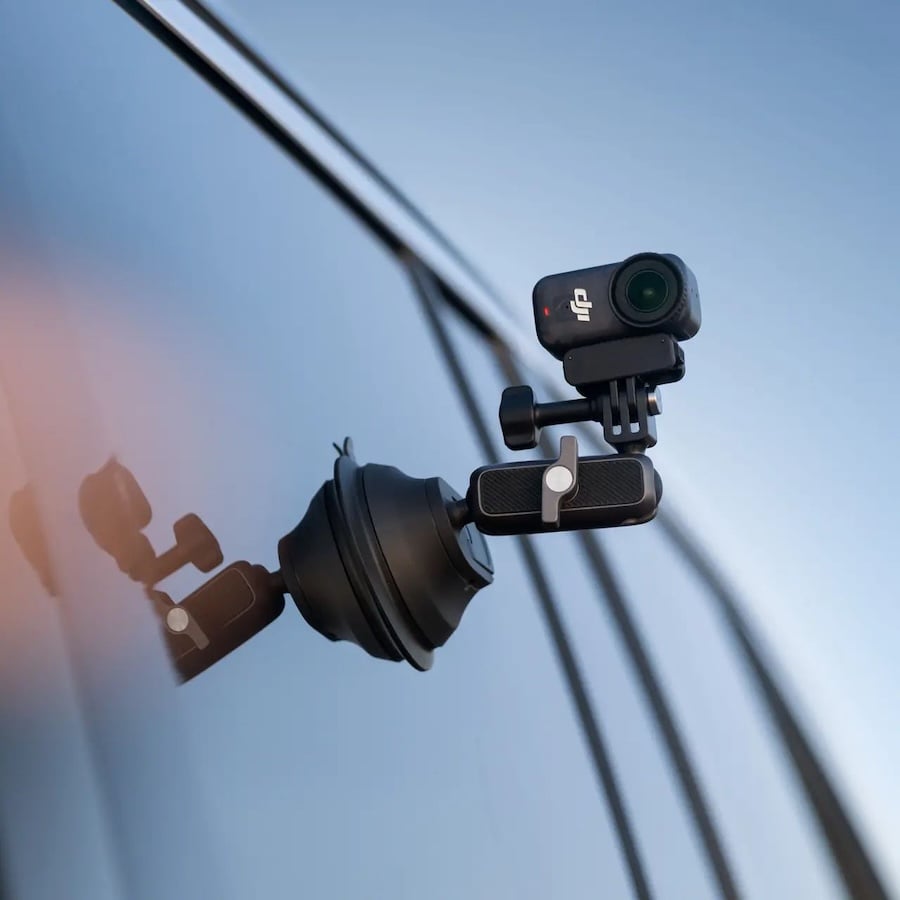
- Car mounting pack : suction cup and bracket for on-board sockets.
- Hiking pack: backpack strap holder and magnetic headband.
- Mountain bike pack: helmet chinrest holder, handle attachment, etc.
A wide range of variations, allowing everyone to create a configuration adapted to their activities, without having to chase after compatible accessories.
OUR BEST SELLERS - DJI Osmo Nano


Action camera

Action camera
Conclusion DJI Osmo Nano: Should you give in?
It’s hard not to be seduced by the DJI Osmo Nano. Compact, discreet and well-built, this modular mini-camera combines a number of solid arguments to win over content creators. Image quality is top-notch, thanks in particular to the 10-bit D-Log M profile, which opens up real possibilities in post-production. Stabilization is mastered, mounting options are varied, and autonomy remains decent thanks to the Vision Dock base.
Not everything is perfect , however. The touchscreen, though responsive, remains small and impractical for comfortable visual feedback. The non-waterproof Vision Dock also limits use in extreme conditions. We also regret the absence of certain creative modes found on Insta360, more geared towards family entertainment or social networking.
But in the face of direct competition, notably the Insta360 GO Ultra, the Osmo Nano scores points: it costs considerably less, it integrates internal storage, and it proves more flexible for semi-pro use. DJI isn’t targeting the general public in search of TikTok filters, but rather videographers looking for a compact, clever tool that’s perfectly integrated into the brand’s ecosystem.
🎯 For whom?
The DJI Osmo Nano is aimed above all at demanding creators who want to capture unique points of view. Thanks to its compact size and magnetic attachment system, it can be taken anywhere, and is suitable for scenarios where a conventional camera would be too cumbersome: attached to a backpack, a cap, or even a car. If you’re looking for a discreet secondary camera, this is an excellent choice.
It’s also ideal for those who already use DJI products. The Mimo app remains familiar, integration with DJI microphones is straightforward (Mic 2, Mic Mini, Mic 3), and the whole package works without the addition of a receiver. If you already own a drone or another DJI camera, the color consistency offered by the D-Log M profile will also make it easier for you to harmonize your images in post-production.
On the other hand, for more versatile or sporty use (shocks, water, cold, extreme conditions), other models like the DJI Osmo Action 5 Pro or the GoPro Hero 13 Black will remain more suitable.
💡Also read
➡️ Want to see what the competition is up to? Read our detailed review of the Insta360 GO Ultra.
➡️ Want to see what another approach has to offer? Check out our Insta360 GO 3S review.

 Blog
Blog