
 Français
 Deutsch
 Español
 Italiano
 Parts & Accessories by Drone
 Drones
 Action camera
 Microphones
 Camera stabilizers
 VR Headsets
DJI Mini 5 Pro vs Air 3S: which drone to choose?
Oct
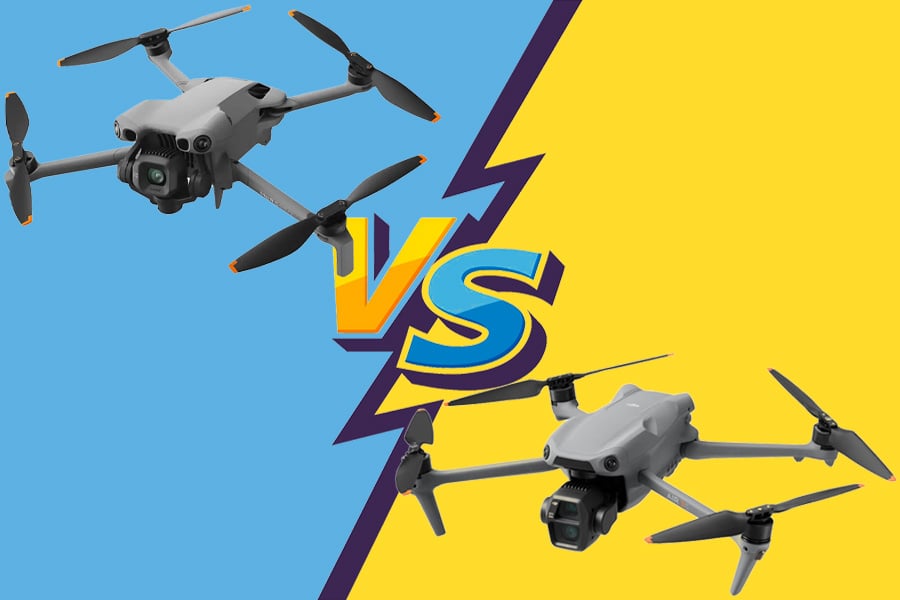
With the DJI Mini 5 Pro, the Mini range is clearly moving up a gear and flirting with DJI’s top range. Opposite it, the Air 3S remains a safe bet, a little more expensive, but also more versatile in certain respects. The DJI Mini 5 Pro vs Air 3S head-to-head is a logical choice: is it worth paying a little more to upgrade? What are the real differences? And above all, which drone is right for you? We take stock in this comprehensive comparison.
DJI Mini 5 Pro vs Air 3S: What you need to know
No time (or laziness 😅 ) to read it all? Here are the key points to remember from this comparison between the DJI Mini 5 Pro and the DJI Air 3S 👇
- 🎒 The Mini 5 Pro is three times lighter and much more compact, ideal for travelling or flying without constraints
- 🎮 Sa me O4 transmission system and compatible remote controls: RC-N2, DJI RC 2 and DJI RC Pro 2
- 🔋 The Air 3S offers almost 50% more autonomy, a real plus for long flight sessions
- ✨ Broadly equivalent functionality, with an additional QuickShot and more advanced ActiveTrack on the Mini 5 Pro
- 🛡️ Identical flight safety: 360° obstacle detection, front LiDAR sensors and intelligent RTH
- 🔄 Rotating gondola unique to the Mini 5 Pro, enabling vertical videos in 4K without cropping, and creative effects thanks to rotation up to 225° on the roll axis
- 📷 1 -inch sensor on the Mini 5 Pro, with a virtual second focal length of 48 mm; dual camera 24 mm + 70 mm on the Air 3S
- 🎞️ Same video resolution on both: up to 4K 120 fps and Full HD 240 fps
- 💰 S ignificant price differential: from €300 to €470 depending on the package, in favor of the Mini 5 Pro
📌 Two very similar drones, each with its own strong points: compactness and rotating pod for the Mini 5 Pro, dual focus and autonomy for the DJI Air 3S.
DJI Mini 5 Pro vs Air 3S: Design
| DJI Mini 5 Pro | DJI Air 3S | |
| Weight | 249,9 g | 724 g |
| Dimensions (folded, without helices) (L x W x H) | 157 × 95 × 68 mm | 214.19 x 100.63 x 89.17 mm |
| Dimensions (unfolded) (L x W x H) | 304 × 380 × 91 mm (with propellers) | 266.11 x 325.47 x 106 mm (without propellers) |
| Internal storage | 42 GB | 42 GB |
| Class (UE) | C0 | C1 |
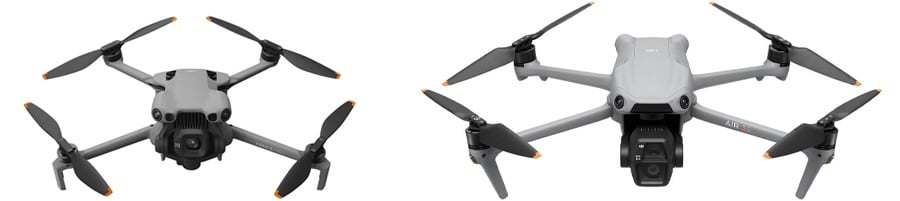
When it comes to size, the Mini 5 Pro is clearly not in the same league as the Air 3S. With
In terms of design, DJI remains true to its standards. We find a folding structure, slender arms, a removable battery at the rear… and above all, a 360° obstacle sensor configuration on both models. As you look around, the similarities are many; but at the front, one big difference stands out: a single camera on the Mini 5 Pro, dual cameras on the Air 3S. We’ll come back to this point later, in the section on images.
Both drones also benefit from a quick-fit propeller system, with no need for screws or tools, as well as 42 GB of internal storage, handy for troubleshooting if you forget your SD card.
Note: the Mini 5 Pro turns on automatically as soon as you unfold your arms: a neat little trick that’s missing from the Air 3S.
Finally, regarding European regulations, the two models belong to different classes: C0 for the Mini 5 Pro (flight allowed without training, but limited to 120 m altitude), C1 for the Air 3S (with mandatory training and registration).
👉 Unlike what was previously possible, the Mini 5 Pro can no longer be reclassified to C1 via the DJI Fly app.
🏆 DJI Mini 5 Pro : more compact, lighter, and more flexible on the regulatory side, a real plus for everyday portability.
DJI Mini 5 Pro vs Air 3S: Transmission and radio controls

| DJI Mini 5 Pro | DJI Air 3S | |
| Compatible radio controls | DJI RC-N3 DJI RC 2 DJI RC Pro 2 | DJI RC-N3 DJI RC 2 DJI RC Pro 2 |
| Video transmission system | O4+ | O4 |
| Live preview quality | Up to 1080p at 60 fps | Up to 1080p at 60 fps |
| Max. transmission distance | FCC: 20 km CE: 10 km | FCC: 20 km CE: 10 km |
Both drones share the same trio of compatible radio controls: the DJI RC-N3 (without screen), the DJI RC 2 (with integrated screen), and the DJI RC Pro 2, the more complete model for advanced pilots. Neither is compatible with DJI FPV equipment, at least for now 🤞.
In terms of transmission, the Mini 5 Pro benefits from a slightly more advanced version of the DJI system, with O4+ , compared withO4 for the Air 3S. In theory, this means greater resistance to interference in complex environments (dense urban areas, thick forests, etc.). In practice, both drones offer
Live video preview quality is also identical: up to 1080p at 60 fps, for smooth, accurate feedback on smartphones and integrated displays alike.
🤝 Perfect equality: both drones offer the same remote controls, the same range and identical video feedback.

Discover our accessories for
DJI Mini 5 Pro
DJI Mini 5 Pro vs Air 3S: Autonomy
| DJI Mini 5 Pro | DJI Air 3S | |
| Battery | 2788 mAh | 4276 mAh |
| Autonomy | 36 minutes | 45 minutes |
| Charging time | 69 min (via drone + 65W charger) 46 min (1 battery via docking station + 65W charger) 115 min (3 battery via docking station + 65W charger) | 80 minutes (65W charger) 60 minutes (100W USB-C adapter + charging station) |
With a larger battery(4276 mAh vs. 2788 mAh), the DJI Air 3S claims 45 minutes of autonomy, compared with 36 minutes for the Mini 5 Pro. In real-life conditions, there is a 10-minute difference between the two models: 30 to 35 minutes for the Air 3S, versus 20 to 25 minutes for its rival, i.e. almost 50% more autonomy.
When it comes to charging, the Mini 5 Pro is a little faster when using the charging station (around 46 minutes for a battery), but times are similar when charging directly (around 70 to 80 minutes with a 65W USB-C charger).
🏆 DJI Air 3S: longer autonomy, ideal for more flights without recharging.
DJI Mini 5 Pro vs Air 3S: In-flight performance
| DJI Mini 5 Pro | DJI Air 3S | |
| Maximum speed | 18 m/s | 21 m/s |
| Max. ascent speed | 10 m/s | 10 m/s |
| Max. descent speed | 6 m/s | 10 m/s |
| Max. wind resistance | 12 m/s (level 6) | 12 m/s (level 6) |
With its more powerful motors, the DJI Air 3S is logically faster than the Mini 5 Pro, with a top speed of 21 m/s versus 18 m/s for the Mini. In Europe, however, speeds are limited to 19 m/s for both models, which slightly reduces the gap in the field. Both drones climb at 10 m/s, but the Air 3S is also faster on the descent, with a drop speed of 10 m/s compared with just 6 m/s for the Mini 5 Pro.
Both drones boast identical maximum wind resistance: 12 m/s, or level 6 on the Beaufort scale. This may come as a surprise: with its almost three times greater weight and larger wingspan, we’d expect the Air 3S to cope much better with gusts. And yet, in practice, the difference remains small. The Mini 5 Pro does surprisingly well. On the most sustained gusts, it can be seen slightly more tossed about, but this is not flagrant, and the gap between the two ranges has narrowed considerably on this point.
🏆 DJI Air 3S: faster, slightly more stable in the wind… but the Mini 5 Pro compares very well.
OUR BEST SELLERS - DJI MINI 5 PRO


Bags Cases Straps
Sunnylife DJI Mini 5 Pro and RC-N1 / RC-N2 / RC-N3 / RC / RC 2 Remote Controls Individual Mini-Bags


DJI Mini 5 Pro vs Air 3S: Features
| DJI Mini 5 Pro | DJI Air 3S | |
| Photo modes | Single shot, Auto exposure bracketing (AEB), Burst, Interval, Panoramas | Single shot, Auto exposure bracketing (AEB), Burst, Interval, Panoramas |
| Video modes | Normal video, Slow motion, Hyperlapse, QuickShots, MasterShots | Normal video, Slow motion, Hyperlapse, QuickShots, MasterShots |
| Intelligent modes | Subject tracking, Waypoint | Subject tracking, Waypoint |
| Obstacle detection | Omnidirectional binocular optical system + forward-looking LiDAR + infrared sensor under the drone | Omnidirectional binocular optical system + forward-looking LiDAR + infrared sensor under the drone |
Photo and video modes
In this respect, there’ s no real difference between the two drones. The same basic functions are available: single shot, AEB, burst, interval, panorama, as well as the video classics: Hyperlapse, QuickShots, MasterShots, slow-motion shots… or even trajectory planning via Waypoints.
The Mini 5 Pro does stand out slightly, however, with an additional QuickShot, made possible by its rotating gondola. Another small advantage: QuickTransfer wireless transfer is faster on this model(100 Mb/s vs. 30 Mb/s for the Air 3S). Nothing revolutionary, but a welcome addition for those who often share content directly from their smartphone.
Subject follow-up
Both drones feature ActiveTrack 360 mode for automatic tracking of a moving target, with the option of circling or tracking at different angles.
But if you dig a little deeper, you’ll find that the Mini 5 Pro benefits from the latest version of ActiveTrack 360. It adds a few welcome options, such as the choice of target type (person, bike, skier…), enabling smoother tracking that’ s better adapted to the scene. The difference is not obvious, but can be felt in specific situations.
In-flight safety
DJI Mini 5 Pro and DJI Air 3S feature the same obstacle detection system, based on omnidirectional vision via binocular optical sensors, complemented by a forward-facing LiDAR . This system ensures reliable detection even in complex conditions, particularly in low light. Both drones feature DJI’s most comprehensive in-flight safety package. ⚠️ But be warned: no system is infallible, and this does not prevent some accidents, particularly in the event of pilot error or an obstacle that is difficult to detect.
They also share two advanced flight safety functions :
- Intelligent RTH, capable of automatically returning the drone to its take-off point, even in the event of GPS loss, thanks to its trajectory memory.
- Visual assistance, which displays a live black-and-white view (captured by visual sensors), helps to better spot fine or unobtrusive obstacles not detected automatically.
🏆 Mini 5 Pro leads the way on smart features: an extra QuickShot and more advanced subject tracking thanks to ActiveTrack 360.
🤝 Perfect equality on flight safety.

All parts and accessories for
DJI Air 3S
DJI Mini 5 Pro vs Air 3S : Image
| DJI Mini 5 Pro | DJI Air 3S | |
| Sensor | 1-inch CMOS | Wide-angle camera: 1-inch CMOS Medium-angle telecamera: 1/1.3-inch CMOS |
| Objective | 24mm equivalent format, f/1.8 aperture, 84° FOV | Wide-angle camera: 24 mm equivalent format, f/1.8 aperture, 84° FOV Medium-angle telecamera: 70 mm equivalent format, f/2.8 aperture, 35° FOV |
| Photo resolution | 12 and 50 MP | Wide-angle camera: 12 and 50 MP Medium telecamera: 12 and 48 MP |
| Max. video resolution | 4K up to 120 fps 1080p up to 240 fps | 4K up to 120 fps 1080p up to 240 fps 2.7K vertical shooting up to 60 fps |
| ISO range | 100 à 12800 | 100 à 12800 |
| Max. bit rate | 130 Mb/s | 130 Mb/s |
| Digital zoom | 12 MP photo: 1 to 3x 4K: 1 to 3x FHD: 1 to 4x | Wide-angle camera: 1 to 2.9x Medium-angle telecamera: 3 to 9x |
| Photo format | JPEG DNG (RAW) | JPEG DNG (RAW) |
| Video format | MP4 (MPEG-4 AVC/H.264, HEVC/H.265) | MP4 (MPEG-4 AVC/H.264, HEVC/H.265) |
| Color profile | Normal (8 or 10 bits) HLG (10 bits) D-Log M (10 bits) | Normal (8 or 10 bits) HLG (10 bits) D-Log M (10 bits) |
Rotary aerial work platform vs. conventional aerial work platform
Thanks to its vertically-tilting gondola, the DJI Mini 5 Pro can film in true vertical 4K format, without cropping. This means it can directly capture vertical videos in 4K resolution at up to 120 fps. An undeniable asset for content creators on social networks, who no longer need to crop the image in post-production. By contrast, the DJI Air 3S can only shoot horizontally, then crop. As a result, the Air 3S’s vertical format is limited to 2.7K at up to 60 fps.
But the Mini 5 Pro’s nacelle doesn’t stop there. As with the Mini 3 Pro and Mini 4 Pro, it can rotate freely on the roll axis up to 225°, allowing the image to be tilted in flight to create unprecedented rotational effects. This freedom of movement is inspired by the Mavic 4 Pro (which is capable of full 360° rotation), and offers more creative possibilities than on the DJI Air 3S, whose nacelle remains more conventional.
Sensors and resolutions
The DJI Air 3S features two independent sensors: a 1″ main sensor at 24 mm, and a 1/1.3″ telephoto sensor at 70 mm. This dual module makes it possible to change focal length without loss, to get closer to a distant subject, to play with depth of field, and to vary shots more easily in flight.
For its part, the Mini 5 Pro uses a single 1″ sensor (24 mm), but offers a x2 zoom (48 mm equivalent). This virtual focal length, digitally generated with very little loss, is a good alternative for tighter framing without changing lenses. However, it remains less powerful than the Air 3S’s true 70 mm telephoto lens.
Both drones offer the same maximum resolutions:
- 4K up to 120 fps
- Full HD (1080p) up to 240 fps
- Photos up to 50 MP
They also share several image-processing strengths: 10-bit color profiles (Normal, HLG, D-Log M), and 130 Mbps video throughput. D-Log M, in particular, captures raw video with a wide dynamic range, ideal for post-production color grading.
Image quality: a draw?
In good light, both drones offer equivalent image quality. Images are crisp and well-balanced, with natural rendering in both classic video and log mode. It’s sometimes difficult to tell the difference between the images captured by the Mini 5 Pro and those of the Air 3S.
In more complex conditions (low light, backlighting or high-contrast scenes) both drones continue to do well. However, in the Standard profile only, the Mini 5 Pro shows slightly darker shadow areas than the Air 3S, which exposes them more evenly. This behavior is not found in D-Log M, and seems to stem from the software processing of the standard profile. It is therefore entirely possible that DJI will correct this small discrepancy via an update in the coming weeks.
🏆 DJI Mini 5 Pro : its rotating pod enables a true vertical format in 4K and opens the way to unique creative movements.
🏆 DJI Air 3S : its two focal lengths of 24 mm and 70 mm offer greater versatility, depth and framing possibilities.
DJI Mini 5 Pro vs Air 3S: Packs and prices

ℹ️ Note: some links in this section are Amazon affiliate links. As Amazon Associates, we earn from qualifying purchases, at no extra cost to you.
| DJI Mini 5 Pro | DJI Air 3S | |
| Standard package | 799 € | 1099€ |
| Fly More Pack (DJI RC-N3) | 999 € | 1399€ |
| Fly More Pack (DJI RC 2) | 1129 € | 1599 € |
The DJI Mini 5 Pro and Air 3S are offered with three strictly identical packages, which makes the comparison of price and content even more relevant:
- Standard pack (RC-N3): includes drone, DJI RC-N3 radio control system (without screen), single battery, USB cable, spare propellers, nacelle protection and a few basic items. This is the minimum equipment needed to start flying.
- Fly More Pack (RC-N3): adds two extra batteries (three in total), a multi-charging station, a shoulder bag, and above all a set of ND filters, often missing from the competition. This pack retains the RC-N3 remote control.
- Fly More Pack (RC 2): includes exactly the same contents, but replaces the RC-N3 with the DJI RC 2 remote control with integrated screen. A real convenience for flying without a smartphone, especially in bright sunlight.
The price difference between the two models ranges from €300 to €470, depending on the package chosen, which is not insignificant. For many, this budgetary difference represents a real point of reflection: it can clearly weigh in the final choice, depending on individual needs and priorities.
🏆 DJI Mini 5 Pro : much more affordable prices on all packs.
OUR BEST SELLERS - DJI AIR 3S


Conclusion DJI Mini 5 Pro vs Air 3S: Which drone to choose?
The DJI Mini 5 Pro and DJI Air 3S are two highly successful drones that are quite simply among the best in their class today. Compact, powerful and well thought-out, they both offer an excellent experience, both for filming and piloting.
The DJI Air 3S is distinguished above all by its dual camera, ideal for varying shots with a more cinematic rendering, and by its slightly longer battery life. The DJI Mini 5 Pro, meanwhile, boasts an ultra-light format that’s easy to take anywhere, and a rotating gondola that lets you shoot directly in native vertical 4K, perfect for mobile content.
But with similar features, the Mini 5 Pro is considerably more affordable, whatever the package chosen. It therefore offers the best quality/features/price ratio of the two models.
💡 Go for the DJI Mini 5 Pro if…
- You travel a lot and need a lightweight, compact and easy-to-transport drone
- You regularly film vertically, for TikTok, Reels, Shorts, etc.
💡 Go for the DJI Air 3S if…
- You need two focal lengths (24 mm and 70 mm) for greater shooting flexibility
- You want to maximize your flying autonomy for long sessions
💡 Readour full tests of the two protagonists in this DJI Mini 5 Pro vs Air 3S duel:
➡️ Our DJI Mini 5 Pro full review
➡️ Our full review of the DJI Air 3S
💡 Also read
➡️ Want to understand the evolution of the Mini range? Take a look at our Mini 5 Pro vs Mini 4 Pro comparison.

 Blog
Blog