
 Français
 Deutsch
 Español
 Italiano
 Parts & Accessories by Drone
 Drones
 Action camera
 Microphones
 Camera Stabilizers
 VR Headsets
DJI Osmo 360 II, Full Review: DJI Steps Up Its Game
Sep
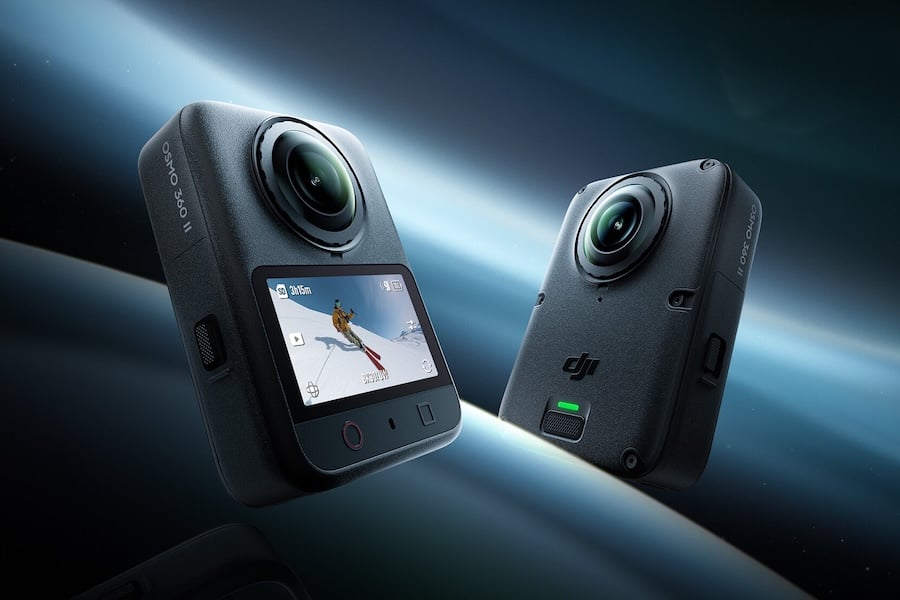
A little over a year after making its debut in the 360-degree camera market with the Osmo 360, DJI is already back with a second-generation model: the DJI Osmo 360 II. This time, the manufacturer isn’t starting from scratch and can draw on the experience gained with its first model to address its main weaknesses and refine the design. But has DJI managed to iron out the Osmo 360’s main flaws? What improvements does this new generation offer? And most importantly, is the Osmo 360 II the 360-degree camera you need? Design, battery life, features, and image quality: we analyze the DJI Osmo 360 II from every angle to find out what it’s really worth.
DJI Osmo 360 II: Key Takeaways
Don’t have time (or just can’t be bothered 😅) to read the whole thing? Here are the key takeaways about the DJI Osmo 360 II 👇
- 📐 The design is virtually identical to the first generation, featuring a compact form factor weighing 183 g, a 2-inch touchscreen, and 105 GB of internal storage
- 🔧 Lenses that are more scratch-resistant and, most importantly, can be replaced directly by the user—one of the main improvements in this second generation
- 💧 Water-resistant up to 10 meters without a housing
- 🔋 Battery capacity increased to 2150 mAh, still offering up to 100 minutes of battery life in 8K30 mode and maintaining compatibility with batteries from the original Osmo 360 and several Osmo Action models
- 🎬 Numerous improved modes, including SuperNight 2.0, Time-Lapse up to 16K, Vortex 8K120, and 4K240 slow motion
- 🎯 New Spotlight Tracking with automatic subject cropping, along with a Dual Recording mode particularly well-suited for vlogging
- 📱 DJI Mimo and DJI Studio for editing and cropping 360° videos, featuring NFC connectivity and AI-powered tools to simplify post-production
- 🎤 Four built-in microphones and DJI OsmoAudio, with the ability to directly connect two compatible DJI wireless microphones
- 📷 Dual 1/1.1-inch CMOS sensors, 360° video up to native 8K60 , and 120 MP photos now available in RAW and HDR
- 🌙 Image quality remains excellent, with notably improved dynamic range and more visible improvements in low-light conditions thanks to SuperNight 2.0
- 💸 Standard Bundle at €589, which is about €110 more than the first generation, but still significantly cheaper than the Insta360 X6 at €699
📌 This second-generation model doesn’t radically change the formula, but it intelligently addresses some of the Osmo 360’s weaknesses and expands its capabilities—most notably with interchangeable lenses, the 8K60 mode, improved image quality in challenging conditions, and new tracking features.
DJI Osmo 360 II: Design
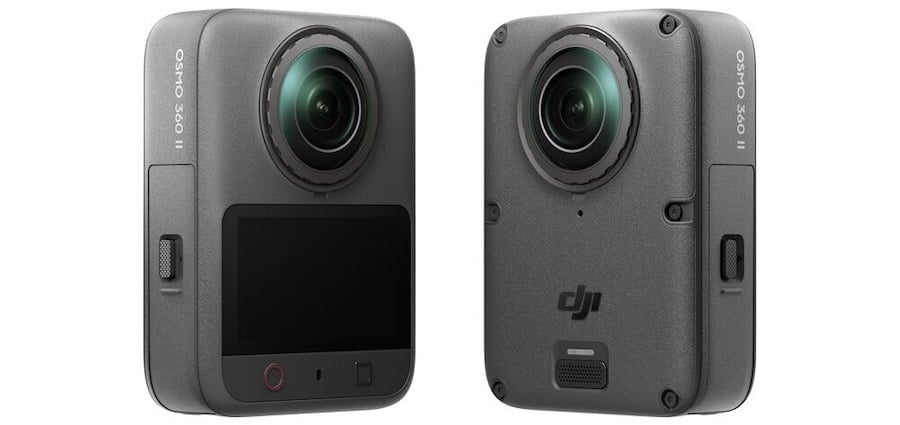
| Dimensions (L x W x H) | 61 × 36.3 × 81 mm |
| Weight | 183 g |
| Touchscreen | 2 inches |
| Storage | 128 GB internal storage (105 GB available) microSD card (up to 1 TB) |
| Operating temperature | -20 to 45°C |
| Water resistance | 10 meters |
Measuring 61 × 36.3 × 81 mm and weighing 183 g, the DJI Osmo 360 II features a design that is virtually identical to that of the first generation. The overall shape, dimensions, and even the weight remain unchanged. On the back, you’ll also find the same 2-inch landscape-oriented touchscreen , capable of reaching 800 nits and bright enough to remain easily readable outdoors.
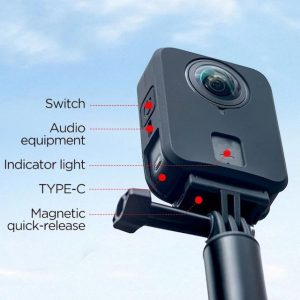
The physical interface is also very simple, with three buttons that let you turn on the camera, start recording, or quickly switch between lenses. Two flaps provide access to the USB-C port on one side and to the removable battery and microSD card slot on the other. The microSD card slot supports cards up to 1 TB, while the 105 GB of available internal storage offers ample capacity—enough to go without a memory card for relatively short sessions, provided you transfer your files regularly.
For the camera, DJI has also retained the standard 1/4-inch threaded mount and its quick-release magnetic mounting system. This makes it easy to switch from a tripod to various compatible accessories without having to repeatedly screw the camera on and off.
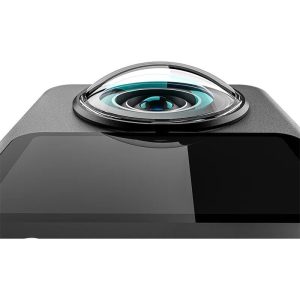
The most interesting changes are actually found on the side of the two lenses. Their coatings have been reinforced to provide better scratch resistance, a particularly important feature on a 360-degree camera, whose domed lenses remain highly exposed. But the real breakthrough comes from the ability to replace a lens yourself damaged by a dedicated kit. This was one of the main limitations of the first Osmo 360 and a much-anticipated improvement in this second generation. If a lens gets scratched or damaged, it is no longer necessary to send the camera to customer service: the user can now replace it directly.
Water resistance is still rated at up to 10 meters without a housing, but it’s important to distinguish between water resistance and image quality underwater. As with the first generation, the convex lenses can cause distortions and assembly errors related to refraction. DJI therefore still recommends using a dedicated waterproof housing for underwater photography. Sold separately, the Invisible Underwater Housing allows for depths of up to 50 meters and features an optical design intended to compensate for this refraction.
DJI Osmo 360 II: Battery Life and Overheating
| Battery | 2150 mAh |
| Battery life | 8K/30 fps: up to 100 minutes |
The DJI Osmo 360 II features a 2, 150 mAh battery, compared to 1,950 mAh in the first generation. However, this increase in capacity does not translate into a noticeable improvement in battery life, as DJI still claims up to 100 minutes of continuous recording in 8K at 30 fps—a duration also achieved in independent tests.
DJI, however, retains a particularly practical advantage for users who already own its cameras: the batteries remain interchangeable between the two generations of the Osmo 360, as well as with several recent models in the Osmo Action lineup. This means you can use the same batteries across different devices in the DJI ecosystem without having to stock up on multiple replacement models.
Overheating does not appear to be a significant issue during normal use, although the very demanding 8K at 60 fps mode requires extra caution. In fact, the camera itself displays a warning about the risk of overheating when this mode is selected. During extended recording sessions in this mode, some tests found that the camera shut down to cool down, while others were able to record for several dozen minutes without interruption. Thermal behavior therefore depends heavily on operating conditions, particularly ambient temperature and airflow around the camera.
Check out our accessories for
DJI Osmo 360 II
DJI Osmo 360 II: Features
| Photo Modes | 360° Panorama, Single Lens |
| Video Modes | Panorama, Single Lens, Video Boost, SuperNight 2.0, Selfie Mode, Spotlight Tracking, Slow Motion, Time-Lapse/Hyperlapse, Vortex, Dual Recording |
| Stabilization | RockSteady 3.0, HorizonSteady |
Photo and Video Modes
The DJI Osmo 360 II includes many of the same shooting modes as the first generation, but several have seen significant improvements:
- SuperNight 2.0: The mode designed for low-light photography now features a new AI-powered noise reduction algorithm.
- Timelapse / Hyperlapse: 360° Timelapse can now be exported up to 16K, compared to 8K on the original Osmo 360.
- Vortex: This rotating effect around the subject has been upgraded from 6K to 8K at up to 120 fps.
- Slow Motion: It has also seen significant improvements, with panoramic sequences now capable of reaching 4K at 240 fps.
- Boost Video: Even when using just one lens, this mode still lets you turn the Osmo 360 II into a true action camera, with 4K video at up to 120 fps.
In addition to these existing modes, there are two important new features:
- Spotlight Tracking: The camera can now automatically track a person and keep them centered in the frame. The tracking is recorded along with the 360° footage, and when you open it in DJI Mimo or DJI Studio, the cropping is already automatically applied. All you have to do is export the result to get a usable flat video, up to 4K at 30 fps.
- Dual Recording: Allows you to simultaneously show the scene being filmed and the reaction of the person behind the camera—a feature that’s particularly useful for vlogging.
Apps: DJI Mimo and DJI Studio
Editing remains an essential part of working with a 360° camera, since you generally have to choose your framing after you’ve filmed. The Osmo 360 II uses the DJI Mimo app on a smartphone and DJI Studio on a computer to crop footage, set keyframes, track a subject, or export a standard video from 360° files.
However, a new feature makes it much easier to access DJI Mimo: NFC connectivity. Now, all you have to do is hold a compatible smartphone near the camera to quickly connect to the app. In just a few seconds, you can access your footage, transfer it, or start editing it.
DJI Mimo also offers AI-powered automatic editing tools. The app can analyze footage, select the clips it deems interesting, apply transitions, and add music to automatically generate a video that’s ready to share. The results vary—some edits are successful, while others are less convincing—but the approach is interesting: like its main competitors, DJI is clearly seeking to simplify post-production and make 360° video more accessible, particularly to those who have neither the desire nor the time to spend hours cropping and editing their footage.
DJI Studio is geared more toward those who want to maintain control over their editing, with all the tools needed to crop 360° footage, set keyframes, and automatically track a subject. The software also allows you to create slow-motion footage at up to 64× speed using frame interpolation, while various editing tools, Pro filters, and custom LUTs let you take your video finishing to the next level.
Audio and Connectivity
The DJI Osmo 360 II features four built-in microphones capable of capturing clear voice audio without necessarily requiring an external microphone. For shoots where audio quality is a top priority, it also features DJI OsmoAudio technology, which allows you to connect compatible DJI wireless microphones directly without using a receiver.
In particular, you can connect two microphones at the same time to record two people, which is especially convenient for interviews or vlogs featuring two people. The built-in microphones can also continue to record simultaneously to capture ambient sound in addition to the voices picked up by the wireless microphones.
DJI Osmo 360 II: Image
| Sensors | Dual 1/1.1-inch CMOS sensors |
| Lens | f/1.9 aperture |
| Max. photo resolution | 120 MP (360°), 30 MP (single lens) |
| Max. video resolution (360°) | 8K up to 60 fps 6K up to 60 fps 4K up to 240 fps (Slow Motion mode) |
| Max. video resolution (single lens) | 4K up to 120 fps (Video Boost mode) 2.7K up to 120 fps (Video Boost mode) |
| Photo format | JPEG, RAW |
| Video format | OSV, MP4 (HEVC) |
| Color profiles | Normal, D-Log M |
| Maximum video bitrate | 220 Mb/s |
| ISO range | 100 to 51,200 |
Sensors and resolutions
The DJI Osmo 360 II retains two 1/1.1-inch square CMOS sensors paired with f/1.9 lenses. DJI has not made any major changes to the hardware found in the first-generation model, but has further expanded its capabilities through image processing and higher frame rates.
The main improvement involves 360° video: the Osmo 360 II is the first 360° camera capable of natively recording in 8K at 60 fps, compared to 50 fps on the original Osmo 360. Beyond providing smoother footage for action scenes, this frame rate especially allows users who typically work at 30 fps to achieve true 2× slow motion in 8K. The camera also offers 6K at up to 60 fps and now supports slow motion up to 4K at 240 fps, compared to 100 fps previously.
On the other hand, the single-lens mode has seen a slight downgrade: the 5K option available on the first generation has been removed. The maximum resolution is now limited to 4K, though the frame rate can reach up to 120 fps in Video Boost mode.
On the photography side, it offers a maximum resolution of 120 MP in 360° , and 30 MP with a single lens. This second generation notably adds support for the RAW format, whereas the first Osmo 360 was limited to JPEG—a welcome addition for photographers seeking greater flexibility when editing their images. The 120 MP panoramic photos also benefit from HDR to better preserve detail in high-contrast scenes.
Finally, video recording remains available in 10-bit, with the option to choose between the Normal profile—for an image that’s ready to use right away—or D-Log M —to preserve more latitude during post-production color grading.
Image Quality
Image quality was already one of the strengths of the first Osmo 360, and the second generation doesn’t represent a dramatic leap forward in daylight conditions. The images remain detailed, sharp, and rich in color, with a very high overall standard for a 360° camera. However, several tests note an improvement, while others find the results very similar to those of the first generation: so this is more of an evolution than a true leap forward.
It’s especially in challenging scenes that the improvements become apparent. DJI now claims a dynamic range of up to 14.5 IL , compared to 13.5 IL previously , which helps preserve details better when a single scene combines very bright areas and deep shadows. Tests conducted in backlit conditions or in indoor settings with views to the outdoors show, in particular, greater detail in dark areas and more balanced transitions between shadows and highlights.
Improvements are also more noticeable in low-light conditions with SuperNight 2.0. The new AI-powered noise reduction algorithm produces cleaner, more detailed images than the first-generation SuperNight, while now allowing recording up to 8K at 60 fps, compared to 30 fps previously. Night scenes are naturally less detailed than those shot in broad daylight, and some tests still reveal artifacts or a loss of sharpness in motion, but the performance is particularly solid for a 360° camera.
However, SuperNight 2.0 imposes a significant limitation: D-Log M is not available when itis enabled. In that case, you must use the standard color profile, which leaves less flexibility for those who wish to perform advanced color grading themselves in post-production.
DJI Osmo 360 II: Bundles and Prices
ℹ️ Note: some links in this section are Amazon affiliate links. As Amazon Associates, we earn from qualifying purchases, at no extra cost to you.
| Standard Package | €589 |
|
| Other bundles | From €609 to €771.96 |
The DJI Osmo 360 II starts at €589 with the Standard Bundle, which is about €110 more than the first Osmo 360 was at launch. This is a significant increase, although it remains considerably more affordable than its main competitor, the Insta360 X6, which retails for €699.
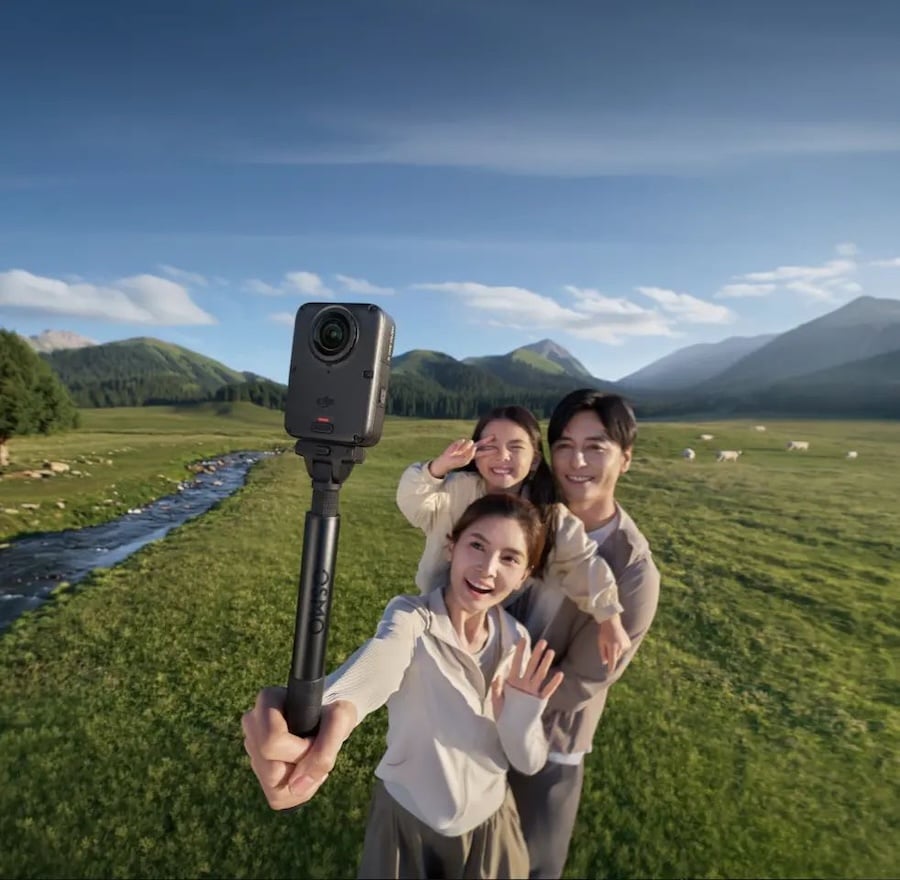
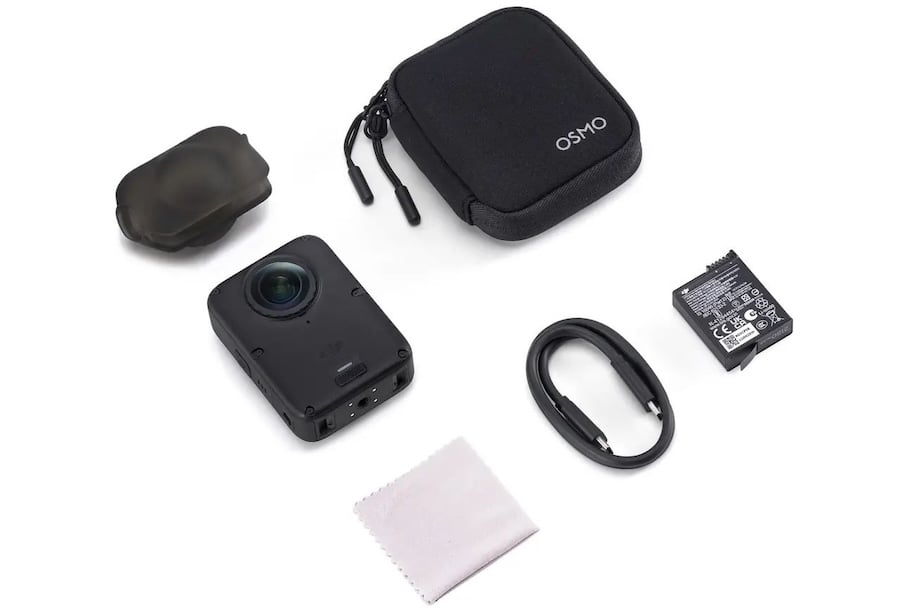
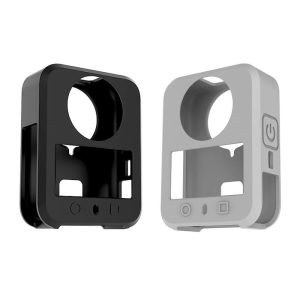
The Standard Bundle includes the camera, a 2,150 mAh Extreme Plus battery, a silicone lens cover, a protective pouch, a USB-C to USB-C cable, and a cleaning cloth. It includes everything you need to start filming, but no invisible selfie stick—an accessory that’s particularly useful with a 360° camera.
DJI also offers a particularly wide range of themed bundles, priced between €609 and €771.96, allowing customers to choose accessories that match their specific needs. The Explorer Bundle includes a 1-meter invisible selfie stick, while other configurations are designed for motorcycling, cycling, or skiing with dedicated mounts. The Vortex Bundle, meanwhile, includes a selfie stick and a rotating grip that lets you create the spinning effects associated with Vortex mode.
📌 Good to know: The new replaceable lenses for the Osmo 360 II can also be purchased separately. The kit costs €25 to replace one lens or €39 for both, allowing you to repair a scratched or damaged lens yourself without having to replace the camera or send it in for service.
OUR BEST SELLERS - DJI Osmo 360 II


Action camera


Conclusion: DJI Osmo 360 II—Is It Worth Buying?
A little over a year after its first foray into the 360-degree camera market, DJI is launching the Osmo 360 II a particularly well-targeted development. The manufacturer isn’t revolutionizing either the design or the image quality in daylight, but it does address one of the main weaknesses of its first model with lenses that can now be replaced, while improving dynamic range, low-light performance, and shooting capabilities. The addition of 8K at 60 fps, 4K slow motion at 240 fps, Spotlight Tracking, RAW photo support, and NFC rounds out a camera that’s already highly versatile.
That said, it’s not all perfect. In particular, the single-lens mode loses 5K support, 8K at 60 fps can cause the camera to overheat during extended recording sessions, and the price has risen significantly, from €479.99 to €589. Despite this increase, the Osmo 360 II remains significantly cheaper than the Insta360 X6 at €699, while offering particularly impressive specs.
Who is the DJI Osmo 360 II designed for?
The Osmo 360 II is primarily designed for those who want to film without having to decide on the framing at the time of shooting. Whether it’s travel, sports, vlogging, family vacations, or action scenes, recording everything happening around the camera lets you choose your angle afterward and even create several different shots from a single clip.
It will also appeal to more demanding users thanks to D-Log M, RAW, 8K60, and a wide range of cropping tools, while remaining relatively accessible to beginners. DJI is specifically aiming to reduce the complexity traditionally associated with 360-degree cameras through automatic tracking, AI-assisted editing, and simplified connectivity to DJI Mimo.
You already have an Osmo 360: Should you upgrade to the Osmo 360 II?
Upgrading isn’t essential for everyone. In broad daylight, the improvement in image quality remains relatively modest, battery life sees little change, and most of the essential features from the first generation are still present. If your Osmo 360 already perfectly meets your needs, this second generation won’t radically transform your experience.
On the other hand, interchangeable lenses alone are a particularly compelling reason to choose a 360-degree camera, whose curved lenses are constantly exposed to impacts and scratches. Add to that improved dynamic range, SuperNight 2.0, 8K60, 4K240, RAW, and the new tracking features, and the upgrade becomes much more appealing for those who use their camera regularly or plan to keep it for several years. If you can resell your first Osmo 360 in good condition, upgrading to the second generation can therefore be a truly worthwhile decision.
💡 See also
➡️ Check out our review of the first DJI Osmo 360 to find out what the first generation had to offer.
➡️ Can’t decide between this and its main competitor? Check out our review of the Insta360 X6 and everything it has to offer compared to DJI’s new camera.

 Blog
Blog