
 Français
 Deutsch
 Español
 Italiano
 Parts & Accessories by Drone
 Drones
 Action camera
 Microphones
 Camera Stabilizers
 VR Headsets
DJI Lito 1 vs. Neo 2: Which Drone Should You Choose?
Jul
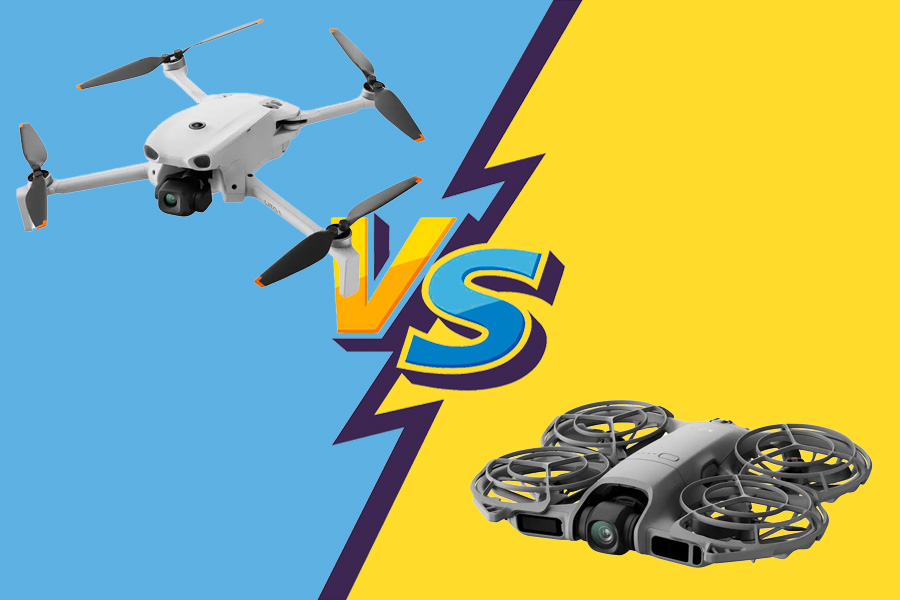
The DJI Lito 1 and the DJI Neo 2 are DJI’s two new entry-level drones. While both models are primarily aimed at beginners, they are based on very different design philosophies. The Lito 1 follows the classic drone design with a stabilized camera, while the Neo 2 is an autonomous drone capable of taking off and filming without a remote control. Beyond this difference in design, what really sets these two drones apart? Which one offers the best flying experience, the most interesting features, and the best image quality? And most importantly, which one is right for you? Find all the answers in this DJI Lito 1 vs. Neo 2 comparison.
DJI Lito 1 vs. Neo 2: Key Takeaways
Don’t have time (or just can’t be bothered 😅) to read it all? Here are the key differences to keep in mind between the DJI Lito 1 and the DJI Neo 2 👇
- 🛩️ Both drones weigh less than 250 g and fall into the C0 category, but the DJI Lito 1 features a foldable design, while the DJI Neo 2 boasts an ultra-compact form factor with built-in propeller guards.
- 🎮 The DJI Neo 2 is by far the most versatile drone to fly: it can fly autonomously, be controlled with a smartphone, a traditional remote control, or even in FPV mode, allowing you to gradually explore every aspect of the world of drones.
- 🔋 The DJI Lito 1 offers significantly longer flight time (36 minutes vs. 19 minutes) and is better suited for long flight sessions.
- 🚀 The DJI Lito 1 also offers better flight performance, with a higher top speed, more responsive acceleration, and quieter operation.
- 🤖 Both drones are very feature-rich, but the DJI Neo 2 offers more advanced obstacle detection thanks to its LiDAR sensor, which enhances the safety of its automatic functions.
- 🎥 The DJI Lito 1 offers slightly better image quality, thanks in part to its 3-axis gimbal, improved low-light performance, and a wider range of formats for photo and video editing.
- 💸 The DJI Neo 2 is the most affordable, with a starting price of €239, compared to €339 for the DJI Lito 1, and its Fly More Pack is also available at a lower price.
📌 The DJI Lito 1 is better suited for those looking for a classic, high-performance drone designed for aerial photography and videography. The DJI Neo 2 , on the other hand, will appeal to users who value simplicity, versatility, and a new way to explore the world of drones.
DJI Lito 1 vs. Neo 2: Design
| DJI Lito 1 | DJI Neo 2 | |
| Weight | 249 g (standard battery) 340 g (Plus battery) | 151 g (without transceiver) 160 g (with transceiver) |
| Dimensions (L x W x H) | 149 × 94 × 62 mm (folded, without propellers) 183 × 251 × 79 mm (unfolded, without propellers) | 147×171×41 mm (without transceiver) 167×171×54 mm (with transceiver) |
| Storage | microSD card (up to 1TB) | 49 GB of internal memory |
| Class (Europe) | C0 | C0 |
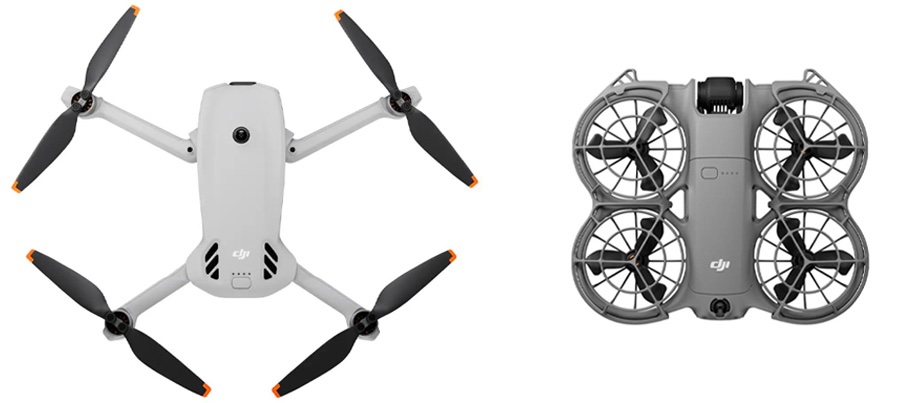
At first glance, the DJI Lito 1 and the DJI Neo 2 showcase two very different approaches. The Lito 1 features the iconic foldable design of the Mini series, with foldable arms that make it particularly compact when folded. The Neo 2, on the other side, features a one-piece frame with built-in propeller guards, ready to fly right out of your pocket or bag.
Once ready to fly, the two drones also have different footprints. The Lito 1 is larger when unfolded, while the Neo 2 remains particularly compact. On the other hand, the Lito 1’s foldable design makes it much more discreet when stored in a bag.
Weight is another significant difference between the two models. Weighing just 151 g (or 160 g with its transceiver), the Neo 2 is significantly lighter than the Lito 1, which weighs 249 g with its standard battery. However, both models remain under the 250 g limit and are therefore classified as Class C0 in Europe, the most flexible category for recreational use.
The storage options also differ. The Lito 1 saves its videos to a microSD card with a capacity of up to 1 TB. The Neo 2 takes the opposite approach: it has no memory card slot and relies exclusively on its 49 GB of internal storage. This is a simple solution to use, but less flexible when storage space runs out.
🏆 DJI Lito 1: Its foldable design makes it easy to carry, while its microSD card storage offers greater flexibility for everyday use.
Discover our accessories for
DJI Lito 1
DJI Lito 1 vs. Neo 2: Transmission and Flight Control
| DJI Lito 1 | DJI Neo 2 | |
| Control methods | Radio control (classic flight) | Autonomous flight DJI Fly application Radio control (conventional flight) FPV flight |
| Compatible radio controls | DJI RC-N2/RC-N3, DJI RC 2 | DJI RC-N2/RC-N3, DJI RC 2, DJI FPV Remote Controller 3, DJI RC Motion 3 |
| Video transmission system | DJI O4 | Wi-Fi (standard) DJI O4 (with optional transceiver) |
| Max. transmission distance | 15 km (IC), 8 km (CE / SRRC / MIC) | 10 km (IC), 6 km (CE / SRRC / MIC) |
| Live preview quality | up to 1080p at 60 fps | up to 1080p at 60 fps |
The differences are probably most pronounced when it comes to how these two drones are flown.
The DJI Lito 1 takes a traditional approach. It is flown exclusively using a remote controller, like most drones in the Mini series. It is compatible with the DJI RC-N2, DJI RC-N3, and DJI RC 2, allowing you to choose between smartphone control or a built-in screen depending on the remote controller used.
The DJI Neo 2, on the other side, is much more versatile. It can take off directly from the palm of your hand, launch its automatic modes using its built-in buttons and status screen, be controlled via the DJI Fly app, with a traditional remote controller, or even in FPV mode using the DJI FPV Remote Controller 3 or the DJI RC Motion 3. This variety of control methods allows you to explore every facet of the drone world—from autonomous flight to traditional piloting, all the way to immersive FPV flight—without having to switch devices.
The two drones also differ in their video transmission systems. The Lito 1 comes equipped with the DJI O4, which allows it to reach a maximum range of 15 km (IC) or 8 km (CE). The Neo 2, on the other hand, operates via Wi-Fi when used on its own or with a smartphone, which naturally limits its range. However, with its O4 transceiver (included in certain bundles), it can be flown using the DJI RC-N2, DJI RC-N3, or DJI RC 2, while offering a range of up to 10 km (IC) or 6 km (CE).
🏆 DJI Neo 2: Its wide range of control options make it the most versatile drone.
DJI Lito 1 vs. Neo 2: Battery Life and Charging
| DJI Lito 1 | DJI Neo 2 | |
| Battery | 2590 mAh | 1606 mAh |
| Maximum autonomy | 36 minutes | 19 minutes (17 minutes with propeller protection) |
| Charging time (standard battery) | Direct 73 min / Station 45 min (1 battery), 87 min (3 batteries) (65W charger) | Direct: 70 min / With charger: 68 min (3 batteries) (65 W charger) |
The DJI Lito 1 features a 2, 590 mAh battery, compared to 1,606 mAh for the DJI Neo 2. This difference in capacity naturally translates to a difference in flight time. DJI claims up to 36 minutes of flight time for the Lito 1, compared to 19 minutes for the Neo 2 (or 17 minutes with propeller guards installed). As always, these figures reflect ideal conditions.
In practice, the discrepancy remains evident. DJI estimatesthe typicalflight time of the Lito 1 at 23 minutes, a figure consistent with feedback from independent tests. On the other side, the Neo 2 does not have an official estimate under real-world conditions, but users generally report a flight time of between 10 and 15 minutes, depending on the flight mode and conditions of use.
This difference in flight time also reflects the intended use for which each drone was designed. The Neo 2 is primarily designed for short, spontaneous flights, making it perfect for taking selfies or shooting short video clips. The Lito 1, on the other hand, is better suited for longer flights, giving you more time to explore your surroundings, capture multiple shots, or simply enjoy flying.
On the side of charging, the two models are virtually neck and neck. The Neo 2 takes about 70 minutes to charge a battery directly via USB-C, compared to 73 minutes for the Lito 1. When using their respective charging stations, the charging times are also very similar. However, the Lito 1 charges a battery slightly faster via its charging station (45 minutes, compared to 68 minutes for the Neo 2, which lists this time for charging three batteries simultaneously).
Finally, a Plus battery is compatible with the Lito 1 and further extends its flight time. However, DJI does not officially offer it with this model in Europe and the United Kingdom, as it would cause the drone to exceed the 250-gram limit. This battery is, however, available with the DJI Lito X1 in its Fly More Plus version, which has a C1 classification.
🏆 DJI Lito 1: Its significantly longer flight time makes it the best choice for long flight sessions.
OUR BEST SELLERS - DJI Lito 1
Propeller Protection Guards
Accessories
DJI Lito 1 vs. Neo 2: Flight Performance
| DJI Lito 1 | DJI Neo 2 | |
| Maximum speed | 18 m/s (Sport mode) 12 m/s (Normal / Tracking mode) | 12 m/s (Sport / Tracking mode) 8 m/s (Normal mode) |
| Max. ascent speed | 7 m/s (Sport mode) 5 m/s (Normal mode) 3 m/s (Cine mode) | 5 m/s (Sport mode) 3 m/s (Normal mode) 0.5 m/s (Cine mode) |
| Max. descent speed | 7 m/s (Sport mode) 5 m/s (Normal mode) 3 m/s (Cine mode) | 3 m/s (Sport mode) , 3 m/s (Normal mode) , 0.5 m/s (Cine mode) |
| Max. wind resistance | 10.7 m/s (level 5) | 10.7 m/s (level 5) |
In flight, the DJI Lito 1 outperforms the DJI Neo 2 in most categories. It reaches a top speed of 18 m/s in Sport mode, compared to 12 m/s for the Neo 2. The differences are also evident in vertical speeds: the Lito 1 can climb and descend at up to 7 m/s, compared to 5 m/s and 3 m/s, respectively, for its competitor. As a result, it offers more dynamic handling and responds more quickly to commands.
The Neo 2 is nonetheless a pleasure to fly. Its more measured handling reflects its purpose as an autonomous drone, designed primarily for automatic shooting and close-range flights. Its performance is more than adequate for tracking a person on foot or by bike, but it reaches its limits more quickly when it comes to covering long distances or tracking a very fast subject.
In terms of wind resistance, both drones are rated for 10.7 m/s (level 5). In practice, the Neo 2 holds up without difficulty under normal conditions, but several user reports indicate that it can be more easily buffeted when gusts pick up. The Lito 1, which is heavier and more powerful, should logically handle these situations a bit better, even though DJI lists the same wind resistance for both models.
Finally, the DJI Lito 1 is also quieter in flight. Its noise level is similar to that of other drones in the Mini series and quickly becomes barely noticeable from a distance. The DJI Neo 2, on the other hand, is more audible in flight, with a higher-pitched noise.
🏆 DJI Lito 1: faster, more dynamic, and quieter.
DJI Lito 1 vs. Neo 2: Features
| DJI Lito 1 | DJI Neo 2 | |
| Photo modes | Single shot, Burst, Auto exposure bracketing (AEB), Interval, Panorama | Single Photo, Interval, SelfieShot |
| Video modes | Slow motion, QuickShots, MasterShots, Hyperlapse, ActiveTrack subject tracking | QuickShots, MasterShots, Dolly Zoom, ActiveTrack subject tracking |
| Obstacle detection | Omnidirectional monocular optical system + downward-looking infrared sensor | Omnidirectional monocular vision system + forward-facing LiDAR + downward-facing infrared sensor |
Both the DJI Lito 1 and the DJI Neo 2 offer an exceptionally high level of features for entry-level drones. Creative modes, subject tracking, and omnidirectional obstacle detection are available on both models. The Neo 2, however, goes a step further in several areas, notably thanks to its LiDAR sensor and its highly advanced subject tracking.
When it comes to photography, the Lito 1 offers a more comprehensive range of modes, including burst mode, exposure bracketing (AEB), panorama, and interval shooting. The Neo 2 focuses more on simplicity with interval shooting and its new SelfieShot mode, designed to automatically take well-framed selfies.
When it comes to video, both drones offer QuickShots, MasterShots, and ActiveTrack tracking. The Lito 1 stands out with its slow-motion andHyperlapse features, while the Neo 2 offers a spectacular Dolly Zoom and features a faster QuickTransfer for transferring videos to a smartphone.
Subject tracking is one of the standout features of both models. The Neo 2, however, features a particularly sophisticated algorithm and offers dedicated modes for cycling and skiing. According to various available tests, its tracking is very smooth and responsive, making it one of the best in its category today.
The difference is even more pronounced when it comes to obstacle detection. Both drones feature omnidirectional coverage, but the Neo 2 adds a forward-facing LiDAR sensor. This sensor notably improves obstacle detection in low-light environments or when encountering certain obstacles that are harder to detect using cameras alone. It also helps ensure the safety of automatic functions, such as Return to Home (RTH).
🏆 DJI Neo 2: Its LiDAR sensor enhances its obstacle detection and gives it a slight edge in terms of features.

Discover our accessories for
DJI Neo 2
DJI Lito 1 vs. Neo 2: Image
| DJI Lito 1 | DJI Neo 2 | |
| Aerial work platform | 3-axis mechanical gondola | 2-axis mechanical gondola (tilt, roll) |
| Sensor | 1/2-inch CMOS | 1/2-inch CMOS |
| Objective | Equivalent format 26.2 mm Aperture f/1.8 FOV 79° (in mm) | 16.5 mm equivalent format Aperture: f/2.2 FOV 119.8 |
| Photo resolution | 12 MP / 48 MP | 12 MP |
| Max. video resolution (horizontal) | 4K up to 60 fps (100 fps in slow-motion mode) FHD up to 100 fps | 4K up to 100 fps FHD up to 100 fps |
| Max. video resolution (vertical) | 2.7K up to 60 fps | 2.7K up to 60 fps |
| ISO range | 100 à 12800 | 100 à 12800 |
| Max. bit rate | 130 Mb/s | 80 Mb/s |
| Digital zoom | 4K: 1 to 3x FHD: 1 to 4x Photo: 1 to 3x | No |
| Photo format | JPEG / DNG (RAW) | JPEG |
| Video format | MP4 (MPEG-4 AVC/H.264, HEVC/H.265) | MP4 |
| Color profile | Normal (8 or 10 bits) | Normal |
Gimbal, sensor and resolutions
The DJI Lito 1 and the DJI Neo 2 take two different approaches to stabilization. The Lito 1 is equipped with a 3-axis mechanical gimbal, while the Neo 2 uses a 2-axis mechanical gimbal, with the third axis compensated electronically. This solution works well in most situations, but the Lito 1 retains a slight advantage when it comes to stabilizing the most demanding movements.
Both drones are equipped with a 1/2-inch CMOS sensor, but their lenses differ. The DJI Lito 1 has an f/1.8 aperture, compared to f/2.2 for the DJI Neo 2, allowing it to capture more light. This advantage doesn’t radically transform image quality, but it can make a difference in certain situations, particularly when light levels drop.
For photos, the Lito 1 can capture images at 12 or 48 megapixels, compared to 12 megapixels for the Neo 2. For video, the Neo 2 takes the lead with 4K at up to 100 frames per second, while the Lito 1 is limited to 60 frames per second in 4K (but also offers a slow-motion mode at 100 fps). Finally, both drones offer a vertical video mode in 2.7K at up to 60 fps, achieved by cropping the image.
The Lito 1 also offers more features in several areas. It supports RAW (DNG) photos, offers a digital zoom (up to 3x in 4K and 4x in Full HD), and has a maximum video bitrate of 130 Mb/s, compared to 80 Mb/s for the Neo 2. The Neo 2, on the other hand, is geared more toward simple use, with photos saved exclusively in JPEG format.
Image quality
In broad daylight, both drones deliver very high image quality. The level of detail is similar, and since they use the same sensor, the differences remain relatively minor. The differences stem mainly from image processing: the Lito 1 favors a more natural look, while the Neo 2 applies slightly higher contrast, resulting in images that are a bit more striking right out of the drone.
In high-contrast scenes, such as backlit shots, the differences depend heavily on the scene being filmed and the automatic exposure setting chosen by each drone. Depending on the situation, the Neo 2 will preserve highlights slightly better, while the Lito 1 will retain more detail in the darkest areas. However, neither has a consistent advantage.
It’s especially in low light that the Lito 1 seems to have a slight edge. Its faster aperture (f/1.8 vs. f/2.2) seems to allow it to produce images that are generally a bit brighter and more detailed in nighttime scenes. The difference remains modest, but it is noticeable in several side-by-side comparisons conducted under similar conditions.
Finally, the Lito 1 offers another advantage for users who want to edit their images. Photos can be saved in RAW (DNG) format, and videos in 8- or 10-bit, offering greater flexibility in post-production. The Neo 2 remains more geared toward simple, immediate use, with JPEG files and a standard color profile, perfectly suited for quick sharing on social media.
🏆 DJI Lito 1: Its 3-axis gimbal, RAW and 10-bit support, and slight edge in low-light performance help it win this round.
DJI Lito 1 vs. Neo 2: Bundles and Prices
ℹ️ Note: some links in this section are Amazon affiliate links. As Amazon Associates, we earn from qualifying purchases, at no extra cost to you.
| DJI Lito 1 | DJI Neo 2 | |
| Drone alone | – | 239 € |
| Standard Package (with standard radio control) | 339 € | – |
| Fly More Pack (with standard radio control) | 479 € | 399 € |
| Motion Fly More Pack (FPV) | – | 579 € |
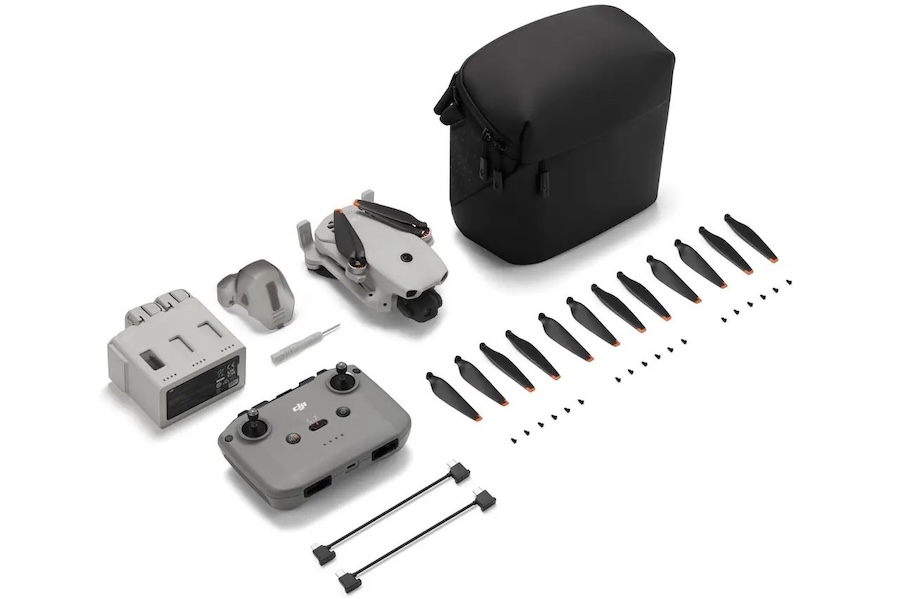
The DJI Neo 2 is the more affordable of the two models, with a starting price of €239, compared to €339 for the DJI Lito 1. This price difference, however, stems from a different sales approach: the Neo 2 is available as a drone-only package, without a remote controller, while the Lito 1 is always sold with a DJI RC-N3. Both drones also offer several bundle options designed to meet different needs.
The DJI Lito 1 starts at €339 and comes in a standard bundle that includes the drone, the DJI RC-N3 remote controller, a battery, a gimbal cover, a pair of spare propellers, and the usual cables. Its Fly More Bundle, priced at €479, adds two additional batteries (three in total), a charging station, two extra pairs of propellers, and a carrying case. Note that, although the Lito 1 is compatible with the DJI RC 2 with a built-in screen, DJI does not currently offer any bundle that includes this remote controller.
The DJI Neo 2, meanwhile, is available in three configurations. The drone-only version, priced at €239, is designed for users who want to take advantage of the drone’s autonomous features or fly it directly from a smartphone. The Fly More Pack, priced at €399, adds a DJI RC-N3 remote controller, the DJI O4 transmission module, a total of three batteries, a charging station, and essential accessories. Finally, the Motion Fly More Pack, priced at €579, replaces the standard remote controller with the RC Motion 3 and DJI Goggles N3, while retaining the three batteries, charging station, and other accessories from the Fly More Pack.
Ultimately, the DJI Neo 2 offers the best value for the money. Its starting price is significantly lower thanks to the drone-only version, and even when compared to the Fly More Bundle with comparable features, it’s still slightly cheaper than the DJI Lito 1. The choice will ultimately depend on your flying style and the accessories you actually need.
🏆 DJI Neo 2: A lower starting price and a more affordable Fly More Pack help it win this round.



Conclusion: DJI Lito 1 vs. Neo 2—Which One Should You Choose?
Based on this comparison, the DJI Lito 1 and the DJI Neo 2 both stand out as excellent entry-level drones , but they clearly aren’t designed for the same purpose.
The DJI Lito 1 is primarily aimed at those looking for a classic drone capable of capturing beautiful photos and videos while offering good battery life and excellent flight performance. It’s particularly well-suited for long flights, aerial photography, and users looking for a drone that can grow with them.
The DJI Neo 2, on the other side, takes a much more accessible and versatile approach. Its ability to take off from the palm of your hand, its many control options, and its automatic features make it a particularly enjoyable drone for quickly capturing everyday moments or gradually exploring the world of drones—all the way up to FPV.
Ultimately, the best choice depends less on their technical specifications than on how you plan to use them. If you prioritize image quality, performance, andbattery life, the DJI Lito 1 is likely the best investment. If you’re looking above all for simplicity, versatility, and value, the DJI Neo 2 will often be the best choice.
Our opinion
On paper, the DJI Lito 1 comes out on top in most categories. It offers longer battery life, superior flight performance, and slightly better image quality. If your main goal is to fly a standard drone to capture beautiful photos and videos, this is probably the best model for you.
The DJI Neo 2 takes a different approach. More compact, less expensive, and—above all—much more versatile, it allows users to fly autonomously as well as gradually learn traditional piloting or FPV flight. It will appeal most to users looking for a fun, easy-to-use drone that can adapt to a variety of uses.
In our view, there is no clear winner. These two drones simply cater to different needs: the DJI Lito 1 prioritizes flight performance and image quality, while the DJI Neo 2 focuses primarily on ease of use, versatility, and its more affordable price.
Choose the DJI Lito 1 if…
- You’re looking for the best image quality.
- You prefer a long flight range so you can enjoy longer flights.
- You’re primarily interested in taking aerial photos and videos with a standard drone.
Choose the DJI Neo 2 if…
- You’re looking for the most affordable admission price.
- Are you looking for an easy-to-use drone that can take off and film without a remote control?
- Would you like to explore every aspect of the world of drones, from autonomous flight to traditional piloting, all the way to FPV?
💡 To learn more, check out our in-depth reviews of the two drones featured in this DJI Lito 1 vs. Mini 3 comparison:
➡️ Our review of the DJI Lito 1
➡️ Our review of the DJI Neo 2
🛠️ For maintenance and repairs, you can find all compatible parts here:
DJI Lito 1 Replacement Parts
DJI Neo 2 Replacement Parts

 Blog
Blog