
 Français
 Deutsch
 Español
 Italiano
 Parts & Accessories by Drone
 Drones
 Action camera
 Microphones
 Camera Stabilizers
 VR Headsets
DJI Neo 2, full review: moving up a gear

Nov
Just over a year after the launch of its very first autonomous selfie drone, the Neo, DJI is back with a new version: the DJI Neo 2. Design, image, features… what’s new in this new opus? What is it really worth, and what are its strengths and limitations? Is this the mini cameraman you need to film all your adventures? Here is our detailed analysis and opinion, based on the first DJI Neo 2 reviews and user feedback.
DJI Neo 2: What you need to know
No time (or laziness 😅 ) to read it all? Here are the key points to remember about the DJI Neo 2 👇
- 🧳 As compact as ever, with a maximum weight of 160 g (151 g without transmitter)
- 📺 New on-board display, much easier to read than the icons on the first model
- 💾 49 GB internal storage, usable without microSD card
- 🕹️ 4 flight modes: autonomous, via the DJI Fly app, with radio control, or in FPV immersion mode
- 🧠 Omnidirectional obstacle detection, for much safer flights
- 🌬️ Better wind resistance (up to 12 m/s, level 5)
- 🎯 More precise subject tracking, even more reliable than before
- 📷 Image quality revamped, with more detail and slow motion up to 4K 100 fps
- 📸 New photo/video modes (Selfie Shot, MasterShots, Dolly Zoom…)
- 🤳 New gesture controls, fun, simple and practical
- 🔋 Autonomy similar to the first Neo, up to 19 theoretical minutes
- 📦 Three packs available, from €239: stand-alone version, version with radio control, or FPV version (with Goggles)
📌 An ultra-complete mini-drone, surely the best selfie drone on the market today.
DJI Neo 2 : Design
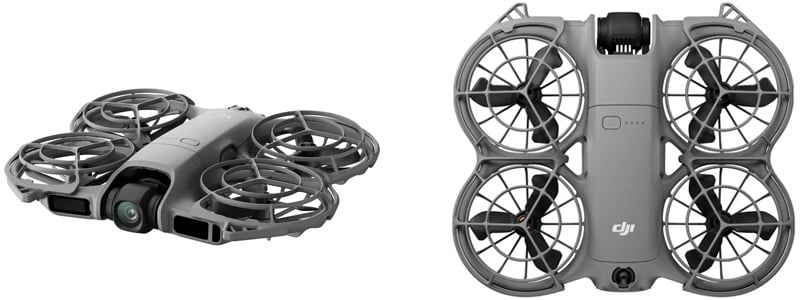
| Weight | 151 g (without transceiver) 160 g (with transceiver) |
| Dimensions | 147×171×41 mm (without transceiver) 167×171×54 mm (with transceiver) |
| Internal storage | 49 GB |
| Class (Europe) | C0 |
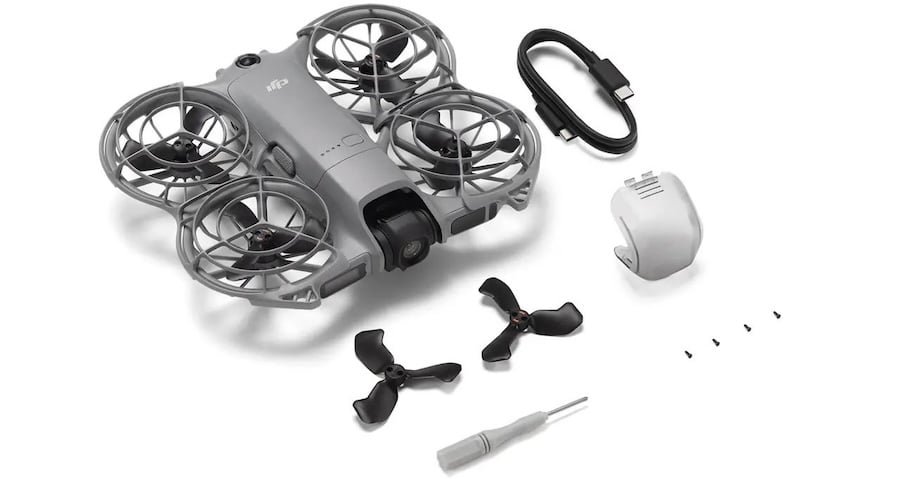
The DJI Neo 2 retains the format and overall look of the original model. Same compact silhouette, same rigid chassis with integrated protective frame around the propellers, and still those little removable protectors attached above. Seen from a distance, the two look very similar: same rounded design, same spirit. But on closer inspection, the Neo 2 is a little bigger (a few centimetres wider and deeper) and a little heavier: 151 to 160 g depending on version, compared with 135 g for the first model. Despite these changes, its dimensions remain very compact, one of the characteristics that have made the Neo range so successful. It also stands out with a slightly darker shade of grey.
The first real innovation on the front is the status display. This small display replaces the luminous icons of the first model, and shows
On the rear of the Neo 2, some packages – those with remote control – include a small, removable transceiver module. This gray box attaches to the rear of the drone via four integrated screws (impossible to lose), and is visually distinguished by two antennas protruding from the top. This module enables the Neo 2 to be used with a
Lastly, DJI’s recording model is still without a microSD card. But the good news is that internal memory has been increased from 22 to 49 GB, enough to record up to 105 minutes of video in 4K 60 fps or 175 minutes in 4K 30 fps. Plenty of room to capture your adventures.
🚦 Note on regulations
Although a little heavier than the first model, the DJI Neo 2 remains well under the 250-gram limit. As a result, it is still classified in C0, the most permissive European category. This means it can be flown over residential, urban or industrial areas, after a simple online declaration. The only major restriction is that it is still forbidden to fly over gatherings of people.
DJI Neo 2 : Control methods
| Control methods | Autonomous flight DJI Fly application Radio control (conventional flight) FPV flight |
| Compatible radio controls | DJI RC-N3 DJI RC-N2 DJI RC 2 Radio control 3 DJI FPV DJI RC Motion 3 |
| Video transmission system | Standard: Wi-Fi video transmission Optional: DJI Neo 2 (O4) digital transceiver |
| Max. transmission distance | FCC: 10 km CE: 6 km |
| Live preview quality | up to 1080p at 60 fps |
The DJI Neo 2 can be controlled in four different ways:
- Autonomous flight, using the drone’s built-in buttons
- DJI Fly application, with virtual joysticks and voice commands
- Radio control, for classic long-range piloting
- FPV mode, for total immersion with helmet
Each of these methods corresponds to a very specific use, depending on the level of experience or the type of shot required.
In autonomous flight, the drone can take off directly from the palm of your hand, once the height and distance settings have been defined using the two buttons on the side of the drone. The display on the front allows you to view these settings before launching the flight. At the end, it automatically returns to land in the outstretched hand. This mode can be used without a phone or remote control, and lends itself perfectly to use of the new gesture control mode(see box above).
✋🏻 Gesture control (new)
An intuitive, well-thought-out mode that lets you pilot the drone without a remote control or smartphone. Once activated (hand raised in front of the drone), several simple gestures enable interaction: palms spread apart to move backwards, palms together to move forwards, or lateral/vertical movement of one hand to adjust position. This system makes it possible to crop or adjust distance on the fly, without interrupting the recording. The result is fluid, natural, and ultra-practical for fine-tuning your framing directly in flight.
Control via theDJI Fly app is a good gateway to classic piloting, with on-screen virtual joysticks and the ability to give voice commands. Connection is via Wi-Fi, with a theoretical range of 500 meters. According to user feedback, this range is often less, especially when there are obstacles or the environment is not very clear.
For more advanced piloting, the Neo 2 can be fitted with an O4 transceiver (supplied in certain packs), to be attached to the rear of the drone. This module unlocks the drone’s full long-range video transmission capabilities: the DJI Neo 2 can then achieve a maximum transmission distance of up to 10 km (FCC) or 6 km (CE), which is more than sufficient for recreational use, although the actual range will always depend on the environment and any obstacles present. Flight altitude remains limited to 120 metres in accordance with European regulations (C0 class).
This mode requires the use of one of the classic compatible radio controls: DJI RC-N3, RC-N2 or DJI RC 2. This is the classic piloting mode par excellence, identical to that of DJI Mini or Mavic drones: you can fly the drone high and far, and capture large scenes or open landscapes, far beyond the selfie approach for which it was originally designed.
The Neo 2 can also be used for FPV flight, with DJI Goggles 3 or DJI Goggles N3 headsets, combined with DJI FPV Radio Control 3 or RC Motion 3. It’s a great way to discover immersive flight, with a real feeling of live piloting. In Sport mode, the drone can reach speeds of up to 12 m/s, and obstacle detection is deactivated for greater freedom. But be warned: the Neo 2 is not designed for very sporty flying. In some cases (too steep a dive, too tight a turn), it may stall momentarily, and hover to stabilize itself. This limits its FPV use to initiation or gentle exploration, but it’s more than enough to experience your first sensations of immersive flight.
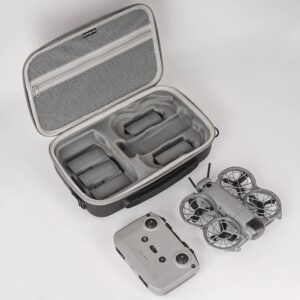
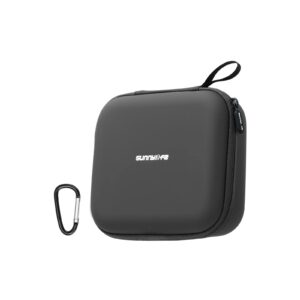
Discover our accessories for
DJI Neo 2
DJI Neo 2: In-flight performance
| Maximum speed | 8 m/s (Normal mode) 12 m/s (Sport mode) 12 m/s (subject tracking) |
| Max. ascent speed | 0.5 m/s (Cine mode) 3 m/s (Normal mode) 5 m/s (Sport mode) |
| Max. descent speed | 0.5 m/s (Cine mode) 3 m/s (Normal mode) 3 m/s (Sport mode) |
| Max. wind resistance | 10.7 m/s (level 5) |
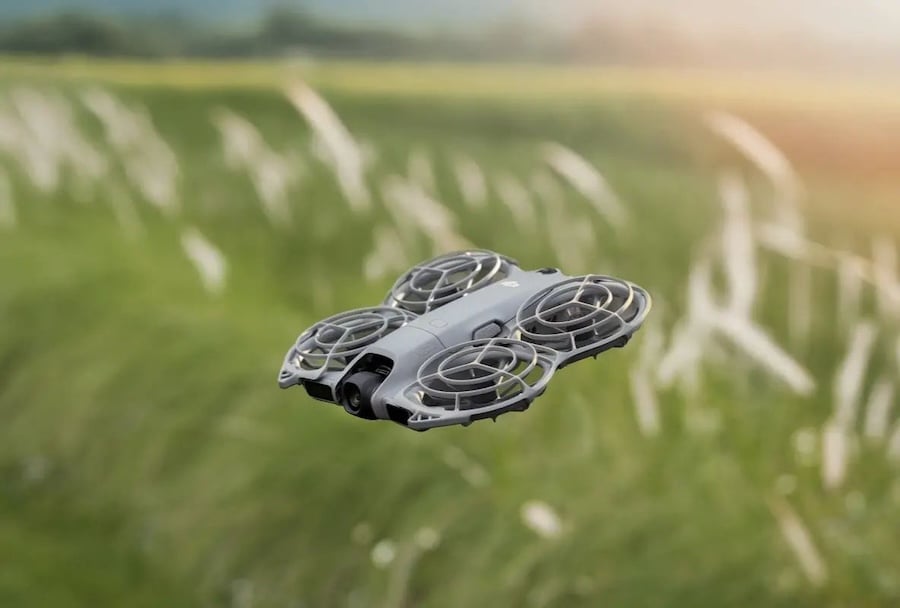
The DJI Neo 2 is still a very light drone, which inevitably influences its flight behaviour. That said, it has made progress on one key point: the Sport mode can now reach 12 m/s, and subject tracking can also climb to this speed, compared with 8 m/s on the first model. An appreciable leap forward, which makes tracking a bicycle or slow-moving vehicle far more credible.
In terms of wind resistance, DJI has announced an improvement to level 5 (up to 10.7 m/s). In concrete terms, according to initial feedback, the Neo 2 holds up well in normal conditions, but can be heckled as soon as gusts exceed 30-35 km/h, sometimes resulting in slightly less stable images. Nothing to worry about for normal use, but it’s not a drone you’d want to take off in the middle of a storm.
DJI Neo 2 : Autonomy
| Battery | 1606 mAh |
| Autonomy | 19 minutes (17 minutes with propeller protection) |
| Recharge time | 68 min (3 batteries via charging station) 70 min (1 battery direct) |
The DJI Neo 2 features a new 1606 mAh battery. DJI claims up to 19 minutes flight time, or 17 minutes with propeller guards installed, figures equivalent to those of the first model. In practice, user feedback suggests an autonomy of 10 to 15 minutes, depending on conditions (activated mode, wind, altitude, etc.). A modest autonomy, but consistent with the drone’s ultra-compact size.
This is more than enough for a few videos in selfie mode or a quick photo session, but as soon as you switch to classic piloting or FPV mode, an extra battery or two quickly becomes essential to avoid frustration.
As for recharging, allow 68 minutes to recharge 3 batteries via the dedicated station (with a 65W charger), or around 70 minutes for a single battery via direct USB-C.
Finally, the Neo 2 battery is not compatible with that of the original Neo, so it’s impossible to reuse your old batteries if you already own the first model.
DJI Neo 2 : Features
| Photo modes | Single shot, Interval shots, SelfieShot |
| Video modes | QuickShots, MasterShots, Dolly Zoom, ActiveTrack subject tracking |
| Obstacle detection | Omnidirectional monocular vision system + forward-facing LiDAR + downward-facing infrared sensor |
More varied photo and video modes
Compared to the first Neo, the Neo 2 introduces several new shooting modes. It retains QuickShots and interval shots, but clearly expands the possibilities:
- SelfieShot: hands-free capture solo or in small groups, with automatic change of angle or distance. The drone adjusts the composition to suit the scene, without the need for a tripod or outside help.
- MasterShots: record a series of pre-programmed movements, then automatically generate an edited sequence with transitions and music.
- Dolly Zoom: produces an inverted zoom effect in flight, to compress the background and accentuate the subject.
A little extra for everyday use: QuickTransfer now reaches 80 Mb/s, significantly speeding up transfers to smartphones over Wi-Fi.
More precise, more logical, more efficient tracking
The DJI Neo 2 significantly improves its tracking system, with several welcome new features. Two specific modes have been added for cycling and skiing, to adapt the drone’s trajectory to these fast, dynamic activities. Tracking speed now climbs to 12 m/s (approx. 43 km/h), enabling you to follow a cyclist or runner at a good pace without stalling.
When it comes to framing, the possibilities are far more precise than before: you can now choose the exact angle of tracking via a dial in the app (like a clock), to place the drone in front, behind, to the side or at an angle, depending on the desired scene. It’s also possible to adjust distance and height during flight, even with gestures, without interrupting the shot.
But it’s thetracking algorithm where the leap forward is most obvious: it’s more responsive, more intelligent and, above all, much more logical in the way it follows the subject. Unlike the Neo 1, it doesn’t try to cut across the field or take random trajectories. It follows movement with real fluidity, as if it understood the scene to be filmed.
According to numerous tests and user feedback, the Neo 2 offers one of the best automatic tracking systems on the market today, of all drones.
Obstacle detection: the real innovation that changes everything
The DJI Neo 2 marks a real step forward in this area, with the integration of an omnidirectional obstacle detection system. Thanks to the combination of several sensors – panoramic monocular vision, front-facing LiDAR and ground-facing infrared sensor – the drone benefits from a veritable 360° bubble of protection around it.
In practice, the system works remarkably well. According to feedback, it even spots small branches, and adjusts its trajectories with fluid, logical movements, without hesitation. Some users have deliberately pushed it to the limit, in automated or manual flight, to test its limits… and the results are clear: it’s very difficult to crash.
Although not infallible, the system proves extremely reliable, making the Neo 2 one of the safest drones in its category. A true complement to subject tracking, which gains in serenity and precision, even in complex environments.



DJI Neo 2 : Image
| Stabilization | 2-axis mechanical gondola (tilt, roll) |
| Sensor | 1/2 inch |
| Objective | 16.5 mm equivalent format Aperture: f/2.2 FOV 119.8 |
| Max. photo resolution | 12 MP |
| Max. video resolution (horizontal) | 4K up to 100 fps |
| Max. video resolution (vertical) | 2.7K up to 60 fps |
| ISO range | 100 à 12800 |
| Max. bit rate | 80 Mb/s |
| Photo format | JPEG |
| Video format | MP4 |
| Color profile | Normal |
Pod, sensor andresolutions
The DJI Neo 2 now features a 2-axis mechanical nacelle (tilt and roll), whereas the first model was limited to a single axis. In theory, this evolution allows for better image stabilization, particularly during lateral movements or changes of angle. The addition remains modest compared to the 3-axis pods of more advanced models, but it does its job of stabilizing images in most situations, as long as weather conditions are not too turbulent.
On the sensor side, we find the same 1/2-inch, but with a reworked image processing. The aperture is increased to f/2.2, slightly brighter than that of the original Neo (f/2.8), which helps a little in low light. The ISO range has also been extended , from 100 to 12800.
For photos, the Neo 2 captures up to 12 megapixels. In video, the Neo 2 films in 4K at up to 60 fps. And with a DJI remote control, it unlocks a 100 fps slow-motion mode. In vertical mode, it automatically crops in 4K to produce 2.7K video at up to 60 fps.
Image quality: a real leap forward
DJI has clearly revised its copy. The Neo 2’s image is much more usable than that of the first model. More detail, sharper focus, better light management… You can feel that image processing has been improved. In daylight, images are really clean and can be shared directly on networks, without retouching.
That said, this is still a camera designed for the general public. No flat profile, no LOG mode, no RAW photos either: you get a ready-to-use image, but no room for calibration. It is possible to manually adjust exposure and a few other classic parameters, but only if the drone is connected to a DJI remote control. In simple use with a smartphone, these options are not available.
In short, the image is much better than before, and for the majority of users, it will more than do the job.
DJI Neo 2: Packs and prices
ℹ️ Note: some links in this section are Amazon affiliate links. As Amazon Associates, we earn from qualifying purchases, at no extra cost to you.
| Standard package (drone only) | 239 € |
|
| Fly More Pack | 399 € |
|
| Motion Fly More Pack | 579 € |
|
The DJI Neo 2 is launched at a slightly higher price than the first-generation Neo, but the difference remains very reasonable in view of the improvements made. Omni-directional obstacle detection, dual-axis nacelle, slow-motion mode, FPV compatibility… at this price, it’s hard to fault DJI for anything that’s still missing.
The standard package (€239) is designed for use in autonomous flight, with integrated tracking functions, or possibly piloting via smartphone. It includes only the drone, a battery, a pair of spare propellers, a USB-C cable and the pod protector. That’s all you need to get started, but without radio control or advanced transmission.
The Fly More pack (€399) unlocks classic piloting with a real DJI RC-N3 radio control system. It also includes the digital transmission module, three batteries in total, a charging station, and all the basic accessories. It’s the all-round package for traditional flying, without compromise.
The Motion Fly More pack (€579 ) is aimed at those who want to switch to FPV, with total immersion. It includes DJI Goggles N3, RC Motion 3 one-hand controller, three batteries, transmission module, charging station and standard accessories. The perfect package for discovering a new, more instinctive way of flying.

Discover our accessories for
DJI Neo 2
Conclusion DJI Neo 2: Should you give in?
The DJI Neo 2 marks a real turning point compared with the first generation. We’ve gone from a fun little drone to a much more complete model, which consolidates the formula and clearly moves upmarket in the ultra-compact market. It retains the three flight styles that made the first model such a success – autonomous, classic and FPV immersion – but makes them more accessible, more stable and more precise.
Improvements include omnidirectional obstacle detection, a much clearer on-board display , almost 50 GB of storage, improved image quality , gesture controls and new photo/video modes that are far more varied than before. All without losing the compactness or ease-of-use of the original model. Our opinion of the DJI Neo 2 is clear: this second generation fixes most of the shortcomings of the original model while preserving everything that made it successful. At this price point and with this level of features, the DJI Neo 2 now stands out as the benchmark among ultra-compact selfie drones.
Who is the DJI Neo 2 designed for?
The DJI Neo 2 ticks so many boxes that it is suitable for a wide range of users, but certain profiles will find it particularly appealing:
- Beginners will find it an excellent, stress-free way of getting started in the drone world. Thanks to its safe autonomous piloting, intuitive gestures and compact size, it lets you discover all the facets of drone flying without having to think about it: assisted flight, classic piloting with radio control, or even total immersion in FPV.
- It’s also a good choice for those who want a flying cameraman, but don’t want to train to fly a conventional drone. It tracks movements, avoids obstacles, films cleanly… and all without the need for the user to be an expert.
- Another obvious target: outdoor sports enthusiasts. Trail, hiking, skiing, road biking or mountain biking… The Neo 2 is light enough, smart enough and reliable enough to easily capture dynamic shots on the move, even in somewhat committed conditions.
- Finally, its low price makes it a good option for nomadic content creators, families or travelers, who want a simple but complete drone capable of producing beautiful images without weighing down their backpack (or their budget).
I already have the Neo, should I upgrade to the DJI Neo 2?
If the first-generation DJI Neo already meets your needs perfectly – short vacation videos, family memories or simple, no-fuss tracking – there ‘s no need to change. The Neo remains an excellent autonomous drone, simple and efficient.
On the other hand, for those who use it regularly and are beginning to feel certain limitations, the Neo 2 brings real improvements: better image quality, omnidirectional obstacle detection, smoother tracking, easier-to-read interface, new photo/video modes… The switch to this new model is all the more justified if safety, ease of use or creative capabilities have become important criteria.
To see exactly what has changed between the two generations, check out our DJI Neo 2 vs Neo comparison.
FAQ – DJI Neo 2: Frequently Asked Questions
Is the DJI Neo 2 classified as C0 in Europe?
Yes. Like its predecessor, the DJI Neo 2 weighs under 250 grams and carries the C0 marking. This means it can be flown in the A1 category, without mandatory training (only online registration is required), with more flexible regulations than heavier drones.
Does the DJI Neo 2 feature omnidirectional obstacle detection?
Yes. The Neo 2 includes omnidirectional obstacle detection, significantly improving flight safety, especially during automated movements and subject tracking.
Can you record in 4K at 100 frames per second with the DJI Neo 2?
Yes. The DJI Neo 2 can record in 4K at up to 100 frames per second, allowing smooth slow-motion footage while maintaining excellent image quality.
What is the real-world flight time of the DJI Neo 2?
DJI advertises a theoretical flight time longer than the first-generation Neo. In real-world conditions, you can generally expect slightly less than the official figures, depending on wind, temperature, and flight intensity.
Should you upgrade from the DJI Neo to the DJI Neo 2?
If you already own the Neo, upgrading to the Neo 2 makes sense mainly if you’re looking for improved flight safety (omnidirectional detection), better video performance, and enhanced usability. For occasional and simple use, the original Neo remains a solid option.
Is the DJI Neo2 compatible with DJI Goggles 3?
Yes. The DJI Neo2 is compatible with DJI Goggles 3 when equipped with the DJI O4 digital transmission module. It can then be used with the RC Motion 3 or the DJI FPV Remote Controller 3 to enjoy an immersive FPV flying experience.
💡 Also read
➡️ Fancy a comparison with the previous generation? Check out our full review of the DJI Neo.
➡️ Are you hesitating between the Neo 2 and the Mini 3? Discover our Neo 2 vs Mini 3 comparison.
➡️ Not sure whether to choose the DJI Neo 2 or the DJI Lito 1? Check out our DJI Neo 2 vs Lito 1 comparison.
➡️ Discover why we selected the DJI Neo 2 as the best autonomous selfie drone, but also as the best drone under $300 in our best drones guide.
➡️ To complete your setup, also check out our guide to the essential DJI Neo 2 accessories.
➡️ Looking for a simple and reassuring drone to get started? Check out our guide to find a drone that’s easy to use.
➡️ Interested in FPV drones? Check out our comparison of which drone to choose between the DJI Avata 360 and the Avata 2.
➡️ Interested in the DJI Avata 360 as well? Discover the differences between the DJI Avata 360 and the DJI Neo 2.
🛠️ Looking for DJI Neo 2 spare parts?
Find all compatible parts and accessories here:
DJI Neo 2 spare parts

 Blog
Blog