
 Français
 Deutsch
 Español
 Italiano
 Parts & Accessories by Drone
 Drones
 Action camera
 Microphones
 Camera Stabilizers
 VR Headsets
DJI Flip vs Neo 2: which drone to choose?
Dec
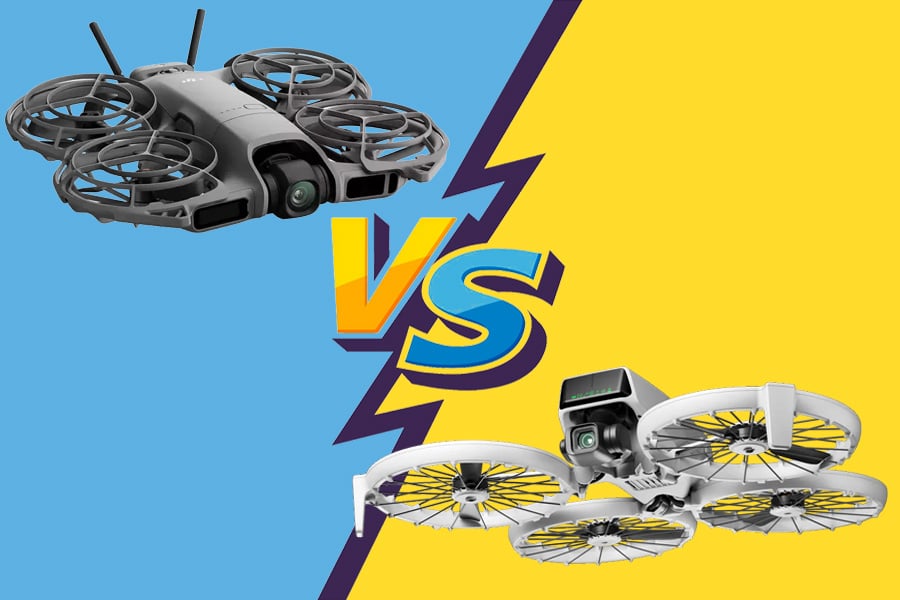
With the Neo 2, DJI offers a significant evolution of its first autonomous drone, while retaining the compact size and ease of use that made the first model such a success. Until now, the DJI Flip could be seen as a more advanced version of the Neo, with a few extra assets for demanding creators. But with this new version, does the Flip still have the edge? Has the Neo 2 closed the gap? And above all, which of these two models is right for you? This DJI Flip vs Neo 2 comparison helps you make the right choice.
DJI Flip vs Neo 2: What you need to know
No time (or laziness 😅 ) to read it all? Here are the key points to remember about the DJI Neo 2 and DJI Flip 👇
- 🧳 Flip foldable, Neo 2 monobloc: two very different sizes to carry around.
- 🪶 Neo 2 lighter (151 g vs. 249 g)
- 💾 49GB of internal storage on the Neo 2, compared with 2GB + microSD card on the Flip
- 🎮 A utonomous flight, via app or radio control on both drones, with additional FPV mode on the Neo 2
- ✋🏻 Advanced gesture control on Neo 2, for hands-free framing adjustment
- 🏃 Equivalent speed (up to 12 m/s for both models)
- 🌬️ Similar wind resistance, up to level 5 (10.7 m/s)
- 🧠 Safer tracking on the Neo 2, thanks to 360° obstacle detection
- 🎥 Larger sensor on the Flip, with slightly better image quality
- 🎞️ RAW photos and 10-bit D-Log M profile on the Flip, for those who want to retouch in post-prod.
- 📦 More affordable Neo 2 packages for all uses (classic, standalone or FPV)
📌 Two drones very similar in use, but targeting different profiles: the Neo 2 for versatility and safety, the Flip for image and endurance.
DJI Flip vs Neo 2 : Design

| DJI Flip | DJI Neo 2 | |
| Weight | < 249 g | 151 g (without transceiver) 160 g (with transceiver) |
| Dimensions (folded) (L x W x H) | 136 x 62 x 165 mm (folded) 233 × 280 × 79 mm (unfolded) | 147×171×41 mm (without transceiver) 167×171×54 mm (with transceiver) |
| Storage | 2 GB internal memory Memory card | 49 GB |
| Class (Europe) | C0 | C0 |
The DJI Neo 2 and DJI Flip share a common vision: to offer a fully autonomous flying experience, designed for selfie, vlogging and person tracking. Both are designed to operate without radio control, with take-off possible directly from the palm of the hand. Their closed chassis, with fixed frames around the propellers, means they can be used safely, even indoors.
But despite this common spirit, they adopt different approaches. The Neo 2 relies on a one-piece structure, permanently ready for use. The Flip, on the other hand, is fully foldable, with inward-folding arms and propellers. In terms of weight, the difference is clear: 151 to 160 g for the Neo 2, versus 249 g for the Flip. However, both drones remain C0-rated in Europe, which means no registration or training is required to fly them.
Both drones feature a small status screen on the front, handy for displaying battery level or checking the selected mode. A side button on the right-hand side lets you quickly switch from one mode to another using your thumb, without having to go through the screen or an application. In terms of protection, the Neo 2 uses clip-on, removable plastic elements, while the Flip relies on a screwed-on carbon-fiber structure that surrounds the propellers. Two different approaches, but in both cases, the aim is the same: to prevent finger injuries during take-off or close-flying.
The Neo 2 also has the advantage of 49 GB of internal memory, enabling recording of up to 105 minutes in 4K60 or 175 minutes in 4K30, even without a microSD card. The Flip makes do with 2GB of internal memory, just enough to tide you over, but it does have a microSD port compatible with high-capacity cards. Handy, provided you don’t forget your card at home.
🏆 DJI Neo 2: lighter, more compact and better equipped with internal memory.

All parts and accessories for
DJI Flip
DJI Flip vs Neo 2: Control methods
| DJI Flip | DJI Neo 2 | |
| Control methods | Autonomous flight DJI Fly application Radio control (classic flight) | Autonomous flight DJI Fly application Radio control (conventional flight) FPV flight |
| Compatible radio controls | DJI RC-N3 DJI RC-N2 DJI RC 2 | DJI RC-N3 DJI RC-N2 DJI RC 2 Radio control 3 DJI FPV DJI RC Motion 3 |
| Video transmission system | DJI O4 | Standard: Wi-Fi video transmission Optional: DJI Neo 2 (O4) digital transceiver |
| Max. transmission distance | FCC: 13 km CE: 8 km | FCC: 10 km CE: 6 km |
| Live preview quality | up to 1080p at 60 fps | up to 1080p at 60 fps |
Both drones can be controlled in a variety of ways, depending on your preferences and the equipment available. Each allows :
- autonomous control, without the need for a smartphone or remote control,
- using the DJI Fly application, directly on your smartphone,
- classic piloting with a compatible DJI remote control,
- and on the Neo 2 side only, an FPV immersion mode with DJI Goggles headset.
The autonomous mode allows the drone to take off without a smartphone or remote control. All you have to do is press the dedicated button, directly on the chassis, to launch an automatic shot. On the DJI Neo 2, this function is taken a step further with advanced gesture control : once activated (hand raised in front of the drone), several gestures can be used to steer the drone without touching anything. It can move backwards, forwards or adjust its lateral/vertical position according to hand movements, all in a fluid, natural way. Ideal for fine-tuning framing without interrupting recording.
The second option is to use the DJI Fly app. Simply connect your smartphone to the drone via Wi-Fi to access all settings, flight modes and a touch-sensitive control interface with on-screen virtual joysticks. This control method is simple and intuitive, but limited in range: only a few dozen meters on the DJI Flip, compared with a theoretical range of up to 500 m on the Neo 2 – a distance which, according to user feedback, is often shorter in real-life conditions.
Third option: more conventional control via radio remote control. Both drones are compatible with the RC-N2, RC-N3 (models without screen, with smartphone support) and the DJI RC 2 (model with integrated screen). The only difference on the Neo 2 side is that a small
Finally, only the DJI Neo 2 offers a true FPV mode. Combined with DJI Goggles 3 (or N3) and RC Motion 3 radio control, it enables immersive, subjective-view piloting. As a result, it’s the only one of the two to offer the full range of piloting possibilities: autonomous flight, gesture control, mobile app, conventional radio control and FPV immersion.
In terms of maximum range, the DJI Flip maintains a slight lead: up to 13 km in FCC (8 km in CE), compared with 10 km (6 km in CE) for the Neo 2. In reality, you’ll never fly that far: a longer range is above all a sign of a more reliable and stable signal.
🏆 DJI Neo 2 : the only one to offer all piloting options, including FPV immersion.


DJI Flip vs Neo 2: In-flight performance
| DJI Flip | DJI Neo 2 | |
| Maximum speed | 12 m/s (Sport mode) 12 m/s (subject tracking) | 8 m/s (Normal mode) 12 m/s (Sport mode) 12 m/s (subject tracking) |
| Max. ascent speed | 2 m/s (Cine mode) 5 m/s (Normal mode) 5 m/s (Sport mode) | 0.5 m/s (Cine mode) 3 m/s (Normal mode) 5 m/s (Sport mode) |
| Max. descent speed | 1.5 m/s (Cine mode) 5 m/s (Normal mode) 5 m/s (Sport mode) | 0.5 m/s (Cine mode) 3 m/s (Normal mode) 3 m/s (Sport mode) |
| Max. wind resistance | 10.7 m/s (level 5) | 10.7 m/s (level 5) |
In both Sport mode and subject tracking, the DJI Neo 2 and DJI Flip both reach 12 m/s, or around 43 km/h. This is more than enough speed to effortlessly follow someone on a bike, on a fast run or even on a ski slope.
In terms of wind resistance, both models are rated at level 5, equivalent to gusts of 10.7 m/s (approx. 38 km/h). According to the information available, neither model seems to have any real advantage over the other. Thanks to its reinforced motorization, the Neo 2 now reaches the Flip’s level of stability, which was not necessarily the case before.
🤝 Tie : same top speed, same wind resistance.
DJI Flip vs Neo 2: Autonomy
| DJI Flip | DJI Neo 2 | |
| Battery | 3110 mAh | 1606 mAh |
| Autonomy | 31 minutes | 19 minutes (17 minutes with propeller protection) |
| Charging time | 45 min (1 battery via station) / 70 min (2 batteries) 70 min (1 battery live) | 68 min (3 batteries via charging station) 70 min (1 battery direct) |
Thanks to its larger size, the DJI Flip boasts a much more generous battery than the Neo 2: 3110 mAh versus 1606 mAh. Unsurprisingly, it therefore lasts much longer in flight, with a theoretical autonomy of 31 minutes versus 19 minutes for the Neo 2 (or 17 minutes if you use the propeller protectors).
But as is often the case with DJI’s figures, ideal conditions are rarely met in the field. In real-world use, the Flip rarely exceeds 25 minutes, and the Neo 2 takes around 10 to 15 minutes, depending on the type of flight (FPV mode, gesture, radio control, etc.) and the weather. This isn’t ridiculous for a drone of this size, but it’s highly advisable to bring along an extra battery or two if you’re planning anything other than a selfie session.
For recharging, both models offer a dedicated station capable of charging several batteries in series, with times that are similar overall: count on around 70 minutesfor one battery, or just over an hour for three batteries, whether on the Neo 2 or the Flip. There’s nothing revolutionary here, but it’s enough to quickly get back in the swing of things between flights.
🏆 DJI Flip : much better autonomy.

Discover our accessories for
DJI Neo 2
DJI Flip vs Neo 2: Features
| DJI Flip | DJI Neo 2 | |
| Photo modes | Single shot, Burst, Interval, Panorama | Single shot, Interval shots, SelfieShot |
| Video modes | QuickShots, MasterShots, ActiveTrack subject tracking, Hyperlapse, Slow motion | QuickShots, MasterShots, Dolly Zoom, ActiveTrack subject tracking |
| Obstacle detection | Downward-facing visual and infrared sensors + forward-facing 3D infrared detection system | Omnidirectional vision system + forward-facing LiDAR + downward-facing infrared sensor |
On paper, the two drones share a very solid base: QuickShots, MasterShots, subject tracking,audio recording via the DJI Fly app or a Bluetooth microphone, and fast transfers via QuickTransfer. But if you dig a little deeper, you’ll discover that each model has its own weapons… and they’re not all the same.
On the photo front, the Flip offers a wider range of classic modes: burst, AEB, panorama (with several options: wide-angle, 180°, sphere, vertical), while the Neo 2 concentrates on more targeted uses such as SelfieShot, designed for quick solo or small-group shots. In video, the same logic applies: the Flip stands out for its 100 fps 4K slow motion and hyperlapse, which are absent from the Neo 2, while the Neo 2 goes for originality with a cinematic DollyZoom mode.
But one of the most interesting features is the subject tracking. Both drones use DJI’s ActiveTrack, with an equivalent maximum speed(12 m/s), and offer the same three modes: ActiveTrack, DirectionTrack and Spotlight. The Flip features an infrared front sensor that automatically brakes in the event of an obstacle. The Neo 2 goes a step further with omnidirectional obstacle detection (front, rear, bottom), combining binocular vision and lidar sensors for far more reliable 3D perception. As a result, it can follow a subject more fluidly, even in complex environments, while greatly limiting the risk of collision.
🏆 DJI Neo 2 : safer tracking thanks to more comprehensive obstacle detection.
DJI Flip vs Neo 2 : Image
| DJI Flip | DJI Neo 2 | |
| Stabilization | 3-axis mechanical gondola (tilt, roll, pan) | 2-axis mechanical gondola (tilt, roll) |
| Sensor | 1/1.3 inch | 1/2 inch |
| Objective | 24mm equivalent format Aperture f/1.7 FOV 82.1 | 16.5 mm equivalent format Aperture: f/2.2 FOV 119.8 |
| Photo resolution | 12 and 48 MP | 12 MP |
| Max. video resolution (horizontal) | 4K up to 100 fps | 4K up to 100 fps |
| Max. video resolution (vertical) | 2.7K up to 30 fps | 2.7K up to 60 fps |
| ISO range | 100 à 6400 | 100 à 12800 |
| Max. bit rate | 150 Mb/s | 80 Mb/s |
| Digital zoom | 4K: 3x FHD: 4x 2.7K vertical pickup: 3x FHD vertical pickup: 4x 12 MP photo: 3x | Not available |
| Photo format | JPEG DNG (RAW) | JPEG |
| Video format | MP4 | MP4 |
| Color profile | Normal D-Log M | Normal |
Pod, sensor and resolutions
The DJI Flip is equipped with a three-axis mechanical gondola (tilt, roll, pan), compared with only two physical axes on the Neo 2 (tilt and roll), the third being digitally stabilized. On paper, full mechanical stabilization may offer smoother shots during complex movements or lateral rotations, but the Neo 2’s hybrid stabilization is designed to compensate for this shortcoming in the majority of use cases.
As for the sensor, the figures speak for themselves: the Flip incorporates a 1/1.3-inch CMOS sensor opening at f/1.7, compared with a smaller 1/2-inch sensor opening at f/2.2 for the Neo 2. In theory, this enables the Flip to capture more light, improve the management of highlights and dark areas, and produce more detailed images in lowlight.
The field of view is also different: 82° for the Flip vs. 119.8° for the Neo 2, which translates into a tighter image on the Flip, while the Neo 2’s ultra-wide angle favors greater immersion, especially for subjective view scenes or shots in open environments.
On the photo front, the Flip lets you shoot at 12 or 48 MP, and save as JPEG or RAW (DNG), while the Neo 2 is limited to 12 MP JPEG. On the video front, both can shoot up to 4K at 100 fps (in slow-motion mode), but the Flip offers a higher bit rate(150 Mb/s vs. 80 Mb/s), as well as digital zoom up to x4, which is not available on the Neo 2.
Image quality
In use, both drones deliver very convincing results overall, but with differences that can be felt depending on the shooting conditions.
According to the available analyses, the DJI Flip takes advantage of its larger sensor and brighter lens to produce a cleaner image in difficult situations, particularly in low light. There’s also better dynamic range management, with more visible detail in both highlights and shadows, as well as smoother, more natural rendering in certain complex scenes.
At the same time, the Flip features the D-Log M 10-bit color profile, opening the way to more advanced post-production for advanced users. This profile enables finer gradation of colors and greater retention of information in the image, which the Neo 2 does not offer.
However, it’s worth noting that the difference in quality is much less pronounced in certain well-exposed, daylight scenes. Several comparative extracts show that the Neo 2 fares very well, with a detailed, colorful and pleasantly contrasted image, sometimes difficult to distinguish from that of the Flip with the naked eye.
In short, the Flip retains the technical edge – especially for the most demanding designers – but in optimal lighting conditions, the gaps can be bridged, and the Neo 2 remains fully up to the task for consumer use.
🏆 DJI Flip: larger sensor, RAW photos, D-Log M profile and slightly more rendering depending on the scene.
DJI Flip vs Neo 2: Packs and prices
ℹ️ Note: some links in this section are Amazon affiliate links. As Amazon Associates, we earn from qualifying purchases, at no extra cost to you.
| DJI Flip | Standard pack (DJI RC-N3 remote control) | 439€ |
|
| Standard pack (DJI RC 2 remote control) | 639€ |
| |
| Fly More pack (DJI RC 2 remote control) | 779€ |
| |
| DJI Neo 2 | Standard package (drone only) | 199€ |
|
| Fly More Pack | 349€ |
| |
| Motion Fly More Pack | 529€ |
|
The Neo 2 is offered in three distinct configurations, from a minimalist pack without radio control to an immersive FPV version, to cover all types of use.
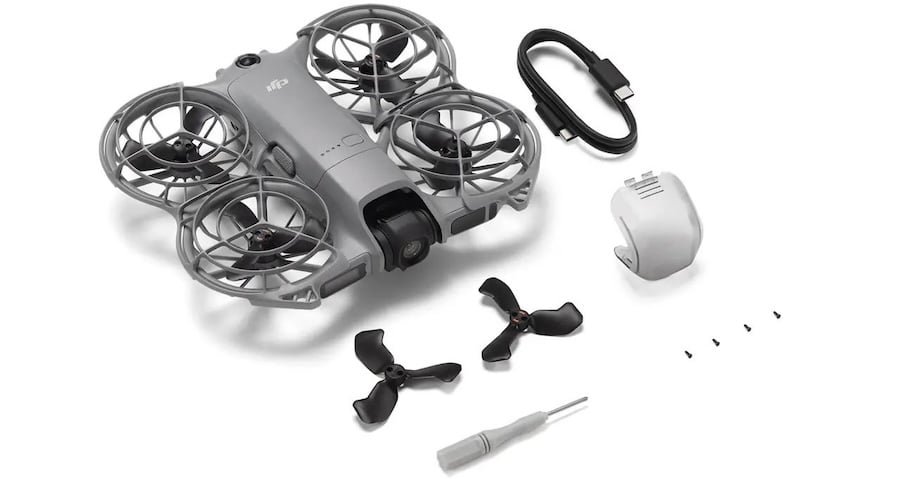
- Standard pack (€199): drone only, battery, spare propellers, USB-C cable and nacelle protection. Ideal for autonomous flight or smartphone piloting.
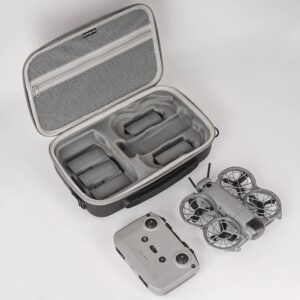
- Fly More Pack (€349): adds DJI RC-N3 radio control, transmission module, three batteries, charging station and standard accessories for traditional piloting.
- Motion Fly More Pack (€529 ): includes Motion 3 RC controller, DJI Goggles N3, three batteries, transmission module, charging station and accessories for FPV flying.
The DJI Flip is always sold with an included radio control system, either the DJI RC-N3 (used with a smartphone) or the DJI RC 2 (with integrated screen). There are three packs in all, including a comprehensive Fly More.
- Standard pack with DJI RC-N3 (€439): drone, RC-N3, battery, basket protector, spare propellers and essential cables.
- Standard package with DJI RC 2 (€639): same features, plus DJI RC 2 radio control with integrated screen for added convenience.
- Fly More Pack with DJI RC 2 (€779 ): adds three batteries, a charging station, a carry bag, three sets of propellers and all necessary accessories.
The two models are not exactly aimed at the same audience. The DJI Neo 2 lets you get started at a very low price, with or without radio control depending on the package, and evolve towards an FPV experience without blowing your budget. The more expensive DJI Flip, on the other hand, offers a ready-to-use configuration right from the basic package, targeting users looking for simplicity and uncompromising comfort.
🏆 DJI Neo 2: more affordable.



Conclusion DJI Flip vs Neo 2: Which to choose?
With the Neo 2, DJI has clearly shaken up the established order. More compact, lighter and better equipped than the first model, it comes to hunt in the Flip’s territory with solid arguments: an immersive FPV mode, 360° obstacle detection, good subject tracking and a much more aggressive price. However, the Flip still has some serious trump cards up its sleeve, especially for those looking for the best possible image quality, with a larger sensor, advanced photo/video options (RAW, D-Log M) and far superior battery life.
Ultimately, both drones share a common philosophy: that of simplified, autonomous flight. But depending on your uses, one or the other will make all the difference.
✅ Choose the DJI Flip if…
- You prefer better overall image quality, with a larger sensor and a more sophisticated rendering depending on the scene.
- You need advanced formats for creation, such as RAW photo (DNG ) and D-Log M video for post-production.
- You’re looking for more autonomy so you can link up plugs without multiplying your batteries.
✅ Choose the DJI Neo 2 if…
- You’re looking for a reassuring autonomous drone, with omnidirectional obstacle detection that makes flying extremely safe.
- You’ll want to be able to track your subject more reliably and with greater peace of mind, especially when on the move, thanks to advanced detection that limits the risk of collision.
- You want an affordable gateway to autonomous UAVs, with the added bonus of being able to switch to immersive FPV.
💡 To extend this DJI Flip vs Neo 2 comparison, find our full reviews of each of the two models:
➡️ Full review of the DJI Neo 2
➡️ DJI Flip: detailed analysis of its strengths and limitations
➡️ Would you like to compare the Neo 2 with the previous generation? Check out our comparison between the DJI Neo and the Neo 2.
➡️ You can also check out our guide dedicated to DJI Neo 2 accessories.
🛠️ Pour l’entretien et la réparation, retrouvez toutes les pièces compatibles ici :
Pièces DJI Flip
Pièces DJI Neo 2
💡 Also read
➡️ Discover why the DJI Flip and DJI Neo 2 are featured in our ranking of the best drones.

 Blog
Blog