
 Français
 Deutsch
 Español
 Italiano
 Parts & Accessories by Drone
 Drones
 Action camera
 Microphones
 Camera Stabilizers
 VR Headsets
Insta360 X4 vs X4 Air: what are the differences?
Jan
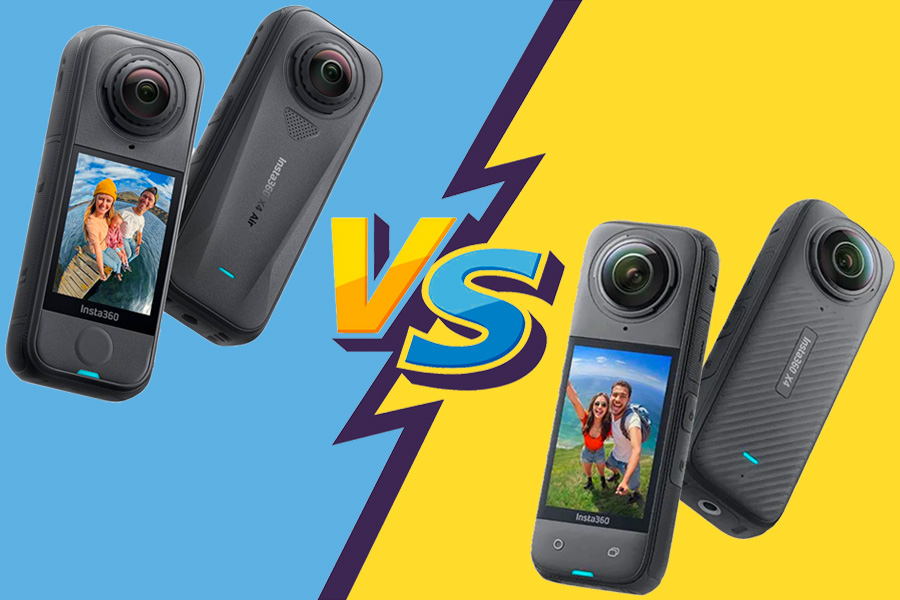
With the X4 Air, Insta360 offers a more compact and lighter version of its X4. The format is clearly evolving, with a camera that’s easier to carry on a daily basis. But the X4 Air is more than just an X4 reduced in size and weight: Insta360 has also revamped what’s under the hood. So what are the real differences between the Insta360 X4 and the X4 Air? And above all, which one is best suited to your needs? We take stock in this Insta360 X4 vs X4 Air comparison.
Insta360 X4 vs X4 Air: Quick comparison
| Insta360 X4 | Insta360 X4 Air | |
|---|---|---|
| Weight | 203 g | 165 g |
| Sensors | 1/2 inch | 1/1.8 inch |
| Max. resolution | 8K at 30 fps | 8K at 30 fps |
| Image quality | Very good | Better, especially in low light |
| Autonomy | Best out of 8K | Best in 8K |
| Slow motion | Up to 4K 100 fps | More limited |
| Price | Higher | More accessible |
Insta360 X4 vs X4 Air: What you need to know
No time (or laziness 😅 ) to read it all? Here are the key points to remember from this Insta360 X4 vs X4 Air comparison 👇
- 🪶 X4 Air more compact and lighter: more comfortable to carry and use every day
- 🖼️ X4 Air advantage in image quality, especially in low light (larger sensors, more recent processing)
- 🔋 X4 advantage on overall autonomy, especially for long shoots in intermediate definition
- 🎞️ X4 advantage in slow motion, at high frame rates (up to 4K at 100 fps)
- 🎥 Newer features on the X4 Air, with modes absent from the X4 (InstaFrame, Mode Me…).
- 💰 X4 Air clearly more accessible in price, with a more affordable entry ticket and packages
📌 In summary: the X4 Air takes the lead on compactness, image and price, while the X4 stays ahead onnon-8K endurance and slow motion.
Insta360 X4 vs X4 Air: Design and size
| Insta360 X4 | Insta360 X4 Air | |
| Dimensions (W x H x D) | 46 x 123.6 x 37.6 mm | 46 x 113.8 x 37 mm |
| Weight | 203 g | 165 g |
| Touch screen | 2.5 inch | 2.5 inch |
| Storage | MicroSD card | MicroSD card |
| Operating temperature | -20 ℃ à 40 ℃ | -20 ℃ à 40 ℃ |
| Waterproofing | 10 meters | 15 meters |
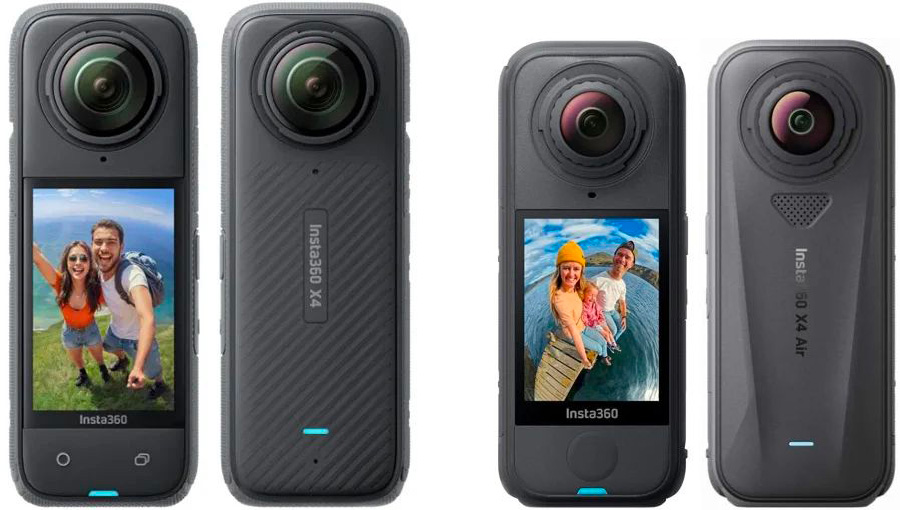
In terms of design, the difference between the X4 and the X4 Air lies above all in size and weight. The X4 Air weighs 165 g, compared with 203 g for the X4, i.e. almost 40 g less. Dimensions also change: both cameras retain the same width(46 mm), but the X4 Air is shorter, with a height of 113.8 mm versus 123.6 mm for the X4, a difference of almost a centimetre. Thickness is also slightly reduced(37 mm for the X4 Air, versus 37.6 mm for the X4). On paper, the gain is most noticeable in height, but in use, the difference is very real.
In practice, the X4 Air is more discreet in the hand and more pleasant to use on a daily basis. It slips more easily into a pocket or small bag, and is less noticeable when mounted on a pole, helmet or stand. This more compact format also reduces wind resistance, a point often raised by users in sports use, particularly mountain biking or cycling, where the camera is less noticeable on a helmet and more stable at high speeds.
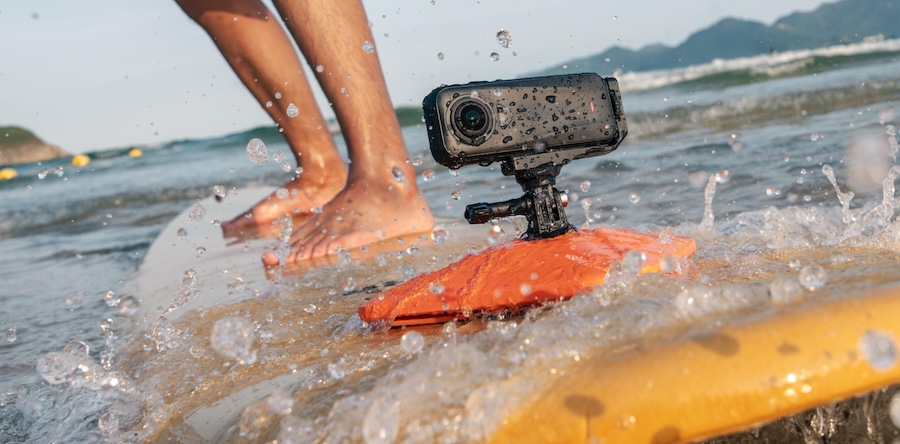
Despite this smaller format, Insta360 has not sacrificed ergonomics. The X4 Air retains the same 2.5″ touchscreen as the X4, making it more compact without compromising navigation comfort or legibility. In terms of ruggedness, the X4 Air is even more robust than the X4: its water resistance has been increased from 10 to 15 meters without the need for a housing, and it has introduced a system of interchangeable lensesalready present on the X5 but absent from the X4, a real plus for a 360 camera in the event of scratches or knocks.
🏆 Insta360 X4Air: more compact, lighter and with interchangeable lenses.
Insta360 X4 vs X4 Air: Autonomy and recharging
| Insta360 X4 | Insta360 X4 Air | |
| Battery | 2290 mAh | 2010 mAh |
| Autonomy | 8K at 30 fps: 75 min 5.7K at 30 fps: 135 min | 8K at 30 fps: 88 min 6K at 24 fps: 105 min |
| Charging time | 80% in 38 minutes 100% in 55 minutes | 80% in 36 min 100% in 57 min |
In terms of autonomy, the Insta360 X4 and X4 Air don’t use the same battery. The X4 Air uses a 2010 mAh battery, versus 2290 mAh for the X4, a logical difference given its more compact size.
In practice, the differences in autonomy depend heavily on the definition used. In 8K at 30 frames per second, the X4 Air claims up to 88 minutes, compared with around 75 minutes for the X4. In this precise scenario, the X4 Air does slightly better, despite its smaller battery.
On the other hand, in 5.7K at 30 fps, the X4 can achieve up to 135 minutes, a much higher value than that offered by the X4 Air in comparable conditions. The X4 thus retains an advantage when more moderate definitions are preferred over longer periods.
The X4 Air compensates in part for this more limited endurance with more efficient fast recharging. It can recover 80% of its charge in around 36 minutes and reach 100% in less than an hour, making it easier to recharge between sessions. The X4 generally takes a little longer for a full charge.
Finally, it should be noted that the batteries of the two models are not interchangeable. An important point for those who already own several X4 batteries and are reluctant to switch to the X4 Air, or vice versa.
🏆 Insta360 X4: better overall endurance for extended non-8K shoots.

Discover our accessories for
Insta360 X4
Insta360 X4 vs X4 Air : Image
| Insta360 X4 | Insta360 X4 Air | |
| Sensors | 1/2 inch | 1/1.8 inch |
| Objective | F1.9 aperture 6.7 mm equivalent | Aperture f/1.95 6.4 mm equivalent |
| Photo resolution | 72 MP (360°) / 18 MP (single-lens) | 29 MP |
| Video resolution (360°) | 8K up to 30 fps / 5.7K up to 60 fps / 4K up to 100 fps | 8K up to 30 fps / 6K up to 50 fps / 4K up to 50 fps |
| Video resolution (single-lens) | 4K up to 60 fps / 2.7K up to 60 fps / 1080p up to 60 fps | Normal video: 4K up to 60 fps / 2.7K up to 60 fps / 1080p up to 120 fps |
| Photo format | INSP, DNG | INSP, DNG |
| Video format | INSV (360°), MP4 (single-lens) | INSV (360°), MP4 (single-lens) |
| Color profiles | Bright, Standard, Flat | Bright, Standard, Flat |
| Maximum video bit rate | 200 Mbps | 180 Mbps |
| ISO range | 100 à 6400 | 100 à 3200 |
Sensors and definitions
Both the Insta360 X4 and Insta360 X4 Air can shoot 360° video up to 8K at 30 frames per second, but the comparison ends quickly.
The X4 uses two 1/2-inch sensors, while the X4 Air adopts larger 1/1.8-inch sensors. This difference in size has a direct impact on light capture, but also on the compromises made in terms of definition and frame rates.
In the photo:
- the X4 offers 360° photos at up to 72 MP and single-lens photos at up to 18 MP;
- the X4 Air boasts a maximum photo resolution of 29 MP.
360° video:
- X4 goes up to 8K at 30 fps, 5.7K at 60 fps and 4K at 100 fps;
- the X4 Air offers 8K at 30 fps, 6K at up to 50 fps and 4K at up to 50 fps.
These differences in frame rates have concrete consequences. The X4 retains the advantage for users looking for slow motion, thanks in particular to 5.7K at 60 fps and especially 4K at 100 fps. Conversely, the X4 Air doesn’t offer a true 360° slow-motion mode, its frequencies being more limited at lower resolutions.
Image quality
In good light, both cameras deliver detailed, well-exposed images. The X4 remains very solid and perfectly usable, and the gap with the X4 Air remains relatively contained in these conditions. The X4 Air, however, is slightly cleaner, with better-controlled highlights and slightly more balanced contrasts, thanks to its larger sensors and more recent image processing.
The X4 Air also offers more advanced image profiles, such as Active HDR up to 8K at 30 fps and the I-Log profile, which offer greater latitude in post-production for those wishing to retouch their images.
As the light diminishes, the difference becomes more pronounced. Without reaching the level of a top-of-the-range model like the X5 and its PureVideo mode, the X4 Air manages digital noise better and maintains more stable colors. The X4 remains usable, but more quickly shows its limitations in dimly lit or night scenes.
🏆 Insta360 X4Air: larger sensors and better low-light rendering.
🏆 Insta360 X4: high frequencies, ideal for slow motion.
OUR BEST SELLERS - INSTA360 X4


Action camera


Action camera

Action camera
Insta360 X4 vs X4 Air : Features
| Insta360 X4 | Insta360 X4 Air | |
| Photo modes | Standard, HDR Photo, Interval, Starlapse, Burst | Standard, HDR Photo, Interval, Starlapse, Burst |
| Video modes | Standard, Active HDR, Timelapse, TimeShift, Bullet Time, Loop recording, Pre-recording | 360°: Standard, Active HDR, InstaFrame, Timelapse, TimeShift, Loop recording, Road mode Single-lens: Video, FreeFrame video, Me mode, Loop recording |
| Audio modes | Automatic wind reduction, Active wind reduction, Stereo, Directional focus | Automatic wind reduction, Active wind reduction, Stereo, Directional focus |
Photo and video features
In terms of functionality, the X4 and X4 Air share a solid foundation. Both cameras integrate the essential photo and video modes of the Insta360 ecosystem, with a clear focus on 360° creation. Both models feature the standard 360° video modes,Active HDR, Timelapse and TimeShift modes, Bullet Time andloop recording. On the photo side, the modes on offer are also identical, with the classic Photo HDR, Interval, Starlapse and Rafale.
The X4 retains an advantage on one particular point: pre-recording, a function absent from the X4 Air, which allows you to capture a few seconds before pressing the record button. A useful option in action situations or when you don’t want to miss an unexpected moment.
The X4 Air, on the other hand, introduces a number of additional features that broaden its possible uses and make it more versatile:
- InstaFrame: simultaneously records a classic video ready for publication and a 360° video to be reworked later, a mode clearly designed for social networks.
- Route mode: optimized for journeys and travels, with automated shooting management.
- More advanced single-lens modes: with options like FreeFrame Video or Me Mode, you can use the camera as a more traditional action cam, beyond pure 360°.
The X4 Air also features the Twist function already seen on the X5. This function allows you to start or stop recording remotely by a simple double back-and-forth movement with the selfie pole, without having to touch the camera. A practical option in certain situations, notably when the camera is mounted on a long or hard-to-reach pole.
FPV drone use: an advantage for the X4 Air
Thanks to its lighter weight and compact size, the X4 Air is particularly well suited to use on FPV drones. It limits the impact on flight performance while capturing immersive 360° images.
Of course, the X4 can still be used in this type of configuration, but its larger size makes it less suitable, especially for compact UAVs or more dynamic flights.
🏆 Insta360 X4 Air: more of the latest video modes and advanced framing options.
Insta360 X4 vs X4 Air: Packs and prices
ℹ️ Note: some links in this section are Amazon affiliate links. As Amazon Associates, we earn from qualifying purchases, at no extra cost to you.
| Insta360 X4 | Insta360 X4 Air | |
| Standard package | 559,99€ | 399 € |
| Discovery pack | Not available | 429 € |
| Theme packs | From €597 to €739 | From €462 to €621 |
In terms of pricing, the comparison is a bit of a surprise. Despite its more recent positioning, the Insta360 X4 Air is considerably less expensive than the Insta360 X4, including on basic packages.
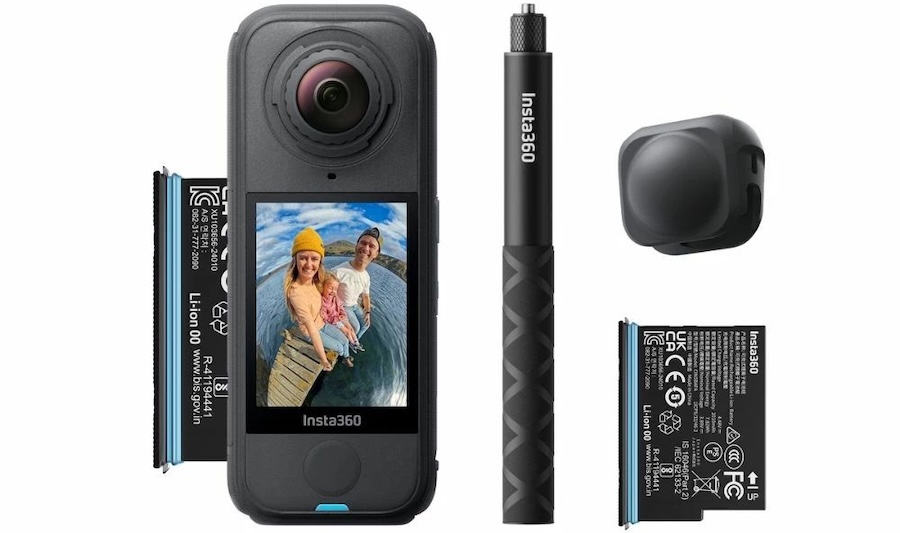
The X4 Air is priced at €399 as a standard package. This pack includes only the camera, a battery and a USB-C cable. A deliberately minimalist configuration, but enough to get you started, especially if you already own compatible accessories.
However, it’s the €429 Discovery Pack that proves the most attractive. For just €30 more, Insta360 adds :
- an additional battery,
- a 114 cm invisible selfie pole,
- a protective cap for the lens.
A well-balanced package that allows you to take full advantage of the camera right out of the box, without the need for immediate additional purchases.
The X4 Air is also available in several theme packs, with prices ranging from €462 to €621, depending on the accessories included (ski, motorcycle, bike, diving, content creation…). Among them, the No Drone No Problem pack, with its invisible boom extendable to 3 meters, is ideal for getting drone-style shots… when you don’t have (or aren’t allowed to take out) a drone.
The Insta 360 X4, on the other hand, is considerably more expensive. The standard package is priced at€559.99, some €160 more than the X4 Air. It includes the camera and a standard plastic lens cap.
Insta360 then offers the X4 in a number of kits with accessories, priced from €597 to €739. These include :
- No Drone No Problem kit with extended boom up to 3 meters,
- the Endurance kit, with additional battery and charging station,
- the more expensive Creator kit, which includes the external microphone adapter and Bullet Time kit.
In the end, the pricing policy is quite clear: the X4 remains more expensive across its range, including in standard packs, while the X4 Air is more affordable, with packs better positioned for first-time purchases or multi-purpose use.
🏆 Insta360 X4 Air: more affordable price.
Discover our accessories for
Insta360 X4 Air
Conclusion Insta360 X4 vs X4 Air: Which to choose?
Contrary to its name, the X4 Air is not simply a lighter version of the X4. While it is much more compact, it also brings several notable improvements, while leaving the X4 with some very real advantages.
The X4 Air clearly concentrates its strengths on what many users are looking for today: a more compact format, better image quality, particularly in low light, reinforced waterproofing, interchangeable lenses that are more reassuring on a 360 camera, and more recent video modes. All this at a lower price, including in its packs, making it particularly attractive for versatile, regular use.
On the other hand, the X4 still has a lot to offer. Its superior endurance in certain definitions and, above all, its higher recording speeds (up to 4K at 100 fps) make it a better choice for those who prefer longer shoots or slow motion, particularly in a sports or action context.
That said, if we take all the criteria into account – image quality, compactness, functionality, robustness and price – the X4 Air appears to be the most coherent choice for the majority of users. Fans of slow motion or maximum endurance will see it as a concession, but in this case it may also be worth looking directly at a higher-end model such as the X5.
👉 In practical terms, the X4 Air is ideal for travel, vlogging or occasional use. Lighter, more compact and easier to handle, it’s also the most logical choice for getting started with 360° video.
Conversely, the X4 is more suited to users who want to go further, whether for regular content creation, more advanced editing or more demanding uses, thanks in particular to its higher frame rates and endurance in certain situations.
Which model to choose when you’re just starting out?
If you’re new to 360° video, the X4 Air is generally the simplest choice. Lighter, more compact and more affordable, it makes it easy to get started without any particular constraints.
The X4 remains an excellent alternative, but is more suited to specific needs, especially for those who prefer autonomy or slow motion. For versatile use and a first experience of 360, the X4 Air is the most logical choice.
Choose the Insta360 X4 Air if…
- you’re looking for a lighter, more compact camera that’s easier to carry and use on a daily basis
- you prefer image quality, especially in low light
- you like the idea of interchangeable lenses, more reassuring on a 360° camera
- you want a more affordable model, including its packs
Choose the Insta360 X4 if…
- you need better overall endurance for your shoots, especially outside 8K
- you often use slow motion, at high frame rates (up to 4K at 100 fps)
- you have the hands of a basketball player 🏀 and prefer a slightly larger case in your hand
💡 To go further after this Insta360 X4 vs X4 Air comparison, find our dedicated reviews of each model:
➡️ Our review of the Insta360 X4 Air
➡️ Our review of the Insta360 X4
OUR BEST SELLERS - Insta360 X4 Air


Action camera

Action camera

Action camera


 Blog
Blog