
 Français
 Deutsch
 Español
 Italiano
 Parts & Accessories by Drone
 Drones
 Action camera
 Microphones
 Camera Stabilizers
 VR Headsets
Insta360 X4 Air vs X5: which 360 camera is right for you?
Jan
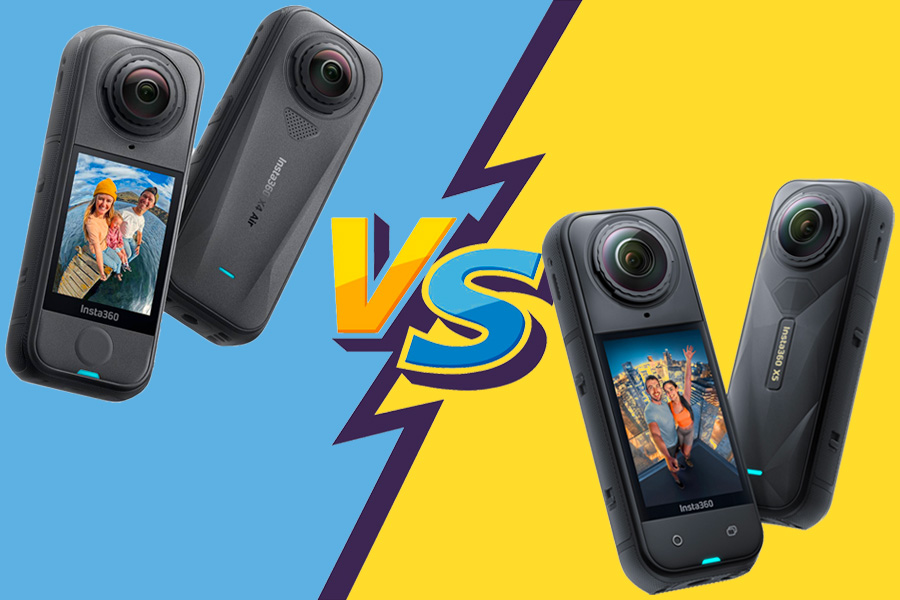
With the X4 Air, Insta360 is taking a rather fine-tuned approach: offering a more compact, lighter and more accessible 360 camera, while incorporating many of the range’s recent evolutions. Contrary to what its name might suggest, the X4 Air isn’t simply a lighter X4; it’s more like a mini X5, easier to carry around on a daily basis, with a few concessions. Opposite it, the X5 remains the brand’s most ambitious and technically advanced model. So, what are the real differences between the Insta360 X4 Air and the X5? And above all, which 360 camera should you choose, depending on your uses, expectations and budget? We take stock in this Insta360 X4 Air vs X5 comparison.
Insta360 X4 Air vs X5: What you need to know
No time (or laziness 😅 ) to read it all? Here are the key points to remember from this Insta360 X4 Air vs Insta360 X5 comparison 👇
- 🎨 Design and size: the X4 Air is significantly lighter (165 g vs. 200 g) and slightly more compact. The difference is most noticeable on a pole or stand, especially during prolonged use.
- 🔋 Autonomy and recharging: X5 advantage, with a longer-lasting battery and faster recharging, especially in intermediate definitions.
- 📷 S ensors: X4 Air equipped with 1/1.8″ sensors, X5 with 1/1.28″ sensors, larger and more efficient in low light.
- 🎥 Resolutions and frequencies: similar 360° resolutions on both models (up to 8K/30). The X5 retains greater flexibility on certain intermediate resolutions and frequencies.
- 🌙 Image quality: very close rendering in good light. The X5 takes a clear advantage when the light drops, thanks to PureVideo mode. The X4 Air stands out with its I-Log profile, offering greater latitude in post-production.
- ⚙️ Features: the essentials are the same (InstaFrame, TimeShift, loop recording, single-lens modes). The real functional difference comes down to PureVideo, reserved for the X5.
- 💰 Prices and packages: marked price difference. The X4 Air is much more affordable, while retaining the essence of the Insta360 experience.
📌 Two solid cameras, each with its own playground: the X4 Air focuses on the essentials, an ultra-light format and a contained price, while the X5 targets demanding creators, particularly in low light.
Insta360 X4 Air vs X5: Design and size
| Insta360 X4 Air | Insta360 X5 | |
| Dimensions (W x H x D) | 46 x 113.8 x 37 mm | 46 × 124.5 × 38.2 mm |
| Weight | 165 g | 200 g |
| Touch screen | 2.5 inch | 2.5 inch |
| Storage | MicroSD card | MicroSD card |
| Operating temperature | -20 ℃ à 40 ℃ | -20 ℃ à 40 ℃ |
| Waterproofing | 15 meters | 15 meters |
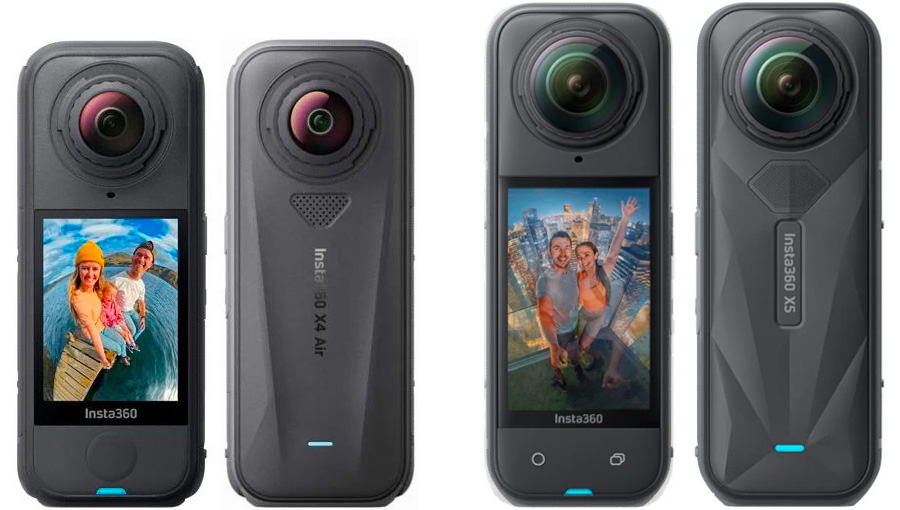
In terms of design, the X4 Air and X5 are very similar… but not quite in terms of handling. The X4 Air is lighter: 165g versus 200g for the X5, a difference of 35g. On paper, the difference may seem moderate, but it becomes more perceptible when the camera is mounted on a pole, helmet or stand, especially during prolonged use.
On the dimensions side, the two cameras share the same width(46 mm), but the X5 is taller: 124.5 mm vs. 113.8 mm for the X4 Air, i.e. a little over a centimeter apart. Thickness also varies slightly(38.2 mm for the X5 vs. 37 mm for the X4 Air). In practice, the X4 Air retains the same overall format, but in a slightly shorter and lighter package, making it more discreet to carry around on a daily basis.
In terms of ergonomics, both models feature a 2.5″ touchscreen, identical in size and ease of use. However, the layout of the controls differs. The X4 Air adopts a more minimalist approach, with a single button on the front panel, while the X5 remains faithful tothe range’s usual ergonomics, with two separate controls. A discreet difference, but one that may affect ease of use depending on individual preferences.
Finally, in terms of robustness, the two cameras are on an equal footing, with water resistance announced at 15 meters and an interchangeable lens system on both models. This is a real plus on a 360 camera, where the optics are particularly exposed to scratches and minor impacts. In the event of a damaged lens, you can easily replace it yourself, without having to send the camera back to the after-sales service.
🏆 Insta360 X4 Air: lighter, more compact, more practical to use.
Discover our accessories for
Insta360 X4 Air
Insta360 X4 Air vs X5: Autonomy and recharging
| Insta360 X4 Air | Insta360 X5 | |
| Battery | 2010 mAh | 2400 mAh |
| Autonomy | 8K at 30 fps: 88 min 6K at 24 fps: 105 min | 8K at 30 fps: 88 min 5.7K at 30 fps: 135 min 5.7K at 24 fps: 185 min |
| Charging time | 80% in 36 min 100% in 57 min | 80% in 20 min 100% in 35 min |
The X4 Air has a 2010 mAh battery, compared with 2400 mAh for the X5. Logically, this has an impact on recording time. In 8K at 30 fps, however, the two models are on a par on paper, with around 88 minutes claimed. In this precise mode, the X4 Air does just as well as the X5, despite its more compact battery.
The difference becomes particularly apparent as soon as you go down in definition. In 6K at 24 fps, the X4 Air can reach around 105 minutes, which remains comfortable for classic sessions. On the other hand, the X5 goes much further at 5.7K, with 135 minutes at 30 fps and up to 185 minutes at 24 fps. For long shoots, travels or applications where you need to film for a long time without cutting, the X5 has a clear advantage.
On the recharging side, theX5 is faster. It recovers 80% in around 20 minutes and reaches 100% in around 30 minutes. The X4 Air is still decent, but a notch below, with 80% in 36 minutes and a full charge in just under an hour. In both cases, rapid recharging means you can get going again fairly quickly between two sessions, but the X5 is more comfortable when you’re taking a series of shots.
Finally, please note that the batteries are not interchangeable between the X4 Air and the X5. An important point if you already own several batteries of one model and are thinking of changing cameras.
🏆 Insta360 X5: more comfortable autonomy and significantly faster recharging.
Insta360 X4 Air vs X5 : Image
| Insta360 X4 Air | Insta360 X5 | |
| Sensors | 1/1.8 inch | 1/1.28 inch |
| Objective | Aperture f/1.95 6.4 mm equivalent | Aperture f/2.0 6 mm equivalent |
| Photo resolution | 29 MP | 72 MP (360°) / 18 MP (single-lens) |
| Video resolution (360°) | 8K up to 30 fps / 6K up to 50 fps / 4K up to 50 fps | 8K up to 30 fps / 6K up to 50 fps / 4K up to 50 fps |
| Video resolution (single-lens) | 4K up to 60 fps / 2.7K up to 60 fps / 1080p up to 120 fps | 4K up to 60 fps / 2.7K up to 60 fps / 1080p up to 120 fps |
| Photo format | INSP, DNG | INSP, DNG |
| Video format | INSV (360°), MP4 (single-lens) | INSV (360°), MP4 (single-lens) |
| Color profiles | Bright, Standard, Flat | Bright, Standard, Flat |
| Maximum video bit rate | 180 Mbps | 180 Mbps |
| ISO range | 100 à 3200 | 100 à 6400 |
Sensors and definitions
The difference between the X4 Air and X5 begins with the sensors. The X4 Air relies on two 1/1.8-inch sensors, while the X5 adopts significantly larger 1/1.28-inch sensors. This difference has a direct impact not only on the amount of light captured, but also on the room for manoeuvre in image processing, particularly in contrasting or poorly lit scenes.
In terms of resolutions and recording frequencies , the two cameras are very similar in 360°. Both can film in 8K at up to 30 fps, in 6K at up to 50 fps and in 4K at up to 50 fps. However, the X5 offers a slightly wider range of definition/frequency combinations depending on the modes used, giving it greater flexibility to adapt rendering or fluidity to different situations. In single-lens mode, the possibilities remain comparable, with high frequencies of up to 120 fps in 1080p on both models.
Image quality
In daylight, both the X4 Air and X5 deliver a very solid image. The X4 Air produces detailed, well-exposed video, with balanced colors and good highlight management. In these conditions, the difference with the X5 remains relatively limited: the X5 retains a slight advantage in sharpness and dynamic range, but the difference remains discreet in classic outdoor use.
As the light decreases, the gap becomes more pronounced. The X5 gains the advantage thanks to its larger sensors and, above all, its PureVideo mode, absent from the X4 Air. In low light, the X5’s image is cleaner, brighter and better controlled, with less digital noise and better detail retention. The X4 Air remains usable in low-light environments, but reaches its limits more quickly, particularly in night-time video.
Finally, on the settings and profiles side, both cameras offer Vivid, Standard and Flat color profiles, as well as DNG format for photos. The X4 Air is distinguished by the presence of active HDR up to 8K and, above all, the I-Log profile, which offers greater latitude in post-production for those who wish to finely rework their images.
🏆 Insta360 X5: better image quality, especially in low light.
🏆 Insta360 X4 Air: I-Log profile, more latitude in post-production.
OUR BEST SELLERS - Insta360 X4 Air


Action camera

Action camera

Action camera


Insta360 X4 Air vs X5 : Features
| Insta360 X4 Air | Insta360 X5 | |
| Photo modes | Standard, HDR Photo, Interval, Starlapse, Burst | Photo (optional HDR), Interval, Starlapse, Burst |
| Video modes | 360°: Standard, Active HDR, InstaFrame, Timelapse, TimeShift, Loop recording, Road mode Single-lens: Video, FreeFrame video, Me mode, Loop recording | 360°: Video (Active HDR integrated), PureVideo, InstaFrame, Timelapse, TimeShift, Bullet Time, Loop recording, Road mode Single-lens: Video, FreeFrame video, Me mode, Loop recording |
| Audio modes | Automatic wind reduction, Active wind reduction, Stereo, Directional focus | Automatic wind noise reduction (two levels), Voice enhancement, Stereo, 360° audio |
Photo and video modes
On paper, the Insta360 X4 Air and X5 cover the essentials of 360 photo and video applications, with a very similar base. In particular, both models offer HDR, Starlapse, Interval and Burst photo modes, as well as essential video modes such as InstaFrame, TimeShift, Timelapse,loop recording and Route Mode. In single-lens mode, both cameras also feature the FreeFrame and Mode Me modes familiar to Insta360 users.
The differences are most apparent in a few very specific modes , which clearly guide the choice according to use:
- PureVideo (X5 only): the X5 features a dedicated low-light mode, designed for filming at night or in poorly lit environments. It significantly improves noise management, detail legibility and overall image dynamic range. This is the biggest difference in use between the two models.
- Bullet Time (X5 only): absent from the X4 Air, this mode creates spectacular circular effects around the subject. More creative than essential, it can make all the difference for certain types of content or visual effects.
In practice, the X4 Air includes all the modes that are really useful on a daily basis, while the X5 adds options aimed at advanced creation and low light. If these specific uses are among your priorities, the X5 has the edge; otherwise, the X4 Air doesn’t give the impression of a restricted model.
Controls, practical functions and audio
Both cameras feature voice and gesture controls, useful when the camera is mounted on a pole, helmet or other hard-to-reach support. For example, it is possible to start or stop recording by voice, or via simple gestures in front of the camera, avoiding the need to manipulate the touch screen in impractical situations.
There’s also the Twist function, already introduced on the X5 and integrated into the X4 Air. A simple back-and-forth movement with the selfie pole starts or stops recording, particularly useful when the camera is at the end of the pole, without having to return to the screen or buttons.
When it comes to audio, both cameras share a solid foundation: stereo recording, wind noise reduction and built-in microphones capable of handling most everyday situations (vlogs, sports, outdoor outings). However, the X5 takes sound processing one step further, with two-stage wind noise reduction and voice enhancement, grouped together under the Audio 360 function. These options ensure that the voice remains more legible and better isolated in noisy or windy environments, whereas the X4 Air remains more basic but effective for everyday use.
🏆 Insta360 X5 : especially for its PureVideo mode.
Insta360 X4 Air vs X5: Packs and prices
ℹ️ Note: some links in this section are Amazon affiliate links. As Amazon Associates, we earn from qualifying purchases, at no extra cost to you.
| Insta360 X4 Air | Insta360 X5 | |
| Standard package | 399 € | 589,99 € |
| Discovery pack | 429 € | Not available |
| Theme packs | From €462 to €621 | From €628 to €769 |
In terms of pricing, the difference between the Insta360 X4 Air and the Insta360 X5 is immediate and unambiguous: we’re clearly not in the same price bracket.
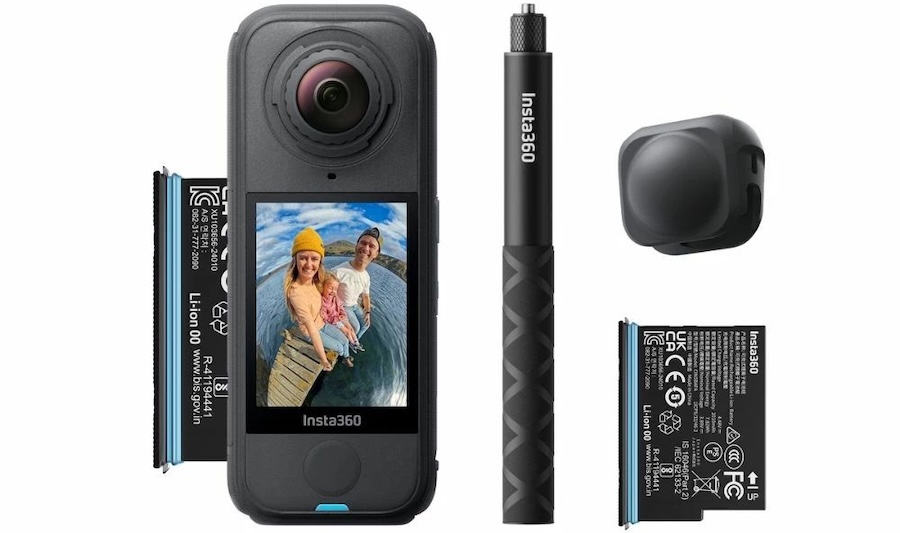
The X4 Air is much more affordable. It is offered at €399 in a standard pack, with the essentials to get you started (camera, battery, USB-C cable). Insta360 also offers a discovery pack at €429, which adds an extra battery, an invisible selfie pole and a protective cap for the lenses. For a limited extra cost, this is the most balanced pack for a first purchase. The X4 Air is also available in theme packs, generally ranging from €462 to €621, depending on the accessories included (bike, ski, motorcycle, content creation, etc.).
The X5, on the other hand, is positioned considerably higher. Its standard package starts at around €559, and the various kits on offer quickly drive up the price, with prices that can exceed €700 depending on the configuration. These packs are aimed at more specific uses, and at those who want a complete configuration right from the outset, with creative or action-oriented accessories.
🏆 Insta360 X4 Air: much more affordable pricing

Discover our accessories for
Insta360 X5
Conclusion Insta360 X4 Air vs X5: Which to choose?
Contrary to what you might think, the Insta360 X4 Air is not a “discount” version of the Insta360 X5. In fact, it’s so close in many key respects that it resembles a slimmed-down X5, with a few clearly identified concessions, rather than a simple intermediate evolution.
The X4 Air takes a very coherent approach to the majority of 360 video applications: a lighter, more compact format, solid image quality, including in low light for its category, reassuring interchangeable lenses , and the essentials of the latest modes in the Insta360 ecosystem. All this at a much more affordable price, including in packs, making it a versatile camera that’s easy to recommend for regular use.
For its part, the X5 retains a real edge in more specific applications. Its PureVideo mode clearly makes the difference in low light, and its more advanced performance is aimed above all at those seeking optimal rendering in difficult conditions or more advanced creative control.
In the end, considering the overall balance between image, format, features and price, the X4 Air appears to be the most logical choice for the majority of users. The X5 remains an excellent option, but it’s most justified if low light is an absolute priority, or if you really want to exploit its advanced capabilities.
Choose the Insta360 X4 Air if…
- you’re looking for a lighter, more compact 360° camera that’s easier to handle and transport
- you want a much more affordable camera, without sacrificing the essentials
- the I-Log profile is important for you to have more latitude in post-production
Choose the Insta360 X5 if…
- you often shoot in low light and want to take advantage of PureVideo mode
- you need longer range and faster recharging
- you want the widest range of modes and the most advanced functions
💡 To go further after this Insta360 X4 Air vs X5 comparison, find our analyses dedicated to each model:
➡️ Our detailed test of the Insta360 X4 Air
➡️ Our complete analysis of the Insta360 X5
💡 Related reading
➡️ Wondering how the X4 Air compares to the most advanced model in the lineup? Check out our full comparison: the differences between the X4 and the X4 Air.
OUR BEST SELLERS - INSTA360 X5


Action camera


Action camera

 Blog
Blog