
 Français
 Deutsch
 Español
 Italiano
 Parts & Accessories by Drone
 Drones
 Action camera
 Microphones
 Camera stabilizers
 VR Headsets
DJI Neo 2 vs DJI Mini 4K: which drone is best for beginners?
Mar
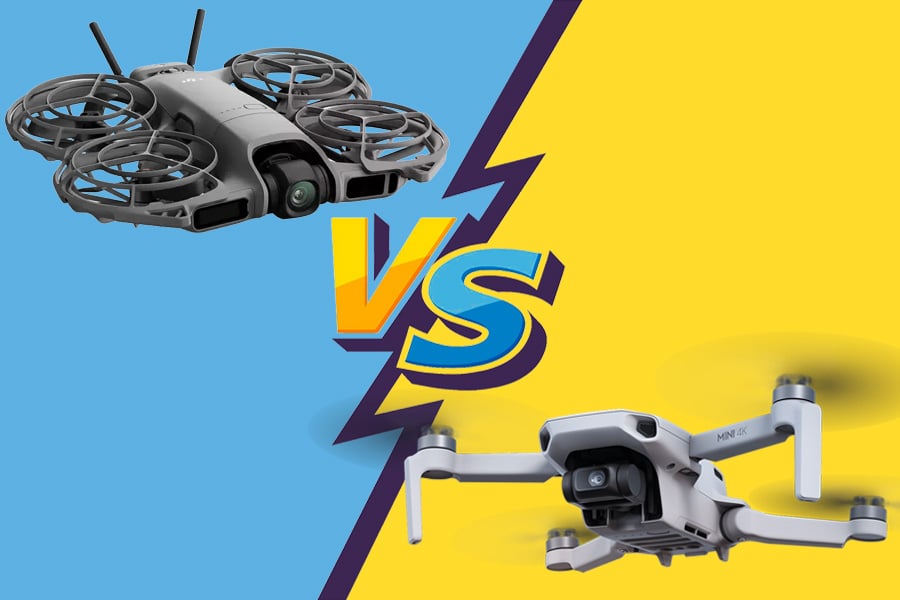
Are you hesitating between the DJI Neo 2 and the DJI Mini 4K as your first drone? On paper, the two seem very similar: compact, affordable and weighing under 250 grams. In reality, their philosophy is very different. The Neo 2 focuses on automation and simplicity, almost like a flying cameraman ready to take off from your hand. The Mini 4K, on the other hand, is a more conventional drone, designed for traditional radio control and gradual learning. Modern and intelligent or simple and reassuring? What are the real differences between these two approaches? And above all, which should you choose for your first purchase? We take stock in this comprehensive comparison of DJI Neo 2 vs DJI Mini 4K.
DJI Neo 2 vs DJI Mini 4K: What you need to know
No time (or laziness 😅 ) to read it all? Here are the key points of this DJI Neo 2 vs DJI Mini 4K comparison 👇
- 🪶 Lighter: Neo 2
- 🧳 More compact when folded: Mini 4K
- 🕹️ Several control methods (autonomous flight, radio control, FPV): Neo 2
- 🔋 S ignificantly longer battery life: Mini 4K
- 🎥 High-performance subject tracking : Neo 2
- 🛑 Obstacle detection : Neo 2
- 🎞️ 4K up to 100 fps + integrated vertical video: Neo 2
- 📷 Photo RAW (DNG) : Mini 4K
- 💸 Lower entry price (without radio control): Neo 2
👉 Neo 2 = automation, tracking, security, modern video
👉 Mini 4K = autonomy, classic piloting, more flexible photo
DJI Neo 2 vs DJI Mini 4K: Design
| DJI Neo 2 | DJI Mini 4K | |
| Weight | 151 g (without transceiver) 160 g (with transceiver) | 246 g |
| Dimensions | 147×171×41 mm (without transceiver) 167×171×54 mm (with transceiver) | 138x81x58 mm (folded, without propellers) 245x289x56 mm (unfolded, with propellers) |
| Internal storage | 49 GB | No |
| External storage | Not supported | microSD card up to 256 GB |
| Class (Europe) | C0 | C0 |
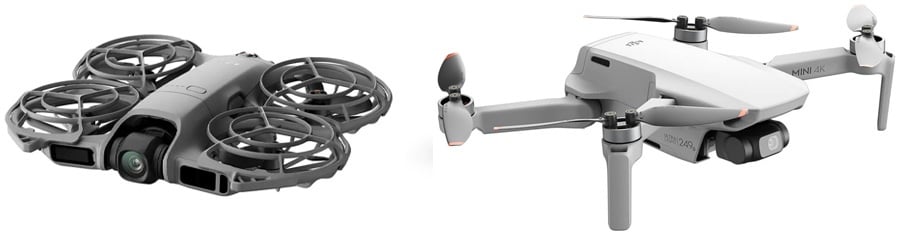
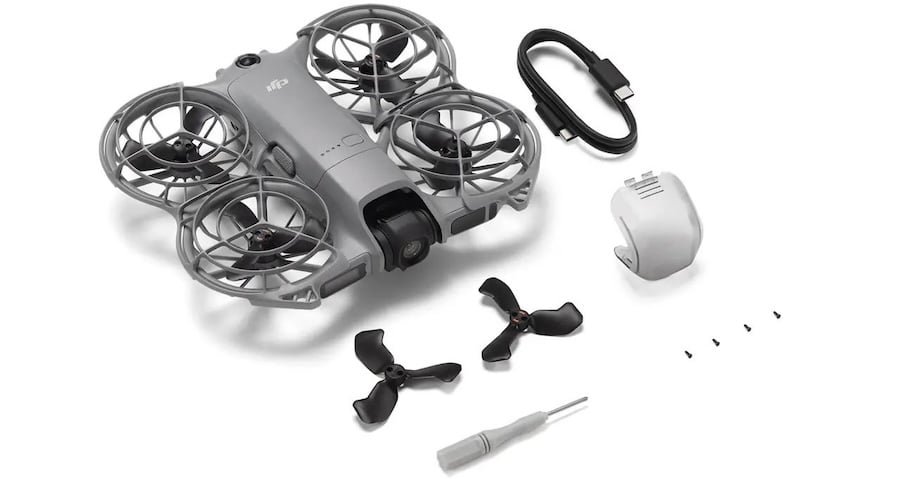
Right from the start, the DJI Neo 2 and DJI Mini 4K reflect two very different visions of the compact drone. The Neo 2 adopts a one-piece structure with integrated propeller guards, designed for rapid take-off and reduced handling. The Mini 4K, on the other hand, follows the classic folding format of DJI drones: folding arms, slimmer silhouette when folded and more traditional design.
The main difference is in terms of size. Folded up, the Mini 4K becomes much more compact, slipping easily into a small case or bag. The Neo 2, on the other hand, retains its fixed size as it does not fold, even if its overall format remains contained.
Weight further accentuates this gap: around 151 g (160 g with transceiver) for the Neo 2 versus 246 g for the Mini 4K. Both models remain under the 250-gram limit and benefit from a C0 classification in Europe, which simplifies regulatory procedures for leisure use. In practice, however, the Neo 2 is considerably lighter in flight and transport.
The last point to consider is storage. The Neo 2 directly embeds 49 GB of internal memory, enabling immediate recording without the need for an additional card. The Mini 4K, on the other hand, has no built-in memory and requires a microSD card (up to 256 GB) to operate.
🏆 DJI Mini 4K: more compact when folded and easier to store, it retains an advantage in terms of sheer size.

Discover our accessories for
DJI Neo 2
DJI Neo 2 vs DJI Mini 4K: Control and piloting methods
| DJI Neo 2 | DJI Mini 4K | |
| Control methods | Autonomous flight DJI Fly application Radio control (conventional flight) FPV flight | Radio control (classic flight) |
| Compatible radio controls | DJI RC-N3 DJI RC-N2 DJI RC 2 Radio control 3 DJI FPV DJI RC Motion 3 | DJI RC-N1C |
| Video transmission system | Standard: Wi-Fi video transmission Optional: DJI Neo 2 (O4) digital transceiver | DJI O2 |
| Max. transmission distance | FCC: 10 km CE: 6 km | FCC: 10 km CE: 6 km |
| Live preview quality | up to 1080p at 60 fps | 720 p at 30 fps |
This is where the two drones’ philosophies really diverge.
The DJI Neo 2 is all about versatility. It can be used in many different ways:
- Autonomous flight, with manual takeoff and automatic mode launch without radio control
- DJI Fly application, with virtual joysticks or intelligent modes
- Classic radio control (DJI RC-N2, RC-N3 or DJI RC 2)
- Immersive FPV flight, via DJI FPV Radio Remote Control 3 or DJI RC Motion 3
One drone, many ways to fly. From simplified piloting to immersive mode, it lets you discover different facets of the drone without changing machines.
In contrast, the DJI Mini 4K takes a much more traditional approach. It operates exclusively with a radio remote control (DJI RC-N1C) and is aimed at those who want to learn classic manual piloting, sticks in hand, without advanced assistance or autonomous mode.
On the transmission side, the DJI Mini 4K is based on the DJI O2 system, renowned for its stability. It boasts a maximum range of 10 km in FCC and 6 km in CE.
The DJI Neo 2, on the other hand, uses Wi-Fi in its standard configuration. In this mode (autonomous flight or piloting via smartphone), the theoretical range is around 500 meters, often less in real-life conditions. For long-distance transmission comparable to that of the Mini 4K(10 km FCC / 6 km CE), use the O4-compatible digital transceiver.
Finally, live previews can go up to 1080p at 60 fps on the Neo 2, compared with 720p at 30 fps for the Mini 4K, a difference that is particularly noticeable in dynamic or immersive use.
🏆 DJI Neo 2: significantly more versatile, it opens the door to several piloting styles without changing drone.



DJI Neo 2 vs DJI Mini 4K: Autonomy and recharging
| DJI Neo 2 | DJI Mini 4K | |
| Battery | 1606 mAh | 2250 mAh |
| Autonomy | 19 minutes (17 minutes with propeller protection) | 31 minutes |
| Recharge time | 68 min (3 batteries via charging station) 70 min (1 battery direct) | Data not provided by DJI |
On paper, the difference in autonomy between the DJI Neo 2 and the DJI Mini 4K is significant. The Neo 2 relies on a small 1606 mAh battery, with official autonomy announced at 19 minutes (around 17 minutes with propeller protection), a value consistent with its ultra-compact format and its orientation towards shorter or spontaneous flights. The Mini 4K, with a more generous 2250 mAh battery, claims around 31 minutes flight time in ideal conditions.
In the field, the difference remains perceptible. While the advertised figures correspond to ideal conditions, user feedback and independent tests show more realistic values. The DJI Neo 2 generally achieves a flight time of around 10 to 15 minutes, depending on the mode used, wind conditions and altitude. The DJI Mini 4K’s autonomy is usually between 20 and 25 minutes in practice. The difference is clear: the Mini 4K allows longer sessions, while the Neo 2 is more geared to short, spontaneous flights.
DJI does not provide official recharging data for the Mini 4K. For the Neo 2, on the other hand, official figures are available: around 70 minutes to recharge a single battery via USB-C, and around 68 minutes to recharge three batteries via the dedicated charging station. Many users who have experimented with charging the Mini 4K report charging times in practice of around1h20 to 1h30 with a standard USB-C charger, but these figures depend on the charger used and are not certified by DJI.
🏆 DJI Mini 4K: far greater autonomy for longer, more comfortable flights.
DJI Neo 2 vs DJI Mini 4K: In-flight performance
| DJI Neo 2 | DJI Mini 4K | |
| Maximum speed | 12 m/s | 16 m/s |
| Max. ascent speed | 5 m/s | 5 m/s |
| Max. descent speed | 3 m/s | 3.5 m/s |
| Max. wind resistance | 10.7 m/s (level 5) | 10.7 m/s (level 5) |
In terms of pure performance, the DJI Mini 4K has a slight advantage in horizontal speed. It can reach up to 16 m/s (≈ 57 km/h), compared with 12 m/s (≈ 43 km/h) for the DJI Neo 2. This difference can make all the difference when it comes to covering an area quickly or following a fast-moving subject. The Neo 2 remains more moderate, more in keeping with its versatile orientation and automated modes.
Vertical speeds are very similar. Both drones climb to 5 m/s, while descent is slightly faster on the Mini 4K(3.5 m/s vs. 3 m/s for the Neo 2). The difference is small, however, and does not fundamentally alter the piloting experience.
With regard to wind resistance, both models are rated for 10.7 m/s (level 5) according to the manufacturer’s data. In practice, several returns indicate that the Mini 4K may seem a little more stable in exposed conditions, probably due to its greater weight (246 g vs. 151 g for the Neo 2). However, it remains in the same performance category.
🏆 DJI Mini 4K: faster and slightly more reassuring in strong winds.

Our parts & accessories for
DJI Mini 4K
DJI Neo 2 vs DJI Mini 4K: Features
| DJI Neo 2 | DJI Mini 4K | |
| Photo modes | Single shot, Interval shots, SelfieShot | Single shot, Interval shots, Auto exposure bracketing (AEB) |
| Video modes | QuickShots, MasterShots, Dolly Zoom, Subject tracking | QuickShots |
| Obstacle detection | Omnidirectional monocular vision system + forward-facing LiDAR + downward-facing infrared sensor | Lower optical system |
Photo and video modes
In terms of photo modes, the two drones take a different approach.
The DJI Mini 4K offers the classic functions of the Mini range: single shot, interval shooting and AEB (automatic exposure bracketing), an interesting option for recovering more dynamic range in post-processing. It is aimed more at those who wish to retouch their images or optimize exposure.
The DJI Neo 2, on the other hand, remains simpler in traditional photography(single shot and intervals), but introduces a mode more geared towards rapid creation: SelfieShot. This mode automates the framing and angle of the shot, enabling you to capture a scene without complex manipulation. The focus is clearly on simplicity and shareable content.
In video, the difference is even more marked: the Mini 4K only offers QuickShots, while the Neo 2 adds MasterShots, Dolly Zoom and, above all, active subject tracking, considerably expanding the possibilities without constant pilot intervention.
Subject follow-up
This is clearly one of the DJI Neo 2’s strong points .
It incorporates tracking capable of keeping a subject in motion at up to 12 m/s, with specific modes for cycling or skiing, designed for dynamic practices. The angle of tracking can be adjusted via the app (front, back, side…), as can distance and height, allowing true creative control without interrupting recording.
According to numerous independent tests and user feedback, the Neo 2’s algorithm is one of the most advanced currently available for a drone of this size. It is more logical in its trajectories, avoids haphazard shortcuts and maintains fluid framing even when the subject changes direction.
The DJI Mini 4K, on the other hand, offers no active tracking. If your aim is to film yourself in action without a dedicated pilot – sport, hiking, biking, running – the choice becomes pretty obvious.
Obstacle detection
On this point, the difference is clear.
The DJI Neo 2 is the only one of the two to incorporate a genuine obstacle detection system. It combines omnidirectional monocular vision, a LiDAR and a lower infrared sensor. This configuration enables it to anticipate obstacles and adapt its trajectory, particularly in automatic modes or subject tracking.
The DJI Mini 4K, on the other hand, has no active avoidance. Its lower optical system is used solely for position-keeping and low-altitude stabilization. It does not intervene to avoid a tree, wall or lateral obstacle.
In practical terms, this makes a big difference for beginners. The Neo 2 offers a much safer flying environment, especially in urban environments, in forests or when taking dynamic shots. The Mini 4K requires more attention and more vigilant piloting.
🏆 DJI Neo 2: advanced video modes, high-performance tracking and true obstacle detection clearly make the difference.
OUR BEST SELLERS - DJI MINI 4K


DJI Neo 2 vs DJI Mini 4K: Camera and image quality
| DJI Neo 2 | DJI Mini 4K | |
| Stabilization | 2-axis mechanical gondola (tilt, roll) | 3-axis mechanical gondola (tilt, roll, panorama) |
| Sensor | 1/2 inch | 1/2.3 inch |
| Objective | 16.5 mm equivalent format Aperture: f/2.2 FOV 119.8 | 24 mm equivalent format Aperture: f/2.8 FOV 83°. |
| Max. photo resolution | 12 MP | 12 MP |
| Max. video resolution (horizontal) | 4K up to 100 fps | 4K up to 30 fps |
| Max. video resolution (vertical) | 2.7K up to 60 fps | Not available |
| ISO range | 100 à 12800 | 100 à 3200 |
| Digital zoom | No digital zoom | 4K: 2 x 2.7K: 3 x FHD: 4 x |
| Max. bit rate | 80 Mb/s | 100 Mb/s |
| Photo format | JPEG | JPEG DNG (RAW) |
| Video format | MP4 | MP4 (MPEG-4 AVC/H.264) |
| Color profile | Normal | Normal |
Pod, sensor and resolutions
In terms of hardware, the two drones adopt different approaches.
The DJI Neo 2 is based on a 2-axis mechanical gondola (tilt and roll), complemented by electronic stabilization on the pan axis. The DJI Mini 4K, on the other hand, benefits from a complete 3-axis mechanical gondola, giving it a theoretical advantage in terms of pure stabilization, particularly when moving sideways or in irregular wind conditions.
On the sensor side, the Neo 2 features a 1/2-inch sensor, slightly larger than the 1/2.3-inch of the Mini 4K. On paper, this gives it a slight advantage in light capture. The aperture is also brighter on the Neo 2(f/2.2 vs. f/2.8), which may help in less favorable conditions.
The optics, on the other hand, are markedly different. The Neo 2 adopts a very wide angle (equivalent to 16.5 mm, FOV 119.8°), designed to accentuate immersion, particularly when following a subject or in dynamic flight. The Mini 4K remains at a more conventional angle ( 24 mm equivalent, FOV 83°), with a more natural, less distorting rendering.
In video, the Neo 2 can go up to 4K at 100 fps (with remote control), compared with 4K at 30 fps maximum for the Mini 4K. This is a significant difference for those wishing to exploit slow motion or produce fluid dynamic sequences.
However, the Mini 4K retains a technical advantage in terms of maximum bit rate(100 Mb/s vs. 80 Mb/s for the Neo 2), as well as the ability to capture photos in DNG (RAW), which the Neo 2 does not offer.
Finally, with regard to the vertical format, the Neo 2 offers an integrated mode producing vertical video in 2.7K at up to 60 fps (resulting from a crop in 4K), enabling direct shooting in 9:16 for social networks. The Mini 4K, on the other hand, does not offer an integrated vertical mode and requires cropping in post-production, a point to bear in mind for those who regularly create content for TikTok, Instagram or YouTube Shorts.
Image quality
In daylight, both drones produce clean images that can be used for leisure or social networking purposes. Colors are well saturated, contrast is strong and the images are immediately ready to share without retouching.
The DJI Neo 2 delivers a punchy image, with dynamic rendering and high contrast. According to published tests and user feedback, image processing has been significantly improved compared to the first generations of Neo. Details are clearly present in good light, and the overall rendering is designed to be effective without the need for post-production.
The DJI Mini 4K, on the other hand, offers a more neutral and natural image. The rendering sometimes appears a little less dynamic, but retains a good level of detail in favorable conditions. In more complex situations (backlighting, lower light levels), it can more quickly show its limitations, with more visible noise and a loss of sharpness in dark areas.
When it comes to photography, the Mini 4K retains an important advantage: the ability to capture in RAW (DNG) in addition to JPEG. This makes it possible to recover more information in post-processing, and to adjust exposure, white balance and color with greater freedom. The Neo 2 remains limited to JPEG, which simplifies use but reduces the scope for retouching.
In video, neither model offers a LOG or flat profile. They both use standard, ready-to-use rendering. This facilitates use for beginners, but limits the possibilities of advanced calibration for more professional use.
🏆 DJI Neo 2: 4K up to 100 fps and integrated vertical video mode make this a clearly more modern drone for video creation.
🏆 DJI Mini 4K: RAW (DNG) format support gives it a real advantage for photo editing.
DJI Neo 2 vs DJI Mini 4K: Packs and prices
ℹ️ Note: some links in this section are Amazon affiliate links. As Amazon Associates, we earn from qualifying purchases, at no extra cost to you.
| DJI Neo 2 | DJI Mini 4K | |
| Drone alone | 239 € | – |
| Drone + standard RC | – | 299 € |
| Pack 2 batteries + RC | – | 389 € |
| Fly More pack (3 batteries + hub) | 399 € (DJI RC-N3) | 439 € |
| FPV Pack | 579 € (Motion Fly More) | – |
On paper, the DJI Neo 2 looks more affordable, with an entry-level price of €239. But beware: at this price, it comes without a radio control system. It is therefore primarily intended for use in autonomous flight or via smartphone.
For a more traditional flying experience with a real radio control system (DJI RC-N3), you’ll need to upgrade to the Fly More package at €399, which also includes three batteries and a charging station. This is where the comparison with the Mini 4K really comes into its own.
The DJI Mini 4K starts at €299, with the RC-N1C remote control included. It then offers two more complete packages:
- 389 €: pack with two batteries, bag and accessories (without charging station).
- 439 €: Fly More pack with three batteries and two-way charging station.
In other words, the Mini 4K includes a complete riding experience from the outset, while the Neo 2 requires a higher budget to achieve an equivalent level of equipment.
If we compare comparable configurations (radio control + several batteries), prices become relatively close: €399 for the Neo 2 Fly More versus €439 for the Mini 4K Fly More.
So it’s not just a question of price, but of what each pack actually contains.
🏆 DJI Neo 2: lower entry price, ideal for discovering the drone in autonomous flight at a lower cost.
🏆 DJI Mini 4K: pack with radio controlincluded more accessible for immediate beginnings in classic piloting.
Conclusion DJI Neo 2 vs DJI Mini 4K: which one to choose?
In the final analysis, the DJI Neo 2 and DJI Mini 4K are not exactly aimed at the same beginner profile.
The Neo 2 is clearly the more modern of the two. Autonomous flight, high-performance tracking, real obstacle detection, 4K up to 100 fps and integrated vertical video mode: it’s designed to easily create content, film yourself in action and get dynamic shots without necessarily mastering traditional piloting. It also offers added reassurance thanks to its obstacle avoidance system.
The Mini 4K, on the other hand, remains a more conventional drone in its approach. It relies on radio control, a much longer battery life and a more flexible photo image thanks to the RAW format. Simpler in its features but also more “pure” in its use, it will suit those who want to learn proper piloting and enjoy longer flights, especially with a few DJI Mini 4K accessories.
To sum up, the choice depends above all on your priority: an intelligent drone that automates a lot and makes video creation easier, or a more traditional drone that’s tough and focused on manual piloting.
Both are excellent entry points into the world of drones. It’s simply a question of choosing the one that best suits your flying style.
💡 Choose the DJI Neo 2 if:
- You want a drone that really follows you like a flying cameraman (sport, hiking, mountain biking, running…).
- You’re looking for a versatile drone, capable of autonomous flight, classic piloting and even FPV to discover all the facets of drone flying.
- Obstacle detection is an important criterion to reassure you as a beginner.
- You create video content and want to enjoy 4K at up to 100 fps and integrated vertical format.
💡 Choose the DJI Mini 4K if:
- You want to learn classic radio control flying, with a more traditional approach.
- You prefer a more comfortable range, so you can fly longer without changing your battery.
- You attach great importance to RAW (DNG) photography for retouching your images.
🔎 Also read
➡️ For a complete analysis of the DJI Neo 2, find our detailed DJI Neo 2 test.
➡️ To discover all the Mini 4K’s capabilities in real-life conditions, check out our in-depth analysis of the DJI Mini 4K.
➡️ Are you hesitating with the Mini 3 too? See our DJI Neo 2 vs DJI Mini 3 comparison.

 Blog
Blog