
 Français
 Deutsch
 Español
 Italiano
 Parts & Accessories by Drone
 Drones
 Action camera
 Microphones
 Camera Stabilizers
 VR Headsets
DJI Neo 2 vs DJI Mini 3: which drone to choose?
Feb
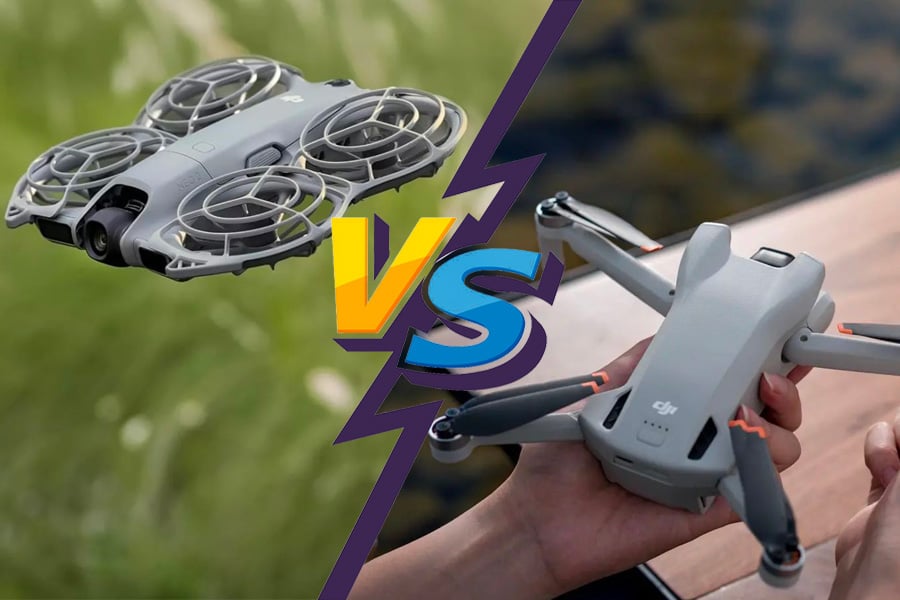
Are you hesitating between the DJI Neo 2 and the DJI Mini 3 when it comes to getting started with a drone? That’s understandable: these two models are among DJI’s most affordable options, with similar prices and a similar promise: to enable you to get started without the need for a professional model. But behind this common positioning, the approach is radically different. The Neo 2 focuses on a modern, autonomous experience, with multiple control methods and simplified operation, while the Mini 3 remains a more traditional drone, designed for conventional radio control. Intelligent, automated drone or more “pure” to fly? What’s the difference in practice, and which one really suits your flying style? All the answers in this comprehensive comparison of the DJI Neo 2 vs DJI Mini 3.
DJI Neo 2 vs DJI Mini 3: What you need to know
No time (or laziness 😅 ) to read it all? Here are the key points of this DJI Neo 2 vs DJI Mini 3 comparison 👇
- 🪶 Lighter: Neo 2 (≈151 g)
- 🧳 More compact when folded: Mini 3
- 🔋 Much longer autonomy: Mini 3 (up to 38 min)
- 📱 Autonomous flight without radio control: Neo 2
- 🎥 Subject tracking + FPV compatibility: Neo 2 only
- 🛑 Advanced obstacle detection (LiDAR included) : Neo 2
- 📸 Best image quality: Mini 3
- 📲 4K vertical native: Mini 3
- 💸 More affordable entry price: Neo 2
👉 Neo 2 = action, automation, versatility
👉 Mini 3 = image, autonomy, classic piloting
DJI Neo 2 vs DJI Mini 3: Design
| DJI Neo 2 | DJI Mini 3 | |
| Weight | 151 g (without transceiver) 160 g (with transceiver) | 248 g |
| Dimensions | 147×171×41 mm (without transceiver) 167×171×54 mm (with transceiver) | 148×90×62 mm (folded, without propellers) 251×362×72 mm (unfolded, with propellers) |
| Internal storage | 49 GB | No |
| External storage | Not supported | microSD card up to 512 GB |
| Class (Europe) | C0 | C0 |
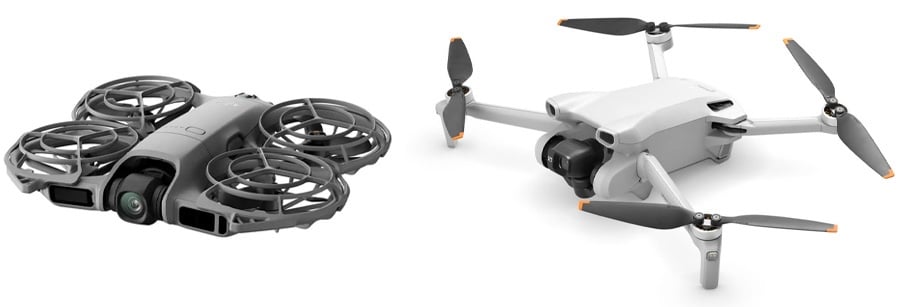
At first glance, the DJI Neo 2 and DJI Mini 3 don’t share the same philosophy. The Neo 2 is based on a compact, one-piece design with integrated propellers, designed for rapid set-up and simplified operation. The Mini 3, on the other hand, retains the classic folding design of the Mini range, with folding arms that significantly reduce its size when stored.
This difference is immediately noticeable during transport. Once folded, the Mini 3 slips more easily into a small bag or backpack. The Neo 2, which doesn’t fold, still retains its original volume, even if its format remains compact and robust for nomadic use.
On the weight side, the gap is wider than you might think: the DJI Neo 2 weighs in at around 151 g, compared with 248 g for the Mini 3. Both models remain under the 250-gram mark and benefit from a C0 classification in Europe, which simplifies their use for leisure purposes. In reality, however, the Neo 2 is considerably lighter.
Last but not least, there’s an important difference when it comes to storage: the Neo 2 directly integrates 49 GB of internal memory, enabling immediate flight without the need for additional accessories. The Mini 3, on the other hand, requires a microSD card (up to 512 GB), offering greater capacity but implying an additional purchase.
🏆 DJI Mini 3: more compact when folded and easier to store, it takes the lead on pure portability.

Discover our accessories for
DJI Neo 2
DJI Neo 2: Control and piloting methods
| DJI Neo 2 | DJI Mini 3 | |
| Control methods | Autonomous flight DJI Fly application Radio control (conventional flight) FPV flight | Radio control (classic flight) |
| Compatible radio controls | DJI RC-N3 DJI RC-N2 DJI RC 2 Radio control 3 DJI FPV DJI RC Motion 3 | DJI RC-N1 |
| Video transmission system | Standard: Wi-Fi video transmission Optional: DJI Neo 2 (O4) digital transceiver | DJI O2 |
| Max. transmission distance | FCC: 10 km CE: 6 km | FCC: 10 km CE: 6 km |
| Live preview quality | up to 1080p at 60 fps | 720 p at 30 fps |
This is where the difference between the two drones is most marked. The DJI Neo 2 offers several control methods, whereas the Mini 3 takes a more traditional approach.
The Neo 2 can be controlled in different ways:
- Autonomous flight: the drone can take off directly from the hand and launch an automatic mode without radio control, simply via the drone or the app.
- DJI Fly application: you can select intelligent modes or pilot manually using virtual joysticks on your smartphone.
- Classic radio control: for more precise control and a more traditional flying experience.
- FPV flight: compatible with DJI Goggles as well as DJI RC Motion 3 or DJI FPV Radio Control 3 for a more immersive approach.
The DJI Mini 3 works exclusively with a dedicated remote control for classic piloting.
The Neo 2’s versatility changes the experience. It lets you discover different ways of flying a drone – from simplified autonomous flight to immersive FPV – without changing aircraft. While each mode is no substitute for a specialized drone, it does offer a complete overview of the drone world. In contrast, the Mini 3 remains focused on more traditional manual piloting.
On the radio control side, the Neo 2 accepts :
- DJI RC-N2 / RC-N3
- DJI RC 2
- Remote control 3 DJI FPV
- DJI RC Motion 3
The Mini 3 is compatible only with the DJI RC-N1.
Regarding video transmission, the Neo 2 operates by default via Wi-Fi (with a theoretical range of around 500 meters when controlled via smartphone) and can be upgraded to the DJI O4 digital transmission system using the dedicated transmitter module. The Mini 3 relies on the DJI O2 system, known for its stability. With the O2 and O4 digital systems, both models officially advertise the same maximum range: 10 km (FCC) and 6 km (CE).
As far aslive previews are concerned, the Neo 2 can go up to 1080p at 60 frames per second, compared with 720p at 30 frames per second for the Mini 3. This difference is particularly noticeable in immersive use.
🏆 DJI Neo 2: more control methods to explore every facet of piloting.



DJI Neo 2 vs DJI Mini 3: Autonomy and recharging
| DJI Neo 2 | DJI Mini 3 | |
| Battery | 1606 mAh | 2453 mAh |
| Autonomy | 19 minutes (17 minutes with propeller protection) | 38 minutes |
| Recharge time | 68 min (3 batteries via charging station) 70 min (1 battery direct) | 56 min (1 battery via charging station) 64 min (1 battery live) |
Autonomy is often a decisive criterion when choosing between two drones. On paper, the official figures already give an idea of the differences: the DJI Neo 2 is equipped with a small 1606 mAh battery, with a theoretical autonomy of 19 minutes (around 17 minutes with propeller protection), while the Mini 3 has a more generous 2453 mAh battery and claims up to 38 minutes flight time in ideal conditions.
In practice, these figures translate differently into everyday use. For the Neo 2, user feedback generally suggests a real autonomy of around 10 to 15 minutes, depending on conditions (flight mode used, wind, altitude, etc.). This is a modest autonomy, but consistent with the drone’s ultra-compact format and its orientation towards shorter or more spontaneous flights.
For the Mini 3, real-world flights are often in the range of 25 to 30 minutes, depending on flying style, weather and activated settings. This more comfortable duration allows for longer flight sessions, especially when taking images or exploring larger areas, without having to change or recharge the battery immediately.
On the recharging side, both drones can be powered either via a dedicated charging station (allowing multiple batteries to be charged), or directly via USB-C. For a single battery, the DJI Neo 2 requires around 70 minutes for direct charging, while the Mini 3 is slightly faster at around 64 minutes. Via the charging station, the Mini 3 drops to around 56 minutes per battery, while the Neo 2 claims around 68 minutes for multiple charging.
🏆 DJI Mini 3: far greater autonomy for longer, more comfortable flights.
DJI Neo 2 vs DJI Mini 3: In-flight performance
| DJI Neo 2 | DJI Mini 3 | |
| Maximum speed | 12 m/s | 16 m/s |
| Max. ascent speed | 5 m/s | 5 m/s |
| Max. descent speed | 3 m/s | 3.5 m/s |
| Max. wind resistance | 10.7 m/s (level 5) | 10.7 m/s (level 5) |
When it comes to horizontal speed, the DJI Mini 3 has the edge. It can reach 16 m/s (≈ 58 km/h) in Sport mode, compared with 12 m/s (≈ 43 km/h) for the Neo 2. This difference can prove useful in conventional flight, particularly for covering large areas more quickly or following a fast-moving subject. Note that the Neo 2’s maximum speed is also reached in subject-following mode, ensuring consistent behavior when using automated modes.
Vertical speeds are more similar. Both models have a maximum ascent speed of 5 m/s, while descent is slightly faster on the Mini 3(3.5 m/s vs. 3 m/s for the Neo 2). The difference remains limited and does not radically transform the flying experience.
In terms of wind resistance, both drones are rated at 10.7 m/s (level 5) on paper. However, some feedback suggests that the Mini 3 feels slightly more stable, probably due to its higher engine power and greater weight. The difference remains moderate, but can be felt in more exposed conditions.
🏆 DJI Mini 3: faster and slightly more stable in windy conditions.

Discover our accessories for
DJI Mini 3
DJI Neo 2 vs DJI Mini 3: Features
| DJI Neo 2 | DJI Mini 3 | |
| Photo modes | Single shot, Interval shots, SelfieShot | Single shot, Interval shots, Auto exposure bracketing (AEB), Panorama, HDR |
| Video modes | QuickShots, MasterShots, Dolly Zoom, Subject tracking | QuickShots |
| Obstacle detection | Omnidirectional monocular vision system + forward-facing LiDAR + downward-facing infrared sensor | Lower optical system |
Photo and video modes
In terms of photo modes, the DJI Mini 3 offers a more creative photography-oriented palette with AEB (automatic exposure bracketing), HDR and Panorama, in addition to single shots and interval shots. It’s ideal for those who want to rework their images or exploit different exposure settings.
The DJI Neo 2 remains simpler in terms of photography (single shot and interval shots), but introduces an original mode: SelfieShot. This mode enables hands-free solo or small-group capture, with automatic change of angle or distance. The drone adjusts the composition to suit the scene, without the need for a tripod or external assistance. An approach clearly designed for content creators or occasional users.
In video, the Neo 2 stands out with QuickShots, MasterShots, Dolly Zoom and subject tracking, while the Mini 3 is limited to QuickShots. The direction is clear: the Neo 2 relies more on automation and easily generated dynamic shots.
Subject follow-up
This is one of the most decisive points of this comparison. The DJI Neo 2 incorporates active subject tracking, capable of maintaining a frame on a moving person at up to 12 m/s (≈ 43 km/h). The Mini 3 does not offer this feature.
User feedback also points to a clear improvement in the algorithm over previous generations, with more stable and reliable tracking. For sports enthusiasts, hikers or content creators wishing to film themselves in action without a dedicated pilot, the choice is quickly made.
Obstacle detection
The DJI Neo 2 features an omnidirectional obstacle detection system, complemented by a forward-facing LiDAR and a lower infrared sensor. The Mini 3 makes do with an inferior optical system, primarily intended for positioning and stabilization in hovering flight.
In concrete terms, the difference is major. The Neo 2 offers a safer flying environment, whether in urban environments, in forests, indoors or when tracking a dynamic subject. The presence of LiDAR also improves automatic return to the starting point, even in more complex environments, in low light and without stable GPS.
The Mini 3, on the other hand, requires more careful driving, especially around obstacles.
🏆 DJI Neo 2: subject tracking and obstacle detection make this drone much more suited to dynamic, autonomous use.


DJI Neo 2 vs DJI Mini 3: Camera and image quality
| DJI Neo 2 | DJI Mini 3 | |
| Stabilization | 2-axis mechanical gondola (tilt, roll) | 3-axis mechanical gondola (tilt, roll, panorama) |
| Sensor | 1/2 inch | 1/1.3 inch |
| Objective | 16.5 mm equivalent format Aperture: f/2.2 FOV 119.8 | 24 mm equivalent format Aperture: f/1.7 FOV 82.1 |
| Max. photo resolution | 12 MP | 48 MP |
| Max. video resolution (horizontal) | 4K up to 100 fps | 4K up to 30 fps |
| Max. video resolution (vertical) | 2.7K up to 60 fps | 4K up to 30 fps |
| ISO range | 100 à 12800 | 100 à 3200 |
| Digital zoom | No digital zoom | 4K: 2 x 2.7K: 3 x FHD: 4 x |
| Max. bit rate | 80 Mb/s | 100 Mb/s |
| Photo format | JPEG | JPEG DNG (RAW) |
| Video format | MP4 | MP4 (H.264) |
| Color profile | Normal | Normal |
Pod, sensor and resolutions
The DJI Neo 2 is based on a 2-axis mechanical gondola, complemented by electronic stabilization on the third axis. The DJI Mini 3 benefits from a complete 3-axis mechanical gondola, offering fully mechanical stabilization for tilt, roll and pan.
According to user feedback and comparative tests, the difference remains limited in steady flight. On the other hand, during more dynamic movements or in irregular wind conditions, the Mini 3’s 3-axis nacelle maintains a slightly more natural image, with fewer visible electronic corrections.
Another major difference is that the Mini 3 features a rotating gondola, enabling native 4K vertical recording at up to 30 fps, without cropping. The Neo 2 offers a crop-based vertical mode limited to 2.7K at up to 60 fps. For TikTok, Instagram or Shorts-oriented content creators, the Mini 3’s advantage is clear.
On the sensor side, the Mini 3 features a 1/1.3-inch sensor, larger than the Neo 2’s 1/2-inch, and a brighter aperture(f/1.7 vs. f/2.2), which is important for light management.
The optics also differ. The Neo 2 offers a very wide field of view(119.8°, equivalent to 16.5 mm), designed to accentuate immersion, particularly when following a subject or in FPV flight. The Mini 3 adopts a more traditional angle(82.1°, 24 mm equivalent), with a more natural, less distorting rendering.
When it comes to photography, the difference is marked: 48 MP for the Mini 3 versus 12 MP for the Neo 2, with the added option of capturing in RAW (DNG) on the Mini 3.
In video, the Neo 2 stands out for its ability to shoot in 4K at up to 100 frames per second, compared with 4K 30 fps maximum for the Mini 3. This is a significant difference for those who want to shoot smooth slow-motion or dynamic sequences.
Finally, the Mini 3 retains a slight technical advantage with a maximum bit rate of 100 Mb/s, compared with 80 Mb/s for the Neo 2, enabling slightly less aggressive compression of video files.
Image quality
In full light, both drones produce sharp, well-detailed images. The difference remains moderate, although the Mini 3 retains better highlight management and a slightly wider dynamic range.
In low light, the difference becomes more perceptible. The Mini 3’s larger sensor limits digital noise and preserves details better.
Another important difference in terms of photography: the Mini 3 can capture in JPEG and DNG (RAW), offering far greater latitude for retouching. The Neo 2, on the other hand, is limited to JPEG, more geared towards simple, immediate use.
In video, on the other hand, neither UAV offers a flat color profile (such as D-Cinelike or D-Log). They both use a standard profile, which simplifies use but limits the scope for advanced color grading in post-production.
🏆 DJI Mini 3: larger sensor, native 4K vertical format and RAW give it the edge in image quality and creative versatility.
DJI Neo 2 vs DJI Mini 3: Packs and prices
ℹ️ Note: some links in this section are Amazon affiliate links. As Amazon Associates, we earn from qualifying purchases, at no extra cost to you.
| DJI Neo 2 | DJI Mini 3 | |
| Drone alone | 239 € | 299 € |
| Drone + standard RC | – | 379 € (DJI RC-N1) |
| Drone + RC with display | – | 499 € (DJI RC) |
| Pack Fly More + RC standard | 399 € (DJI RC-N3) | 529 € (DJI RC-N1) |
| Pack Fly More + RC with screen | – | 649 € (DJI RC) |
| FPV Pack | 579 € (Motion Fly More) | – |
On the price side, the two drones don’t play exactly the same card.
The DJI Neo 2 starts at €239 for the drone-only version. At this price, you get the bare essentials for flying in autonomous mode or via smartphone: the drone, a battery and basic accessories. No radio control is included, but that’s not necessarily a problem if you’re aiming for automatic tracking or simple flights.
The DJI Mini 3 can still be found for around €299 in a bare-bones version at some retailers, although it is no longer always offered in this way on the official website. This version is mainly aimed at those who already own a compatible DJI RC-N1, since the Mini 3 cannot fly without a radio control system.
Only the Mini 3 then offers “simple” packages withremote control included and a single battery, accompanied by standard accessories (cables, spare propellers, nacelle protection, etc.). These versions are priced at €379 with RC-N1 or €499 with DJI RC (integrated screen).
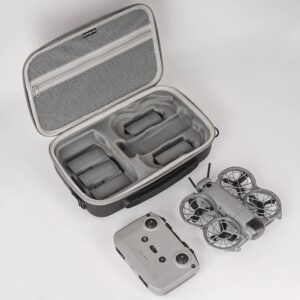
On the Neo 2 side, you have to go straight to the €399 Fly More pack to get a radio control system (RC-N3). This pack includes three batteries, a recharging station and a carry bag, making it a complete package.
On the Mini 3, the Fly More with RC-N1 goes up to €529, and the version with screen radio control reaches €649. The logic here is more modular, but also more expensive for equivalent equipment.
Finally, the Neo 2 offers a Motion Fly More package at €579, including N3 Goggles and RC Motion 3 for an immersive FPV experience. The Mini 3 offers no equivalent alternative, as it is not FPV-compatible.
🏆 DJI Neo 2: the most affordable way to get started on a budget.
Conclusion DJI Neo 2 vs DJI Mini 3: which to choose?
In the final analysis, the DJI Neo 2 and DJI Mini 3 are not aimed at exactly the same user profile, even though they operate in a similar price range.
The DJI Neo 2 is all about modernity and versatility. Autonomous flight, high-performance subject tracking, FPV compatibility, obstacle detection with LiDAR… it offers a more automated and safer experience. It’s also lighter and more affordable for entry-level models. On the other hand, its autonomy remains limited and its camera, although capable of 4K 100 ips, doesn’t rival that of the Mini 3 in pure image quality.
The DJI Mini 3, on the other hand, remains more traditional in its approach. No active tracking or FPV, but better autonomy, a full 3-axis nacelle, a larger sensor, RAW and true native 4K vertical format. It will suit those who prefer image quality and longer flight sessions.
In short: the Neo 2 is more action/automation-oriented, the Mini 3 more image/endurance-oriented.
💡 Choose the DJI Neo 2 if:
- You want a drone that really follows you, like a flying cameraman (sport, hiking, mountain biking, etc.).
- You’re looking for a versatile drone, capable of autonomous flight, classic flight and even FPV – perfect for discovering all facets of the drone world.
- You’re on a tight budget and want the best “fun/functionality” ratio right from the outset.
💡 Choose the DJI Mini 3 instead if:
- Your priority is image quality (larger sensor, RAW, cleaner rendering in difficult conditions).
- You mainly shoot vertical and you want native vertical 4K (without crop), for TikTok / Reels / Shorts.
- You want a more classic, “pure drone” flying experience, and longer flights thanks to its much greater autonomy.
🔎 Also read
➡️ Are you hesitating between the Neo 2 and its predecessor? Discover our DJI Neo 2 vs Neo comparison.
➡️ For a more in-depth analysis of the DJI Neo 2, check out our detailed review of the DJI Neo 2.
➡️ To explore the Mini 3’s photo and video capabilities in detail, check out our full feature on the DJI Mini 3.
➡️ New to drones and want to learn in the best conditions? Check out our guide to choosing an easy-to-fly beginner drone.
➡️ Looking for an even more capable model? Check out our Mini 5 Pro vs Lito X1 comparison.
➡️ Want to compare the Mini 3 with a more recent DJI model? Check out our Mini 3 vs Lito X1 comparison.

 Blog
Blog