
 Français
 Deutsch
 Español
 Italiano
 Parts & Accessories by Drone
 Drones
 Action camera
 Microphones
 Camera Stabilizers
 VR Headsets
DJI Mic 3, full review: smaller, stronger

Sep
DJI continues to refine its audio range with a brand-new model: the DJI Mic 3. The official successor to the Mic 2, it adopts an ultra-compact format more reminiscent of the Mini version. As the Mic 2 is already a highly accomplished model, it’s hard to beat it… So what’s this Mic 3 really worth? What’s new about it? Who is it for? And is this the right microphone for your film shoots, vlogs or interviews? A complete overview: design, features, sound quality… follow the guide!
DJI Mic 3: What you need to know
No time to read it all? Here are the key points to remember:
- 📐 Transmitters twice as compact as those of the Mic 2, close to the Mic Mini format – and a new charging case capable of storing everything (TX + RX + all accessories).
- 🎙️ High-quality audio with 32-bit floating-point recording
- ⚙️ New built-in pro settings: voice tone presets, two-level noise reduction, adaptive gain, lossless recording, timecode compatibility
- 📡 E xtended range up to 400 meters via DJI receiver
- 🔋 Enhanced autonomy: 8 h per transmitter, 10 h for the receiver, and up to 28 h with the charging box
- 🧩 S calable ecosystem: up to 4 TXs connectable to a single RX, and support for up to 8 receivers (RXs) in parallel
📌 A boosted Mic 2, in the compact format of the Mic Mini: hard to dream of anything better for demanding designers.
DJI Mic 3 : Design
| Dimensions (L × W × H) | Transmitter: 28.77 × 28.34 × 16.35 mm Receiver: 53.85 × 28.69 × 22 mm Charging case: 106.30 × 42.50 × 59.20 mm |
| Weight | Transmitter: 16 g (with magnet) Receiver: 25.1 g Rechargeable case: 164.1 g |
| Internal memory (transmitter) | 32 GB |
| Available internal recording time | 24-bit (single file): 57.3 hours 24-bit (double file): 28.6 hours 32-bit floating (single file): 43.0 hours 32-bit floating (double file): 21.5 hours |
The transmitter (RX)
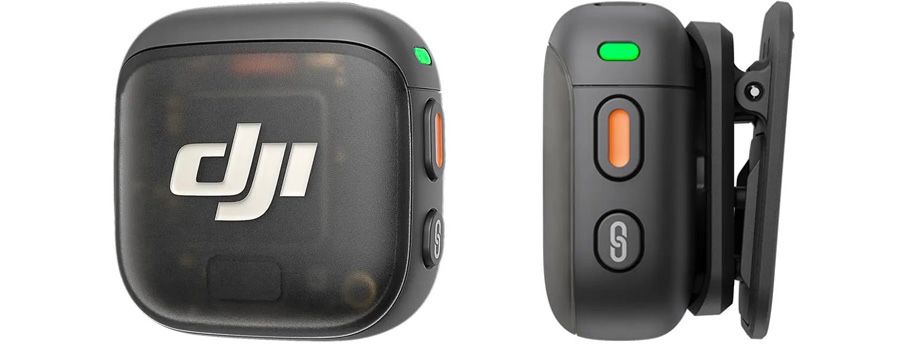
First surprise on opening the box: the DJI Mic 3’s transmitter is tiny. It is about half the size of the Mic 2’s transmitter, making it much more discreet and pleasant to wear. Once clipped to a collar or jacket, it’s quickly forgotten.
When it comes to mounting, you have two options:
- the classic pliers, solid and efficient,
- the magnetic system, which allows the transmitter to be attached using the magnetic clip or the separate, more powerful magnets supplied in the pack.
A neat little detail: once in place, the transmitter can be tilted to direct the microphone capsule towards the mouth or sound source. And since the transmitters themselves are magnetic, they can even be magnetized to a metal surface – a handy feature in certain situations.
The only drawback: no more 3.5 mm jack plug. Fans of external microphones will have to do without them… which may inconvenience those who prefer to hide the microphone under clothing.
The good news is that internal memory has been increased from 8 GB to 32 GB, giving up to 57 hours of uncompressed recording. Enough to keep you going.
The receiver (TX)
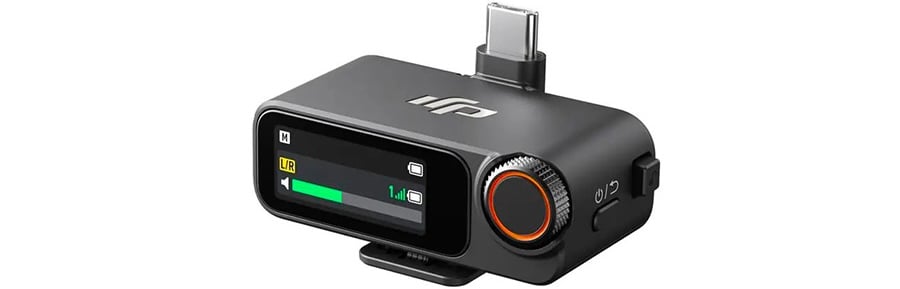
There’s no revolution in the design of the receiver (RX), but a few welcome improvements. It’s a little more compact than the Mic 2, which is always a good thing.
The 1.1″ AMOLED screen is still clearly legible, and the touchscreen wheel allows easy menu navigation. USB-C or Lightning adapters can still be plugged in at the bottom (depending on the model), and the 3.5 mm jack output now features a screw thread, to prevent the cable from accidentally coming unplugged during shooting.
Speaking of cables, DJI also supplies a reinforced TRS cable with a clamping system to ensure a reliable connection with a camera or recorder.
Charging box
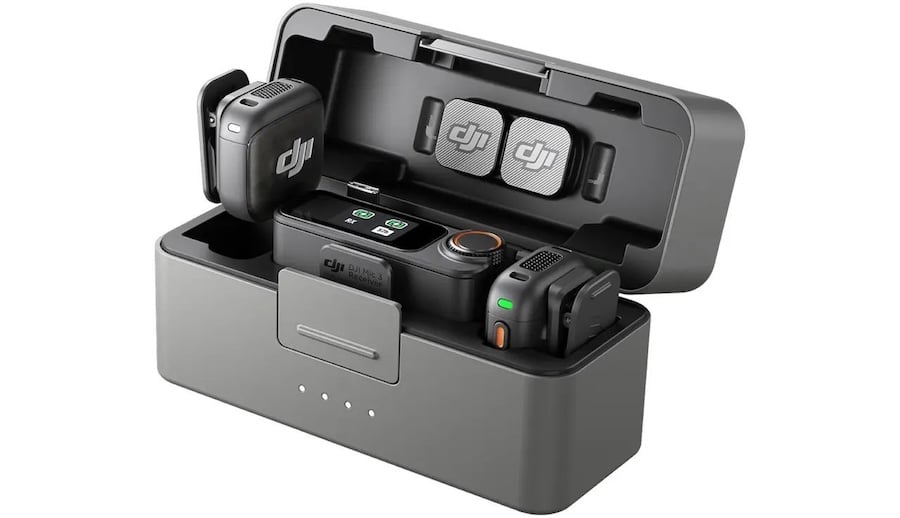
The DJI Mic 3 charging unit is evolving in the right direction. Smaller than that of the Mic 2, it now comes closer to the Mic Mini’s compact, well-optimized format, while offering even more functional space. Almost as compact as the Mic Mini, it’s easy to carry, even in a small bag.
As with the Mic Mini, everything fits into the case: the two transmitters, the receiver, but also the clamps, windscreens (including fur models, which didn’t fit into the Mic 2 case), magnets, and a 3.5 mm to 3.5 mm TRS cable. The space is perfectly arranged, including in the lid.
A real plus for on-the-go designers, who can carry everything in a single case, without having to lug around separate accessories.
DJI Mic 3: Autonomy
| Battery | Transmitter: 137mAh Receiver: 275 mAh Charging case: 1950 mAh |
| Autonomy | Transmitter: 8 hours Receiver: 10 hours |
| Charging time | Transmitter: 50 minutes Receiver: 50 minutes Recharge box: 1.5 hours |
In terms of endurance, the DJI Mic 3 has made significant progress over its predecessor. It can now be used for up to 28 hours with the recharging box, compared with 18 hours for the Mic 2. This gain in autonomy is appreciable, especially when shooting on location or over several days. So, yes, it’s not quite up to the 48 hours of the Mic Mini, which remains the absolute benchmark in this respect, but the Mic 3 strikes a good balance between compactness, power and autonomy. Clearly, it’s already very comfortable for most uses.
In detail :
- each transmitter lasts up to 8 hours,
- the receiver goes up to 10 o’clock,
- and the case can be recharged a little more than twice, for a total of 28 hours.
Another plus point is the rapid recharging. If you forget or have a hard time, 5 minutes in the box is enough to recover around 2 hours of autonomy on a transmitter. And for a full recharge, you need around 50 minutes for a transmitter or receiver, and 1h30 for the box.
In short, between endurance and recharge speed, the DJI Mic 3 is perfectly cut out to keep pace, even on long days of shooting. You’ll never be caught short.
DJI Mic 3: Connectivity and compatibility
| Available audio channels | Record up to 4 separate tracks |
| Number of transmitters supported | Up to 4 TXs connected simultaneously |
| Receiver connection | USB-C, Lightning (with adapter), 3.5 mm audio output |
| Direct connection without receiver | Via Bluetooth (compatible smartphones/tablets) + compatibility with Osmo Audio ecosystem: Osmo Action 4, Action 5 Pro, Osmo 360, Osmo Pocket 3 |
With the Mic 3, DJI moves up a gear. Where the Mic 2 was limited to 2 transmitters and stereo recording, this new version allows up to 4 transmitters to be connected simultaneously, with the option ofrecording 4 separate audio tracks. A real plus for multi-voice shoots, multiple interviews or more ambitious setups.
The system also offers a choice of recording modes: mono, stereo or multichannel, depending on your configuration. Everything is set directly from the receiver.
💡 The DJI Mic 3 can be used in two ways, depending on your equipment:
1️⃣ With receiver: you connect the RX to a smartphone via USB-C or Lightning (with the supplied adapter), or to a camera/camera via the 3.5 mm audio output.
2️⃣ Without receiver: connect the transmitter directly via Bluetooth to a compatible smartphone or tablet, or use OsmoAudio technology for an immediate wireless link with compatible DJI devices such as theOsmo Action 4, Action 5 Pro, Osmo Pocket 3 and Osmo 360.
The receiver is very versatile: it can be connected to most devices thanks to its USB-C, Lightning (via adapter) or 3.5 mm jack outputs. Transmitters, on the other hand, have no built-in file transfer ports. To retrieve internal recordings, either insert them into the recharging box, which is then recognized as an external hard drive, or use the USB mini-dock supplied if you have purchased the transmitter on its own.
Another interesting new feature is 32-bit floating compatibility. When used in direct connection with an Osmo Audio device, the transmitter can record a second file in 32-bit floating, stored directly in its internal memory, in parallel with the transmitted audio. Handy for capturing a backup file in the event of saturation or poor balance.
And as with the Mic 2, each transmitter can also operate autonomously, thanks to its 32 GB of on-board storage. So you can use it as an independent microphone, even without an active connection to the receiver.
DJI Mic 3: Features and audio quality
| Transmission distance (with TX) | 400 meters |
| Bit depth | 32-bit floating / 24-bit (switchable) |
| Noise reduction | 2 selectable active reduction levels |
| Gain control | 2 modes: Automatic or Dynamic |
| Voice presets | Regular, Rich, Glossy |
| Timecode | Taken care of |
In terms of audio processing, the DJI Mic 3 builds on the solid foundations laid by the Mic 2, in particular 32-bit floating-point recording, still offered alongside the classic 24-bit format. This format offers an ultra-wide dynamic range, enabling us to capture usable sound even when the volume is too low or too high. In post-prod, discreet voices can be enhanced without parasitic noise, or a saturated scream recovered without distortion. It’s the audio equivalent of the RAW file in photography or video: more control, more security. The 32-bit file is automatically stored in the transmitter’s internal memory, alongside the transmitted audio.
Two levels of noise reduction are now available. The first remains discreet, while the second is more aggressive without altering the voice too much. According to published tests and user feedback, even outdoors with urban traffic, voices remain natural and clearly intelligible.
Another clever new feature is adaptive gain control. Two modes are available:
- Automatic mode, which adjusts volume in real time to avoid sudden peaks (useful in the city or when reporting from the field)
- The more stable Dynamic mode, designed for recordings in controlled environments such as studios or closed rooms.
Three voice presets are also available to customize audio rendering without post-processing:
- Regular: a neutral, natural, balanced sound,
- Rich: accentuates bass for a warmer, more powerful sound,
- Brilliant: enhances the treble to give greater clarity to the voice.
The DJI Mic 3 also supports timecode, a feature expected by professionals but absent from the Mic 2. So you can easily synchronize your audio and video files when editing, without any headaches.
Finally, on the transmission side, the range increases from 250 m on the Mic 2 to 400 m on the Mic 3 (in open field). In most cases, the signal remains perfectly stable, but beware: if the transmitter is oriented with its back to the receiver, or if there are obstacles, cuts may occur. Nothing dramatic, but good to know if you’re filming on the move or at a distance.
🎙️ And the sound quality ? Quite simply, excellent. Clear, well-balanced, with no hiss, and with 32-bit backup files for those who want a margin of safety. Most creators will have nothing to complain about, whether for vlogs, interviews or studio recordings.
DJI Mic 3: Packs and prices

ℹ️ Note: some links in this section are Amazon affiliate links. As Amazon Associates, we earn from qualifying purchases, at no extra cost to you.
| Transmitter only | 99€ |
|
| Transmitter + receiver | 199€ |
|
| Complete pack (2 transmitters + receiver + recharger box) | 309€ |
|
The DJI Mic 3 is available in three configurations, each adapted to specific needs:
- Transmitter only – €99: an excellent option if you simply want to record internally. The transmitter can operate autonomously, without a receiver, and the audio files (in 32-bit floating) can then be transferred to a computer. Ideal for solo interviews or mobile creators.
- Transmitter + Receiver Pack – €199: the standard pack, designed for a basic configuration. It includes a single transmitter, a DJI Mic 3 receiver, the main accessories (USB-C adapter, 3.5 mm TRS cable, magnetic clip, windscreens, etc.) and a compact carrying case. Ready to use for vlogs, interviews or mono recordings.
- Complete pack (2 transmitters + receiver + recharging box) – €309: the logical choice for professionals. This pack includes all the features of the previous pack, but adds a second transmitter and a compact recharging box, capable of recharging all three modules simultaneously while protecting them. It’s also the only pack to include all adapters, cables and windscreens, as well as a larger carrying pouch.
DJI also makes it possible to purchase certain components separately, offering great flexibility for completing or upgrading your setup.
📦 For example:
- The charger box is available on its own at €69.
- DJI Mic 3 (RX) receiver available individually at €119
This à la carte sale is particularly welcome: it allows you toupgrade progressively according to your budget or needs. For example, you can start with a simple stand-alone transmitter, then add a receiver later, or complete an existing setup with a second TX.
Conclusion DJI Mic 3: Should you give in?
With the Mic 3, DJI has not only fine-tuned its formula, it has also brought together in a single product everything that made the Mic 2 and Mic Mini such successes. These include top-level audio quality, with 32-bit floating recording for demanding users, and a compact rechargeable case for easy transport and use on the move.
The new features are numerous: voice tone presets, lossless recording, two-stage noise reduction, adaptive gain control, timecode compatibility, more compact transmitters, extended range up to 400 meters… All this without pushing up the price, quite the contrary: the Mic 3 is even offered at a lower price than the Mic 2 at the time of its release.
This is DJI’ s most complete wireless microphone to date, designed for both beginners and professionals. It’s hard not to recommend it.
For whom?
The DJI Mic 3 is aimed above all at demanding content creators: professional vloggers, videographers, journalists or regular podcasters. It’s perfect for anyone who needs a reliable, full-featured wireless microphone that’s ready to take on complex shoots.
For more occasional or family use (vacation films, travel souvenirs…), a more affordable model like the DJI Mic Mini is generally more relevant: simpler, lighter, less expensive, and more than sufficient for this type of scenario.
I already have the DJI Mic 2: should I upgrade to the DJI Mic 3?
If you’re happy with your DJI Mic 2, there’s no need to rush: audio quality remains comparable, with the same solid foundations such as 32-bit floating recording and noise reduction. But for certain uses, the Mic 3 represents a significant step forward.
This is especially true for demanding professionals, who will appreciate the timecode support, integrated audio presets, management of 4 simultaneous transmitters on a single receiver, and integration into an ecosystem capable of up to 4 TXs and 8 TRXs. Added to this is a more compact and lightweight design, making it even more discreet and portable.
💡 Also read
➡️ Our review of the DJI Mic 2: a pro microphone that marked a milestone for DJI, and remains a solid reference to this day.
➡️ Focus on the DJI Mic Mini: an ultra-compact, simplified model, more affordable than its big brothers, ideal for tight budgets.
➡️ Still hesitating between these two previous models? Check out our DJI Mic Mini or DJI Mic 2 comparison to find out which wireless microphone best suits your needs and budget.
➡️ The DJI Mic 3 is also included in the Creator Combo of the DJI Osmo Pocket 4. Discover our full analysis of the DJI Osmo Pocket 4, as well as the differences between the DJI Osmo Pocket 4 and the Pocket 3.

 Blog
Blog