
 Français
 Deutsch
 Español
 Italiano
 Parts & Accessories by Drone
 Drones
 Action camera
 Microphones
 Camera stabilizers
 VR Headsets
DJI Avata 360 vs Avata 2: which drone to choose?
Apr
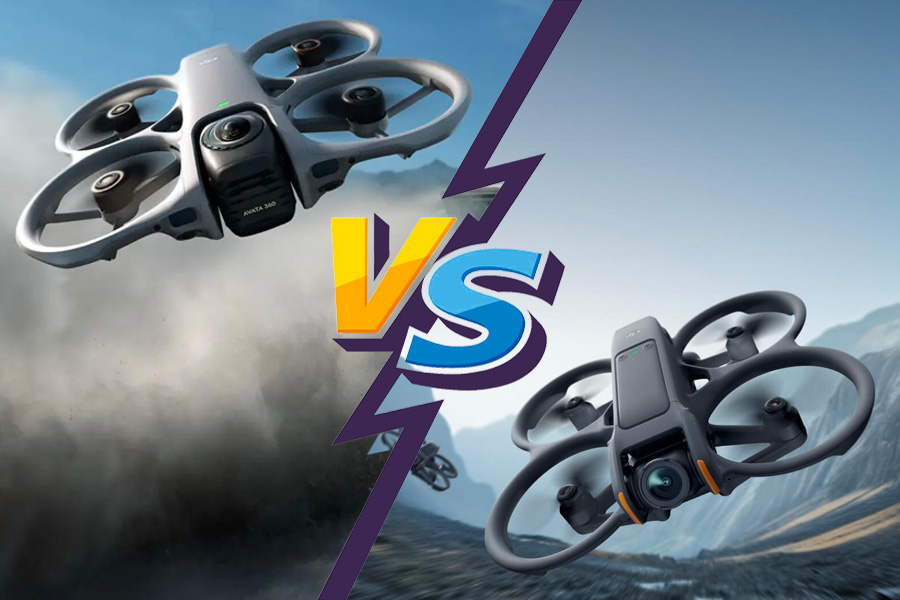
After the success of the DJI Avata 2, DJI is back with an intriguing model: the DJI Avata 360. On paper, it could easily be seen as a successor… but the reality is a little different. In this DJI Avata 360 vs DJI Avata 2 face-off, we’re faced with two visions of the FPV drone: on one side, a classic model designed for piloting and immersive video, on the other, a new way of filming focused on 360° capture and post-production. But what are the real differences between these two drones? What do they have in common? And above all, which one should you choose? All the answers in this comprehensive comparison.
DJI Avata 360 vs Avata 2: What you need to know
No time (or laziness 😅 ) to read it all? Here are the key points of this DJI Avata 360 vs DJI Avata 2 comparison 👇
- 🪶 Lighter and more compact: Avata 2
- 🎮 Most versatile piloting(FPV + conventional radio control) : Avata 360
- 🥽 DJI’s most complete FPV ecosystem: Avata 2
- 📡 Slightly higher-performance transmission (O4+): Avata 360
- 🕹️ Steering feel and maximum speed (Manual mode) : Avata 2
- 🔋 Equivalent autonomy : Avata 360 = Avata 2
- ⚡ Faster charging: Avata 360
- 🧠 Most comprehensive features (tracking, obstacle detection) : Avata 360
- 🎥 Image rendering: Avata 360 (brighter) / Avata 2 (more detailed)
- 🎬 Most advanced slow motion : Avata 2
- 💸 Most affordable FPV packs: Avata 2
👉 Avata 2 = pure piloting, sensations and direct shooting
👉 Avata 360 = creativity, versatility and freedom in post-production
💡 Contrary to what its name might suggest…
The DJI Avata 360 does not directly replace the DJI Avata 2. DJI has instead developed a drone focused on 360° video capture and reframing in post-production, while the Avata 2 remains centered on FPV flying and flight sensations. The two models therefore coexist in the lineup and serve different uses.
DJI Avata 360 vs Avata 2 : Design
| DJI Avata 360 | DJI Avata 2 | |
| Weight | 455 g | 377 g |
| Dimensions (L x W x H) | 246 × 199 × 55.5 mm | 185 x 212 x 64 mm |
| Storage | 42 GB internal memory Memory card up to 1 TB | 46 GB internal memory Memory cards up to 512 GB |
| Class (UE) | C1 | C1 |
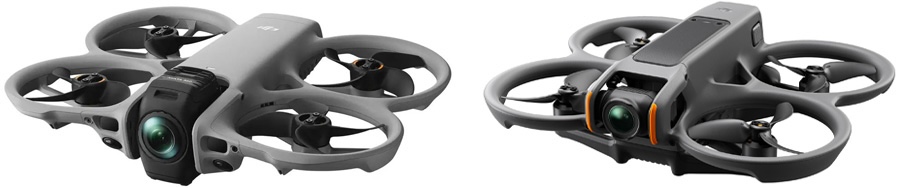
In terms of design, both drones remain faithful to the DNA of the Avata range, with a compact Cinewhoop format and propellers protected in an enclosed structure. This is a design conceived for submerged flight, both robust and reassuring, especially in tight environments. But despite this common base, a few differences quickly become apparent.
The DJI Avata 360 is more imposing, measuring 246 × 199 × 55.5 mm and weighing 455 g, compared with 185 × 212 × 64 mm and 377 g for the Avata 2. It is therefore larger and heavier, while remaining slimmer in design. This difference can be explained by the integration of its 360° capture system. There’s also a difference in propeller design, with slightly longer 4-blade propellers on the Avata 360, versus 3-blade propellers on the Avata 2. Both models remain C1-rated, however, which implies the same overall regulatory constraints.
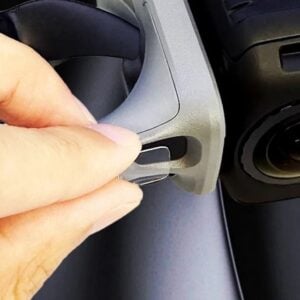
Where the differences become interesting is in the camera. The DJI Avata 360 features two “bubble” lenses, positioned on either side of the drone for 360° capture. A more exposed system, by necessity, but well thought-out: when stationary, the lenses are oriented so as to be protected by the chassis, and in flight, they tilt automatically to cover the entire scene. DJI has also included replaceable lenses, a real plus for a drone destined to operate in sometimes risky environments.
Finally, on the storage side, both drones boast comfortable internal memory, with 42GB for the Avata 360 and 46GB for the Avata 2, plus a microSD slot. That’s enough to get you started, although the addition of a memory card is still recommended, especially to fully exploit video capabilities.
🏆 DJI Avata 2: lighter and more compact
DJI Avata 360 vs Avata 2: Transmission and radio controls
| DJI Avata 360 | DJI Avata 2 | |
| Compatible radio controls | DJI RC 2 DJI RC-N2 / DJI RC-N3 DJI RC Motion 3 DJI FPV Remote Controller 3 | DJI RC Motion 2 DJI RC Motion 3 DJI FPV Remote Controller 2 DJI FPV Remote Controller 3 |
| Compatible FPV goggles | DJI Goggles 3 DJI Goggles N3 | DJI Goggles 2 DJI Goggles Integra DJI Goggles 3 DJI Goggles N3 |
| Video transmission system | DJI O4+ | DJI O4 |
| Max. transmission distance | FCC: 20 km CE: 10 km | FCC: 13 km CE: 10 km |
| Live preview quality | Single lens: 1080p up to 100 fps 360°: 1080p up to 60 fps | 1080p up to 100 fps |
One of the major differences between these two drones is the way they are flown. The DJI Avata 360 is clearly more versatile, offering a choice of two approaches:
- Classic radio control (DJI RC 2, RC-N2 or RC-N3), without headphones
- Immersive FPV piloting with goggles (DJI Goggles 3 or N3) and suitable controllers (RC Motion 3 or FPV remote control)
This dual use makes it easy to adapt to your needs: quick flight without heavy installation, or a full FPV session for a more immersive experience.
The Avata 2, on the other hand, makes a clearer choice: it can only be flown in FPV mode. It therefore systematically requires compatible goggles (DJI Goggles 2, Integra, Goggles 3 or N3) and a dedicated remote control such as the RC Motion 2, RC Motion 3 or a conventional FPV remote control. In return, it benefits from a broader FPV ecosystem, with more compatible accessories.
On the transmission side, both drones use the latest, reliable systems. The DJI Avata 360 uses DJI O4+ technology, while the Avata 2 uses DJI O4. Both offer 1080p video return at up to 100 frames per second, with a stable connection. The O4+ maintains a slight advantage, notably in terms of interference management and maximum range (up to 10 km in CE, with a more comfortable margin in difficult conditions). Overall, both solutions prove particularly stable and reliable in use.
🏆 DJI Avata 360: more versatile thanks to dual piloting mode
🏆 DJI Avata 2: more complete FPV ecosystem
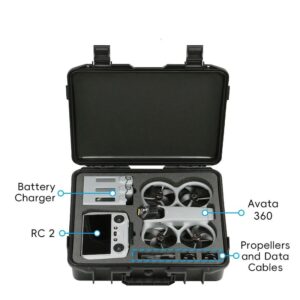
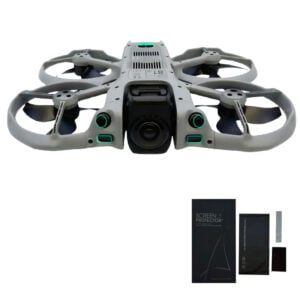
Discover our accessories for
DJI Avata 360
DJI Avata 360 vs Avata 2: In-flight performance
| DJI Avata 360 | DJI Avata 2 | |
| Maximum speed | 6 m/s (Cine mode) 16 m/s (Normal mode) 18 m/s (Sport mode) | 8 m/s (Normal mode) 16 m/s (Sport mode) 27 m/s (Manual mode) |
| Max. ascent speed | 2 m/s (Cine mode) 6 m/s (Normal mode) 10 m/s (Sport mode) | 6 m/s (Normal mode) 9 m/s (Sport mode) |
| Max. descent speed | 1.5 m/s (Cine mode) 6 m/s (Normal mode) 10 m/s (Sport mode) | 6 m/s (Normal mode) 9 m/s (Sport mode) |
| Max. wind resistance | 10.7 m/s (level 5) | 10.7 m/s (level 5) |
In this respect, the two drones perform very similarly overall, with healthy, accessible behavior in the majority of situations. According to user feedback and available independent tests, there is no noticeable difference in terms of piloting: despite its heavier weight, the DJI Avata 360 remains stable and pleasant to control, on a par with the Avata 2.
On the speed side, things are a little more nuanced. In assisted modes (Normal and Sport), the two drones show similar performance, with a top speed of 16 m/s (≈ 57.6 km/h) in Normal mode and 18 m/s (≈ 64.8 km/h) for the Avata 360 in Sport mode, compared with 16 m/s (≈ 57.6 km/h) for the Avata 2.
The Avata 2 can go much further thanks to its Manual mode, with a maximum advertised speed of 27 m/s (≈ 97.2 km/h). In European Union countries, however, this speed is limited to 19 m/s (≈ 68.4 km/h) in accordance with current regulations. By contrast, the DJI Avata 360 does not support Manual mode, with DJI having officially confirmed that this feature is not available on this model. For pilots looking for a more aggressive FPV experience or freestyle flying, the Avata 2 therefore retains a clear advantage in this area.
As for wind resistance, both models claim an identical value of 10.7 m/s (level 5). In the absence of a direct comparison in real-life conditions, it’s hard to tell them apart on this point.
One final point emerges from the various tests available: noise. The DJI Avata 360 is generally described as noisier than the Avata 2, with a more pronounced sound signature. A point to be taken into account depending on the flight environment or type of use.
🏆 DJI Avata 2: an advantage in pure speed and piloting sensations (thanks to Manual mode)
DJI Avata 360 vs Avata 2: Autonomy and recharging
| DJI Avata 360 | DJI Avata 2 | |
| Battery | 2700 mAh | 2150 mAh |
| Autonomy | 23 minutes | 23 minutes |
| Charging time | Direct charge (65W): 73 min (1 battery) Station (100W): 47 min (1 battery) / 100 min (3 batteries) | Direct charge (30W): 88 min (1 battery) Station (60W): 45 min (1 battery) |
On paper, the two drones boast identical autonomy of 23 minutes, despite a difference in battery capacity(2700 mAh for the Avata 360 vs. 2150 mAh for the Avata 2). A difference that doesn’t really translate into practice.
According to user feedback and available independent tests, actual autonomy is closer to 15 to 18 minutes for both models, depending on flying style and conditions. A classic level for this type of FPV drone, where performance and stability often take precedence over endurance.
On the recharging side, the differences are a little more marked. The DJI Avata 360 benefits from faster recharging, with 73 minutes of direct charging (65W ) and 47 minutes via a charging station (100W) for one battery. The Avata 2 requires a little more time for direct charging(88 minutes with 30W), but is very close to the same time via a docking station, with around 45 minutes for a battery (60W).
In the end, while autonomy remains equivalent between the two drones, the DJI Avata 360 retains a slight advantage in terms of recharging speed.
🏆 DJI Avata 360: faster recharging
DJI Avata 360 vs Avata 2: Features
| DJI Avata 360 | DJI Avata 2 | |
| Capture type | Single lens + 360 | A single goal |
| Photo modes | Single shot | Single shot |
| Video modes | Standard video, QuickShots (via classic RC) | Standard video |
| Subject follow-up | ActiveTrack 360° subject tracking | ❌ |
| Flight planning | ❌ | ❌ |
| Obstacle detection | Omnidirectional sensing + front LiDAR | Optical positioning (bottom + rear) |
Photo and video modes
On this point, both drones remain rather limited in appearance, with few modes available. In photography, both models offer a single shot. For video, the same logic applies: a standard mode, with the addition of QuickShots on the DJI Avata 360 (only when used with a conventional remote control).
The main difference comes from the DJI Avata 360 which, thanks to its rotating gondola, offers two ways of filming:
- Single-lens mode, similar to that of a conventional drone
- 360° mode, capturing the entire environment
This 360° mode lets you film without worrying about framing during the flight, since you can choose the angles in post-production. On the other hand, it does require some cropping afterwards.
In photography, this function can also be used to generate complete panoramic images, with each shot capturing the entire scene.
Subject follow-up
The difference here is very clear: subject tracking is only available on the DJI Avata 360.
The drone incorporates ActiveTrack 360°, capable of following a subject while leaving the possibility of adjusting the framing in post-production. There are also functions such as Spotlight Free, which lets you lock on to a subject while retaining control of the drone.
The Avata 2, on the other hand, does not offer subject monitoring.
Obstacle detection
Here, the DJI Avata 360 gains a technical advantage with omnidirectional detection, complemented by forward-looking LiDAR, particularly useful in difficult conditions.
On the other hand, the Avata 2 is limited to optical positioning to the rear and down, which does not constitute true obstacle detection. The level of assistance is therefore much more limited in this respect.
FPV and other functions
The two drones share a number of features related to their use in FPV. These include:
- Simplified Acro mode, to create figures automatically
- Head Tracking, to orient the camera with head movements
- QuickTransfer, for fast file transfer to a smartphone
The Avata 2 does have a practical advantage, however, with its Turtle mode, which turns the drone upside down when it’s knocked to the ground, allowing it to take off again without intervention.
🏆 DJI Avata 360: more comprehensive (QuickShots, subject tracking and obstacle detection)

All our parts & accessories for
DJI Avata 2
DJI Avata 360 vs Avata 2 : Image
| DJI Avata 360 | DJI Avata 2 | |
| Aerial work platform | Single-axis mechanical gondola (tilt) | Single-axis mechanical gondola (tilt) |
| Sensor | 2 1/1.1-inch sensors | 1/1.3 inch |
| Objective | Equivalent format 7.8 mm Aperture f/1.9 FOV 200° (in mm) | Equivalent format 12 mm Aperture f/2.8 FOV 155° (in mm) |
| Photo resolution | 30 MP / 120 MP | 12 MP |
| Max. video resolution | 360° mode: 8K up to 60 fps 6K up to 60 fps Single-lens mode: 4K up to 60 fps 2.7K up to 120 | 4K up to 100 fps 2.7K up to 120 fps 1080p up to 120 fps |
| ISO range | 100 à 12800 | 100 à 25600 |
| Max. bit rate | 180 Mb/s | 130 Mb/s |
| Photo format | JPEG DNG (RAW) | JPEG |
| Video format | OSV/MP4 (H.265) | MP4 (H.264/H.265) |
| Color profile | Normal D-Log M | Normal D-Log M |
Nacelle, sensors and resolution
Both drones use a single-axis mechanical nacelle (tilt), typical of this type of FPV model.
The difference lies mainly in the sensors. The DJI Avata 360 has two 1/1.1-inch sensors, compared with one 1/1.3-inch sensor on the Avata 2. In theory, these slightly larger sensors allow more light to be captured, which can be an advantage in more difficult conditions.
On the definition side, the DJI Avata 360 can go up to 8K at 60 fps in 360°, and 4K at 60 fps in single lens, with photos up to 120 MP in 360°.
The Avata 2 is limited to 4K at up to 100 fps, but stands out for its fluidity. It can go up to 120 fps in 2.7K and 1080p, enabling slow-motion shots of up to x4.
Image quality
According to user feedback and available tests, both drones offer solid image quality, but with slightly different rendering.
The DJI Avata 360 benefits from larger sensors and a brighter aperture (f/1.9 vs. f/2.8), enabling it to capture more light. The image often appears brighter, with a better dynamic range, particularly in high-contrast scenes.
The Avata 2, on the other hand, is often perceived as sharper and more precise, with a slightly higher level of detail in certain shots. This difference seems to be mainly due to image processing.
On the photo side, the DJI Avata 360 also boasts support for the RAW (DNG) format, absent on the Avata 2.
Last but not least, both drones feature a D-Log M profile, enabling colorimetric work to be carried out in post-production. A real plus for those who want to go further in the final rendering.
🏆 DJI Avata 360: larger sensors and better light management
🏆 DJI Avata 2: slow-motion advantage
DJI Avata 360 vs Avata 2: Packs and prices
ℹ️ Note: some links in this section are Amazon affiliate links. As Amazon Associates, we earn from qualifying purchases, at no extra cost to you.
| DJI Avata 360 | DJI Avata 2 | |
| Drone alone | 459 € | 409 € |
| Basic package | 719 € (DJI RC 2) | 619 € (Fly Smart – 1 battery, Goggles N3) 849 € (Fly More – 1 battery, Goggles 3) |
| Complete package | 939 € (Fly More DJI RC 2) | – |
| FPV Pack | 939 € (Motion Fly More) | 789 € (Fly Smart – 3 batteries, Goggles N3) 1019 € (Fly More – 3 batteries, Goggles 3) 1029 € (Explorer – 3 batteries, Goggles Integra) |
|
|
|
The two drones take very different approaches when it comes to packages, making the comparison less obvious than it might seem. Where the DJI Avata 360 offers a simple, progressive range, the Avata 2 multiplies FPV variants, with several similar configurations but different equipment.
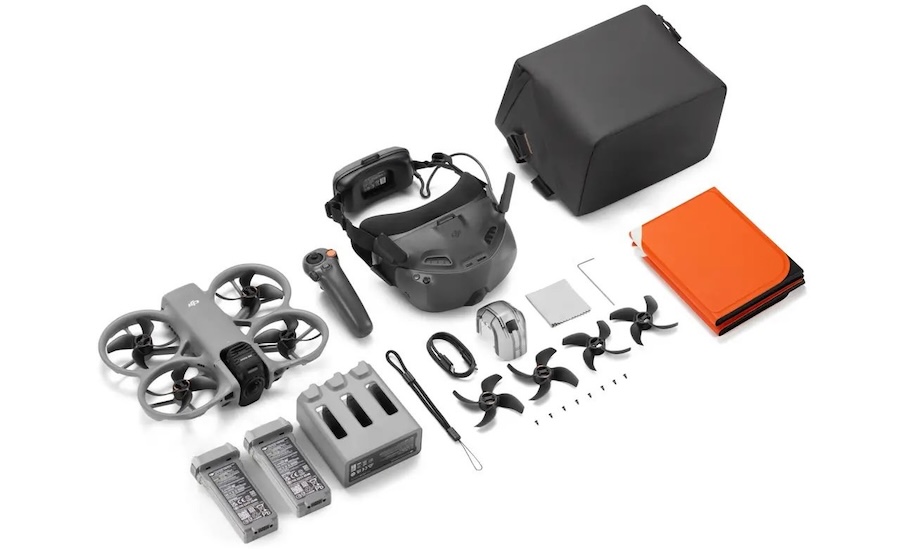
On the DJI Avata 360 side, the offer is clear, with four clearly identified packs: drone alone (€459), pack with classic DJI RC 2 remote control (€719), Fly More version with 3 batteries, docking station and bag (€939), and finally a complete Motion Fly More FPV pack also at €939. A simple logic, with the choice between classic piloting or FPV immersion.
The DJI Avata 2 is more complex. In addition to the drone alone (€409), DJI offers several FPV packages based on different combinations of helmets (Goggles 3, N3 or Integra) and remote controls. In particular, there are “Fly More” and “FlySmart” versions with 1 or 3 batteries, with contents that are sometimes very similar, making the range less clear at first glance.
In terms of price, however, a few trends emerge. The DJI Avata 2 is slightly cheaper at the entry-level, and remains more affordable overall for FPV packages. For example, the Avata 360’s Motion Fly More (€939) can be compared to the Avata 2’s FlySmart 3 batteries (€789 ): both offer a complete FPV configuration with Goggles N3 helmet, three batteries and charging station, although the Avata 360 also includes a carry bag. With similar equipment, the Avata 2 therefore retains a slight price advantage, while the Avata 360 can become interesting if you’re already equipped with DJI gear.
It’s also worth noting that for FPV use, the Avata 2 is considerably more affordable, with complete packages available from around €619, compared with a minimum of €939 for an equivalent FPV configuration on the Avata 360.
🏆 DJI Avata 2: slightly less expensive for equivalent equipment
OUR BEST SELLERS - DJI AVATA 2


Avata 2
Individual Storage Bags for DJI Avata 2 / Goggles 3 / RC Motion 3 / DJI FPV Remote Control 3


Conclusion DJI Avata 360 vs Avata 2: which to choose?
At the end of this DJI Avata 360 vs DJI Avata 2 comparison, one thing is clear: we’re not dealing with a successor, but with two different drones, designed for different uses.
The DJI Avata 2 remains a classic FPV drone, focused on piloting and sensations. It focuses on a direct immersive experience, with precise flight behavior and, above all, the presence of Manual mode, which allows you to go further in terms of speed and control. This is a drone designed above all to fly, have fun in immersion and achieve a clean rendering without spending hours editing.
By contrast, the DJI Avata 360 takes a completely different approach. More versatile, it lets you choose between traditional flying and FPV, while above all taking advantage of 360° capture. In practice, you record everything around you and choose your framing afterwards. A single recording can therefore produce several different shots, offering far greater creative possibilities than a conventional drone. The trade-off is that it inevitably requires more time in post-production to make the most of this potential, something to keep in mind if you’re primarily looking for a solution that’s quick and easy to use.
👉 In short, the choice depends above all on how you film and fly.
Which DJI Avata should you choose based on your profile?
| Your profile | Recommended drone | Why? |
|---|---|---|
| 🥽 You’re new to FPV flying | DJI Avata 2 | More accessible, lighter, and designed for a straightforward FPV experience. |
| 🕹️ You’re looking for thrilling FPV flying | DJI Avata 2 | Manual mode offers greater speed and more precise control. |
| 🎥 You want to shoot 360° videos | DJI Avata 360 | Capture the entire scene and choose the framing afterwards during editing. |
| 📱 You create content for social media | DJI Avata 360 | A single flight can generate multiple camera angles thanks to post-production reframing. |
| 🎮 You want to fly without FPV goggles | DJI Avata 360 | It can also be flown with compatible standard remote controllers. |
| 💸 You’re looking for the most affordable FPV package | DJI Avata 2 | Its FPV bundles are generally more affordable for similar equipment. |
🎯 Choose the DJI Avata 360 if:
- You want to shoot in 360° and create several shots from a single take (while accepting to spend time on post-production).
- Looking for a more versatile drone (FPV + classic piloting)?
- More features (subject tracking, obstacle detection)
🎯 Choose the DJI Avata 2 if:
- Are you looking for the thrill of FPV piloting?
- You want a drone that’s simple, straightforward and doesn’t require a lot of assembly work.
- Looking for a more affordable way to get started in FPV?
FAQ – DJI Avata 360 vs Avata 2
What is the difference between the DJI Avata 360 and the Avata 2?
The main difference lies in their purpose. The DJI Avata 360 is designed for 360° video capture and post-production reframing, while the DJI Avata 2 is a traditional FPV drone focused on immersive flying and flight performance.
Is the DJI Avata 2 faster than the DJI Avata 360?
Yes. Thanks to Manual mode, the DJI Avata 2 can reach up to 27 m/s (97.2 km/h), compared with 18 m/s (64.8 km/h) for the DJI Avata 360 in Sport mode. In European Union countries, however, the Avata 2 is limited to 19 m/s (68.4 km/h) in Manual mode.
Which drone is best for getting started with FPV?
The DJI Avata 2 is generally the better choice for beginners. It offers a more straightforward FPV experience, more affordable FPV bundles and a true Manual mode for progressing as a pilot.
Does the DJI Avata 360 replace the DJI Avata 2?
No. Despite its name, the DJI Avata 360 is not the direct successor to the DJI Avata 2. Both drones remain in DJI’s lineup and target different types of users.
Can the DJI Avata 360 record in 8K?
Yes. In 360° mode, the DJI Avata 360 records up to 8K at 60 fps. In single-lens mode, it records up to 4K at 60 fps.
💡 Want to know more?
➡️ Discover our review of the DJI Avata 360
➡️ Discover everything you need to know about the DJI Avata 2
🛠️ For maintenance and repairs, you can find all compatible spare parts here:
DJI Avata 360 Spare Parts
DJI Avata 2 Spare Parts
💡 Also read
➡️ Discover why the DJI Avata 360 and DJI Avata 2 are featured in our 2026 drone comparison.

 Blog
Blog