
 Français
 Deutsch
 Español
 Italiano
 Parts & Accessories by Drone
 Drones
 Action camera
 Microphones
 Camera Stabilizers
 VR Headsets
DJI RC Pro 2 vs RC 2: which remote control to choose?
Jul
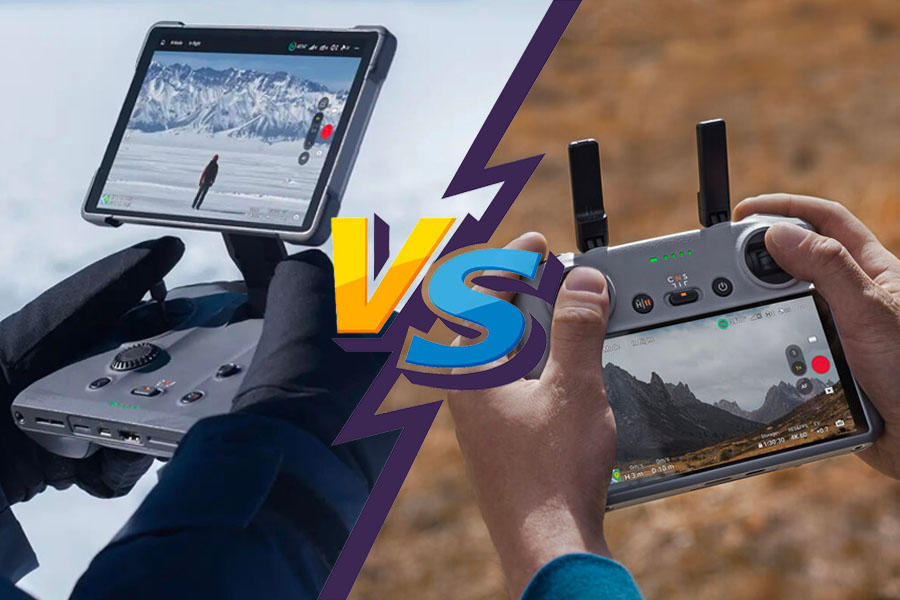
With the release of the Mavic 4 Pro, DJI has taken the opportunity to unveil a new high-end remote control: the DJI RC Pro 2. Bigger, brighter and above all, it completes the existing range, offering a more professional alternative to the DJI RC 2 and satisfying even the most demanding pilots. So, what are the real differences between these two remotes? Should you invest in the RC Pro 2 or stick with the RC 2? And if your drone is compatible with both, which one should you choose? This DJI RC Pro 2 vs RC 2 comparison takes a look at everything you need to know.
DJI RC Pro 2 vs RC 2: What you need to know
For those in a hurry (or less brave), here’s a quick summary of the comparison:
🧳 Design & size
– The RC 2 is lighter and more compact, ideal for travel or lightweight drones like the Mini 4 Pro.
– The larger RC Pro 2 focuses on maximum comfort with a robust, well-balanced design.
📺 Screen
– The RC Pro 2’s 7-inch screen is much brighter (2000 nits vs. 700), deploys above the remote control and swivels vertically for optimal viewing comfort, even in direct sunlight.
– The RC 2’s display is still correct, but may lack a little legibility in certain contexts.
🎮 Controls, connectivity & storage
– The RC Pro 2 comes with more customizable buttons, an HDMI port and 128 GB of internal storage.
– The RC 2 is simpler, but more than enough to comfortably pilot all compatible drones.
📡 Transmission & compatibility
– Both RCs use the O4 system, but only the RC Pro 2 supports O4+ (with the Mavic 4 Pro), offering superior range and signal stability .
– The RC 2 remains compatible with more current drones (Mini 4 Pro, Air 3, Neo…), making it a very versatile option today.
⚡ Autonomy
– The RC Pro 2 is slightly ahead of the RC 2, with an autonomy of around 4 hours, compared with 3 hours for the RC 2.
– Both radio controls recharge in around 1h30.
🧠 Advanced features
– The RC Pro 2 runs on Android, allowsinstallation of third-party apps, access to DJI Flight Simulator, incorporates a microphone and is DJI Mic Mini & 2 compatible.
– The RC 2 doesn’t offer any of these options, but remains simple and effective.
💰 Price
– The RC Pro 2 is almost 3 times more expensive than the RC 2.
– It is clearly aimed at demanding or professional users, ready to invest in top comfort and an all-in-one workstation.
📌 To sum up:
The RC 2 remains an excellent all-round remote control, perfect for light travel.
The RC Pro 2, on the other hand, is designed for professional or enthusiast pilots who want a top-of-the-range driving experience, even if it means paying the price.
DJI RC Pro 2 vs RC 2: Design and ergonomics
| DJI RC Pro 2 | DJI RC 2 | |
| Dimensions folded (L x W x H) | 182 × 139 × 61 mm | 168.4 x 132.5 x 46.2 mm (without joysticks) 168.4 x 132.5 x 62.7 mm (with joysticks) |
| Weight | 750 g | 420 g |
| Screen size | 7.02 inches | 5.5 inch |
| Screen definition | 1920 × 1200 | 1920 x 1080 |
| Refresh rate | 60 fps | 60 fps |
| Brightness | 2000 nits | 700 nits |
| Internal storage | 128 GB | 32 GB |
Size and weight
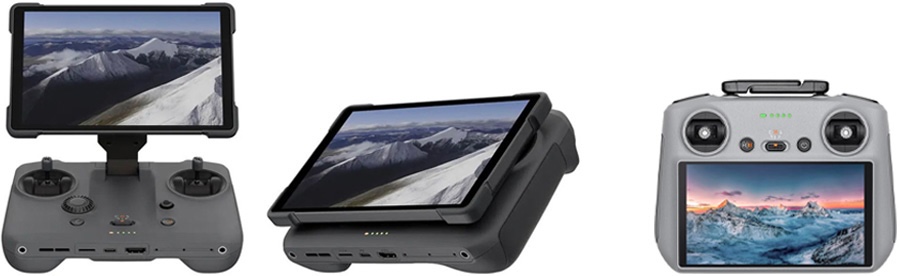
Physically, the DJI RC Pro 2 is clearly larger. When folded, it measures 182 × 139 × 61 mm and weighs 750 g, compared with just 420 g for the RC 2. This difference is immediately noticeable in the hand, but also in a bag. For users looking for a compact, lightweight setup, especially with a drone like the Mini 4 Pro, the RC 2’s comfort gain is still notable.
However, the RC Pro 2 is a serious, robust machine. Its more massive size inspires confidence and is aimed above all at professional or semi-professional riders. If portability is your priority, the RC 2 is clearly more suitable. On the other hand, for those who prefer comfort and stability in prolonged use, the RC Pro 2 scores well.
Screen: size, brightness, operator comfort
This is probably one of the biggest differences between the two remotes: the screen. The DJI RC Pro 2 boasts a very bright 7.02″ screen(2000 nits), compared with the RC 2’s 5.5″ and 700 nits. The difference in bright sunlight is obvious: where the RC 2 can sometimes become difficult to read, the RC Pro 2’s screen remains perfectly legible.
Another major advantage: the RC Pro 2’s screen is mounted on an articulated arm and positioned above the joysticks, allowing pilots to fly in a more natural posture, without having to look down. It can also be rotated in vertical mode, for full-screen display of portrait shots, which is not possible with the RC 2 (the image is cropped and centered).
Finally, the smoothness of navigation is better on the RC Pro 2, which runs on Android. Where the RC 2 can sometimes be a little slow, especially when chaining complex tasks, the RC Pro 2 remains fluid and pleasant to use.
Controls, connectors and storage
As far as controls are concerned, the basic layout of the two remotes remains very similar: knobs, buttons, joysticks – it’s all there. The general layout is familiar to those accustomed to the DJI ecosystem. But the RC Pro 2 takes ergonomics a step further.
It offers a few extra features:
- A click wheel near the left joystick for controlling ISO, exposure or shutter speed
- A customizable 5D button on the right
- An additional back button for navigation
Another difference: the joysticks on the RC Pro 2 retract automatically when the screen is folded, a real time-saver in everyday use. On the RC 2, they have to be screwed in/out and stored manually (or left mounted, which is not ideal for transport).
In terms of connectivity, the RC Pro 2 adds an HDMI port for displaying video feedback on an external screen, in addition to the USB-C port and microSD slot also found on the RC 2. It also incorporates a microphone, useful for recording audio comments, and a slot for a 4G dongle.
Finally, internal storage is far more generous on the RC Pro 2: 128 GB compared with just 32 GB on the RC 2. Enough to comfortably store apps, files and media, without having to rely solely on an SD card.

Discover our accessories for
DJI RC Pro 2
DJI RC Pro 2 vs RC 2: Transmission and compatibility
| DJI RC Pro 2 | DJI RC 2 | |
| Transmission system | O4 O4+ | O4 |
| Compatible drones | DJI Air 3 DJI Air 3S DJI Mavic 4 Pro DJI Mini 4 Pro DJI Mini 5 Pro | DJI Flip DJI Air 3 DJI Air 3S DJI Mavic 4 Pro DJI Mini 4 Pro DJI Neo |
Both remotes support DJI’s latest O4 transmission system. But the DJI RC Pro 2 goes one step further with dual compatibility: it can switch between O4 and O4+, depending on the drone used.
In practice, this means that if you’re flying a Mavic 4 Pro or a Mini 5 Pro, the RC Pro 2 will use the O4+ protocol, which offers not only a greater theoretical range, but above all a more stable link in complex environments. For all other drones(Air 3, Air 3S, Mini 4 Pro), transmission remains in O4, identical to that of the RC 2.
The RC 2, on the other hand, only supports O4 – an already high-performance system that ensures more than adequate range, low latency and excellent stability, even under demanding conditions.
👉 The main advantage of O4+, rather than offering longer transmission distances, is to provide an extra margin of safety in terms of link quality, particularly for professional flights or in complex environments.
📌 In other words:
- If you fly several recent drones, or if you’re banking on the future (with potentially future O4+ models), the RC Pro 2 offers greater scalability.
- If you own a Mini 4 Pro, Air 3 or Air 3S, the RC 2 is more than sufficient – and it even has the advantage of being compatible with a larger number of DJI models, such as the DJI Neo or DJI Flip.
DJI RC Pro 2 vs RC 2: Autonomy and recharging
| DJI RC Pro 2 | DJI RC 2 | |
| Battery | 3100 mAh × 2 | 3100 mAh × 2 |
| Autonomy | 4 hours | 3 hours |
| Recharge time | 1h30 (with 65 W charger) | 1h30 (with 9V/3A charger) |
On paper, both radio controllers carry two 3100 mAh internal batteries. However, in real-life use, the DJI RC Pro 2 has a slight advantage: thanks to better energy management, it offers around 4 hours of autonomy, an hour more than the DJI RC 2, which lasts around 3 hours during a typical session.
In practical terms, this level of autonomy makes it possible to carry out multiple flights without intermediate recharging, providing real comfort during extended shooting sessions. A clear advantage for professionals or enthusiasts who need to operate far from any power source.
⚡ Fast recharging is a must in both cases: allow around 90 minutes for a full charge, using a 65W charger for the RC Pro 2, or a 9V/3A for the RC 2.
📌 In short: the RC Pro 2 lasts a little longer, which can make all the difference on longer shoots. Nevertheless, the RC 2 is still a very decent choice, especially in view of its compactness and lower price.
OUR BEST SELLERS - DJI RC PRO 2


Bags Cases Straps
Sunnylife Individual Pouches for DJI Mavic 4 Pro, RC 2 or RC Pro 2


DJI RC Pro 2 vs RC 2 : Features
In this respect, the DJI RC Pro 2 clearly has the upper hand. It’s not just a radio control system: it also works like a real Android tablet, with full Internet access and the ability to install third-party applications.
The result? You can surf the web, check the weather, install editing tools, or publish directly to social networks, without ever taking out your smartphone. In short, it’s possible to shoot, edit and share content from a single device. The interface is fluid, navigation pleasant, and the system remains stable even with several apps open.
Another notable difference: The RC Pro 2 features DJI Flight Simulator, a complete simulator for risk-free flight training. You can test your maneuvers, learn how to frame, or fine-tune your photo/video settings – all from the remote control.
It also incorporates a microphone, useful for recording audio comments during flight or taking voice notes. And to take things a step further, it’s compatible with DJI Mic 2 and DJI Mic Mini microphones, thanks to its USB-C port.
DJI RC Pro 2 vs RC 2 : Price
ℹ️ Note: some links in this section are Amazon affiliate links. As Amazon Associates, we earn from qualifying purchases, at no extra cost to you.
| DJI RC Pro 2 | DJI RC 2 | |
| Remote control only | 999 € | 369 € |
Unsurprisingly, this is the point that creates the biggest gap between the two models. The DJI RC Pro 2 retails for €999, compared with around €369 for the DJI RC 2. A difference of over €600, reflecting the very different ambitions of these two radio controllers.
With the RC 2, DJI offers a compact, affordable solution that is more than sufficient for most hobby and semi-pro pilots. Excellent value for money, especially for those who value ease of use and light weight.
In contrast, the RC Pro 2 is clearly aimed at a more demanding audience – videographers, image professionals, content creators – ready to invest in a high-end flying experience with enhanced comfort, improved legibility and advanced functions.
📌 In a nutshell :
- RC 2: an economical choice that’s already very complete, at less than €400
- RC Pro 2: a top-of-the-range tool designed for intensive users, but at a premium price
Conclusion DJI RC Pro 2 vs RC 2: Which one to choose?
When it comes to choosing, everything depends on your use, your expectations and… your budget.
👉 Choose the DJI RC 2 if you’re looking for a compact, lightweight, easy-to-carry radio control. It already offers a very good flying experience, decent autonomy, broad compatibility (Mini 4 Pro, Air 3, Air 3S, DJI Neo…) and above all excellent value for money. It’s the best option for most pilots, especially those who travel a lot and want to keep their drone setup light and consistent.
🚀 On the other hand, the DJI RC Pro 2 is aimed at an entirely different audience: those who want the best. With its large, ultra-bright screen, piloting comfort, generous internal storage, comprehensive connectivity, integrated Android system and extensive compatibility, it transforms the remote control into a veritable mobile station. But all this comes at a price: nearly €1,000 on its own, almost three times the price of the RC 2. It’s clearly aimed at professionals, or passionate amateurs ready to invest to please themselves.
📌 In a nutshell:
- DJI RC 2 ➜ compact, practical, affordable, perfect for traveling light.
- DJI RC Pro 2 ➜ more complete, more comfortable, more expensive… but cut out for those who want the best.

Discover our accessories for
DJI RC 2
FAQ – DJI RC Pro 2 vs RC 2
What’s the real difference between DJI RC Pro 2 and RC 2?
The DJI RC Pro 2 boasts a larger (7″), much brighter (2000 nits) screen, a full Android system, more connectivity (HDMI), more storage (128 GB) and longer battery life. On the other hand, it’s heavier… and much more expensive.
Is the DJI RC 2 enough to pilot a drone like the Mavic 4 Pro?
Yes, totally. It’s compatible and allows you to exploit the essential functions. Even for demanding users, the RC 2 remains an excellent option… provided you don’t need the more advanced features of the RC Pro 2.
Is it worth buying the RC Pro 2 if I already have an RC 2?
It all depends on your needs. If you’re looking for greater piloting comfort, an ultra-bright screen, or you’re flying several O4+ drones, then the RC Pro 2 can really make a difference.
Can I install apps on the RC 2 as well as the RC Pro 2?
No. The RC 2 doesn’t come with Android, so no third-party apps. On the RC Pro 2, you can install editing, broadcasting and scheduling apps… and manage your entire workflow from the remote control.
Which is best suited to travel?
The DJI RC 2. It’s much lighter and more compact, ideal for accompanying a drone like the Mini 4 Pro or DJI Neo without weighing down your bag.
💡 Also worth reading
👉 Discover our complete test of the DJI RC Pro 2: screen, comfort, compatibility, performance… we tell you everything!

 Blog
Blog