
 Français
 Deutsch
 Español
 Italiano
 Parts & Accessories by Drone
 Drones
 Action camera
 Microphones
 Camera stabilizers
 VR Headsets
DJI Neo 2 vs Neo: what are the differences?

Nov
After the success of its first autonomous selfie drone, the Neo, DJI is back with its successor, the Neo 2, which aims to correct the original model’s teething problems. So, DJI Neo 2 vs Neo: what are the real differences between the two generations? Should you upgrade to the new model if you already own the first? Which one to choose for filming your adventures? All the answers in this full comparison!
DJI Neo 2 vs Neo: What you need to know
No time (or laziness 😅 ) to read it all? Here are the key points to remember about this DJI Neo 2 vs Neo comparison 👇
- 🎨 Design and format: the Neo 2 is a little wider and heavier (up to 160 g), with a small status screen on the front and more control buttons. It also doubles the internal memory (49 GB vs. 22 GB).
- 🎮 Control methods: No difference. Both drones offer exactly the same 4 control methods (autonomous flight, DJI Fly app, conventional radio control, FPV mode). Same accessory compatibility.
- 🛩️ Flying performance: The Neo 2 is faster and more powerful than the Neo, both in conventional flight and in automatic tracking. It climbs faster, descends faster, and is more resistant to wind (level 5 vs. level 4).
- 🔋 Autonomy and recharging: Autonomy almost identical (19 min vs 18 min), but batteries not compatible between the two drones. Slightly faster recharging for the Neo.
- 🎥 Photo/video features: The Neo 2 adds three new creative modes (SelfieShot, MasterShots, Dolly Zoom) and much faster QuickTransfer (80 Mb/s vs. 25 Mb/s).
- 👁️🗨️ Subject tracking: Better than the Neo 2, with tracking up to 12 m/s, two new modes (bike and ski), adjustable framing (angle, distance, height), adjustable on the fly and by gesture.
- 🧱 O bstacle detection: this is the biggest difference. The Neo 2 introduces a full 360° system with panoramic vision + LiDAR at the front, where the Neo has only a downward sensor.
- 📷 Image quality: Still the same 1/2-inch 12 MP sensor, but optimized processing on the Neo 2, sharper, higher-contrast image. Much higher video resolutions (up to 4K 100 fps vs. 4K 30 fps).
- 📁 Formats and profiles: Neither records in RAW or LOG. They produce simple JPEG/MP4 files, designed to be shared directly. Manual settings only via radio control.
- 💰 Packs and prices: Three packs available for each model, with comparable contents. The Neo 2 costs around €40-50 more, depending on version.
📌 To sum up: the DJI Neo 2 takes up the basics of the first model, but improves on them in almost every respect (obstacle detection, image, tracking fluidity…). A reasonable extra cost for a real move upmarket.
DJI Neo 2 vs Neo : Design
| DJI Neo 2 | DJI Neo | |
| Weight | 151 g (without transceiver) 160 g (with transceiver) | 135 g |
| Dimensions | 147×171×41 mm (without transceiver) 167×171×54 mm (with transceiver) | 130 x 157 x 48.5 mm |
| Internal storage | 49 GB | 22 Go |
| Class (Europe) | C0 | C0 |
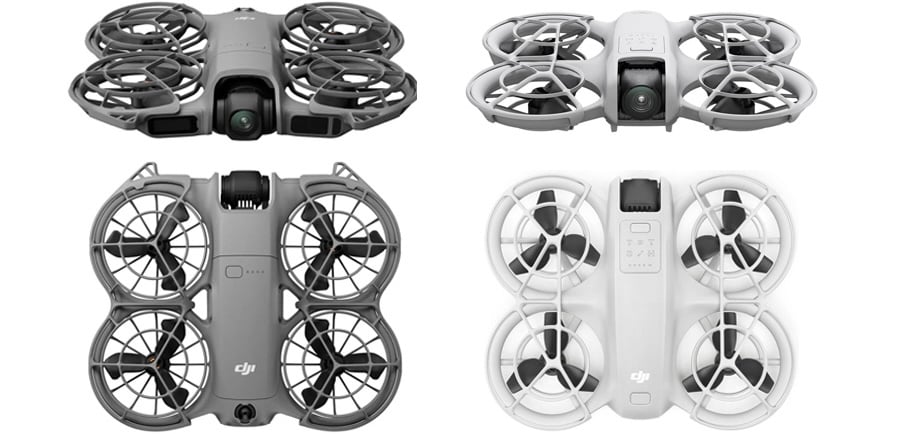
From an aesthetic point of view, the DJI Neo and Neo 2 share the same DNA: compact chassis, integrated protective frame around the propellers, rounded look typical of Whoop-type drones. Both are designed to fly safely close to people. But on closer inspection, the Neo 2 boasts a number of aesthetic innovations.
Firstly, the format has changed slightly. The Neo measures 130 x 157 x 48.5 mm and weighs 135 g. The Neo 2 is wider and heavier: 147 x 171 x 41 mm without the module and 167 x 171 x 54 mm with the rear module, weighing 151 to 160 g depending on configuration. This module, supplied in certain packs, is only required when flying the drone with a conventional radio control system or in FPV mode. It is not used for autonomous flights via smartphone.
Visually, the Neo 2’s gray hue is a little darker, and the front features a small, easy-to-read status display, right next to the camera. The Neo, on the other hand, makes do with
On the memory side, DJI has almost doubled the capacity: 22 GB on the Neo, 49 GB on the Neo 2. Neither model has a microSD slot, but this increase means you can record for much longer without emptying the memory.
Finally, an important point for European regulations: both drones are C0-rated. No need for training or registration to fly, even in urban areas or close to people.
DJI Neo 2 : Control methods
| DJI Neo 2 | DJI Neo | |
| Control methods | Autonomous flight DJI Fly application Radio control (conventional flight) FPV flight | Autonomous flight DJI Fly application Radio control (conventional flight) FPV flight |
| Compatible radio controls | DJI RC-N3 DJI RC-N2 DJI RC 2 Radio control 3 DJI FPV DJI RC Motion 3 | DJI RC-N3 DJI RC-N2 DJI RC 2 Radio control 3 DJI FPV DJI RC Motion 3 |
| Video transmission system | Standard: Wi-Fi video transmission Optional: DJI Neo 2 (O4) digital transceiver | Wi-Fi DJI O4 |
| Max. transmission distance | FCC: 10 km CE: 6 km | FCC: 10 km CE: 6 km |
| Live preview quality | up to 1080p at 60 fps | up to 1080p at 60 fps |
Both models offer exactly the same control methods, with identical accessories for different uses:
- Autonomous flight: with no need for a smartphone or remote control, the drone takes off and lands in your hand using the two buttons on its side. This mode is ideal for simple autonomous shots, especially with the new gesture control available only on the Neo 2.
- DJI Fly application: via a Wi-Fi connection with your smartphone (up to 500 m on the Neo 2, 50 m on the Neo), you can access virtual joysticks and voice commands.
- Classic radio control: compatible with DJI RC-N2, RC-N3 and DJI RC 2 remote controls on both models.
- Immersive flight (FPV ): possible with DJI Goggles 3 or N3 helmets, combined with DJI FPV Radio Remote Control 3 or RC Motion 3, for an immersive experience.
There are several practical differences between the two models:
- Improved Wi-Fi range : when connected to a smartphone, the range increases from 50 meters on the Neo to 500 meters on the Neo 2. In practice, the actual range depends greatly on the environment, but the gain is still appreciable.
- Gesture control exclusive to Neo 2: This mode lets you interact with the drone with your bare hands, for example by spreading your palms to move it backwards, or bringing them together to move it forwards. Ideal for framing from a distance, without accessories.
- External O4 module on Neo 2: On the Neo, DJI O4 video transmission is directly integrated. On the Neo 2, you need to attach a small module to the rear to unlock this functionality. This does not change the range (10 km FCC / 6 km CE), but adds a hardware step.

Discover our accessories for
DJI Neo 2
DJI Neo 2 vs Neo: In-flight performance
| DJI Neo 2 | DJI Neo | |
| Maximum speed | 8 m/s (Normal mode) 12 m/s (Sport mode) 12 m/s (subject tracking) | 6 m/s (Normal mode) 8 m/s (Sport mode) 16 m/s (Manual mode) |
| Max. ascent speed | 0.5 m/s (Cine mode) 3 m/s (Normal mode) 5 m/s (Sport mode) | 0.5 m/s (Cine mode) 2 m/s (Normal mode) 3 m/s (Sport mode) |
| Max. descent speed | 0.5 m/s (Cine mode) 3 m/s (Normal mode) 3 m/s (Sport mode) | 0.5 m/s (Cine mode) 2 m/s (Normal mode) 2 m/s (Sport mode) |
| Max. wind resistance | 10.7 m/s (level 5) | 8 m/s (level 4) |
Overall, the DJI Neo 2 is faster than its predecessor. In Normal mode, it reaches 8 m/s, compared with 6 m/s for the Neo. In Sport mode, the difference is even more marked: 12 m/s for the Neo 2, versus 8 m/s for the Neo. The same is true for ascents and descents, where the Neo 2 climbs and descends faster in all modes. In use, you can feel that the propulsion system has been strengthened, with more powerful motors and improved responsiveness. in flight.
A key point concerns tracking mode. The DJI Neo 2 reaches tracking speeds of up to 12 m/s, compared with 8 m/s for the Neo. This increase in speed makes tracking much more effective during sporting activities such as cycling, skiing or fast running. The drone can track fast-moving subjects without difficulty, with smoother trajectories.
Wind resistance has also improved. The Neo 2 boasts level 5 wind resistance (up to 10.7 m/s), compared with level 4 (8 m/s ) for the Neo. This is due to a slightly larger size and a revised motorization. In windy conditions, the Neo 2 offers greater stability.
👉 To go further on flight performance, check out our full review of the DJI Neo 2.
DJI Neo 2 vs Neo: Autonomy
| DJI Neo 2 | DJI Neo | |
| Battery | 1606 mAh | 1435 mAh |
| Autonomy | 19 minutes (17 minutes with propeller protection) | 18 minutes (17 minutes with propeller protection) |
| Recharge time | 68 min (3 batteries via charging station) 70 min (1 battery direct) | 60 min (3 batteries via charging station with 65W charger) 50 min (1 battery direct) |
The DJI Neo 2 has a 1606 mAh battery, compared with the Neo’s 1435 mAh. The capacities are slightly different, but the most important point is elsewhere: the batteries are totally incompatible between the two models. So you can’t reuse your Neo batteries if you switch to the Neo 2, which means you have to start from scratch when it comes to accessories.
On paper, theclaimed maximum autonomy remains very similar: 19 minutes for the Neo 2 versus 18 minutes for the Neo, or 17 minutes in both cases if you install the propeller guards. In real-life conditions, user feedback and available tests suggest times of between 10 and 15 minutes, depending on flight intensity and video settings.
As for recharging, the Neo 2 requires around 68 minutes for three batteries via the charging station, or 70 minutes for a single battery connected directly via USB-C. The Neo does slightly better: 60 minutes for three batteries (station + 65 W charger) and around 50 minutes for a single battery.


DJI Neo 2 vs Neo : Features
| DJI Neo 2 | DJI Neo | |
| Photo modes | Single shot, Interval shots, SelfieShot | Single shot, Interval shots |
| Video modes | QuickShots, MasterShots, Dolly Zoom, Subject tracking | QuickShots, Subject tracking |
| Obstacle detection | Omnidirectional monocular vision system + forward-facing LiDAR + downward-facing infrared sensor | Optical downward positioning |
Photo and video modes
The two drones share several basic functions, which are sufficient for a large number of uses:
- Single shot: instant capture of a photo via the application or a gesture.
- Interval shots: take regular shots to create a timelapse or document a journey.
- QuickShots: automatically link predefined camera movements for stylized shots (such as circles, spirals, dronies, etc.).
The DJI Neo 2 does, however, add several modes that were absent from the first version, offering more variety in shots:
- SelfieShot: ideal for solo or duo portraits, this mode automatically adjusts angle or distance without touching the remote control.
- MasterShots: record a complete sequence of dynamic shots and automatically assemble them with music and transitions.
- Dolly Zoom: produces a cinematic inverted zoom effect in flight, with perspective compression around the subject.
📲 Faster QuickTransfer
The DJI Neo 2 seriously speeds up file transfers thanks to QuickTransfer 2.0. From 25 Mb/s (Neo) to 80 Mb/s Wi-Fi to smartphone. Ideal for quick video sharing after a flight.
Subject follow-up
The automatic tracking mode has improved significantly between the DJI Neo and the Neo 2. On the first model, speed was limited to
Another improvement is that framing becomes much more flexible. Where the Neo 1 offered fairly conventional tracking, the Neo 2 now lets you define theangle of tracking (front, back, side…) directly via a dial in the app, and adjust the angle to suit your needs. height or distance even during flight, including by gesture.
But it is above all in thealgorithm that the evolution is most notable. Tracking becomes smoother, more logical and more natural in its trajectories. Unlike the Neo 1, which tended to take shortcuts that were sometimes incoherent, the Neo 2 follows the subject’s movements with real consistency.
Obstacle detection
This is probably the most striking difference between the DJI Neo and the Neo 2. The first model had only a downward-pointing optical sensor, used for hover positioning, but no obstacle avoidance system. In other words, it couldn’t see what was around it.
The Neo 2 introduces a truly omnidirectional detection system, capable of anticipating obstacles at 360° and automatically adapting its trajectory.
It relies mainly on two new types of sensors:
- a monocular panoramic camera, to cover the sides and rear,
- a front-end LiDAR, designed to precisely detect obstacles in front of the drone.
The downward-facing infrared sensor is still present, but remains dedicated to in-flight stability close to the ground, and is not involved in obstacle avoidance as such.
According to user feedback, this new system is extremely effective, even in the face of fine obstacles such as branches. Avoidance trajectories are fluid and natural, making automated flight much more serene, even in complex environments.

Discover our accessories for
DJI Neo
DJI Neo 2 vs Neo : Image
| DJI Neo 2 | DJI Neo | |
| Stabilization | 2-axis mechanical gondola (tilt, roll) | Single-axis mechanical gondola (tilt) |
| Sensor | 1/2 inch | 1/2 inch |
| Objective | 16.5 mm equivalent format Aperture: f/2.2 FOV 119.8 | 14 mm equivalent format Aperture: f/2.8 FOV 117.6 |
| Max. photo resolution | 12 MP | 12 MP |
| Max. video resolution (horizontal) | 4K up to 100 fps | 4K up to 30 fps |
| Max. video resolution (vertical) | 2.7K up to 60 fps | 1080p up to 60 fps |
| ISO range | 100 à 12800 | 100 à 6400 |
| Max. bit rate | 80 Mb/s | 75 Mb/s |
| Photo format | JPEG | JPEG |
| Video format | MP4 | MP4 |
| Color profile | Normal | Normal |
Pod, sensor and resolutions
The first visible difference between the two models concerns the nacelle. The DJI Neo 2 switches to 2-axis mechanical stabilization (tilt + roll), versus the single-axis (tilt) of the Neo. This change should offer better overall stability, especially when the drone is buffeted by the wind.
As for the sensor, it remains a 1/2-inch 12-megapixel in both cases. The lens evolves slightly: from a
Finally, video resolutions have taken a significant leap forward:
- 4K at up to 100 fps (with remote control) for Neo 2, versus 4K 30 fps for Neo
- Vertical: 2.7K up to 60 fps for Neo 2, versus 1080p 60 fps for Neo
Image quality
Although both models use identical sensors, the Neo 2 benefits from visibly improved image processing. The DJI Neo 2 offers a sharper, more detailed image than the first model. Rendering is more pleasing to the eye, with better detail even in dark areas or against the light. As a result, videos are easier to use straight away, without retouching, whereas those of the Neo can sometimes seem a little bland or lacking in relief.
In terms of formats, nothing changes between the two drones: they both use standard JPEG and MP4 files, with a single, non-customizable color profile. Neither can capture photos in RAW, nor film in LOG profile for advanced calibration. And without a DJI remote control, manual settings remain inaccessible. In short, both drones are clearly aimed at consumer use, with an image ready to share, but no room for professional use.
DJI Neo 2 vs Neo: Packs and prices
ℹ️ Note: some links in this section are Amazon affiliate links. As Amazon Associates, we earn from qualifying purchases, at no extra cost to you.
| DJI Neo 2 | DJI Neo | |
| Standard package (drone only) | 239 € | 199 € |
| Fly More Pack | 399 € | 349 € |
| Motion Fly More Pack | 579 € | 529 € |
Both models are offered in three distinct configurations: a standard pack for autonomous flights, a Fly More pack for classic use with radio control, and a Motion Fly More pack for total FPV immersion. It’s easy to draw parallels, as the contents are very similar from one drone to the next. Please note: the Neo’s prices are between €40 and €50 lower than those of the Neo 2, depending on the pack chosen.
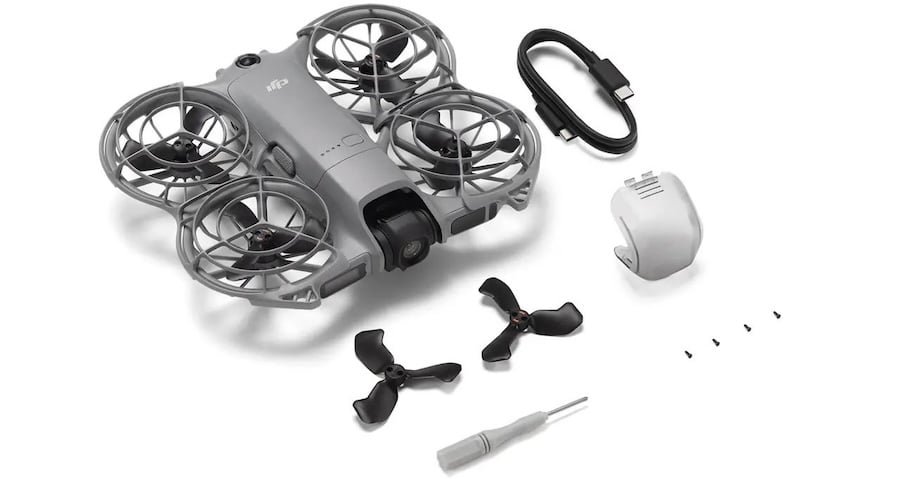
The standard pack, sold for €199 for the Neo and €239 for the Neo 2, includes only the essentials: drone, battery, protectors, USB-C cable… but no radio control. That’s enough to fly in tracking mode or via smartphone, without any advanced options.
The Fly More pack, priced at €349 for the Neo and €399 for the Neo 2, adds the RC-N3 radio control, two additional batteries, a recharging station and the transmission module. This is the recommended pack for more classic flying, without compromising on autonomy.
Finally, the Motion Fly More package takes the experience a step further, with immersive flight. It includes DJI Goggles N3 and RC Motion 3 control, for intuitive piloting by hand movements. The pack is priced at €529 for the Neo and €579 for the Neo 2.


Conclusion DJI Neo 2 vs Neo: which to choose?
Logically, the DJI Neo 2 inheritsa number of improvements over its predecessor. Smoother video (4K up to 100 fps), more efficient stabilization, doubled internal memory, omnidirectional obstacle detection, enriched photo/video modes, smarter tracking… These evolutions make the experience safer, smoother and more enjoyable, with images that are easier to exploit right out of the box.
For its part, the Neo retains the essential basics for those wishing to learn hands-free flying at a lower cost. With its 4K 30 fps, simple tracking functions and affordable FPV options, it remains a good alternative for learning the basics without breaking the bank.
In short: the same assisted flight philosophy , but a much more complete experience on the Neo 2, which corrects most of the first model’s limitations without denying its simplicity.
I already have the DJI Neo: is upgrading to the Neo 2 worth it?
If your DJI Neo is all you need to film family moments, travel memories or make fun, no-holds-barred videos, there’s no reason to change. It’s still a very affordable autonomous drone, easy to fly and still effective in its class.
On the other hand, if you use it a lot and start to run up against certain limitations, the Neo 2 has some real arguments to make. Improved image quality, obstacle detection in all directions, more precise subject tracking, a redesigned interface, new shooting modes… these are just some of the additions that can really make a difference for those looking to go further, both in terms of comfort and creativity.
💡 Readour full reviews of the two protagonists in this DJI Neo 2 vs Neo duel:
➡️ Our review of the DJI Neo 2
➡️ A full review of the first-generation DJI Neo
➡️ If you choose this drone, you can check out our selection of the best DJI Neo 2 accessories.
🛠️ Looking for DJI Neo or Neo 2 spare parts?
Find all compatible parts and accessories for each model:
DJI Neo spare parts · DJI Neo 2 spare parts
💡 Also read
➡️ Still unsure between several models? Discover which drone to choose in 2026 in our complete guide.

 Blog
Blog