
 Français
 Deutsch
 Español
 Italiano
 Parts & Accessories by Drone
 Drones
 Action camera
 Microphones
 Camera stabilizers
 VR Headsets
DJI Osmo Action 4 vs GoPro HERO 12 Black: which action camera to choose?

Nov
DJI’s latest action camera versus GoPro’s. Long lagging behind in terms of image quality, DJI seems to have made up for lost time with its latest copy, putting more pressure than ever on the market leader. So which is the best action camera? What are the advantages of each? Which one is right for you? Our DJI Osmo Action 4 vs GoPro HERO 12 Black comparison will help you make your choice!
DJI Osmo Action 4 vs GoPro HERO 12: similar designs

| DJI Osmo Action 4 | GoPro HERO 12 Black | |
| Dimensions (L x W x H) | 70.5 x 44.2 x 32.8 mm | 71.8 x 50.8 x 33.6 mm |
| Weight | 145 g | 154 g |
| Screens | Front screen: 1.4 inch Rear screen: 2.25 inch | Front screen: 1.4 inches Rear screen: 2.27 inches |
| Operating temperature | -20 to 45 °C | -10 to 35 °C |
| Waterproofing | 18 meters | 10 meters |
On paper, the DJI Osmo Action 4 is slightly smaller and lighter than the GoPro HERO 12. With the two cameras side by side, it’s clear that the Action 4 is smaller and, above all, less tall than its competitor.
However, this advantage needs to be put into perspective, because unlike the GoPro, DJI’s camera doesn’t come with a built-in mounting system, or a protective frame that you’ll need to add if you want to shoot vertically. Add it all up, and the Action 4 becomes a tad heavier and bulkier than the HERO 12.
The mounting system is surely the point on which the two cameras differ most in terms of design.
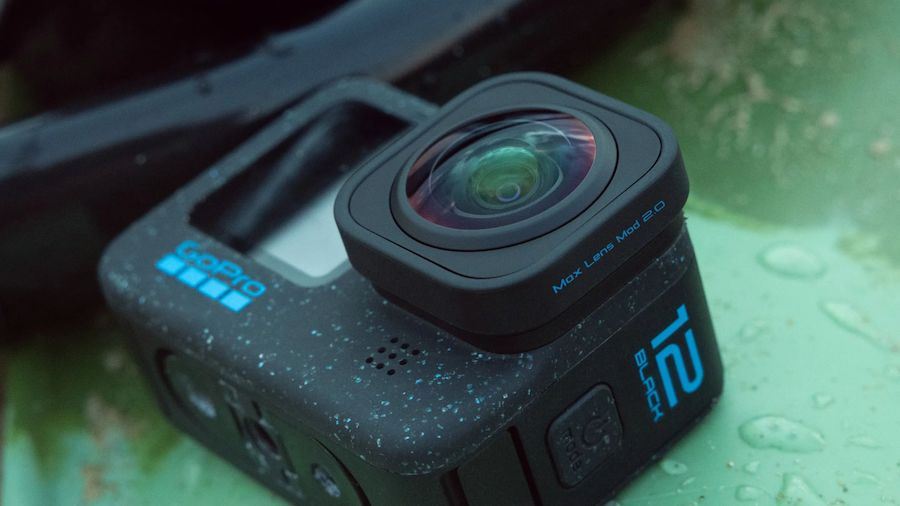
As we said, the one on the HERO 12 is integrated. No need to look for it everywhere. We always have the two legs in the center of which, for the first time, the manufacturer has added a universal 1/4-inch screw thread .
The Osmo Action 4‘s mount is detachable, which makes it incredibly quick and easy to use, thanks to an ingenious magnetic system doubled with hooks to snap onto the sides. Every second counts for an action camera, don’t you think 😉
The rest is more or less the same, except for the screens. Both models feature a large color screen on the rear and a smaller one on the front. Except that while the two screens on the DJI Osmo Action 4 are touch-sensitive, the small front screen on the GoPro 12 is not. This means greater flexibility for the Action 4, on which you can modify directly on the front panel without having to move or detach the camera. Apart from that, the rear screens are similar, and both are equally fluid and responsive.
Another point in common is that the lenses of both cameras are equipped with a removable glass that protects the camera lens and can therefore be replaced if necessary.
Last but not least, there’s no change in the waterproofing aspect compared with previous generations of either camera, with DJI still winning this round. Its Action 4 can dive to a depth of 18 meters, compared with 10 meters for the HERO 12 Black. This difference will be particularly useful for divers, as in reality 10 metres will be more than sufficient for most situations.

Discover our accessories for
DJI Osmo Action 4
DJI Osmo Action 4 vs GoPro HERO 12: performances
| DJI Osmo Action 4 | GoPro HERO 12 Black | |
| Batteries | LiPo 1S 1770mAh | Enduro 1720mAh |
| Autonomy | 160 minutes | 5.3K 60 fps: 70 minutes 5.3K 30 fps: 1h30 1080p 30 fps: 2h30 |
| Stabilization | RockSteady 3.0 RockSteady 3.0+ HorizonBalancing HorizonSteady | HyperSmooth 6.0 |
| Number of microphones | 3 | 3 |
Battery and autonomy
Both devices retain the battery from the previous generation: the 1770mAh battery on the Osmo Action 4 side, and the famous 1720mAh Enduro battery on the HERO 12 side. While autonomy has not changed from the Action 3 to the Action 4 on the DJI side, GoPro has improved its copy and reviewed its camera power management. The result is up to 2 times more autonomy, depending on the mode used.
The GoPro 12 can film up to 2h30 in 1080p at 30 fps, and 70 minutes in 5.3K at 60 fps. GoPro is closing the gap, although DJI is still slightly ahead, with up to 160 minutes of autonomy for its Action 4.
In real-world conditions, available feedback and measurements indicate slightly better battery life on the DJI Osmo Action 4. That is, if you put all the recording sessions end-to-end, because naturally both cameras heat up, and you’ll never be able to use the entire battery before the recording cuts itself off, for either camera.
Stabilization
Both the DJI Osmo Action 4 and the GoPro HERO 12 Black feature stabilization systems with impressive names: RockSteady 3.0 for DJI, and HyperSmooth 6.0 for GoPro.
Both have several levels of stabilization. However, it’s hard to tell the two cameras apart on this point: stabilization is something that current action cameras manage very well, and both do the job very well.
Note also that both cameras feature a horizon lock mode up to 360 degrees, which will keep the horizon straight even if you rotate the camera a full turn on itself.
Sound recording
Both the Action 4 and HERO 12 are natively equipped with three microphones. It’s hard to say which camera will give you the best sound, as the result will vary greatly depending on external conditions. But on the whole, both cameras are equal in this respect, and provide generally usable sound.
For external options, each has its advantages. The Action 4 will be able to accommodate an external microphone directly on its USB-C port, like the DJI Mic for example. Handy for improving sound quality. It will also be possible to do this on the GoPro, but this will require the purchase of an adapter module sold separately by the manufacturer.
But the GoPro has a new advantage: this twelfth version features a Bluetooth connection that allows you to connect headphones with microphones, such as Airpods. In addition to using these headphones for voice control of the device, you’ll record the sound they pick up and get an extra sound track, in addition to that of the original microphones.

Discover our accessories for
GoPro HERO 12 Black
DJI Osmo Action 4 vs GoPro HERO 12: the image
| DJI Osmo Action 4 | GoPro HERO 12 Black | |
| Sensor | 1/1.3-inch CMOS | 1/1.9-inch CMOS |
| Opening | f/2,8 | f/2,5 |
| Field of view | 155° | 156° in 8:7 format |
| Max. photo resolution | 10 MP | 27.13 MP |
| Video resolution | 4K up to 120 fps 2.7K up to 120 fps 1080p up to 240 fps | 5.3K up to 60 fps 4K up to 120 fps 2.7K up to 240 fps 1080p up to 240 fps |
| Photo formats | JPEG RAW | .jpg .gpr (RAW) |
| Video formats | MP4 (H.264/HEVC) | MP4 (H.265/HEVC) |
| Max. bit rate | 130 Mb/s | 120 Mb/s |
| Idle time | 4K: 4x (120 fps) 2.7K: 4x (120 fps) 1080p: 8x (240 fps), 4x (120 fps) | 5.3K : 2x 4K : 4x 2.7K : 8x 1080p : 8x |
| Digital Zoom | Photo: 4x Video: 2x max. | Up to x2 |
Sensor size for DJI, resolution for GoPro
With its new Osmo Action 4, DJI introduces a new, larger 1/1.3-inch sensor. Larger, too, than the 1/1.9-inch sensor on the GoPro HERO 12, which retains the sensor from the HERO 11. The advantage for DJI, whose sensor lets in more light. We’ll take a closer look at the effect on image quality.
It’s when it comes to resolution that the Hero 12 Black comes out on top, or at least maintains its lead over the competition. In fact, it’s the only one of the two to offer 5.3K resolution at up to 60 frames per second. The Action 4 remains “locked” in 4K up to 120 fps.
The GoPro also boasts the best photo definition, with a 27 MP resolution that overshadows the 10 MP of the Osmo Action 4. The HERO 12 will therefore offer greater flexibility in post-production, particularly when it comes to cropping captured images.
More image formats for HERO 12
While both action cameras offer 4:3 and 16:9 formats, the GoPro goes one step further by adding a 9:16 vertical format and, above all, the versatile 8:7 format. The latter offers enormous flexibility, allowing all videos to be cropped to landscape or portrait without any loss. Perfect for those who post on Youtube as well as TikTok or Instagram.
As for DJI, you’ll have to choose sides before registration. If you choose to film in portrait mode, you’ll need to turn the camera vertically to film in the best possible conditions. In fact, the protective frame supplied is largely intended to provide a vertical mounting option.
Color profiles
Both cameras offer a flat color profile, D-Log M for the DJI and GP-Log for the GoPro. A real plus for videographers who want to fine-tune the colorimetry of their sequences themselves in post-production.
The images produced by the Osmo Action 4 generally appear flatter than those of the GoPro, according to available analyses and comparisons. DJI’s camera, with its D-Log M profile, will offer even more calibration possibilities.
The GoPro also features an HDR mode, which will compile low and high exposures to bring out contrasts and details. However, available analyses indicate that the improvement is rather limited, mainly visible in very bright areas.
Photo and video modes
In terms of shooting modes, the GoPro offers more creative modes and is therefore superior to its competitor in this respect.
Both cameras feature the Timelaspe and Hyperlapse accelerated video modes, but the GoPro goes one step further with its famous Light Painting, Vehicule Lights and Star Trails night modes , making it easy to create superb light trail effects when shooting at night.
Image quality
DJI has long lagged behind GoPro in terms of pure image quality. By equipping its Action 4 with a new, larger 1/1.3-inch sensor, the manufacturer has made up a lot of ground, offering the best quality available on its action cameras to date. Color rendition and dynamic range are much better, and the camera does very well in both bright and shadowy areas, where more detail is visible.
According to numerous comparisons and analyses, the GoPro HERO 12 retains a slight edge, with images perceived as sharper and richer in detail. However, the difference is small and it will also be a matter of taste. Some may find the GoPro’s image more saturated and less smooth.
But where the Action 4 definitely comes out on top is in low-light scenes, for example at night with artificial lighting such as street lamps. Once again, its larger sensor puts it at an advantage, offering a brighter image with less noise and more detail in dark areas than the HERO 12.
DJI Osmo Action 4 vs GoPro HERO 12: the price

ℹ️ Note: some links in this section are Amazon affiliate links. As Amazon Associates, we earn from qualifying purchases, at no extra cost to you.
| DJI Osmo Action 4 | GoPro HERO 12 Black | |
| Basic package | 299€ | 399.99€ |
| Basic package + accessories | From €318 to €498 | 449.99€ |
As a standard package, the DJI Osmo Action 4 is priced at 299€, compared with 399.99€ for the GoPro HERO 12 Black. [Editor’s update: the Osmo Action 4 has seen its price drop since the release of the Osmo Action 5 Pro, while that of the GoPro 12 has, on the contrary, increased].
Both models are also available in packs with additional accessories . There’s only one from GoPro, available at €449.99, and it includes two additional batteries, a handle, a headband and a storage case.
DJI offers a wider choice, with no less than nine accessory packs or “bundles”, named according to the main activity you wish to practice and film. These include the Adventure Bundle, the Motorcycle/Mountain Bike Bundle and the Diving Bundle. Prices range from €318 for the Surf Bundle to €498 for the Vlog Bundle.

Conclusion DJI Osmo Action 4 vs GoPro HERO 12: which one to choose?
| DJI Osmo Action 4 | GoPro HERO 12 Black | |
| Benefits 👍 | Mounting system Front touch screen Night shooting Flatter Log profile | Resolution 5.3K Format 8:7 Creative night modes |
It’s hard to tell the two action cameras apart. Both the DJI Osmo Action 4 and the GoPro HERO 12 Black offer robust, hard-wearing cameras with superb image quality, and DJI has largely made up for lost time in this respect. What’s more, neither has anything to envy the other when it comes to image stabilization.
Your choice will depend above all on your application.
The main advantages of the Action 4 are its incredible mounting system, which allows it to be moved easily and, above all, very quickly from one support to another, and its larger sensor, which provides better low-light rendering. Likewise, its front touchscreen will be a real asset for changing your settings in the blink of an eye, and if you like to retouch your colors on your computer, its flat profile will win out hands down.
As far as the HERO 12 is concerned, its great strength lies in the resolution and image formats it offers. GoPro remains the only one of the two manufacturers to offer 5.3K, and its 8:7 aspect ratio means you can use the same video for all platforms. A real plus if you post on different social networks.
Discover our tests of each of the cameras in this DJI Osmo Action 4 vs GoPro HERO 12 comparison :
➡️ DJI Osmo Action 4: the new best action camera?
➡️ GoPro HERO 12 Black: what’s new? Full test
🚀 Want to see how the latest models compare? Check out our Test Osmo Action 5 Pro, or head over to our DJI ou GoPro comparison between the Osmo Action 5 Pro and the GoPro HERO 13 Black!

 Blog
Blog