
 Français
 Deutsch
 Español
 Italiano
 Parts & Accessories by Drone
 Drones
 Action camera
 Microphones
 Camera Stabilizers
 VR Headsets
DJI Avata 360 vs Antigravity A1: which 360 drone to choose?
Apr
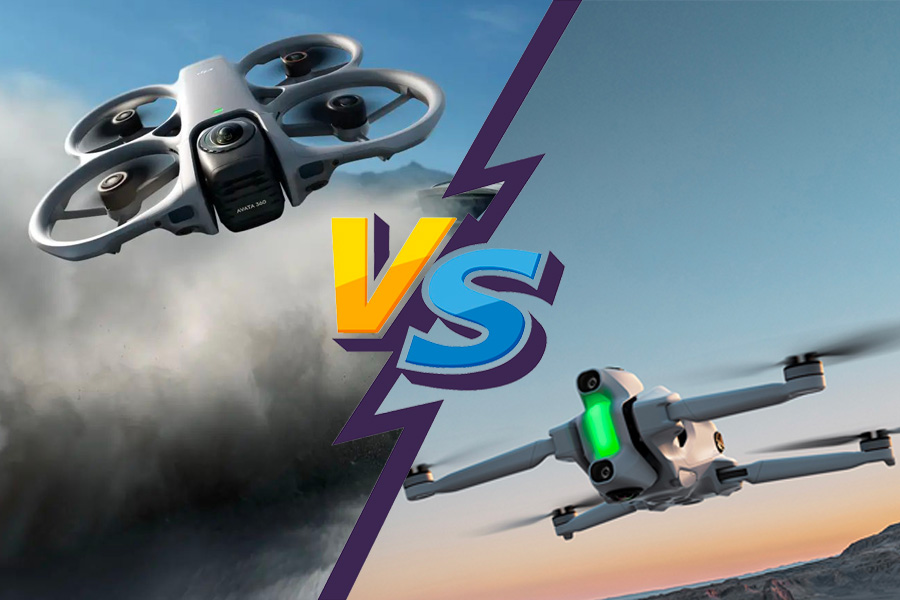
Following the arrival of the Antigravity A1, the first FPV drone capable of 360° filming, DJI was quick to respond with its own model. The DJI Avata 360 vs Antigravity A1 showdown is a veritable duel between two visions of the same concept: on one side, a pioneer from the world of 360° video; on the other, the leader in consumer drone technology, with a vision all its own. But what are the differences between these two drones? What do they have in common? And above all, which one should you choose? All the answers in this comprehensive comparison.
DJI Avata 360 vs Antigravity A1: What you need to know
No time (or laziness 😅 ) to read it all? Here are the key points of this DJI Avata 360 vs Antigravity A1 comparison 👇
- 🛡️ More robust and better protected: Avata 360
- 🪶 Lighter and more compact : Antigravity A1
- 🎮 Versatile piloting (FPV + conventional radio control) : Avata 360
- 📡 More reliable, longer-range transmission: Avata 360
- 🔋 B etter autonomy (especially with high-capacity battery) : Antigravity A1
- 🎬 More photo/video modes (HDR, timelapse…) : Antigravity A1
- 🎥 Best overall image quality: Avata 360
- 🧠 More advanced editing software: Antigravity A1
- 💸 Much more affordable: Avata 360
👉 Avata 360 = versatility, image, performance, price
👉 Antigravity A1 = pure 360°, autonomy, creativity
DJI Avata 360 vs Antigravity A1 : Design
| DJI Avata 360 | Antigravity A1 | |
| Weight | 455 g | 249 g (with standard battery) 291 g (with high-capacity battery) |
| Dimensions (L x W x H) | 246 × 199 × 55.5 mm | 141.3 × 96.2 × 81.4 mm (folded) 308.6 × 382.3 × 89.2 mm (unfolded) |
| Storage | Internal memory 42 GB Memory card up to 1 TB | Internal memory 20 GB microSD card up to 1 TB |
| Class (UE) | C1 | C0 with standard battery C1 with high-capacity battery |
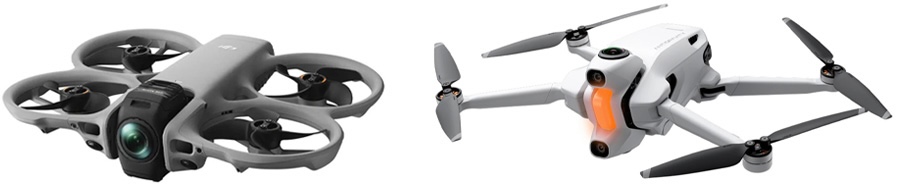
In terms of design, these two drones take radically different approaches, and this is immediately apparent when you first pick them up. The DJI Avata 360 relies on a fixed chassis with integrated propeller guards, typical of CineWhoop drones. The result is a more robust unit, better protected in the event of impact, but also safer when flying close to people or in tight environments. In contrast, the Antigravity A1 uses a more conventional design with folding arms and unprotected propellers, making it more compact when folded and easier to transport, but also more exposed.
This difference in design has a direct impact on the weight and regulations. The A1 is considerably lighter, weighing in at 249 g in the standard version (standard battery), which means it can be classified as a C0 – a generally more flexible category, with fewer constraints for leisure use, depending on the country. On the other hand, with the high-capacity battery, it reaches 291 g and falls into C1, with slightly stricter rules. The DJI Avata 360, on the other hand, weighs in at 455g and is directly classified C1. An important point to take into account, depending on your use.
On the camera side, both UAVs use a dual-lens system for 360° capture, but with different logics. On the Antigravity A1, the lenses are fixed, with an automatically retractable undercarriage that protects the lower lens during ground phases. The DJI Avata 360 offers a more advanced system, capable of switching between 360° capture and a single forward-facing lens, while automatically protecting the lenses when the drone is landed.
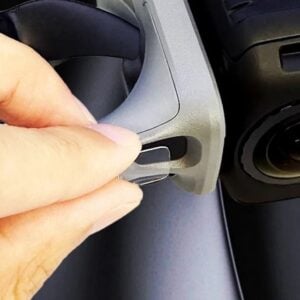
Both models also feature lenses that can be replaced via a dedicated kit, so you can change them yourself in the event of a scratch, without having to go to the after-sales service. Finally, on the storage side, the DJI Avata 360 has the edge with 42 GB of internal memory, versus 20 GB for the Antigravity A1, although both accept microSD cards to expand capacity.
🏆 DJI Avata 360: more robust and better protected
🏆 Antigravity A1: lighter, easier to carry and more flexible on the regulatory side
DJI Avata 360 vs Antigravity A1: Transmission and radio controls
| DJI Avata 360 | Antigravity A1 | |
| Compatible radio controls | DJI RC 2 DJI RC-N2 / DJI RC-N3 DJI RC Motion 3 DJI FPV Remote Controller 3 | Grip Motion Controller |
| Compatible FPV goggles | DJI Goggles 3 DJI Goggles N3 | Vision Goggles |
| Video transmission system | DJI O4+ | OmniLink 360 |
| Max. transmission distance | FCC: 20 km CE: 10 km | FCC: 10 km CE: 6 km |
| Live preview quality | Single lens: 1080p up to 100 fps 360°: 1080p up to 60 fps | 2K at 30 fps |
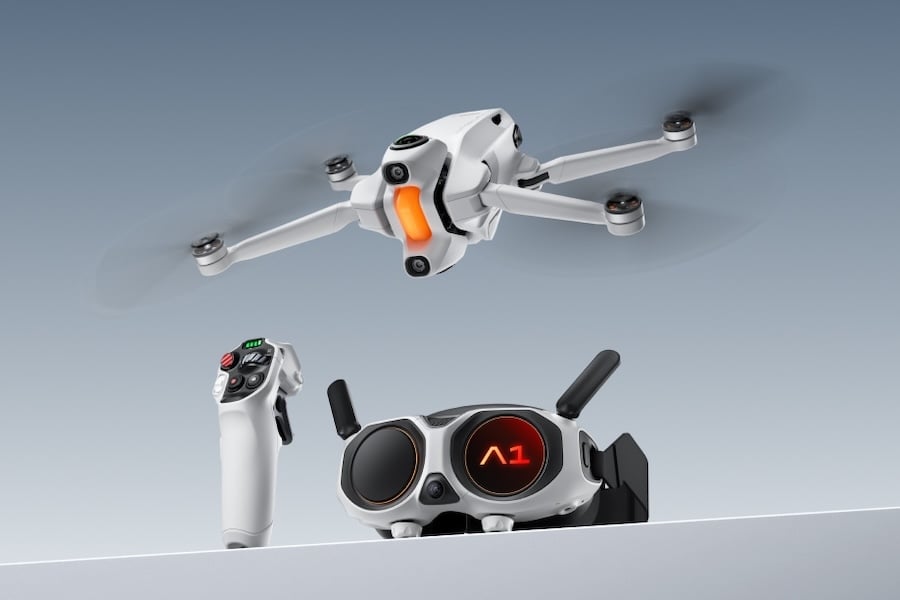
In this respect, the difference between the two drones is quite clear from the outset: the DJI Avata 360 can be flown in two ways, either with a conventional remote control or in FPV with a helmet, whereas the Antigravity A1 is designed exclusively for FPV use. An important difference, which changes the flying experience in concrete terms.
With the Avata 360, you can fly without a helmet, just like with a conventional drone. DJI offers several options:
- DJI RC 2: ready-to-use remote control with integrated display
- DJI RC-N2 / RC-N3: remote controls without display, requiring the use of a smartphone
A real advantage for simple or quick shots, without having to bring out an entire FPV setup. In contrast, the Antigravity A1 systematically requires the use of an FPV helmet, with a 100% immersive approach.
In FPV, both drones use a similar logic, with a single-handed gyro controller . The DJI Avata 360 uses the DJI RC Motion 3, while the Antigravity A1 relies on the Grip Motion Controller. Both offer intuitive control based on wrist movements, although the Antigravity controller has a few more buttons, while the DJI controller is more streamlined and accessible. Note that the DJI Avata 360 can also be flown with a conventional two-handed FPV remote controller (DJI FPV Remote Controller 3), which the A1 does not offer.
When it comes to goggles, too, approaches differ. DJI offers its Goggles 3 and Goggles N3, with a battery integrated into the headband and a well-established ecosystem. On the other hand, the Antigravity A1 uses the Vision Goggles, which are distinguished by the presence of an external screen on the front, enabling a nearby person to see the live video feed. Here, the battery is deported, attached to the strap, which slightly alters comfort and balance.
On the immersion side, both drones offer the full benefit of FPV, but with a different logic. On the Antigravity A1, the 360° view is native to the helmet, allowing you to look freely in all directions during flight. On the DJI Avata 360, the view is forward-facing by default, and you need to activate Head Tracking to achieve similar behavior.
Last but not least, video transmission turns out to DJI’s advantage. The DJI O4+ system offers a longer range (up to 10 km in CE) and, above all, a more stable connection, with 1080p video return at up to 100 fps in classic mode. Opposite, the Antigravity A1 uses the OmniLink 360 system, with a more limited range(6 km in CE) and 2K video return at 30 fps, which is correct but sometimes subject to latency or micro-lags depending on conditions.
🏆 DJI Avata 360: more versatile and more reliable in transmission
Discover our accessories for
DJI Avata 360
DJI Avata 360 vs Antigravity A1: In-flight performance
| DJI Avata 360 | Antigravity A1 | |
| Maximum speed | 6 m/s (Cine mode) 16 m/s (Normal mode) 18 m/s (Sport mode) | 3 m/s (Mode C) 12 m/s (Mode N) 16 m/s (Mode S) |
| Max. ascent speed | 2 m/s (Cine mode) 6 m/s (Normal mode) 10 m/s (Sport mode) | 3 m/s (Mode C) 6 m/s (Mode N) 8 m/s (Mode S) |
| Max. descent speed | 1.5 m/s (Cine mode) 6 m/s (Normal mode) 10 m/s (Sport mode) | 3 m/s (Mode C) 6 m/s (Mode N) 8 m/s (Mode S) |
| Max. wind resistance | 10.7 m/s (level 5) | 10.7 m/s (level 5) |
In the field, both drones offer a generally stable and accessible flying experience, with healthy behavior in most situations. In both cases, you’ll find several flight modes (Cine, Normal, Sport), allowing you to adapt the drone’s behavior according to use: smooth shots in Cine mode, balanced flight in Normal, or maximum performance in Sport mode (often with fewer assists).
On the speed side, the DJI Avata 360 takes a slight advantage, with a top speed of 18 m/s (≈ 64.8 km/h) in Sport mode, versus 16 m/s (≈ 57.6 km/h) for the Antigravity A1. A difference that remains moderate, but slightly noticeable on fast trajectories or dynamic shots. Overall, the Avata 360 is a little more responsive on all axes.
On the wind resistance side, both drones claim an identical value of 10.7 m/s (level 5). In fact, the available feedback suggests that both models behave in a stable and reassuring manner, even if no direct test can really distinguish them on this point.
One thing stands out quite clearly, however: noise. The DJI Avata 360 is often described as louder, with a high-pitched sound typical of CineWhoop drones. The Antigravity A1 is more discreet in flight, which can be an advantage depending on the environment or type of use.
🏆 DJI Avata 360: slightly faster and more responsive in flight
DJI Avata 360 vs Antigravity A1: Battery life and recharging
| DJI Avata 360 | Antigravity A1 | |
| Battery | 2700 mAh | 2360 mAh (standard battery) 4345 mAh (high-capacity battery) |
| Autonomy | 23 minutes | 24 minutes (standard battery) 39 minutes (high-capacity battery) |
| Charging time | Direct charge (65W): 73 min (1 battery) Station (100W): 47 min (1 battery) / 100 min (3 batteries) | Standard battery: 45 min (hub) / 58 min (drone) High-capacity battery: 60 min (hub) / 103 min (drone) |
On paper, the two drones boast fairly similar autonomy, with 23 minutes for the DJI Avata 360 and 24 minutes for the Antigravity A1. in standard configuration. Classic theoretical values, to be taken with a little hindsight.
In real-world conditions, according to independent tests and user feedback, the Avata 360 takes 15 to 18 minutes , compared with 18 to 20 minutes for the Antigravity A1. A slight advantage for the latter, even if the difference remains moderate and highly dependent on flying style and conditions.
The Antigravity A1 does, however, offer an interesting feature: an optional high-capacity battery, which provides up to 39 theoretical minutes , or around 30 minutes in actual use. A more durable configuration, but one that weighs the drone down and puts it in category C1.
On the recharging side, both drones offer similar solutions, with direct recharging or via a charging station. The Antigravity A1 is a little quicker to recharge, especially with its standard battery, while the DJI Avata 360 remains in the middle of the range, with around 1h to 1h15 per battery, depending on the charging mode.
🏆 Antigravity A1: better overall autonomy, especially with the high-capacity battery
OUR BEST SELLERS - DJI Avata 360
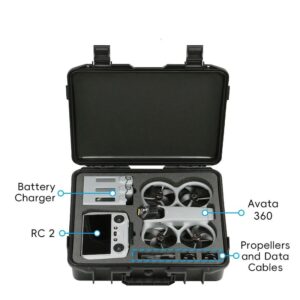
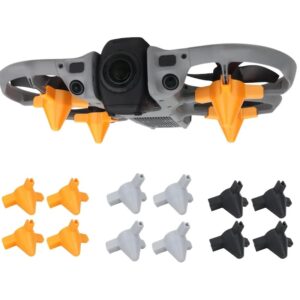
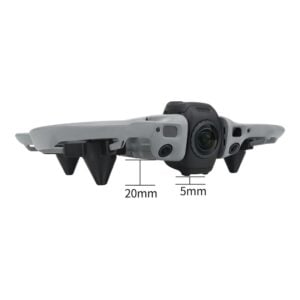
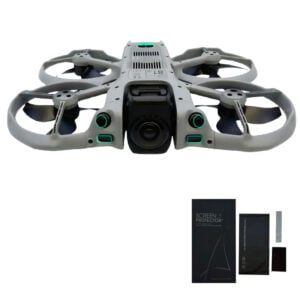
Avata 360
DJI Avata 360 vs Antigravity A1 : Features
| DJI Avata 360 | Antigravity A1 | |
| Capture type | Single lens + 360 | 360° only |
| Photo modes | Single shot | Standard photo, HDR, Rafale, AEB |
| Video modes | Standard video, QuickShots (via classic RC) | Standard video, Slow motion, Timelapse, Sky Genie |
| Subject follow-up | ActiveTrack 360° subject tracking | Subject follow-up |
| Flight planning | ❌ | Sky Path (routes) |
| Obstacle detection | Omnidirectional + front LiDAR | Front only |
Two user philosophies
The DJI Avata 360 and the Antigravity A1 are both based on 360° capture, but their approach differs slightly. The Antigravity A1 is a drone entirely designed for 360°, with an immersive capture logic where framing is always an afterthought. The DJI Avata 360, on the other hand, adds a second possibility with its single-lens mode, allowing more conventional filming without the need for post-production cropping. This makes it more versatile in use, whereas the A1 remains more specialized.
Photo and video modes: A1 advantage
In terms of shooting modes, the Antigravity A1 is more complete. It offers several photo options(HDR, burst, AEB) as well as more video possibilities, including a slow-motion mode and timelapse, absent as dedicated modes on the DJI.
That said, the DJI Avata 360 makes up for this in part with its recording capabilities. It can film at up to 60 frames per second, in both 8K and 4K, whether in single-lens or 360° mode. Even so, it’s possible to achieve x2 slow motion in post-production, even without a specific mode.
Both drones also offer QuickShots-type automated movements (or the equivalent with Sky Genie on the A1), although those of the DJI are only available for use with a conventional remote control.
Subject tracking: similar functions
The Antigravity A1 offers subject tracking with several positioning options around the target (front, side, rear). The system maintains a stable trajectory while adapting the drone’s position around the subject according to the desired rendering.
The DJI Avata 360 takes subject-tracking functions a step further. It incorporates ActiveTrack 360°, as well as Spotlight Free mode, which lets you lock on to a subject while retaining control of the drone. DJI also offers several tracking profiles adapted to certain situations (standard mode, cycling or skiing), to adjust tracking behavior according to activity. Note that these functions are only available in 360° mode, and are not accessible in single-lens mode.
In both cases, 360° capture then enables the framing to be reworked in post-production, with tracking tools available in the respective applications.
Obstacle detection: the DJI advantage
In this respect, the DJI Avata 360 has a clear advantage. It features omnidirectional detection, reinforced by forward-facing LiDAR, capable of improving detection in difficult conditions, particularly in low light or against low-contrast surfaces.
In contrast, the Antigravity A1 is limited to forward detection only. This is consistent with its operation (the drone moves forwards only), but is inevitably more limited in complex environments.
Applications and post-production: advantage A1
On the software side, both UAVs take full advantage of 360° capture, with tools for cropping, tracking and creating key points.
However, the Antigravity A1 benefits from the Insta360 ecosystem, renowned for its particularly intuitive, comprehensive and mature applications, with real experience in 360° image processing.
The DJI Avata 360 is still very solid with DJI Fly and DJI Studio, which already let you do a lot of things, but the overall experience appears slightly less advanced and less fluid.
🏆 DJI Avata 360: more versatile and better equipped for safety
🏆 Antigravity A1: richer in modes and more advanced on the software side
Discover our accessories for
Antigravity A1
DJI Avata 360 vs Antigravity A1 : Image
| DJI Avata 360 | Antigravity A1 | |
| Aerial work platform | Single-axis mechanical gondola (tilt) | Fixed cameras (without mechanical gondola) |
| Sensors | 1/1.1 inch | 1/1.28 inch |
| Objective | Equivalent format 7.8 mm Aperture f/1.9 FOV 200° (in mm) | Aperture f/2.2 |
| Photo resolution | 30 MP / 120 MP | 14 MP / 55 MP |
| Max. video resolution | 360° mode: 8K up to 60 fps 6K up to 60 fps Single-lens mode: 4K up to 60 fps 2.7K up to 120 | 8K up to 30 fps 5.2K up to 60 fps 4K up to 100 fps |
| ISO range | 100 à 12800 | 100 à 6400 |
| Max. bit rate | 180 Mb/s | 170 Mb/s |
| Photo format | JPEG DNG (RAW) | INSP DNG |
| Video format | OSV/MP4 (H.265) | INSV |
| Color profile | Normal D-Log M | Standard |
Nacelle, sensors and resolution
Technically, the two drones are based on a similar architecture, with two opposing sensors dedicated to 360° capture, but the DJI Avata 360 retains a slight advantage on several key points.
It uses 1/1.1-inch sensors, compared with 1/1.28-inch for the Antigravity A1. This discrepancy, however moderate, works in the DJI’s favor, especially when it comes to managing light and contrasting scenes.
Another important difference is that the DJI features a single-axis mechanical gondola, enabling it to switch to single-lens mode with a steerable camera. The A1, on the other hand, relies on fixed cameras designed exclusively for 360° capture, which limits its versatility.
On the definition side, the DJI Avata 360 also has the edge, with photos up to 120 MP in 360°, compared with 55 MP for the A1. In video, it goes up to 8K 60 fps in 360°, but also offers a classic 4K mode at up to 60 fps with a single lens. The Antigravity A1, on the other hand, remains limited to 360° capture with a maximum of 8K 30 fps.
👉 On paper, then, the DJI Avata 360 is more complete, both more versatile and more capable on raw specs.
Image quality
In practice, the two drones deliver very similar image quality in favorable conditions, with a good level of detail and convincing 360° rendering.
However, the DJI Avata 360 stands out for its often higher-contrast rendering, with better dynamic range management. Highlights are generally better controlled, and the image gains in relief in complex scenes.
On the other hand, the Antigravity A1 offers a softer rendering, sometimes slightly less contrasted, but also more homogeneous in certain situations. In simple, well-exposed scenes, the difference between the two models remains relatively discreet.
However, the difference becomes more apparent in more demanding situations, such as low light or high contrast. Thanks to its slightly larger sensors, the DJI Avata 360 generally retains more detail in dark areas, with a cleaner, better-balanced image.
Last but not least, the DJI Avata 360 comes with a D-Log M profile for post-production colorimetry. A real plus for those who like to fine-tune their images, with more scope to correct exposure or rework colors. The A1 remains limited to standard rendering, which is easier to use, but less flexible.
🏆 DJI Avata 360: a more controlled image, especially in difficult conditions
DJI Avata 360 vs Antigravity A1: Packs and prices
ℹ️ Note: some links in this section are Amazon affiliate links. As Amazon Associates, we earn from qualifying purchases, at no extra cost to you.
| DJI Avata 360 | Antigravity A1 | |
| Drone alone | 459 € | Not available |
| Standard package | 719 € | 1399 € (Standard) |
| Complete package | 939 € (Fly More DJI RC 2) | 1599 € (Explorer) |
| FPV Pack | 939 € (Motion Fly More) | 1699 € (Infinite) |
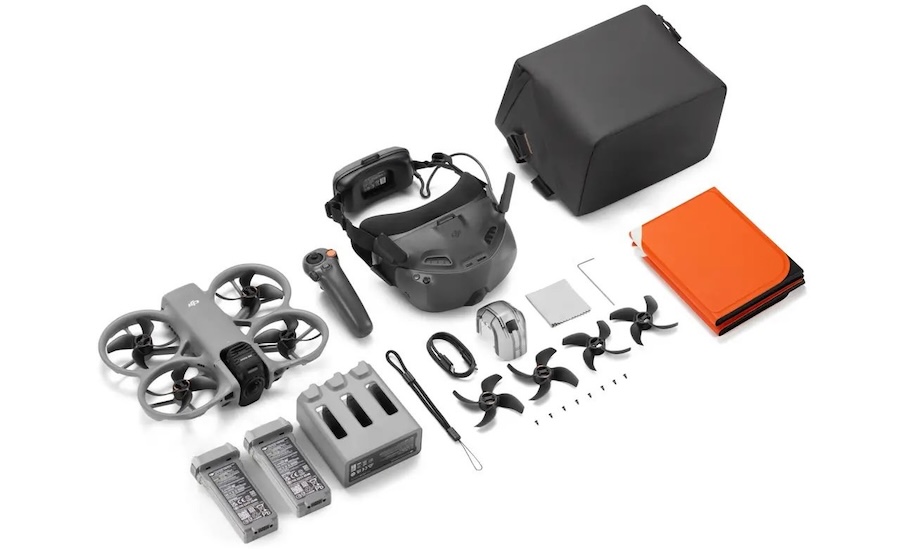
The two drones take very different approaches to packaging, which largely explains the price difference.
On the DJI side, we find a more accessible offering, with a key point: the DJI Avata 360 is available as a stand-alone drone (€459). A real advantage for those who already own a DJI remote control or compatible FPV equipment, since the drone can be easily integrated into an existing setup without having to buy everything again.
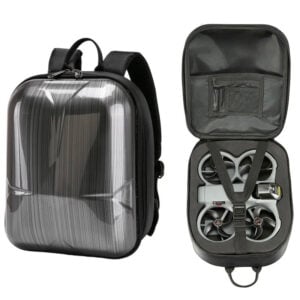
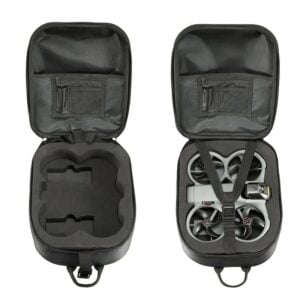
For those starting from scratch, the pack with DJI RC 2 (€719) provides a ready-to-use solution with integrated screen. The Fly More versions (€939) add extra batteries, a charging station and a carry bag for added comfort. Finally, a pack at the same price directly offers an FPV configuration with Goggles N3 and RC Motion 3, for a complete immersive experience right from the outset.
At Antigravity, the approach is different: no “drone-only” version is offered. All packs directly include a complete FPV setup. The standard pack (€1399) already includes drone, goggles and radio control. The Explorer pack (€1599) adds extra batteries and a charging station, while the Infini pack (€1699) incorporates high-capacity batteries to maximize autonomy.
The brand also offers other, more complete packs( Ultimatepack, versions with propeller protectors…), which mainly add accessories such as an SD card, quick charger or protectors. In practice, these versions make no difference to the drone’s performance, but rather allow you to add to your equipment from the outset, at a price that quickly climbs.
All in all, the DJI Avata 360 is far more affordable, with a much lower initial price and the option of upgrading gradually. The Antigravity A1, on the other hand, offers a more complete all-in-one package from the outset, but is also much more expensive.
🏆 DJI Avata 360: a much more affordable price
OUR BEST SELLERS - Antigravity A1


Accessories


Accessories
Conclusion DJI Avata 360 vs Antigravity A1: which to choose?
The DJI Avata 360 is an extremely versatile drone. It can be used both in conventional mode with a remote control, and in FPV with a helmet, while offering the possibility of single-lens or 360° filming. It also boasts superior overall image quality, especially in complex scenes, as well as a more accessible price positioning, especially for users already equipped with DJI equipment.
For its part, theAntigravity A1 takes a more specialized approach. Designed entirely around 360° capture, it offers a coherent, immersive experience, with more shooting modes and a highly advanced software ecosystem. Its more compact and lighter format is also an advantage, especially for transport and regulation with the standard battery.
💡 To sum up : the DJI Avata 360 is the most versatile and accessible choice, while the Antigravity A1 is more for those who want to focus fully on 360° video.
👉 Choose the DJI Avata 360 if:
- you want a versatile drone (360° + single lens)
- you want to fly in FPV or with a conventional remote control
- you’re looking for better overall image quality
- you want a cheaper drone, especially if you already have compatible DJI equipment
👉 Choose Antigravity A1 if :
- you want a drone entirely dedicated to 360° capture
- you’re looking for more photo and video modes (HDR, timelapse, etc.)
- you prefer more advanced, intuitive editing software
- you want a lighter, more compact drone
💡 Looking for more?
➡️ Read our detailed review of the DJI Avata 360
➡️ Read our complete guide to the Antigravity A1

 Blog
Blog