
 Français
 Deutsch
 Español
 Italiano
 Parts & Accessories by Drone
 Drones
 Action camera
 Microphones
 Camera stabilizers
 VR Headsets
Autel EVO Nano+: full review
Jul
With the Autel EVO Nano+, Autel Robotics expands its drone range to compete with DJI’s best-sellers in the sub-250-gram drone category. So what’s under the hood? How does it stack up against the market leaders? Does it have a place among the best light drones on the market? Discover all the answers in this article!
Autel EVO Nano+: design

| Weight | 249g |
| Dimensions (folded, with propellers) | 142 × 94 × 55 mm |
| Dimensions (unfolded, with propellers) | 260 × 325 × 55 mm |
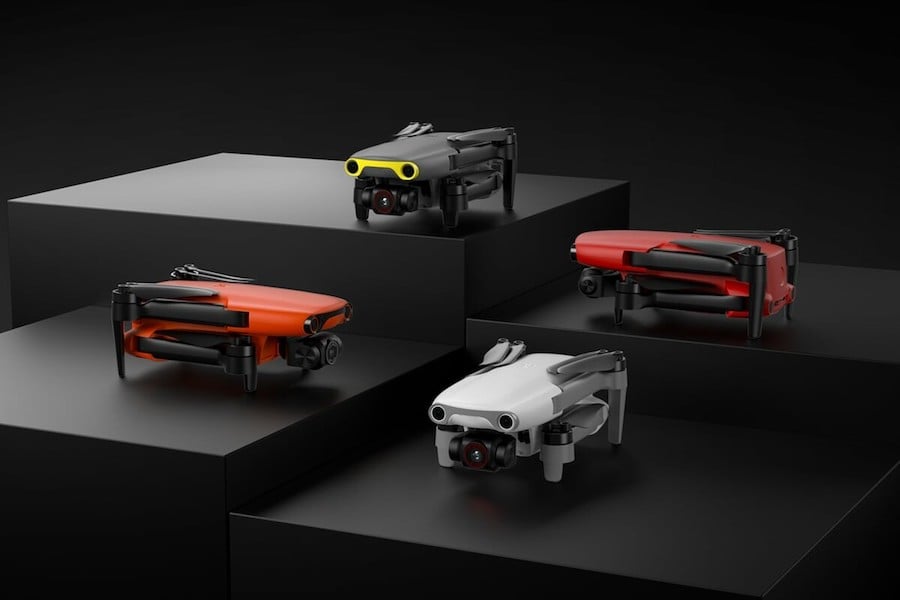
Like many competitors of the famous DJI Mini, the Autel EVO Nano+ boasts a very similar design, with its folding arms characteristic of the market leader’s mini drones. With dimensions of 142 × 94 × 55 mm when folded, the Nano+ is slightly longer and wider than the Mini 2, but remains under the 250-gram mark (249g to be precise) and can still fit in the palm of your hand.
Unlike the first DJI Minis, the Nano+ is distinguished by the absence of a rear hatch. The battery slides directly into the drone, beneath the charging port and memory card slot, with the power button integrated into the battery itself. Another notable feature is the presence of obstacle sensors: two at the front, two at the rear and two underneath.
When it comes to style, the Nano+ offers four attractive colors: the iconic Autel orange, the brand’s signature color, arctic white, “deep space” gray and flamboyant red.
Autel EVO Nano+ : radio control

| Video transmission system | SkyLink altar |
| Maximum transmission distance | 10 km (FCC) 5 km (CE) |
| Real-time transmission quality | 2.7K 30ips (less than 1 km) 1080P 30ips (more than 1 km) |
| Autonomy | approx. 2.5 hours (connected to a smartphone) approx. 3.5 hours (not connected to a smartphone) |
The Autel EVO Nano+’s remote control is clearly inspired by video game controllers, with its elongated handles ensuring a comfortable grip. Like DJI’s RC-N1, this standard remote control without screen features a retractable holder on the top edge for your smartphone.
Lightweight and ergonomic, this remote control is easy to use and highly responsive. That said, it remains a little basic. We’d have liked a little space to store the joysticks, as well as a switch for the flight modes. Although these are accessible from the top left of the Autel Sky application, a dedicated button would have been even more practical.
On the transmission side, the remote control uses Autel’s SkyLink system, offering a range of 10 km for FCC-compliant countries and 5 km for European-compliant countries.
According to available feedback, the transmission proves to be excellent. The connection remains stable beyond one kilometer, with no noticeable signal loss. Video feed quality is impressive (2.7K at 30 fps up to 1 km, then 1080p), with no perceptible latency.

Discover our accessories for
Autel EVO Nano+
Autel EVO Nano+: in flight
Flight performance
| Maximum speed | 15 m/s |
| Maximum ascent speed | 5 m/s |
| Maximum descent speed | 4 m/s |
| Maximum wind resistance | 10 m/s |
Like drones from rival DJI, the Autel EVO Nano+ offers three flight modes:
- Smooth mode (equivalent to DJI’s Cine mode), ideal for slow flights and smooth shots.
- Standard mode (equivalent to DJI’s Normal mode), perfect for everyday flying.
- Ludicrous mode (equivalent to DJI’s Sport mode), for maximum drone speeds.
In all these modes, the Nano+ tends to be a little slower than the DJI Mini in the same modes. Similarly, the drone’s maximum speed (15 m/s, or 54 km/h) is lower than that of DJI’s, which tops out at 16 m/s (around 58 km/h). However, this is not a problem in itself, and the reduced speed in Smooth mode offers even smoother shots.
So how does the Nano+ perform in flight? Firstly, it’s a little quieter than the DJI Mini. The difference is subtle, but the lower-pitched sound of the Nano+ is more pleasant. In terms of handling, it’s very similar to the Mini 2. The Nano+ flies superbly well, is easy to handle and very stable in flight. You quickly feel at ease with him.
The only hitch? Wind resistance. On paper, Autel claims a wind resistance of 10 m/s (up to 36 km/h). However, we found it a little less capable than DJI drones in this area. In hovering flight, the Nano+ stabilizes well in the face of a few gusts, but its speed in flight is significantly reduced when facing the wind.
Obstacle detection
| Obstacle detection system | Forward Backward Downward |
If you’re worried about flying close to walls or trees, the Nano+ will put your mind at rest. It is equipped with a three-way obstacle avoidance system that detects everything in front of, behind and below it. This function is active in Smooth and Standard modes, and logically deactivated in Ludicrous mode to allow maximum speed.
The Nano+ has no obstacle avoidance system like DJI’s APAS, which automatically avoids obstacles. If an obstacle is detected, the drone will slow down, giving you time to maneuver manually to avoid a collision. If no action is taken, the drone will stop automatically.
This feature works well, sometimes a little too well. Some feedback mentions slowdowns caused by obstacle detections considered overly sensitive, with no clearly identifiable reason. We haven’t been able to determine exactly why, but we assume that sunlight entering the sensors may have been interpreted as an object.
Autonomy
| Batteries | 2250mAh |
| Autonomy | 28 minutes |
| Charging time | 90 minutes |
The Autel EVO Nano+’s battery has a capacity of 2250 mAh, promising a flight time of 28 minutes , according to the manufacturer. That’s a little less than the 31 minutes claimed by DJI for its Mini 2 and other equivalents (Mini 2 SE, Mini 4K, etc.).
But let’s face it, these figures are obtained under optimal conditions. In practice, actual flight times are often 5 to 10 minutes shorter than advertised. In real-world conditions, observed flight time generally sits around 25 minutes, which remains very close to that of the DJI Mini 2 and similar models. So, on this point, the Nano+ holds its own and has little to be ashamed of when compared with its rivals.
OUR BEST SELLERS - Autel EVO Nano+


Autel EVO Nano+: photo and video
| Sensor | 1/1.28-inch 50 MP CMOS |
| Lens | Equivalent format 23mm Aperture f/1.9 FOV 85° (in mm) |
| Maximum photo resolution | 50 MP |
| Maximum video resolution | 4K up to 30 fps 2.7K up to 30 fps 1080p up to 60 fps |
| ISO range | 100 à 6400 |
| Maximum bit rate | 100 Mbps |
| Digital Zoom | up to 16 times |
| Photo format | JPG(8-bit) DNG(10-bit) JPG+DNG |
| Video format | MP4 MOV |
Sensor and resolution
When we take a look at the Autel EVO Nano+’s technical specifications, we immediately see that the camera is its main attraction. It is equipped with a 1/1.28-inch CMOS sensor, much larger than those of DJI drones available at the same time, such as the Mini 2 with its 1/2.3-inch sensor, and even very slightly larger than those of the Mini 3 and higher models, which feature a 1/1.3-inch sensor.
With a fixed aperture of f/1.9, the Nano+ lens lets in a large amount of light, guaranteeing exceptional results even in low light. We’ll look at this in more detail in the next section on image quality.
Although the Nano+’s sensor is more powerful than that of the Mini 2 and similar models, its maximum video resolution remains 4K at 30 frames per second. In 2.7K, frame rate is also limited to 30 fps, while the Mini 2 can reach 60 fps. For slow-motion fans, you’ll need to switch to 1080p to benefit from a higher frame rate (60 fps).
When it comes to photography, on the other hand, the Nano+ stands out with its ability to take both 12 MP and 50 MP photos, offering impressive sharpness and richness of detail.
Image quality
To cut a long story short, the Autel EVO Nano+ looks great. Thanks to its large sensor, it produces vivid images with good dynamic range and rich detail. In automatic mode, exposure is generally well-balanced and images are sharp.
However, this sharpness can sometimes be excessive. We can see that software processing accentuates contours, which can enhance certain shots but also distort the scenery by overemphasizing details.
Autel has clearly opted for a calibration process that aims to please as many people as possible, by accentuating sharpness, saturation and contrast. This often results in really superb, high-contrast images, but can sometimes lack smoothness. It all depends on taste.
In low light, the Nano+’s large sensor works wonders. It captures light well without needing to go too high on the ISO scale, resulting in well-exposed images with very little grain.
Photo and video features
First of all, the Autel EVO Nano+ offers a manual mode, the Pro mode, which lets you manually set exposure, ISO and white balance, for perfectly adjusted shots.
The drone is also equipped with a digital zoom of up to 16 times. Impressive for a sensor of this size, but beware: image quality suffers at this level of magnification. Ideal for scouting, less so for obtaining usable images.
The Nano+ integrates a wide range of modes and functions to boost your creativity:
- Panorama mode: Create wide-angle images with horizontal, vertical, wide-angle and sphere options.
- Hyperlapse mode: shoot fast-motion videos, a mode often found on action cameras but absent from DJI Mini up to Mini 3.
- Cinematic Shots: Like DJI’s QuickShots, these modes let you create automatic motion videos with a single click. Choose between Rocket, Fade Away, Orbit and Flick.
- MovieMaster: use ready-made templates to quickly edit personalized video clips and post them instantly to social networks.
- SkyPortrait: Select yourself and/or a group of people as the subject, and the drone will automatically fly to include everyone in the image and blur the background for a professional effect.
- Dynamic Track: Autel’s subject tracking function can follow a person, a vehicle or even a moving animal.
- SoundRecord: Uses your smartphone’s microphone to record surrounding sounds as you film.
Finally, the Nano+ also features the SuperDownload function, which, like DJI’s QuickTransfer, allows you to download videos to your phone quickly and easily (20 MB/s) by placing it close to the drone.
Autel EVO Nano+: price

ℹ️ Note: some links in this section are Amazon affiliate links. As Amazon Associates, we earn from qualifying purchases, at no extra cost to you.
| Standard Pack | 679 $ |
|
| Premium Pack | 799 $ |
|
The Autel EVO Nano+ is offered as a standard package for $679 on the manufacturer’s official store. For this price, you’ll receive the drone, remote control, battery, four spare propellers, a protective cover for the nacelle and various charging and data transfer cables.
For those who want more accessories, the Nano+ is also available in a Premium package. This pack includes three batteries instead of one, twelve spare propellers instead of four, a carry bag, a charging station and a propeller attachment. The complete package is priced at $799 on the official store.
🚨 Two different models
In addition to the Nano+, there’s the Autel EVO Nano (for short). This little brother is distinguished only by its camera. The Nano is equipped with a smaller sensor (1/2 inch), which means slightly lower image quality, but it’s also more affordable.
Conclusion Autel EVO Nano+: the drone for you?
The Autel EVO Nano+ was a breath of fresh air and full of promise when it came out. Compared with drones weighing less than 250 grams available at the time (such as DJI’s Mini 2), the Nano+ stands out for its much larger sensor, offering superior results, especially in low-light conditions. It also offers new features for a drone in this range, such as obstacle detection and subject tracking.
That said, it didn’t take long for DJI to catch up, with the release of the Mini 3 Pro a few months later, in May 2022. For a similar price to the Nano+, the Mini 3 Pro offers advantages such as a rotating camera for true vertical shots, and superior battery life.
However, if you’re looking for an alternative to DJI, then the Nano+ could well be the drone for you. Reliable, powerful and capable of producing beautiful images, the Autel drone is a solid option. It also represents the competition needed to ensure that drone fans continue to benefit from innovation at affordable prices.
In short, the Autel EVO Nano+ is an excellent option for those who want to explore beyond DJI’s offerings. With its features, performance and image quality, the Nano+ has everything to seduce. So, is this the drone for you? It’s up to you!
See also our full test of the DJI Mini 3 Pro:
➡️ DJI Mini 3 Pro: our full test

All our accessories & parts for
Autel EVO Nano+

 Blog
Blog