
 Français
 Deutsch
 Español
 Italiano
 Parts & Accessories by Drone
 Drones
 Action camera
 Microphones
 Camera Stabilizers
 VR Headsets
Insta360 Luna Pro vs. Luna Ultra: Which One Should You Choose?
Oct
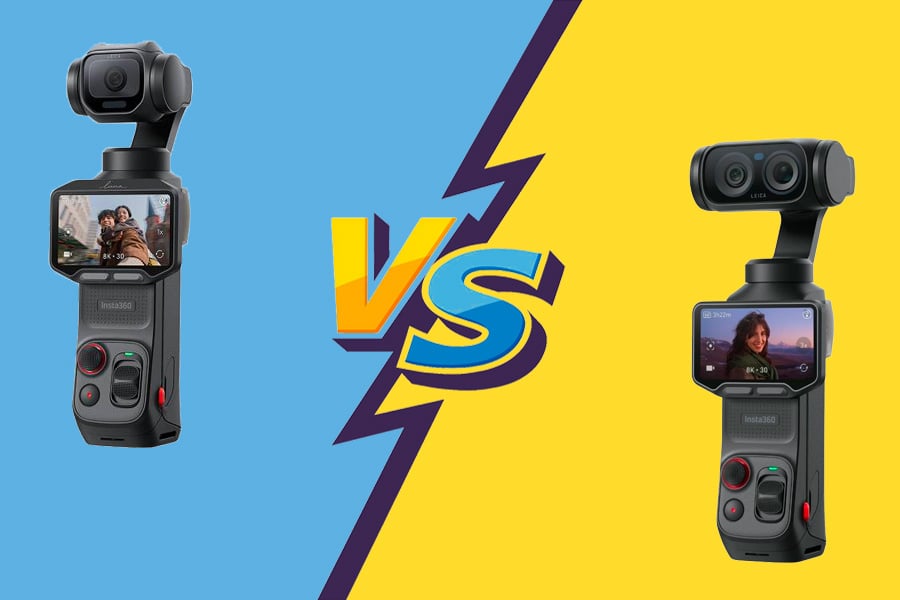
After establishing itself as one of the key players in the 360° camera market, Insta360 is now venturing into new territory: that of stabilized pocket cameras, a market previously dominated by DJI and its Osmo Pocket line. And for its debut in this category, the manufacturer has launched not one, but two cameras: the Luna Pro with its single lens and the Luna Ultra with its dual-lens system. But beyond this major difference, what really sets these two models apart? Does the Luna Ultra justify its higher price, or does the Luna Pro offer the best balance? And most importantly, which one should you choose based on your needs? Find all the answers in our comprehensive comparison. Insta360 Luna Pro vs. Luna Ultra.
Insta360 Luna Pro vs. Luna Ultra: Key Takeaways
Don’t have time (or just can’t be bothered 😅) to read it all? Here are the key differences to keep in mind between the Insta360 Luna Pro and the Luna Ultra 👇
- 📐 The Luna Pro is slightly more compact and lighter, but both cameras offer very similar ergonomics, including the same fully detachable 2-inch OLED screen and 47 GB of internal storage.
- 🔋 On the side of battery life and charging, there are no notable differences: both models feature a 1,550 mAh battery, with up to 240 minutes of battery life advertised and 80% battery charge restored in 23 minutes.
- 🎬 The core features are largely the same, but the Luna Ultra has a slight edge thanks to its Scene mode and features specifically designed for concerts and live performances, particularly in terms of tracking and audio.
- 📷 The image quality is very similar to that of the main camera, since both cameras use the same 1-inch sensor and the same 20 mm f/1.8 lens. The Luna Ultra stands out mainly because of its second sensor and 60mm telephoto lens, which offer much more flexibility in framing and zooming.
- 💸 The Luna Pro is significantly less expensive, with a Standard Pack priced at €529 compared to €729 for the Luna Ultra. The various packs and accessories available for the Luna Ultra can also drive up the cost even further.
📌 The Luna Pro offers the best balance for enjoying the core Luna experience at a lower cost, while the Luna Ultra justifies its higher price primarily through its telephoto lens and significantly greater versatility in terms of framing.
Insta360 Luna Pro vs. Luna Ultra: Design
| Insta360 Luna Pro | Insta360 Luna Ultra | |
| Dimensions (L x W x H) | 155.7 × 52.8 × 38.5 mm | 169.9 × 52.4 × 38.5 mm |
| Weight | 215 g (black) to 218 g (white) | 233 g (black) to 235 g (white) |
| Touchscreen | Detachable 2-inch OLED | Detachable 2-inch OLED |
| Storage | 47 GB built-in memory microSD card (up to 2 TB) | 47 GB built-in memory microSD card (up to 2 TB) |
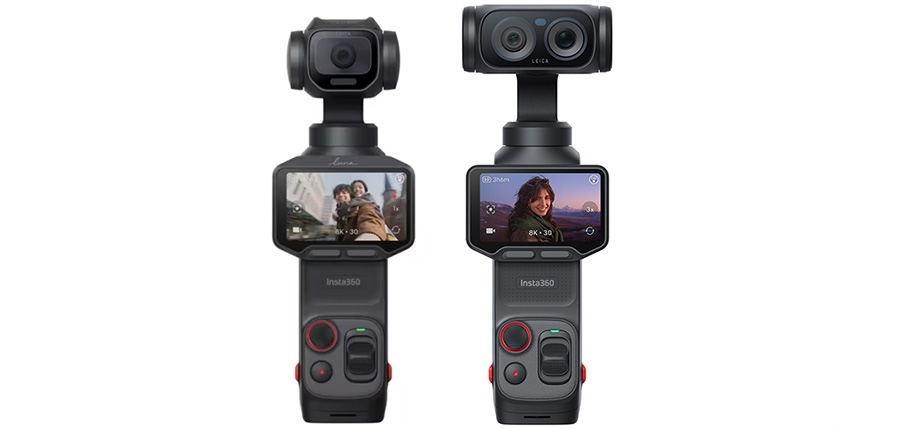
Visually, the Insta360 Luna Pro and Luna Ultra are very similar and share the same overall design . The most noticeable difference, of course, is the camera module: the Luna Pro has a single lens, while the Luna Ultra has two. This configuration also makes it slightly more compact and lighter, measuring 155.7 mm in height and weighing 215 to 218 g, compared to 169.9 mm and 233 to 235 g for the Ultra. The difference is modest, but it gives the Luna Pro a slight edge for everyday portability.
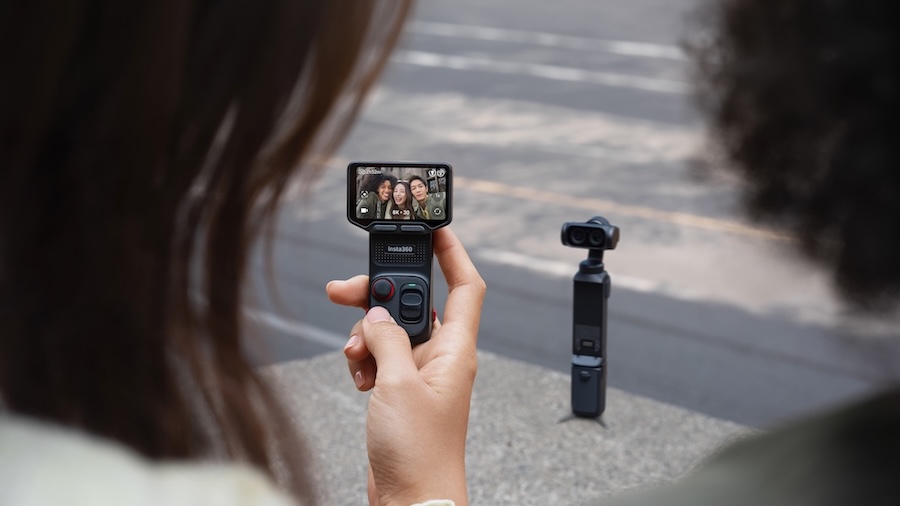
Otherwise, both cameras offer virtually the same experience. In particular, they both feature the same fully detachable 2-inch OLED touchscreen—one of the most interesting features of the lineup. Once removed, the screen functions as a wireless remote control and provides a video feed from up to about 20 meters away. Its built-in microphone can also be used to record your voice remotely, especially when filming yourself.
The ergonomics are also identical, featuring a clickable joystick to control the gimbal, a zoom slider, a record button, and two customizable controls located below the screen. Both models also feature 47 GB of internal storage and support microSD cardsup to 2 TB.
🏆 Insta360 Luna Pro
No real compromises on design or ergonomics: it retains the Luna Ultra’s strengths while being slightly more compact and lighter.
Check out our accessories for
Insta360 Luna Pro
Insta360 Luna Pro vs. Luna Ultra: Battery Life and Charging
| Insta360 Luna Pro | Insta360 Luna Ultra | |
| Battery | Main battery: 1550 mAh Detachable touchscreen: 210 mAh | Main battery: 1550 mAh Detachable touchscreen: 210 mAh |
| Autonomy | 240 min | 240 min |
| Recharge time | 80% in 23 minutes, 100% in 35 minutes | 80% in 23 minutes |
In this regard, the Insta360 Luna Pro and Luna Ultra are on par with each other. Both feature a 1,550 mAh battery, and Insta360 claims up to 240 minutes of battery life—a figure achieved under particularly favorable conditions, at 1080p and 24 fps. In the most demanding modes, you should naturally expect significantly shorter battery life: for example, an independent test of the Luna Pro achieved about 1 hour and 30 minutes in 8K30 with the screen on, which is still respectable given the resolution used.
Their detachable touchscreen also has its own 210-mAh battery, separate from the camera’s. Again, there is no notable difference between the two models: its battery life depends heavily on how it is used, especially when it is constantly being used as a remote live view monitor.
Charging is also the same, with the battery reaching 80% capacity in just 23 minutes. Insta360 also states that the Luna Pro can be fully charged in 35 minutes using a 45 W USB-C charger compatible with PD 3.0 PPS.b
Both cameras can get hot during extended 8K or high-frame-rate 4K recordings. However, various tests show that this behavior can vary depending on the conditions and settings used, while less demanding modes are significantly less affected.
🤝 Tie
Same battery, same advertised battery life, and equally fast charging: there’s no difference significant enough to distinguish between the two models on this point.
OUR BEST SELLERS - Insta360 Luna Pro


Accessories
Insta360 Luna Pro vs. Luna Ultra: Features
| Insta360 Luna Pro | Insta360 Luna Ultra | |
| Photo modes | Photo (Standard/UltraPhoto), Live Frame, Panorama | Photo (Standard/UltraPhoto), Live Frame, Panorama |
| Video modes | Video, PureVideo, Slow Motion, Time-Lapse, TimeShift, Barrel Roll | Video, PureVideo, Slow Motion, Time-Lapse, TimeShift, Barrel Roll |
| Audio modes | Wind Reduction, Voice Enhancement, Original Audio | Wind reduction, voice enhancement, original audio |
| Number of microphones | 4 (3 on the stabilizer + 1 on the detachable screen) | 4 (3 on the stabilizer + 1 on the detachable screen) |
In terms of features, the Luna Pro and Luna Ultra share many of the same features and shooting modes. There are, however, a few differences, particularly due to the features added to the Luna Ultra since its launch.
Photo and video modes
Both cameras offer the same main photo modes, including UltraPhoto, Live Frame, and Panorama, as well as a very comprehensive set of video features including PureVideo, Slow Motion, Timelapse, TimeShift, and Barrel Roll. The latter automates dynamic frame rotations inspired by FPV shots, while PureVideo is designed to improve image quality in low-light environments.
However, the Luna Ultra offers an additional feature: Scene Mode, which was added in the September 2026 update. Designed for concerts, festivals, and live performances, it adjusts focus, exposure, subject tracking, white balance, and color rendering to the specific conditions of these types of events.
Subject follow-up
Both models use Deep Track 5.0 to automatically recognize and track different types of subjects using their gimbals. They also allow you to choose the subject’s position within the frame using a 3×3 grid, rather than always keeping it in the center of the image.
Tracking also remains active when zooming. The Luna Ultra, however, offers specific improvements at high magnifications, particularly with its Scene mode—a feature that will be of particular interest to those who regularly film distant subjects at concerts or shows.
Audio
Once again, the equipment is virtually identical. Both cameras feature four microphones: three built into the stabilizer and one in the detachable screen. The latter can thus serve as a remote microphone when filming yourself. Wind reduction, voice enhancement, and preservation of the original audio are also available on both models, which can be paired directly with the Insta360 Mic Air and Mic Pro.
The Luna Ultra also includes Stage Audio and Ambient Audio in its Scene mode, which prioritize sound from the stage or the overall atmosphere of an event, respectively. These are fairly specialized features, but they make the device particularly appealing to users who regularly film concerts and shows.
🏆 Insta360 Luna Ultra
The core features are largely the same, but the Scene mode and its specific video, tracking, and audio features give it a slight edge, especially for concerts and live performances.
Check out our accessories for
Insta360 Luna Ultra
Insta360 Luna Pro vs. Luna Ultra: Image
| Insta360 Luna Pro | Insta360 Luna Ultra | |
| Main Lens | 1-inch sensor, 20 mm f/1.8 | 1-inch sensor, 20 mm equivalent, f/1.8 |
| Telephoto | – | 1/1.3-inch sensor, 60 mm equivalent, f/2.0 |
| Minimum focusing distance | 9 cm | 9 cm |
| Photo resolution | Up to 37 MP | Up to 37 MP |
| Video resolution | 8K up to 30 fps 4K up to 120 fps 3K up to 60 fps 2.7K up to 120 fps 1080p up to 240 fps | 8K up to 30 fps 4K up to 120 fps 3K up to 60 fps 2.7K up to 120 fps 1080p up to 240 fps |
| Digital zoom | Up to 4× | Up to 15× |
| ISO range | 100 à 6400 | 100 à 6400 |
| Photo format | jpg, jpg+RAW | jpg, jpg+RAW |
| Video format | MP4 | MP4 |
| Color profiles | Standard, Dolby Vision, 10-bit I-Log | Standard, Dolby Vision, 10-bit I-Log |
| Max. bit rate | 120 Mbps | 120 Mbps |
Sensors and resolutions
This is where the main difference between the Insta360 Luna Pro and Luna Ultra lies. Both cameras share exactly the same core specifications for their main lens: a 1-inch sensor paired with a 20mm equivalent focal length and an f/1.8 aperture. They also offer the same resolution options, including 8K at up to 30 fps, 4K at up to 120 fps, and 1080p at up to 240 fps, as well as a minimum focus distance of just 9 cm.
However, the Luna Ultra adds a second 1/1.3-inch sensor paired with a 60mm f/2.0 telephoto lens. This offers many more options for shooting close-ups or filming distant subjects without relying solely on digital cropping.
This difference is immediately apparent in the zoom capabilities. The Luna Pro is limited to 4×, with a 2× Clarity Zoom designed to preserve more detail. The Luna Ultra can now reach 15×, which is equivalent to approximately 300 mm. Its 3× setting uses the 60 mm telephoto lens directly, while the 2× and 6× settings utilize pixel binning from both sensors to maintain better image quality. Insta360 describes these zoom levels as lossless or near-lossless, while higher levels rely more on digital cropping and software processing, resulting in progressively more noticeable degradation.
Otherwise, the two models are very similar. They take photos at up to 37 MP, save images in JPEG and RAW formats, and offer Standard, Dolby Vision, and 10-bit I-Log profiles.
Image quality
When it comes to their primary purpose, the differences in image quality are minimal. This finding makes sense given their identical sensors and lenses, and is reflected in the various comparisons available. In broad daylight, both cameras produce detailed images with impressive dynamic range. Depending on the scene, there may be slight variations in exposure, contrast, or color, but neither camera consistently outperforms the other.
The results are quite similar when the light dims. Both cameras feature PureVideo mode to reduce noise and preserve more detail in dark scenes. The Luna Ultra has a triple-chip AI architecture, compared to the Pro’s dual-chip setup, but comparisons again show very similar results with their main cameras. Depending on the scene, the Pro can produce a slightly brighter image, while the Ultra sometimes appears a bit darker or higher in contrast; however, there isn’t a consistent enough pattern to declare a clear winner.
Users who want to refine their footage further also have access to the I-Log profile with 10-bit recording on both models. This profile offers greater latitude in post-production for adjusting color and working on both highlights and shadows. The Luna Pro therefore makes no particular concessions to the Ultra in this regard.
🏆 Insta360 Luna Ultra
The image quality is very similar to that of their main lens, but the Ultra’s 60 mm telephoto lens and significantly better zoom capabilities give it a level of versatility that the Luna Pro can’t match.
Insta360 Luna Pro vs. Luna Ultra: Bundles and Prices
| Insta360 Luna Pro | Insta360 Luna Ultra | |
| Standard package | 529 € | 729 € |
| Other theme packs | From €615 to €635 | From €821 to €929 |
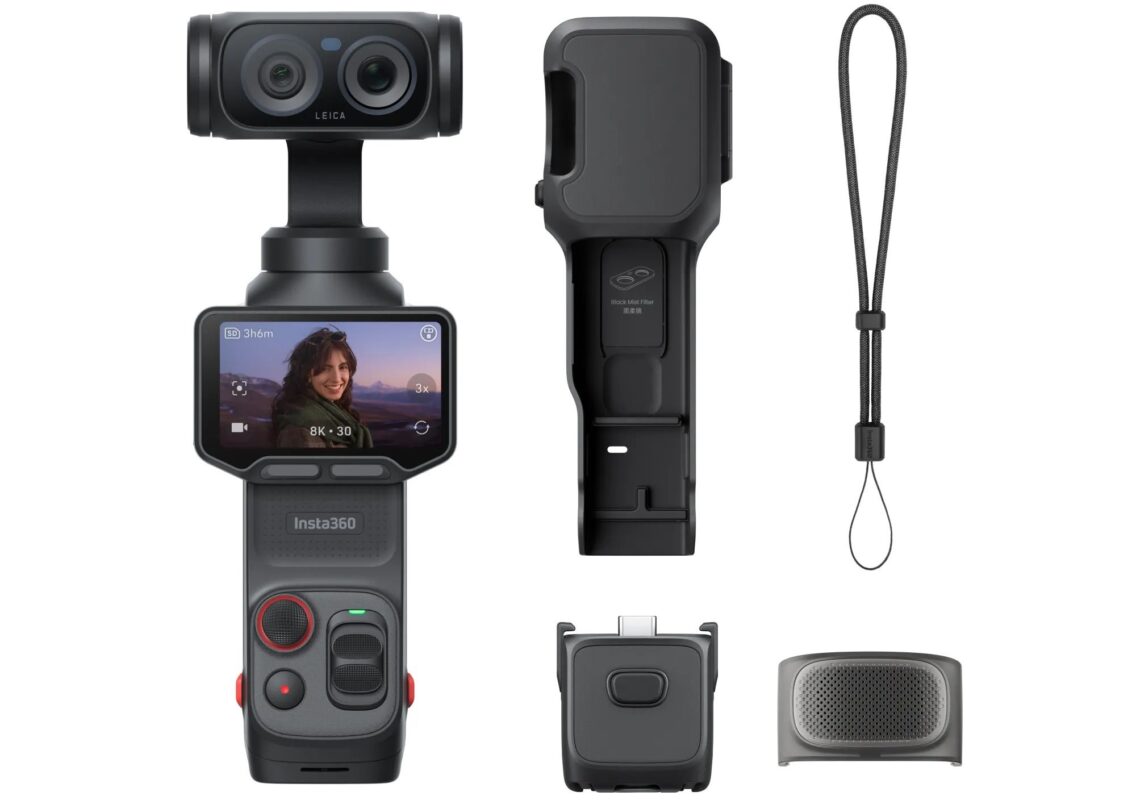
The price difference between the two cameras is significant even in the Standard Pack: €529 for the Insta360 Luna Pro versus €729 for the Luna Ultra— a difference of exactly €200. Their basic accessories are quite similar, including a protective case, a windscreen, a handle with a 1/4-inch threaded mount, and a wrist strap. The Pro’s case is more compact, however, and primarily protects the top of the camera, while the Ultra’s case wraps more fully around the device and provides storage for some accessories.
Insta360 then offers both models in several themed bundles thataren’t directly comparable across the two cameras. For the Luna Pro, prices range from €579 to €635, with configurations tailored for lighting, battery life, vlogging, or POV shots. On the side of the Luna Ultra, the various bundles offered range from €821 to €929 and place greater emphasis on its accessories and specific capabilities.
The Luna Ultra benefits in particular from configurations directly linked to its dual-lens system. Its Zoom Pack can include the Ultra telephoto lens, which adds 1.5× magnification in front of its telephoto lens and allows for a focal length of up to 450 mm (full-frame equivalent) when combined with the 15× zoom. Most accessories that are not directly lens-dependent, however, remain shared or compatible between the two models.
🏆 Insta360 Luna Pro
It’s €200 cheaper starting with the Standard Bundle, includes most of the essential features, and is clearly the better value of the two.
OUR BEST SELLERS - Insta360 Luna Ultra
Accessories
Insta360 Luna Ultra
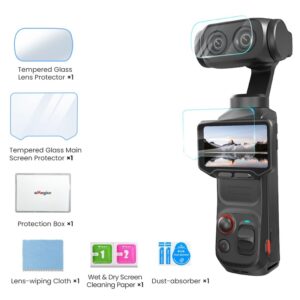
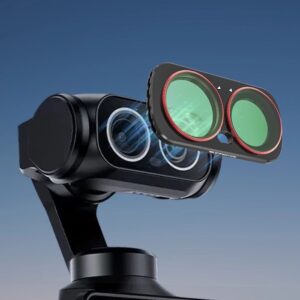
Tempered Glass Screen and Lens Protectors for the Insta360 Luna Ultra
Insta360 Luna Ultra
Insta360 Luna Ultra
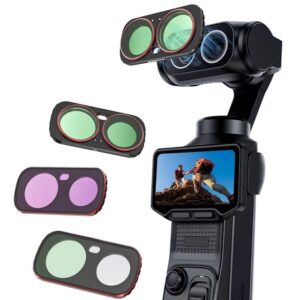
Sunnylife Magnetic Camera Lens Filters (UV / CPL / ND / Black Mist) for Insta360 Luna Ultra
Conclusion: Insta360 Luna Pro vs. Luna Ultra—Which One Should You Choose?
At the end of this comparison, one thing is clear: the Insta360 Luna Pro and Luna Ultra are much more similar than one might think. They share the same 1-inch main sensor, the same resolutions up to 8K30 and 4K120, the same detachable OLED screen, nearly identical ergonomics, Deep Track 5.0, four microphones, the 10-bit I-Log profile, and the same advertised battery life of 240 minutes. With their main lens, their image quality is also very similar, even in low-light conditions.
The real difference lies mainly in the Luna Ultra’s second lens. Its 60mm-equivalent telephoto lens makes it much easier to vary the framing, capture close-ups, and achieve significantly greater zoom levels while preserving more detail. It also offers a few additional features, notably its Scene mode designed for concerts and live performances. This makes it the more feature-rich and versatile of the two cameras.
That said, the Luna Pro is far from being a severely stripped-down version of the Ultra. It retains most of the Ultra’s strengths, delivers virtually the same image quality with its main lens, and is even more compact and lightweight. Most importantly, its Standard Pack costs €529, compared to €729 for the Luna Ultra. The extra €200 for the Ultra is therefore justified primarily if its telephoto lens and the framing options it offers truly align with your needs. If not, the Luna Pro likely offers the best balance of features, image quality, and price.
Choose the Insta360 Luna Pro if:
- You mainly use a wide-angle lens and don’t really need a telephoto lens;
- you prefer a more compact and lightweight camera for everyday filming;
- you want to save a significant amount of money while still retaining most of the Luna Ultra’s features.
Choose the Insta360 Luna Ultra if:
- you want to take advantage of the versatility of its dual lens system, with a 60 mm telephoto lens that allows for a wider variety of framing options;
- you regularly film distant subjects and want to take advantage of significantly greater zoom capabilities;
- You film concerts, shows, or events where the camera’s Scene mode and specific features offer a real advantage.
💡 To learn more, check out our in-depth reviews of both cameras in this Insta360 Luna Pro vs. Luna Ultra comparison:
➡️ Everything you need to know about the Insta360 Luna Pro
➡️ Everything you need to know about the Insta360 Luna Ultra

 Blog
Blog